
Arid Zone Research ›› 2025, Vol. 42 ›› Issue (10): 1939-1948.doi: 10.13866/j.azr.2025.10.16
• Agricultural Ecology • Previous Articles
DENG Chaohong1( ), YE Qiang2, MENG Yan3, CUI Dafang1,2, ZHAGN Jinbo4()
Received:2025-03-13
Revised:2025-05-06
Online:2025-10-15
Published:2025-10-22
Contact:
ZHAGN Jinbo
E-mail:symans@foxmail.com;jinbozhang@ms.xjb.ac.cn
DENG Chaohong, YE Qiang, MENG Yan, CUI Dafang, ZHAGN Jinbo. Development and present situation of classification of Triticeae Dumort. in Xinjiang[J].Arid Zone Research, 2025, 42(10): 1939-1948.
Add to citation manager EndNote|Reference Manager|ProCite|BibTeX|RefWorks
Tab. 1
Changes in the classification and number of Triticeae species in Xinjiang"
| 禾本科 | XJJ (1982年) | CuiNR (1984年) | XJLR (1987年) | FRPS (1987年) | XJGPL (1990年) | LuJQ (1991年) | FXJ (1996年) | XJAoAS (1998年) | FOC (2006年) | FXJA (2014年) |
|---|---|---|---|---|---|---|---|---|---|---|
| 鹅观草属Roegneria | 24种 2亚种 | 31种 4亚种 | 24种 3亚种 | 21种 2变种 | 33种 4亚种 1变种 | 28种 | 0 | 42种 | 0 | 0 |
| 偃麦草属Elytrigia | 7种 2亚种 | 5种 3亚种 | 6种 3亚种 | 1种 3引种 | 7种 3亚种 | 2种 2亚种 | 7种 1亚种 | 2种 | 2种 2亚种 | 7种 1亚种 |
| 冰草属Agropyron | 5种 | 5种 | 5种 | 1种 1变种 | 5种 | 4种 | 6种 | 4种 | 4种 2变种 | 6种 |
| 旱麦草Eremopyrom | 4种 | 4种 | 4种 | 2种 | 4种 | 4种 | 4种 | 4种 | 4种 | 4种 |
| 小麦属Triticum | 5种 | 0 | 0 | 1种 1变种 | 0 | 0 | 6种 | 0 | 3种 2亚种 | 7种 |
| 黑麦属Secale | 1种 | 1种 | 1种 | 1种 | 1种 | 1种 | 1种 | 1种 | 2种 | 1种 |
| 披碱草属Elymus | 4种 1亚种 | 5种 1亚种 | 6种 | 7种 | 4种 1亚种 | 6种 | 42种 5变种 | 10种 | 39种 11变种 | 42种 6变种 |
| 赖草属Leymus | 9种 1亚种 | 12种 3亚种 | 12种 1亚种 | 8种 | 10种 3亚种 | 11种 | 15种 3亚种 | 11种 | 15种 1变种 | 14种 3亚种 |
| 新麦草属Psathyrostachys | 3种 | 3种 1亚种 | 2种 2亚种 | 3种 | 3种 1亚种 | 2种 | 3种 1亚种 | 3种 | 3种 1变种 | 3种 1亚种 |
| 大麦属Hordeum | 4种 2亚种 2变种 | 4种 3亚种 2变种 | 3种 3亚种 | 5种 1变种 | 3种 3亚种 2变种 | 3种 4亚种 | 6种 3变种 | 6种 | 4种 2亚种 2变种 | 6种 3变种 |
| 山羊草属Aegilops | 0 | 1种 | 1种 | 1种 | 1种 | 1种 | 1种 | 1种 | 1种 | 1种 |
| 仲彬草属Kengyilia | 0 | 0 | 0 | 0 | 0 | 0 | 0 | 15种 | 13种 1变种 | 14种 1变种 |
| 假鹅观草属Pseudoroegn-eria | 0 | 0 | 0 | 0 | 0 | 0 | 0 | 0 | 1种 | 0 |
| 总计 | 10属 66种 8亚种 2变种 | 10属 71种 15亚种 2变种 | 10属 64种 12亚种 | 11属 53种 5变种 | 10属 71种 15亚种 2变种 | 10属 62种 6亚种 | 10属 91种 5亚种 8变种 | 10属 99种 | 12属 91种 6亚种 18变种 | 11属 105种 5亚种 10变种 |
Tab. 2
Key of the Triticeae plants in Xinjiang"
| 1. 小穗单生于穗轴的各节。 2. 穗状花序的顶生小穗不孕或退化,其余小穗呈蓖齿状排列于穗轴的二侧。 3. 一年生短命植物…………………………………… 旱麦草属 Eremopyrom (Ldb.) Jaub. et Spach 3. 多年生植物………………………………………………………… 冰草属 Agropyron Gaertner 2. 穗状花序顶生小穗大都正常发育,其余小穗呈覆瓦状排列于穗轴的两侧。 4. 一年生或越年生植物。 5. 颖卵形,具3至数脉。 6. 小穗呈圆柱形;颖背部无脊……………………………………………………… 山羊草属 Aegilops Linn. 6. 小穗两侧压扁,颖背部明显有脊…………………………………………… 小麦属 Triticum Linn. 5. 颖锥形,仅具一脉……………………………………………………………… 黑麦属 Secale Linn. 4. 多年生植物。 7. 植物体具根状茎;小穗成熟时脱节于颖之下,小穗轴不于诸花之间断………………… 偃麦草属Elytrigia Desv. 7. 植物体无根状茎,或具短的根状茎;小穗成熟时脱节于颖之上。其小穗轴于诸花之间断落………………… 披碱草属 Elymus Linn. 1. 小穗常以2至数枚生于穗轴的各节,或在花序上下两端可为单生,有少数种单生,但外稃常因小穗轴扭转而与颖交叉排列,使外稃背部露出。 8. 小穗含1-2(3)花,常以3枚生于穗轴的各节;穗轴(除大麦属的栽培种外)均具关节而可逐节断落。 9. 小穗含1-2(3)花,全部无柄且均能孕……………………… 新麦草属 Psathyrostachys Nevski 9. 小穗仅含1花,除栽培种外,仅居中小穗无柄且能孕,侧部小穗具短柄,通常不孕或具l 雄花……… 大麦属 Hordeum Linn. 8. 小穗含2至数花,以2至数枚(有时为l枚)生于穗轴的各节;穗轴延续而无关节,故并不逐节断落。 10. 叶片坚硬;颖片细长,呈锥状,具1~3脉…………………………………… 赖草属 Leymus Hochst. 10. 叶片柔韧;颖披针形,具3~5脉。 11. 外稃基部的基盘通常十分明显…………………………………… 披碱草属 Elymus Linn. 11. 外稃基部的基盘通常不明显…………………………………… 假鹅观草属 Pseudoroegneria Á. Löve |
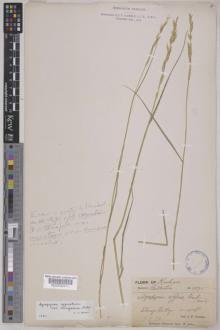
Fig. 1
The type specimen of Pseudoroegneria cognata"

Fig. 2
The type specimen of Elymus kengii"

Fig. 3
The type specimen of Elymus kronokensis"

| [1] | 陈慧妹, 李文军, 邱娟, 等. 新疆野生维管植物名录[J]. 生物多样性, 2023, 31(9): 56-62. |
| [Chen Huimei, Li Wenjun, Qiu Juan, et al. A checklist of wild vascular plants in Xinjiang[J]. Biodiversity Science, 2023, 31(9): 56-62. ] | |
| [2] | 新疆八一农学院. 新疆植物检索表(第一册)[M]. 乌鲁木齐: 新疆人民出版社, 1982: 149-194. |
| [Xinjiang Bayi Agricultural College. Xinjiang Plant Retrieval List (Volume 1)[M]. Urumqi: Xinjiang People’s Press, 1982: 149-194. ] | |
| [3] | 崔乃然, 钟骏平. 新疆谷类作物的野生近缘植物[J]. 八一农学院学报, 1984, 4(1): 11-32. |
| [Cui Nai’ran, Zhong Junping. Wild relatives of cereal crops in Xinjiang[J]. Journal of Bayi Agricultural College, 1984, 4(1): 11-32. ] | |
| [4] | 陆峻峮. 新疆小麦族野生植物的种类[J]. 新疆农业科学, 1991, 34(4): 147-151. |
| [Lu Junjun. Species of wild plants of Triticeae in Xinjiang[J]. Xinjiang Agricultural Sciences, 1991, 34(4): 147-151. ] | |
| [5] | 新疆植物志编辑委员会. 新疆植物志(第六卷)[M]. 乌鲁木齐: 新疆科技卫生出版社, 1990: 54-56. |
| [Xinjiang Flora Editorial Committee. Flora of Xinjiang (Volume 6)[M]. Urumqi: Xinjiang Science and Technology Health Press, 1990: 54-56. ] | |
| [6] | 陆峻峮, 刘志勇, 白玉亭, 等. 新疆的小麦族野生植物资源[J]. 作物品种资源, 1998, 4(2): 28-30. |
| [Lu Junjun, Liu Zhiyong, Bai Yuting, et al. Wild plant resources of Triticeae in Xinjiang[J]. Crop Variety Resources, 1998, 4(2): 28-30. ] | |
| [7] | 新疆植物志编辑委员会. 新疆植物志简本[M]. 乌鲁木齐: 新疆人民出版社, 2014: 709-723. |
| [Xinjiang Flora Editorial Committee. Brief Flora of Xinjiang[M]. Urumqi: Xinjiang People’s Press, 2014: 709-723. ] | |
| [8] | 周永红, 郑有良, 杨俊良, 等. 10种披碱草属植物的RAPD分析及其系统学意义[J]. 植物分类学报, 1999, 37(5): 425-432. |
| [Zhou Yonghong, Zheng Youliang, Yang Junliang, et al. RAPD analysis and phylogenetic significance of 10 species of Elymus[J]. Plant Taxonomic Journal, 1999, 37(5): 425-432. ] | |
| [9] | 中国植物志编委会. 中国植物志(第九卷第三分册)[M]. 北京: 科学出版社, 1987: 1-118. |
| [Editorial Committee of Flora of China. Flora of China (Vol. 9, Part 3)[M]. Beijing: Science Press, 1987: 1-118. ] | |
| [10] | 吴征镒. Flora of China(Volume 22)[M]. 北京: 科学出版社, 2006: 386-444. |
| [Wu Zhengyi. Flora of China (Volume 22)[M]. Beijing: Science Press, 2006: 386-444. ] | |
| [11] | Fan X, Sha L N, Dong Z Z, et al. Phylogenetic relationships and Y genome origin in Elymus L. sensu lato (Triticeae; Poaceae) based on single-copy nuclear Acc1 and Pgk1 gene sequences[J]. Molecular Phylogenetics and Evolution, 2013, 69: 919-928. |
| [12] |
刘冰, 叶建飞, 刘夙, 等. 中国被子植物科属概览: 依据APG Ⅲ系统[J]. 生物多样性, 2015, 23(2): 225-231.
doi: 10.17520/biods.2015052 |
|
[Liu Bing, Ye Jianfei, Liu Su, et al. An overview of angiosperms and genera in China: Aaccording to the APG Ⅲ system[J]. Biodiversity Science, 2015, 23(2): 225-231. ]
doi: 10.17520/biods.2015052 |
|
| [13] | Nevskisa. Tribe XIV. Hordeae Benth[C]// Komarov V L. Flora USSR. Leningrad, USSR: The Botanical Institute of the Academy of Sciences of the USSR, 1934: 590-728. |
| [14] | 新疆维吾尔自治区国土整治农业区划局. 新疆国土资源(第一分册)[M]. 乌鲁木齐: 新疆人民出版社, 1982: 278-286. |
| [Xinjiang Uygur Autonomous Region Administration of Territorial Planning and Agricultural Regional Division. Xinjiang Land and Resources (Volume 1)[M]. Urumqi: Xinjiang People’s Press, 1982: 278-286. ] | |
| [15] | 新疆维吾尔自治区畜牧厅. 新疆草地植物名录[M]. 乌鲁木齐: 新疆人民出版社, 1990: 54-56. |
| [Department of Animal Husbandry, Xinjiang Uygur Autonomous Region. List of Grassland Plants in Xinjiang[M]. Urumqi: Xinjiang People’s Press, 1990: 54-56. ] | |
| [16] | Linnaeus C. Hortus Upsaliensis[M]. Uppsala: Laurentius Salvius, 1748: 76-80. |
| [17] | Linnaeus C. Genera Plantarum[M]. 2nd ed. Stockholm: Laurentius Salvius, 1754: 36-37. |
| [18] | Melderis A. Generic problems within the tribe Hordeae[C]// Osvald H, Aberg E. Proceedings of the 7th International Botany Congress. Stockholm: Almquist & Wiksell Press, 1950: 853-854. |
| [19] | Melderis A. Triticeae Dumort.[C]// Tutin T G, Heywood V H, Burges N A, et al. Flora Europaea. Cambridge: Cambridge University Press, 1980: 190-206. |
| [20] | Tzvelev N N. Tribe 3. Triticeae Dumort.[C]// Fedorov A A, Poaceae URSS. Leningrad: Navka Publishing House, 1976: 105-206. |
| [21] | 蔡联炳. 中国鹅观草属的分类研究[J]. 植物分类学报, 1997, 35(2): 148-177. |
| [Cai Lianbing. Study on the classification of Roegneria in China[J]. Journal of Systematics and Evolution, 1997, 35(2): 148-177. ] | |
| [22] | Löve Á. Conspectus of the Triticeae[J]. Feddes Repertorium, 1984, 95(7-8): 425-521. |
| [23] | Dewey D R. Cytogenetics of Elymus sibiricus and its hybrids with Agropyron tauri, Elymus canadensis and Agropyron caninum[J]. Botanical Gazette, 1984, 135: 80-87. |
| [24] | Dewey D R. The genomic system of classification as a guide to intergeneric hybridization within the perennial Triticeae[J]. Stadler Genetics Symposium, 1984, 16: 209-280. |
| [25] | 谢可军, 文乐元. 鹅观草属与披碱草属分类学的历史与现状[J]. 草原与草坪, 2000, 4(4): 6-9. |
| [Xie Kejun, Wen Leyuan. The taxonomic history and present situation of Roegneria and Elymus[J]. Grassland and Turf, 2000, 4(4): 6-9. ] | |
| [26] | Yen C, Yang J L, Yen Y, et al. Hitoshi Kihara, Áskell Löve and the modern genetic concept of the genera in the tribe Triticeae (Poaceae)[J]. Acta Phytotaxon Sinica, 2005, 43: 82-93. |
| [27] | 杨俊良, 伯纳德 R 包姆, 颜济. 鹅观草属(Roegneria C. Koch)的订正(禾本科: 小麦族)(英文)[J]. 四川农业大学学报, 2008, 26(4): 311-381. |
| [Yang Junliang, Bernard R Baum, Yan Ji. Revision of Roegneria C. Koch (Gramineae: Triticae)[J]. Journal of Sichuan Agricultural University, 2008, 26(4): 311-381. ] | |
| [28] | 凡星. 小麦族植物单拷贝核Acc1和Pgk1基因序列的分子系统发育研究[D]. 雅安: 四川农业大学, 2009. |
| [Fan Xing. Molecular Phylogeny of Acc1 and Pgk1 Gene Sequences in Triticae[D]. Ya’an: Sichuan Agricultural University, 2009. ] | |
| [29] | 颜济, 陈俊良. 耿氏草属Kengyilia,中国禾本科小麦族一新属[J]. 四川农业大学学报, 1990, 4(1): 75-76. |
| [Yan Ji, Chen Junliang. Kengyilia, a new genus of Triticeae in China[J]. Journal of Sichuan Agricultural University, 1990, 4(1): 75-76. ] | |
| [30] | 蔡联炳, 智力. 以礼草属的分类研究[J]. 植物分类学报, 1999, 37(5): 451-467. |
| [Cai Lianbing, Zhi Li. Study on the classification of Herba[J]. Journal of Systematics and Evolution, 1999, 37(5): 451-467. ] |
| [1] | GUAN Yiheng, MENG Mei, YANG Songxiao, LI Daqiang. Coordinated development and multi-scenario simulation of land use intensity and carbon emissions in Xinjiang [J]. Arid Zone Research, 2025, 42(8): 1501-1513. |
| [2] | LIN Qi, ZHANG Yanlong, CAO Liangming, WANG Xiaoyi, Rouzi TUREPU, GAO Guizhen. Agrilus viduus Kerremans: An emerging pest in Xinjiang wild fruit forest and assessment of associated damage [J]. Arid Zone Research, 2025, 42(7): 1348-1356. |
| [3] | GUO Jianmao, WU Dengguo, HAN Jinlong, ZHANG Rushui, WANG Yong. Precipitation retrieval for Xinjiang region based on radar and remote sensing satellites [J]. Arid Zone Research, 2025, 42(6): 957-969. |
| [4] | CHEN Ying, LIU Jing, SHAO Weiling, Jiazila BAISHAN, TIAN Shuting. Multi-time scale circulation characteristics of extreme low-temperature events in Xinjiang during winter from 1981 to 2020 [J]. Arid Zone Research, 2025, 42(5): 775-787. |
| [5] | CHEN Zhen, CAI Zhaozhao, MA Nan, DAI Shuo, WANG Zhenlu. Spatial-temporal pattern and driving force analysis of NDVI in Xinjiang from 2001 to 2023 [J]. Arid Zone Research, 2025, 42(5): 922-932. |
| [6] | LIU Jing, ZHENG Yulin, LIU Yan, LI Hanwei. Interdecadal variations and influencing factors in the leading modes of summer precipitation in Xinjiang [J]. Arid Zone Research, 2025, 42(4): 577-588. |
| [7] | LI Xiaopeng, LI Kang, LEI Shuang, JIA Fugui, XU Jing. Spatiotemporal variations in drought conditions in Xinjiang based on TVDI [J]. Arid Zone Research, 2025, 42(4): 589-599. |
| [8] | LUO Lei, LI Xiguang, LI Xiaoting, WANG Lei, WANG Lei. Potential distribution pattern of Hippophae rhamnoides in Xinjiang under climate change predicted using the MaxEnt model [J]. Arid Zone Research, 2025, 42(3): 511-522. |
| [9] | ZHAO Shikang, MU Zhenxia, LI Gang, YANG Rongqin, HUANG Mianting. Spatial and temporal evolution characteristics of atmospheric precipitable water vapor in Xinjiang and its relationship with precipitation conversion [J]. Arid Zone Research, 2025, 42(2): 191-201. |
| [10] | GUO Na, CHEN Fulong, WANG Tongxia, LYU Tingbo, LONG Aihua. Characteristics of airborne water vapor changes and future multi-scenario projections in Xinjiang, 1979-2022 [J]. Arid Zone Research, 2025, 42(10): 1753-1765. |
| [11] | LYU Ning, GUO Yu, PENG Qin, YIN Feihu, ZHANG Jiaqi, LIU Xingren, ZENG Mei, XU Zihan. Spatiotemporal evolution characteristics and contributing factors of the carbon effect in cultivated land use in Xinjiang [J]. Arid Zone Research, 2025, 42(1): 179-190. |
| [12] | ZOU Bin, ZOU Shan, YANG Yuhui. Dynamic changes and driving factors of surface water body in Xinjiang from 1990 to 2023 [J]. Arid Zone Research, 2025, 42(1): 40-50. |
| [13] | SUN Linlin, LIU Qiong, HUANG Guan, CHEN Yonghang, WEI Xin, GUO Yulin, ZHANG Taixi, GAO Tianyi, XU Yunhong. Analysis of surface solar radiation under different cloud conditions in Xinjiang and the surrounding “Belt and Road” regions [J]. Arid Zone Research, 2024, 41(9): 1480-1490. |
| [14] | JIAN Zhengbo, LUO Hao, SHAN Nana. A study on the spatial and temporal evolution and carbon effects of production-living-ecological in Xinjiang under carbon peak and carbon neutrality goals [J]. Arid Zone Research, 2024, 41(7): 1238-1248. |
| [15] | LIU Huaqing, WANG Bo, JIA Yanyan, XIE Xinran, ZHANG Wei. Characterization of the freezing injury to Juglans regia at different slope positions in the West Tianshan valley of Xinjiang, China [J]. Arid Zone Research, 2024, 41(6): 1079-1088. |
|
||
