
Arid Zone Research ›› 2025, Vol. 42 ›› Issue (4): 577-588.doi: 10.13866/j.azr.2025.04.01
• Weather and Climate • Previous Articles Next Articles
LIU Jing1,2( ), ZHENG Yulin3, LIU Yan2(), LI Hanwei4
Received:2024-08-27
Revised:2024-12-31
Online:2025-04-15
Published:2025-04-10
Contact:
LIU Yan
E-mail:1107092572@qq.com;1127780551@qq.com
LIU Jing, ZHENG Yulin, LIU Yan, LI Hanwei. Interdecadal variations and influencing factors in the leading modes of summer precipitation in Xinjiang[J].Arid Zone Research, 2025, 42(4): 577-588.
Add to citation manager EndNote|Reference Manager|ProCite|BibTeX|RefWorks
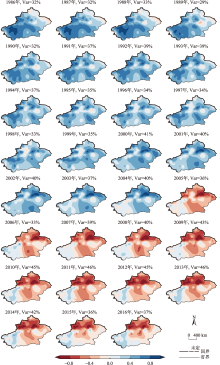
Fig. 1
Decomposition of the first modal distribution of the 15-year sliding EOF of summer precipitation in Xinjiang from 1979 to 2023"

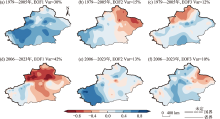
Fig. 2
EOF decomposition of summer precipitation in Xinjiang 1979-2005 (a, b, c), 2006-2023 (d, e, f), first mode (a, d), second mode (b, e) and third mode (c, f)"

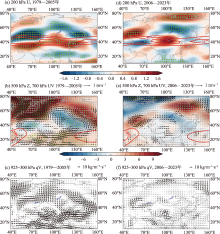
Fig. 3
Xinjiang summer precipitation 1979-2005 (a-c) and 2006-2023 (d-f) PC1 regression period 200 hPa zonal wind anomaly (shadow, units: m·s-1) (a, d), 500 hPa height field anomaly (shadow, units: gpm) and 700 hPa wind field anomaly (vector, units: m·s-1) (b, e), troposphere (925-300 hPa) integral water vapor transport over the whole layer (vector, units: kg·m-1·s-1) (c, f)"

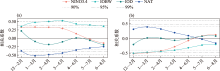
Fig. 4
Sliding correlation of PC1 with the pre-winter to contemporaneous summer SST index for summer precipitation in Xinjiang for 1979-2005 (a) and 2006-2023 (b)"

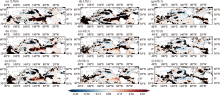
Fig. 5
SST anomaly field from December to August of the same year before PC1 regression of summer precipitation in Xinjiang from 1979 to 2005 (unit: ℃)"

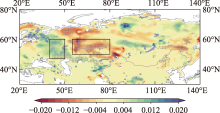
Fig. 6
Snow-water equivalent anomaly field for Xinjiang summer precipitation 2006-2023 for the winter preceding the PC1 return period (units: m)"

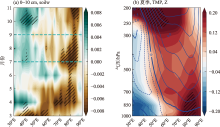
Fig. 7
EUSISD index regression of March-November 0-10 cm soil moisture anomalies (a), summer atmospheric temperature anomalies (shaded, units: K) with height field anomalies (contours, units: m) (b), averaged radially over 47°-60°N"

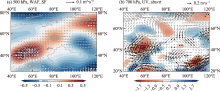
Fig. 8
EUSISD index regression summer 500 hPa flow function anomaly (shadow, units: 106 m2·s-1) and wave flux anomaly (vector, units: m2·s-2) (a), 700 hPa absolute vorticity anomaly (shadow, units: 10-6 s-1) and wind field anomaly (vector, units: m·s-1) (b)"

| [1] | Zhang Q, Yang J, Wang W, et al. Climatic warming and humidification in the arid region of Northwest China: Multi-scale characteristics and impacts on ecological vegetation[J]. Journal of Meteorological Research, 2021, 35(1): 113-127. |
| [2] |
闫昕旸, 张强, 张文波, 等. 泛中亚干旱区气候变化特征分析[J]. 干旱区研究, 2021, 38(1): 1-11.
doi: 10.13866/j.azr.2021.01.01 |
|
[Yan Xinyang, Zhang Qiang, Zhang Wenbo, et al. Analysis of climate characteristics in the Pan-Central-Asia arid region[J]. Arid Zone Research, 2021, 38(1): 1-11.]
doi: 10.13866/j.azr.2021.01.01 |
|
| [3] |
郑孟林, 赵勇, 杨霞. 1961—2022年中国西北干旱区夏季降水变化特征[J]. 干旱区地理, 2025, 48(3): 367-379.
doi: 10.12118/j.issn.1000-6060.2024.207 |
|
[Zheng Menglin, Zhao Yong, Yang Xia. Variation characteristics of summer precipitation in the arid region of northwest China from 1961 to 2022[J]. Arid Land Geography, 2025, 48(3): 367-379.]
doi: 10.12118/j.issn.1000-6060.2024.207 |
|
| [4] | 刘天虎, 刘天龙. 集合经验模态分解下中国新疆降水变化趋势的区域特征[J]. 沙漠与绿洲气象, 2015, 9(4): 17-24. |
| [Liu Tianhu, Liu Tianlong. Regional features of precipitation variation trends over xinjiang in china by the ensemble empirical mode decomposition method[J]. Desert and Oasis Meteorology, 2015, 9(4): 17-24.] | |
| [5] | 吕新生, 周雅蔓, 余行杰, 等. 1961—2019年新疆暴雨山洪灾害损失的时空变化特征[J]. 沙漠与绿洲气象, 2021, 15(4): 42-49. |
| [Lyu Xinsheng, Zhou Yaman, Yu Xingjie, et al. Temporal and spatial variation characteristics of rainstorm torrential flood disaster loss in Xinjiang during 1961-2019[J]. Desert and Oasis Meteorology, 2021, 15(4): 42-49.] | |
| [6] |
王前, 赵勇, 陈飞, 等. 南亚高压的多模态特征及其与新疆夏季降水的联系[J]. 高原气象, 2017, 36(5): 1209-1220.
doi: 10.7522/j.issn.1000-0534.2016.00123 |
|
[Wang Qian, Zhao Yong, Chen Fei, et al. Characteristics of different patterns of South Asia High and their relationships with summer precipitation in Xinjiang[J]. Plateau Meteorology, 2017, 36(5): 1209-1220.]
doi: 10.7522/j.issn.1000-0534.2016.00123 |
|
| [7] |
赵勇, 王前, 黄安宁. 南亚高压伊朗高压型与新疆夏季降水的联系[J]. 高原气象, 2018, 37(3): 651-661.
doi: 10.7522/j.issn.1000-0534.2017.00049 |
|
[Zhao Yong, Wang Qian, Huang Anning. Relationship between Iran high pattern of South Asia High and summer precipitation in Xinjiang[J]. Plateau Meteorology, 2018, 37(3): 651-661.]
doi: 10.7522/j.issn.1000-0534.2017.00049 |
|
| [8] | 杨莲梅, 张庆云. 新疆夏季降水年际变化与亚洲副热带西风急流[J]. 应用气象学报, 2008, 19(2): 171-179. |
| [Yang Lianmei, Zhang Qingyun. Interannual variation of summer precipitation in Xinjiang and Asian subtropical westerly jet stream[J]. Journal of Applied Meteorological Science, 2008, 19(2): 171-179.] | |
| [9] |
任国强, 赵勇. 副热带西风急流与中亚夏季降水的关系[J]. 高原气象, 2022, 41(6): 1425-1434.
doi: 10.7522/j.issn.1000-0534.2021.00082 |
|
[Ren Guoqiang, Zhao Yong. Relationship between the subtropical westerly jet and summer rainfall over Central Asia from 1961 to 2016[J]. Plateau Meteorology, 2022, 41(6): 1425-1434.]
doi: 10.7522/j.issn.1000-0534.2021.00082 |
|
| [10] | 杨涛, 杨莲梅, 李建刚, 等. 中亚低涡及其对新疆强降雨影响研究进展[J]. 暴雨灾害, 2022, 41(6): 613-620. |
| [Yang Tao, Yang Lianmei, Li Jiangang, et al. Review of studies about Central Asian vortex and its influence on heavy precipitation in Xinjiang[J]. Torrential Rain and Disasters, 2022, 41(6): 613-620.] | |
| [11] |
程姗岭, 于海鹏, 任钰, 等. 中国干旱半干旱区气候异常影响机理研究进展[J]. 中国沙漠, 2023, 43(3): 21-35.
doi: 10.7522/j.issn.1000-694X.2022.00126 |
|
[Cheng Shanling, Yu Haipeng, Ren Yu, et al. Research progress on the influence mechanism of climate anomalies in arid and semi-arid regions in China[J]. Journal of Desert Research, 2023, 43(3): 21-35.]
doi: 10.7522/j.issn.1000-694X.2022.00126 |
|
| [12] | 张人禾, 张若楠, 左志燕. 中国冬季积雪特征及欧亚大陆积雪对中国气候影响[J]. 应用气象学报, 2016, 27(5): 513-526. |
| [Zhang Renhe, Zhang Ruonan, Zuo Zhiyan. An overview of wintertime snow cover characteristics over China and the impact of Eurasian snow cover on Chinese climate[J]. Journal of Applied Meteorological Science, 2016, 27(5): 513-526.] | |
| [13] | 赵文清, 马耀明, 曹殿斌. 中亚干旱地区降水异常及其影响机制研究[J]. 大气科学学报, 2023, 46(1): 18-29. |
| [Zhao Wenqing, Ma Yaoming, Cao Dianbin. Review of increasing precipitation in Central Asia and its possible mechanism[J]. Transactions of Atmospheric Sciences, 2023, 46(1): 18-29.] | |
| [14] | Lu B, Li H, Wu J, et al. Impact of El Niño and Southern Oscillation on the summer precipitation over Northwest China[J]. Atmospheric Science Letters, 2019, 20(8): e928. |
| [15] |
马金龙, 庞雪琪, 杨建玲. 中国西北东部汛期降水主模态的年代际差异及其大气环流特征[J]. 干旱气象, 2017, 35(6): 940-948.
doi: 10.11755/j.issn.1006-7639(2017)-06-0940 |
| [Ma Jinlong, Pang Xueqi, Yang Jianling. Interdecadal difference of dominant modes of precipitation in rainy season over the Eastern part of Northwest China and their corresponding atmospheric circulation characteristics[J]. Journal of Arid Meteorology, 2017, 35(6): 940-948.] | |
| [16] | 郑然, 陈丽娟, 李维京, 等. 四川盆地夏季降水年际变化的主模态分析[J]. 大气科学, 2022, 46(6): 1454-1468. |
| [Zheng Ran, Chen Lijuan, Li Weijing, et al. Interannual variation of the leading modes of summertime precipitation in the Sichuan Basin[J]. Chinese Journal of Atmospheric Sciences, 2022, 46(6): 1454-1468.] | |
| [17] | 庞轶舒, 祝从文, 刘凯. 中国夏季降水异常EOF模态的时间稳定性分析[J]. 大气科学, 2014, 38(6): 1137-1146. |
| [Pang Yishu, Zhu Congwen, Liu Kai. Analysis of stability of EOF modes in summer rainfall anomalies in China[J]. Chinese Journal of Atmospheric Sciences, 2014, 38(6): 1137-1146.] | |
| [18] | Sun B, Wang H. Inter-decadal transition of the leading mode of inter-annual variability of summer rainfall in East China and its associated atmospheric water vapor transport[J]. Climate Dynamics, 2015, 44(9-10): 2703-2722. |
| [19] | 黄荣辉, 陈际龙, 刘永. 我国东部夏季降水异常主模态的年代际变化及其与东亚水汽输送的关系[J]. 大气科学, 2011, 35(4): 589-606. |
| [Huang Ronghui, Chen Jilong, Liu Yong. Interdecadal variation of the leading modes of summertime precipitation anomalies over Eastern China and its association with water vapor transport over East Asia[J]. Chinese Journal of Atmospheric Sciences, 2011, 35(4): 589-606.] | |
| [20] | He C, Lin A, Gu D, et al. Interannual variability of Eastern China summer rainfall: The origins of the meridional triple and dipole modes[J]. Climate Dynamics, 2017, 48(1-2): 683-696. |
| [21] | 李维京, 刘景鹏, 任宏利, 等. 中国南方夏季降水的年代际变率主模态特征及机理研究[J]. 大气科学, 2018, 42(4): 859-876. |
| [Li Weijing, Liu Jingpeng, Ren Hongli, et al. Characteristics and corresponding mechanisms of the leading modes of interdecadal variability of summer rainfall in Southern China[J]. Chinese Journal of Atmospheric Sciences, 2018, 42(4): 859-876.] | |
| [22] | Kanamitsu M, Ebisuzaki W, Woollen J, et al. NCEP-DOE AMIP-II Reanalysis (R-2)[J]. Bulletin of the American Meteorological Society, 2002, 83(11): 1631-1643. |
| [23] | Rayner N A A, Parker D E, Horton E B, et al. Global analyses of sea surface temperature, sea ice, and night marine air temperature since the late Nineteenth Century[J]. Journal of Geophysical Research Atmospheres, 2003, 108(D14): 4407. |
| [24] | Muñoz-Sabate J, Dutra E, Agustí-Panareda A, et al. ERA5-Land: A state-of-the-art global reanalysis dataset for land applications[J]. Earth System Science Data, 2021, 13(9): 4349-4383. |
| [25] | 杨梦兮, 胡瑞金, 刘梅. 热带印度洋海表面温度偶极子模态的气候演变特征[J]. 热带气象学报, 2017, 33(2): 177-186. |
| [Yang Mengxi, Hu Ruijin, Liu Mei. Climatic evolution characteristics of the dipole mode of sea surface temperature in the Tropical Indian Ocean[J]. Journal of Tropical Meteorology, 2017, 33(2): 177-186.] | |
| [26] | 杨莲梅, 关学锋, 张迎新. 亚洲中部干旱区降水异常的大气环流特征[J]. 干旱区研究, 2018, 35(2): 249-259. |
| [Yang Lianmei, Guan Xuefeng, Zhang Yingxin. Atmospheric circulation characteristics of precipitation anomaly in arid regions in Central Asia[J]. Arid Zone Research, 2018, 35(2): 249-259.] | |
| [27] | 张家宝, 苏起元, 孙沈清, 等. 新疆短期天气预报指导手册[M]. 乌鲁木齐: 新疆人民出版社, 1986: 161-170. |
| [Zhang Jiabao, Su Qiyuan, Sun Shenqing, et al. Guide Handbook on Xinjiang Shortterm Weather Forecast[M]. Urumqi: Xinjiang People Press, 1986: 161-170.] | |
| [28] | Zhang R, Sun C, Zhang R, et al. The impact of Arctic sea ice on the inter-annual variations of summer ural blocking[J]. International Journal of Climatology, 2018, 38(12): 4632-4650. |
| [29] | 陈活泼, 孙建奇, 范可. 新疆夏季降水年代际转型的归因分析[J]. 地球物理学报, 2012, 55(6): 1844-1851. |
| [Chen Huopo, Sun Jianqi, Fan Ke. Possible mechanism for the interdecadal change of Xinjiang summer precipitation[J]. Chinese Journal of Geophysics, 2012, 55(6): 1844-1851.] | |
| [30] | 姚秀萍, 肖峰, 马嘉理. 新疆地区夏季降水研究进展与展望[J]. 沙漠与绿洲气象, 2023, 17(1): 1-9. |
| [Yao Xiuping, Xiao Feng, Ma Jiali. Research progress and prospect of summer precipitation in Xinjiang[J]. Desert and Oasis Meteorology, 2023, 17(1): 1-9.] | |
| [31] |
秦贺, 杨莲梅, 张云惠. 近40 a来塔什干低涡活动特征的统计分析[J]. 高原气象, 2013, 32(4):1042-1049.
doi: 10.7522/j.issn.1000-0534.2012.00099 |
|
[Qin He, Yang Lianmei, Zhang Yunhui. Statistical analysis on activity characteristic of Tashkent vortex in last 40 years[J]. Plateau Meteorology, 2013, 32(4): 1042-1049.]
doi: 10.7522/j.issn.1000-0534.2012.00099 |
|
| [32] | Xie S P, Hu K M, Hafner J, et al. Indian Ocean capacitor effect on Indo-Western Pacific climate during the summer following El Niño[J]. Journal of Climate, 2009, 22(3): 730-747. |
| [33] | Hu K M, Huang G, Huang R H. The impact of tropical Indian Ocean variability on summer surface air temperature in China[J]. Journal of Climate, 2011, 24(20): 5365-5377. |
| [34] | 钱代丽, 管兆勇. 滤除ENSO信号前后夏季热带印度洋海盆尺度海温距平对西太平洋副热带高压的不同影响[J]. 气象学报, 2019, 77(3): 442-455. |
| [Qian Daili, Guan Zhaoyong. Impacts of tropical Indian Ocean sea surface temperature anomalies on the variation of western Pacific subtropical high in the summer: Dependent and independent of ENSO[J]. Acta Meteorologica Sinica, 2019, 77(3): 442-455.] | |
| [35] | Ding Y H, Liu Y Y, Hu Z Z. The record-breaking mei-yu in 2020 and associated atmospheric circulation and tropical SST anomalies[J]. Advances in Atmospheric Sciences, 2021, 38(12): 1980-1993. |
| [36] | 黄刚, 胡开明, 屈侠, 等. 热带印度洋海温海盆一致模的变化规律及其对东亚夏季气候影响的回顾[J]. 大气科学, 2016, 40(1): 121-130. |
| [Huang Gang, Hu Kaiming, Qu Xia, et al. A review about Indian Ocean basin mode and its impacts on East Asian summer climate[J]. Chinese Journal of Atmospheric Sciences, 2016, 40(1): 121-130.] | |
| [37] | 容新尧, 张人禾, Li Tim. 大西洋海温异常在ENSO影响印度-东亚夏季风中的作用[J]. 科学通报, 2010, 55(14): 1397-1408. |
| [Rong Xinyao, Zhang Renhe, Li Tim. Impacts of Atlantic sea surface temperature anomalies on Indo-East Asian summer monsoon-ENSO relationship[J]. Chinese Science Bulletin, 2010, 55(14): 1397-1408.] | |
| [38] | Zuo J Q, Li W J, Sun C H, et al. Impact of the North Atlantic sea surface temperature tripole on the East Asian summer monsoon[J]. Advances in Atmospheric Sciences, 2013, 30: 1173-1186. |
| [39] | 于怡秋, 李忠贤, 杨宝钢, 等. 夏季北大西洋三极型海温异常与中国西南地区气温年际变化的联系[J]. 大气科学学报, 2022, 45(5): 745-754. |
| [Yu Yiqiu, Li Zhongxian, Yang Baogang, et al. Relationship between North Atlantic SSTA tripole and interannual temperature variation in Southwest China in summer[J]. Transactions of Atmospheric Sciences, 2022, 45(5): 745-754.] | |
| [40] | Ma Q, Zhang J, Ma Y, et al. How do multiscale interactions affect extreme precipitation in Eastern Central Asia?[J]. Journal of Climate, 2021, 34(18): 1-50. |
| [41] | 李栋梁, 王春学. 积雪分布及其对中国气候影响的研究进展[J]. 大气科学学报, 2011, 34(5): 627-636. |
| [Li Dongliang, Wang Chunxue. Research progress of snow cover and its influence on China climate[J]. Transactions of Atmospheric Sciences, 2011, 34(5): 627-636.] | |
| [42] | Yao H, Zhao L, Shen X, et al. Synergistic impacts of wintertime regional snow anomalies in the Northern Hemisphere on the summer rainfall pattern in China[J]. Environmental Research Letters, 2024, 19(1): 14-64. |
| [43] | 李震坤, 武炳义, 朱伟军. 春季欧亚积雪异常影响中国夏季降水的数值试验[J]. 气候变化研究进展, 2009, 5(4): 196-201. |
| [Li Zhenkun, Wu Bingyi, Zhu Weijun. Numerical simulation on effect of spring Eurasian snow cover on summer rainfall in China[J]. Advances in Climate Change Research, 2009, 5(4): 196-201.] | |
| [44] |
张若楠, 孙丞虎, 李维京. 北极海冰与夏季欧亚遥相关型年际变化的联系及对我国夏季降水的影响[J]. 地球物理学报, 2018, 61(1): 91-105.
doi: 10.6038/cjg2018K0755 |
| [Zhang Ruonan, Sun Chenghu, Li Weijing. Zhang ruonan, relationship between the interannual variations of Arctic sea ice and summer Eurasian teleconnection and associated influence on summer precipitation over China[J]. Chinese Journal of Geophysics, 2018, 61(1): 91-105.] | |
| [45] |
王素艳, 纳丽, 王璠, 等. 海冰和海温对西北地区中部6月降水异常的协同影响[J]. 干旱区地理, 2021, 44(1): 63-72.
doi: 10.12118/j.issn.1000–6060.2021.01.07 |
|
[Wang Suyan, Na Li, Wang Fan, et al. Synergistic effects of ice and sea surface temperature on the precipitation abnormal in June in the central part of Northwest China[J]. Arid Land Geography, 2021, 44(1): 63-72.]
doi: 10.12118/j.issn.1000–6060.2021.01.07 |
|
| [46] |
王岱, 李欣, 张雯, 等. 海温与海冰对宁夏汛期降水分布特征异常的协同影响[J]. 干旱区研究, 2024, 41(8): 1288-1299.
doi: 10.13866/j.azr.2024.08.03 |
|
[Wang Dai, Li Xin, Zhang Wen, et al. Synergistic effects of sea surface temperature and sea ice on the anomalous characteristics of precipitation distribution during the flood season in Ningxia[J]. Arid Zone Research, 2024, 41(8): 1288-1299.]
doi: 10.13866/j.azr.2024.08.03 |
|
| [47] | Yin X, Zhou L T. Strengthened relationships of Northwest China wintertime precipitation with ENSO and midlatitude North Atlantic SST since the mid-1990s[J]. Journal of Climate, 2020, 33(10): 3967-3988. |
| [48] |
王天竺, 赵勇. 青藏高原和热带印度洋5月热力异常与新疆夏季降水的关系[J]. 高原气象, 2021, 40(1): 1-14.
doi: 10.7522/j.issn.1000-0534.2020.00003 |
| [Wang Tianzhu, Zhao Yong. Relationships between thermal anomalies over the Qinghai-Xizang Plateau and Tropical Indian Ocean in May with summer rainfall in Xinjiang[J]. Plateau Meteorology, 2021, 40(1): 1-14.] | |
| [49] | 张强, 杨金虎, 王朋岭, 等. 西北地区气候暖湿化的研究进展与展望[J]. 科学通报, 2023, 68(14): 1814-1828. |
| [Zhang Qiang, Yang Jinhu, Wang Pengling, et al. Progress and prospect on climate warming and humidification in Northwest China[J]. Chinese Science Bulletin, 2023, 68(14): 1814-1828.] |
|
||
