
Arid Zone Research ›› 2025, Vol. 42 ›› Issue (7): 1348-1356.doi: 10.13866/j.azr.2025.07.17
• Agricultural Ecology • Previous Articles
LIN Qi1,2( ), ZHANG Yanlong2, CAO Liangming2, WANG Xiaoyi2, Rouzi TUREPU1, GAO Guizhen1()
Received:2025-01-20
Revised:2025-04-01
Online:2025-07-15
Published:2025-07-07
Contact:
GAO Guizhen
E-mail:1786331486@qq.com;gaoguizhen1984@163.com
LIN Qi, ZHANG Yanlong, CAO Liangming, WANG Xiaoyi, Rouzi TUREPU, GAO Guizhen. Agrilus viduus Kerremans: An emerging pest in Xinjiang wild fruit forest and assessment of associated damage[J].Arid Zone Research, 2025, 42(7): 1348-1356.
Add to citation manager EndNote|Reference Manager|ProCite|BibTeX|RefWorks
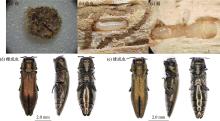
Fig. 1
Different development stages of Agrilus viduus"

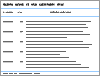
Tab. 1
Life history of Agrilus viduus (Ili of Xinjiang,2024)"
| 虫态 | 5月 | 6月 | 7月 | 8月 | 9月 | 10月 | 11—4月 | ||||||||||||||||||||
|---|---|---|---|---|---|---|---|---|---|---|---|---|---|---|---|---|---|---|---|---|---|---|---|---|---|---|---|
| F | M | L | F | M | L | F | M | L | F | M | L | F | M | L | F | M | L | F | M | L | |||||||
| 越冬幼虫 | * | * | * | * | * | * | * | * | * | ||||||||||||||||||
| 卵 | • | • | • | • | • | ||||||||||||||||||||||
| 幼虫 | — | — | — | — | — | — | — | — | — | — | — | * | * | * | |||||||||||||
| 蛹 | △ | △ | △ | △ | |||||||||||||||||||||||
| 成虫 | + | + | + | + | |||||||||||||||||||||||
Tab. 2
Distribution of Agrilus viduus in Ili"
| 地点 | 时间/年-月-日 | 经纬度 | 寄主 | 是否在野果林范围 | 发现虫态 |
|---|---|---|---|---|---|
| 霍城县清水河镇 | 2019-07-28 | 80.7348°E, 44.1893°N | 家苹果、桃树 | 否 | 幼虫、成虫、卵 |
| 霍城县福寿山 | 2023-06-12 | 80.7316°E, 44.3987°N | 杏树 | 是 | 卵 |
| 新源县改良场 | 2023-05-26 | 83.5804°E, 43.3806°N | 杏树 | 否 | 卵、幼虫 |
| 2023-07-04 | 83.5611°E, 43.4038°N | 杏树 | 否 | 幼虫 | |
| 2023-07-20 | 83.5829°E, 43.3798°N | 家苹果 | 否 | 卵、幼虫、成虫 | |
| 特克斯县兑街 | 2023-07-13 | 81.8231°E, 43.2137°N | 家苹果 | 否 | 卵 |
| 巩留县野核桃沟 | 2023-05-08 | 82.2684°E, 43.3847°N | 杏树 | 否 | 卵、幼虫 |
| 巩留县库尔德宁河滩 | 2023-06-24 | 82.4912°E, 43.1522°N | 野苹果 | 是 | 卵 |
| 巩留县乌鸦岭 | 2023-08-02 | 82.5917°E, 43.3136°N | 野杏 | 是 | 卵、幼虫 |
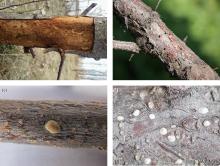
Fig. 2
Damage characteristics caused by Agrilus viduus"

Tab. 3
The relationship between the egg cases of Agrilus viduus and height of the apricot tree"
| 高度/cm | M(P25,P75)/个 | 秩和检验 | |
|---|---|---|---|
| H | P | ||
| 0~40 | 0(0,28) | 14.19 | 0.048 |
| 40~80 | 11(0,21) | ||
| 80~120 | 14(0,78) | ||
| 120~160 | 27(0,58) | ||
| 160~200 | 21(18,64) | ||
| 200~240 | 29(8,49) | ||
| 240~280 | 9(3,16) | ||
| 280~320 | 0(0,5) | ||
Tab. 4
The relationship between the egg cases of Agrilus viduus and base diameter of the apricot tree"
| 基径/cm | M(P25,P75)个/dm2 | 秩和检验 | |
|---|---|---|---|
| H | P | ||
| 0~1 | 0(0.57,4.55) | 12.95 | 0.024 |
| 1~2 | 3.98(2.12,6.63) | ||
| 2~3 | 6.05(4.14,12.10) | ||
| 3~4 | 3.29(2.02,6.16) | ||
| 4~5 | 0.97(0.71,4.07) | ||
| 5~6 | 0.80(0.36,6.58) | ||
| [1] | 张新时. 伊犁野果林的生态地理特征和群落学问题[J]. 植物学报, 1973, 15(2): 239-253. |
| [Zhang Xinshi. On the eco-geographical characteristics and the pronlems of classification of the wild fruit-tree forests in the Ili Valley of Sinkiang[J]. Acta Botanica Sinica, 1973, 15(2): 239-253.] | |
| [2] | 白玲, 阎国荣, 许正. 伊犁野果林植物多样性及其保护[J]. 干旱区研究, 1998, 15(3): 10-13. |
| [Bai Ling, Yan Guorong, Xu Zheng. Study on phyto-diversity and conservation of the wild fruit forests of Tianshan Mts in Xinjiang[J]. Arid Zone Research, 1998, 15(3): 10-13.] | |
| [3] | Duan N, Bai Y, Sun H, et al. Genome re-sequencing reveals the history of apple and supports a two-stage model for fruit enlargement[J]. Nature Communications, 2017, 8(1): 24. |
| [4] | 刘爱华, 张新平, 温俊宝, 等. 天山野苹果林苹果小吉丁与苹果腐烂病复合危害研究[J]. 新疆农业科学, 2014, 51(12): 2240-2244. |
| [Liu Aihua, Zhang Xinping, Wen Junbao, et al. Preliminary research on the composite damage of Agrilus mali Matsumura and Valsa mali Miyabe et Yamada in wild apple trees in Tianshan Mountain[J]. Xinjiang Agricultural Sciences, 2014, 51(12): 2240-2244.] | |
| [5] | 羊海军, 崔大方, 许正, 等. 中国天山野果林种子植物组成及资源状况分析[J]. 植物资源与环境学报, 2003, 12(2): 39-45. |
| [Yang Haijun, Cui Dafang, Xu Zheng, et al. Analysis on the components and resource situation of seed plants in the wild fruit forest in Tianshan Mountain in China[J]. Journal of Plant Resources and Environment, 2003, 12(2): 39-45.] | |
| [6] | 崔大方, 廖文波, 羊海军, 等. 中国伊犁天山野果林区系表征地理成分及区系发生的研究[J]. 林业科学研究, 2006, 19(5): 555-560. |
| [Cui Dafang, Liao Wenbo, Yang Haijun, et al. Studies on the floristic composition and genesis of the wild fruit forest in Tianshan Mountains in China[J]. Forest Research, 2006, 19(5): 555-560.] | |
| [7] | 王春晓, 赵健桐, 隋建中, 等. 新疆发生苹果小吉丁虫[J]. 新疆农业科学, 1995, 38(5): 225-226. |
| [Wang Chunxiao, Zhao Jiantong, Sui Jianzhong, et al. Occurrence of Agrilus mali Matsumura in Xinjiang[J]. Xinjiang Agricultural Sciences, 1995, 38(5): 225-226.] | |
| [8] | 何海明, 银建民, 伊力哈木, 等. 伊犁地区果树发生苹果小吉丁虫[J]. 新疆农业科技, 1999, 21(6): 18. |
| [He Haiming, Yin Jianmin, Yilihamu, et al. Agrilus mali Matsumura occurred on fruit trees in Ili[J]. Xinjiang Agricultural Science and Technology, 1999, 21(6): 18.] | |
| [9] | 祝怀发. 伊犁巩留野果林遭苹果小吉丁严重危害[J]. 植物保护, 2003, 29(2): 60. |
| [Zhu Huaifa. The wild fruit forest in Gongliu, Yili, is severely damaged by Agrilus mali Matsumura[J]. Plant Protection, 2003, 29(2): 60.] | |
| [10] | 刘忠权, 陈卫民, 许正, 等. 新疆天山西部野苹果林分布与苹果小吉丁虫危害现状研究[J]. 北方园艺, 2014, 38(17): 121-124. |
| [Liu Zhongquan, Chen Weimin, Xu Zheng, et al. Malus Sievers forest distribution and Agrilus mali Matsumura status of damage in the West part of Tianshan Mountains[J]. Northern Horticulture, 2014, 38(17): 121-124.] | |
| [11] | 王玉丽, 吕昭智, 令狐伟, 等. 新疆野果林的新害虫——杏树鬃球蚧(半翅目:蚧总科:蚧科)[J]. 林业科学研究, 2021, 34(5): 152-158. |
| [Wang Yuli, Lyu Zhaozhi, Linghu Wei, et al. Sphaerolecanium prunastri (Hemiptera: Coccoidae: Co-ccidae), A new pest in wild fruit forests, Xinjiang[J]. Forest Research, 2021, 34(5): 152-158.] | |
| [12] | 林培钧, 崔乃然. 天山野果林资源——伊犁野果林综合研究[M]. 北京: 中国林业出版社, 2000: 266-276. |
| [Lin Peijun, Cui Nai’ran. Resources of Wild Fruit Forest in Tianshan: A Comprehensive Study on Wild Fruit Forest in Yili[M]. Beijing: China Forestry Press, 2000: 266-276.] | |
| [13] | 郭文超, 吐尔逊, 周桂玲, 等. 新疆农林外来生物入侵现状、趋势及对策[J]. 新疆农业科学, 2012, 49(1): 86-100. |
| [Guo Wenchao, Tuxun, Zhou Guiling, et al. The status quo and trend of invasive alien species in culture & in Xinjiang, China and relevant countermeasures[J]. Xinjiang Agricultural Sciences, 2012, 49(1): 86-100.] | |
| [14] | 刘忠军. 新疆外来林业有害生物入侵现状及趋势分析[J]. 新疆林业, 2019, 45(2): 37-41, 48. |
| [Liu Zhongjun. Current situation and trend of invasive alien forest pests in Xinjiang[J]. Forestry of Xinjiang, 2019, 45(2): 37-41, 48.] | |
| [15] | Jendek E, Grebennikov V. Agrilus(Coleoptera, Buprestidae)of East Asia[M]. Prague: Jan Farkač, 2011. |
| [16] | 胡红英, 黄人鑫. 新疆昆虫原色图鉴[M]. 乌鲁木齐: 新疆大学出版社, 2012. |
| [Hu Hongying, Huang Renxin. Colored Pictorial of Insects in Xinjiang[M]. Urumqi: Xinjiang University Press, 2012.] | |
| [17] | 马文梁. 新疆森林昆虫[M]. 乌鲁木齐: 新疆科学技术出版社, 2015. |
| [Ma Wenliang. Insects of Forest in Xinjiang[M]. Urumqi: Xinjiang Science and Technology Press, 2015.] | |
| [18] | 刘万里, 薛茜, 曹明芹, 等. 用SPSS实现完全随机设计多组比较秩和检验的多重比较[J]. 地方病通报, 2007, 22(2): 27-29. |
| [Liu Wanli, Xue Qian, Cao Mingqin, et al. Nonparametic test of completely random ized design and multiple comparisonsw with SPSS[J]. Endemic Disease Bulletin, 2007, 22(2): 27-29.] | |
| [19] | 彭忠亮. 中国吉丁虫图鉴[M]. 福州: 海峡书局,2021: 481. |
| [Peng Zhongliang. Aniconography of Chinese Buprestidae (Coleoptera)[M]. Fuzhou: Strait Book Bureau, 2021: 481.] | |
| [20] | 季英. 警惕外来害虫——苹果小吉丁虫在我区的猖獗发生[J]. 新疆农业科技, 2004, 26(2): 18. |
| [Ji Ying. Beware of alienpests—Agrilus mali is rampant in our area[J]. Xinjiang Agricultural Science and Technology, 2004, 26(2): 18.] | |
| [21] | 刘爱华, 王玉兰, 阿里木. 两种药剂防治苹果小吉丁虫试验[J]. 新疆农业科学, 2005, 42(S1): 101-102. |
| [Liu Aihua, Wang Yulan, A Limu. Experiment on the two insecticides against Agriluus mali Matsumura[J]. Xinjiang Agricultural Sciences, 2005, 42(S1): 101-102.] | |
| [22] | 王念平, 于江南, 陈卫民, 等. 苹果小吉丁虫发生规律及防治技术研究[J]. 林业实用技术, 2007(9): 30-31. |
| [Wang Nianping, Yu Jiangnan, Chen Weimin, et al. The occurrence law and control technology of apple small girdler were studied[J]. Forest Science and Technology, 2007(9): 30-31.] | |
| [23] | 崔晓宁, 刘德广, 刘爱华. 苹果小吉丁虫综合防控研究进展[J]. 植物保护, 2015, 41(2): 16-23. |
| [Cui Xiaoning, Liu Deguang, Liu Aihua. Research progress in integrated management of Agrilus mali[J]. Plant Protection, 2015, 41(2): 16-23.] | |
| [24] | 廖小龙, 史开奇, 李斌, 等. 白蜡窄吉丁危害及防治[J]. 农业与技术, 2021, 41(15): 85-87. |
| [Liao Xiaolong, Shi Kaiqi, Li Bin, et al. Harm and prevention of Agrilus planipennis[J]. Agriculture and technology, 2021, 41(15): 85-87.] | |
| [25] | 茹善古丽. 博乐市开展白蜡窄吉丁普查工作[EB/OL]. https://www.xjbl.gov.cn/info/1493/90052.htm , 2023-11-30. |
| [RushanGuli. Bole City carries out the survey work of Agrilus planipennis Fairmaire[EB/OL]. https://www.xjbl.gov.cn/info/1493/90052.htm , 2023-11-30.] | |
| [26] | 刘华, 臧润国, 丁易, 等. 天山西部新疆野苹果种群特征[J]. 林业科学, 2010, 46(11): 1-7. |
| [Liu Hua, Zang Runguo, Ding Yi, et al. Population characteristics of Malus sieversii in the West part of Tianshan Mountains, Xinjiang[J]. Scientia Silvae Sinicae, 2010, 46(11): 1-7.] | |
| [27] | 刘爱华, 张新平, 温俊宝, 等. 苹果小吉丁虫入侵新疆的风险分析及管理对策[J]. 江苏农业科学, 2013, 41(3): 105-107. |
| [Liu Aihua, Zhang Xinping, Wen Junbao, et al. Risk analysis and management countermeasures for the invasion of Agrilus mali Borer in Xinjiang[J]. Jiangsu Agricultural Sciences, 2013, 41(3): 105-107.] | |
| [28] | 宋海天. 福建省林木吉丁害虫的发生及防控对策[J]. 武夷科学, 2020, 36(2): 80-87. |
| [Song Haitian. Occurrence and control strategies of wood-damaging Buprestidae pests in Fujian Province[J]. Wuyi Science Journal, 2020, 36(2): 80-87.] | |
| [29] |
王小艺, 杨忠岐, Juli R Gould, 等. 白蜡窄吉丁(鞘翅目:吉丁甲科)的生物防治研究进展[J]. 中国生物防治学报, 2015, 31(5): 666-678.
doi: 10.16409/j.cnki.2095-039x.2015.05.007 |
|
[Wang Xiaoyi, Yang Zhongqi, Juli R Gould, et al. Biological control progress of Agrilus planipennis (Coleoptera: Buprestidae)[J]. Chinese Journal of Biological Control, 2015, 31(5): 666-678.]
doi: 10.16409/j.cnki.2095-039x.2015.05.007 |
| [1] | KONG Xiangwei, LI Chenrui, DI Wenjing, Yang Yi, FU Zhengxu, YANG Xiumei. Characteristics of regional heavy rain showers in eastern Gansu Province [J]. Arid Zone Research, 2025, 42(6): 970-980. |
| [2] | MENG Qingshuai, GONG Yu, LIU Xiaoyan, TONG Xin, WANG Dongmin, XIE Guoying, LIU Tingxi. Research and prediction of the degree of coupling coordination of water resources, socioeconomic development, and the ecological environment: A case of the Inner Mongolia section in the Yellow River Basin [J]. Arid Zone Research, 2025, 42(4): 682-694. |
| [3] | WANG Jingqi, QU Jianjun, WANG Yanxi, LI Mengchao. Characteristics of singing sands in Mulei, Xinjiang [J]. Arid Zone Research, 2025, 42(4): 708-717. |
| [4] | ZHANG Junyao, HAN Qingchi, Alatengsuhe , WANG Haichao, CHEN Congyu, LI Hengkai, WANG Weilong, WANG Xinping, PEI Zhiyong. Differences in rainfall redistribution between pure shrub forests and willow bay based on artificial rainfall [J]. Arid Zone Research, 2025, 42(3): 489-498. |
| [5] | MA Chao, LIU Yan, LIU Jing, YANG Lianmei. Spatial and temporal distribution characteristics of cloud water resources in the Tarim Basin in summer [J]. Arid Zone Research, 2025, 42(2): 223-235. |
| [6] | TIAN Wenjun, XUE Yibo, ZHANG Xiaoxiao, LEI Jiaqiang, LI Shengyu, FAN Jinglong, ZHANG Heng. Study on the vertical distribution and transport of dust aerosols during typical dust weather events in the Tarim Basin, Northwest China in spring, 2021 [J]. Arid Zone Research, 2025, 42(1): 14-26. |
| [7] | WANG Ting, SHEN Ganhua, LIU Bing, SUN Yinglin, WANG Zaiguang. Evolution characteristics of spatial and temporal distribution pattern and driving force analysis of reservoirs in the economic zone on the north slope of Tianshan Mountains [J]. Arid Zone Research, 2024, 41(9): 1456-1467. |
| [8] | CHEN Songqing, DONG Hongfang, YUE Yifeng, HAO Yuanyuan, LIU Xin, CAO Xianyu, MA Jun. Geographical distribution and dynamic change prediction of Hippophae rhamnoides subsp. sinensis under different climate scenarios [J]. Arid Zone Research, 2024, 41(9): 1560-1571. |
| [9] | WANG Dai, LI Xin, ZHANG Wen, MA Yang, WANG Suyan, LI Jiayao. Synergistic effects of sea surface temperature and sea ice on the anomalous characteristics of precipitation distribution during the flood season in Ningxia [J]. Arid Zone Research, 2024, 41(8): 1288-1299. |
| [10] | ZHANG Qunhui, CHANG Liang, GU Xiaofan, WANG Qian, MA Maonan, LI Xiaodeng, DUAN Rui, YOU Xiangzhi. Spatial-temporal variations and trends in the human body comfort index in the Qaidam Basin, China, during 1979-2020 [J]. Arid Zone Research, 2024, 41(8): 1300-1308. |
| [11] | SU Yuqi, MA Suliya, LI Yufan, WEI Qiuyu, WANG Hongfeng, LI Wenjun. Species diversity and distribution patterns of threatened vascular plants in Kyrgyzstan [J]. Arid Zone Research, 2024, 41(8): 1405-1412. |
| [12] | LONG Weiyi, SHI Jianfei, LI Shuangyuan, SUN Jinjin, WANG Yugang. Evaluation of multimodel inversion effects on soil salinity in oasis basin [J]. Arid Zone Research, 2024, 41(7): 1120-1130. |
| [13] | ZHOU Jie, WANG Xuhu, DU Weibo, ZHOU Xiaolei, YANG Jie, ZAHNG Xiaowei. Prediction of potential distribution area of Picea schrenkiana under the background of climate change [J]. Arid Zone Research, 2024, 41(7): 1167-1176. |
| [14] | GUO Shiyu, ZHANG Yuxin, HAN Huibang, ZHOU Wanfu, KANG Xiaoyan, ZHANG Liyan. Vertical characteristics of raindrop size distribution in a precipitation process in a Three-River Source Region [J]. Arid Zone Research, 2024, 41(3): 353-362. |
| [15] | CHENG Qiulian, LIU Jie, YANG Zhiwei, ZHANG Tianyi, WANG Bin. Spatial distribution and factor analysis of avalanche in the Aerxiangou section of the Duku expressway [J]. Arid Zone Research, 2024, 41(2): 220-229. |
|
||
