
Arid Zone Research ›› 2025, Vol. 42 ›› Issue (4): 682-694.doi: 10.13866/j.azr.2025.04.10
• Ecology and Environment • Previous Articles Next Articles
MENG Qingshuai1( ), GONG Yu1,2,3,4, LIU Xiaoyan1,2,3,4(), TONG Xin1,2,3,4, WANG Dongmin5, XIE Guoying6, LIU Tingxi1,2,3,4
Received:2024-09-27
Revised:2025-03-04
Online:2025-04-15
Published:2025-04-10
Contact:
LIU Xiaoyan
E-mail:menqinshu@163.com;liuxy6675@163.com
MENG Qingshuai, GONG Yu, LIU Xiaoyan, TONG Xin, WANG Dongmin, XIE Guoying, LIU Tingxi. Research and prediction of the degree of coupling coordination of water resources, socioeconomic development, and the ecological environment: A case of the Inner Mongolia section in the Yellow River Basin[J].Arid Zone Research, 2025, 42(4): 682-694.
Add to citation manager EndNote|Reference Manager|ProCite|BibTeX|RefWorks
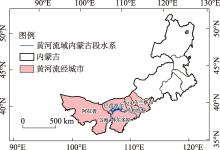
Fig. 1
Study area overview diagram"
Tab. 1
Water resources-socioeconomic-ecological environment system indicator system of the Inner Mongolia section in the Yellow River Basin"
| 准则层 | 指标层 | |||
|---|---|---|---|---|
| 序号 | 名称 | 指标计算 | 单位 | |
| 水资源指标 | 1 | 水资源人均占有量 | 水资源量/区域年人口数 | m3∙人-1 |
| 2 | 水资源模数 | 水资源量/区域总面积 | 105 m3∙km-2 | |
| 3 | 产水系数 | 水资源总量/年降雨总量 | 无量纲 | |
| 4 | 总用水量 | 区域年耗水资源量 | 108 m3 | |
| 5 | 年平均降雨量 | 历年降雨量之和/年数 | mm | |
| 6 | 年平均蒸发量 | 历年蒸发量之和/年数 | mm | |
| 社会经济指标 | 7 | 农业用水占比 | 农业用水量/总用水量×100% | % |
| 8 | 工业用水占比 | 工业用水量/总用水量×100% | % | |
| 9 | 生活用水占比 | 生活用水量/总用水量×100% | % | |
| 10 | 城镇居民人均可支配收入 | 城镇可支配收入/城镇人口总数 | 元∙人-1 | |
| 11 | 农村居民人均可支配收入 | 农村可支配收入/农村人口总数 | 元∙人-1 | |
| 12 | 城镇化率 | 在城镇居住半年以上人口/总人口数×100% | % | |
| 13 | 人口密度 | 人口总数/土地面积 | 人∙km-2 | |
| 14 | 一产占比 | 第一产业产值/地区总GDP | % | |
| 15 | 二产占比 | 第二产业产值/地区总GDP | % | |
| 16 | 三产占比 | 第三产业产值/地区总GDP | % | |
| 17 | 工业产值模数 | 工业产值/土地面积 | % | |
| 18 | 人均GDP | GDP/总人口 | 元∙人-1 | |
| 生态环境指标 | 19 | 污水处理率 | 区域污水处理比例 | % |
| 20 | 生态用水比例 | 生态环境用水量/总用水量 | % | |
| 21 | 植被覆盖率 | 有植被覆盖面积/总面积 | % | |
| 22 | 工业二氧化硫排放量 | 工业生产中SO2排放量 | t∙a-1 | |
| 23 | 工业废水排放量 | 工业生产中废水排放量 | t∙a-1 | |
Tab. 2
Division standard of the degree of coordinated development"
| 等级划分 | 完全失调 | 严重失调 | 中等失调 | 轻微失调 | 濒临失调 | 勉强协调 | 初级协调 | 中级协调 | 显著协调 | 优质协调 |
|---|---|---|---|---|---|---|---|---|---|---|
| 区间 | [0,0.1) | [0.1,0.2) | [0.2,0.3) | [0.3,0.4) | [0.4,0.5) | [0.5,0.6) | [0.6,0.7) | [0.7,0.8) | [0.8,0.9) | [0.9,1.0] |
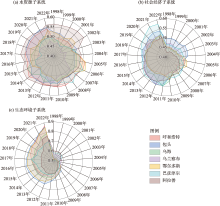
Fig. 2
Time series development trend of the comprehensive evaluation index of each subsystem in the league cities of the Inner Mongolia section in the Yellow River Basin"

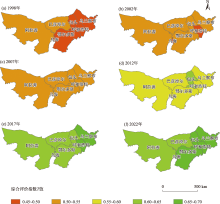
Fig. 3
T-value changes by league/city in typical years of the Inner Mongolia section in the Yellow River Basin"

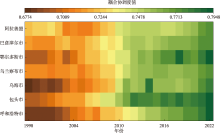
Fig. 4
Interannual variation of coupling coordination in seven cities of the Inner Mongolia section in the Yellow River Basin"

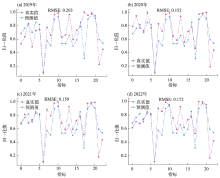
Fig. 5
Prediction accuracy diagram of traditional LSTM model (typical year in Hohhot)"
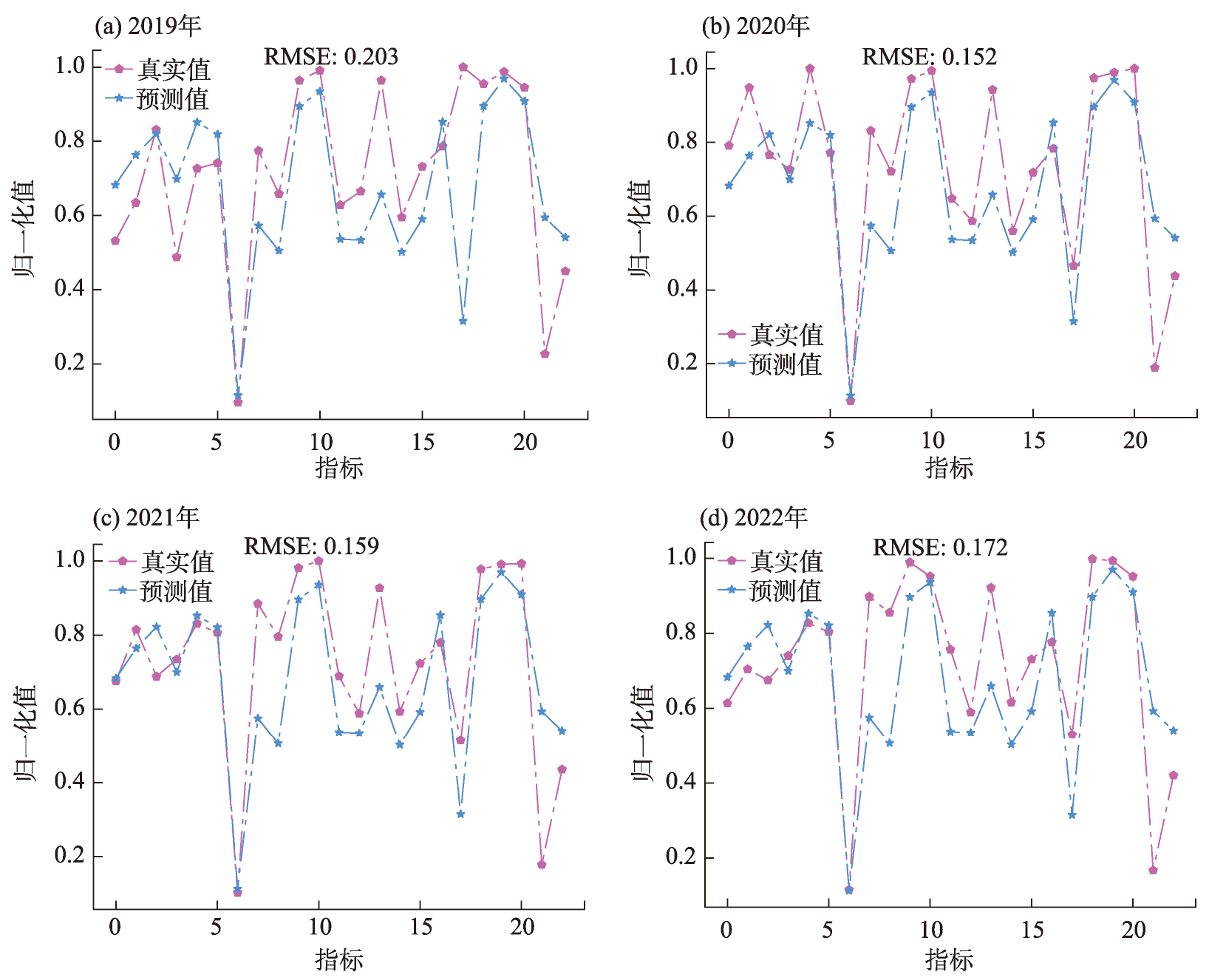
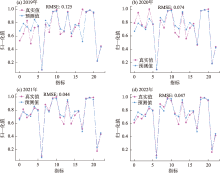
Fig. 6
Schematic diagram of improved prediction accuracy of LSTM model (typical year in Hohhot)"

Tab. 3
Real value and forecasted value of Hohhot City in 2023 (Option 1)"
| 指标 | I1 | I2 | I3 | I4 | I5 | I6 | I7 | I8 |
|---|---|---|---|---|---|---|---|---|
| 真实值 | 210.3 | 4.40 | 0.14 | 10.73 | 256.63 | 1875.26 | 62.78 | 9.50 |
| 预测值 | 268.6 | 4.86 | 0.12 | 10.48 | 274.00 | 1931.00 | 62.52 | 7.43 |
| 指标 | I9 | I10 | I11 | I12 | I13 | I14 | I15 | I16 |
| 真实值 | 20.03 | 57085 | 25518 | 80.7 | 207 | 4.4 | 35.2 | 60.4 |
| 预测值 | 19.85 | 59137 | 24836 | 79.8 | 205 | 4.05 | 31.72 | 64.23 |
| 指标 | I17 | I18 | I19 | I20 | I21 | I22 | I23 | |
| 真实值 | 545.77 | 106337 | 97.60 | 7.69 | 46.77 | 11535 | 2191 | |
| 预测值 | 580.14 | 98668 | 98.45 | 10.20 | 48.23 | 15389 | 2280 |
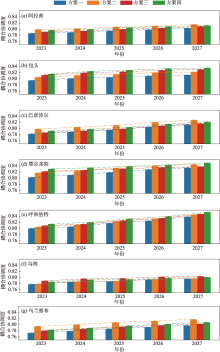
Fig. 7
Changes in coupling coordination of water resources, socioeconomic, and ecological systems in different adjustment scenarios across regions from 2023 to 2027"

| [1] | Zhao D, Liu J, Sun L, et al. Quantifying economic-social-environmental trade-offs and synergies of water-supply constraints: An application to the capital region of China[J]. Water Research, 2021, 195: 116986. |
| [2] |
马海涛, 张雪莹, 梁源钊, 等. 东北地区黑土保护与区域发展综合评价及耦合协调研究[J]. 地理科学, 2023, 43(12): 2183-2195.
doi: 10.13249/j.cnki.sgs.2023.12.012 |
| [Ma Haitao, Zhang Xueying, Liang Yuanzhao, et al. Comprehensive evaluation and coupling coordination of black soil prolecion and regional development in Norheast China[J]. Scientia GeographicaSinica, 2023, 43(12): 2183-2195.] | |
| [3] |
吴玥葶, 郭利丹, 井沛然, 等. 中亚五国水-能源-粮食-生态耦合关系及时空分异[J]. 干旱区研究, 2023, 40(4): 573-582.
doi: 10.13866/j.azr.2023.04.06 |
|
[Wu Yueting, Guo Lidan, Jing Peiran, et al. Coupling relationship and spatiotemporal differentiation of the water-energy-food-ecology nexus in five Central Asian countries[J]. Arid Zone Research, 2023, 40(4): 573-582.]
doi: 10.13866/j.azr.2023.04.06 |
|
| [4] | Dong L, Long W L, Zhen B W, et al. Exploration of coupling effects in the economy-society-environment system in urban areas: Case study of the Yangtze River Delta Urban Agglomeration[J]. Ecological Indicators, 2021, 128: 107858. |
| [5] | Sun K, Han J, Wu Q, et al. The coupling coordination and spatiotemporal evolution of industrial water-energy-CO2 in the Yellow River Basin[J]. Science of the Total Environment, 2024, 912: 169012. |
| [6] | Wang X Y, Zhang S L, Gao C, et al. Coupling coordination and driving mechanisms of water resources carrying capacity under the dynamic interaction of the water-social-economic-ecological environment system[J]. Science of the Total Environment, 2024, 920: 171011. |
| [7] | Cui Y, Zhou Y, Jin J, et al. Coordinated development evaluation and diagnosis of regional water resources-social economy-ecological environment system based on mechanical model and risk matrix[J]. Journal of Hydrology, 2024, 633: 131013. |
| [8] |
胡醒木子. 内蒙古沿黄地区经济发展-生态环境-水资源耦合协调研究[J]. 地域研究与开发, 2023, 42(6): 165-171.
doi: 10.3969/j.issn.10032363.2023.06.026 |
|
[Hu Xingmuzi. Coupling coordination of economic development, ecological environment and water resources: A case study of the Yellow River Region in Inner Mongolia[J]. Areal Research and Development, 2023, 42(6): 165-171.]
doi: 10.3969/j.issn.10032363.2023.06.026 |
|
| [9] | 张娟娟, 黎佳茜, 吴瑞, 等. 我国再生水循环利用: 现状、趋势及对策[J]. 环境科学, 2024, 45(12): 7031-7040. |
| [Zhang Juanjuan, Li Jiaxi, Wu Rui, et al. Recycling of reclaimed water in China: Current situation, development trend, and counter measures[J]. Environmental Science, 2024, 45(12): 7031-7040.] | |
| [10] | 张建云, 胡庆芳, 王银堂, 等. 区域水平衡与健康水平衡实现路径[J]. 水科学进展, 2023, 34(3): 323-335. |
| [Zhang Jianyun, Hu Qingfang, Wang Yintang, et al. Regional water balance and the path to healthy water balance[J]. Advances in Water Science, 2023, 34(3): 323-335.] | |
| [11] | 谢海浪, 赵伟, 江雅婷, 等. 城镇生态化视角下三峡库区人口-经济-环境(PEE)耦合协调发展[J]. 水土保持学报, 2024, 38(4): 209-221, 235. |
| [Xie Hailang, Zhao Wei, Jiang Yating, et al. Coupling coordination of Population-Economic-Environmental (PEE) in the Three Gorges Reservoir Area from the perspective of urban ecologicalization[J]. Journal of Soil and Water Conservation, 2024, 38(4): 209-221, 235.] | |
| [12] | 吴艳霞, 魏志斌, 王爱琼. 基于DPSIR模型的黄河流域生态安全评价及影响因素研究[J]. 水土保持通报, 2022, 42(6): 322-331. |
| [Wu Yanxia, Wei Zhibin, Wang Aiqiong. Ecological safety evaluation and influencing factors of Yellow River Basin based on DPSlR model[J]. Bulletin of Soil and Water Conservation, 2022, 42(6): 322-331.] | |
| [13] | 陈莉, 张安安. 黄河流域水资源与社会经济协同评价及影响因素分析[J]. 水资源保护, 2023, 39(2): 1-8. |
| [Chen Li, Zhang Anan. Synergistic evaluation of water resources and social economy in the Yellow River Basin and analysis of influencing factors[J]. Water Resources Protection, 2023, 39(2): 1-8.] | |
| [14] | 王富强, 应卓晖, 吕素冰, 等. 京津冀地区水-经济-生态耦合协调发展特征评价[J]. 水资源保护, 2022, 38(5): 80-86. |
| [Wang Fugiang, Ying Zhuohui, Lyu Subing, et al. Evaluation of coupling coordinated development characteristics of water-economy-ecology system in Beiing Tianjin-Hebei region[J]. Water Resources Protection, 2022, 38(5): 80-86.] | |
| [15] | Mortazavi M, Kuczera G, Cui L. Multiobjective optimization of urban water resources: Moving toward more practical solutions[J]. Water Resources Research, 2012, 48(3): W03514. |
| [16] |
章光新, 陈月庆, 吴燕锋. 基于生态水文调控的流域综合管理研究综述[J]. 地理科学, 2019, 39(7): 1191-1198.
doi: 10.13249/j.cnki.sgs.2019.07.018 |
| [Zhang Guangxin, Chen Yueqing, Wu Yanfeng. Commentary on eco-hydrological regulation for integrated river basin management[J]. Scientia Geographica Sinica, 2019, 39(7): 191-1198.] | |
| [17] |
王少剑, 崔子恬, 林靖杰, 等. 珠三角地区城镇化与生态韧性的耦合协调研究[J]. 地理学报, 2021, 76(4): 973-991.
doi: 10.11821/dlxb202104013 |
|
[Wang Shaojian, Cui Zitian, Lin Jingjie, et al. Coupling relationship between urbanization and ecological resilience in the Pearl River Delta[J]. Acta Geographica Sinica, 2021, 76(4): 973-991.]
doi: 10.11821/dlxb202104013 |
|
| [18] |
郝潘潘, 刘志有. 新疆绿洲土地利用隐性形态与土地生态安全协调特征——以伊犁河谷为例[J]. 干旱区研究, 2024, 41(9): 1605-1614.
doi: 10.13866/j.azr.2024.09.16 |
|
[Hao Panpan, Liu Zhiyou. Coordination characteristies between land use implicit forms and landecological security in Xinjiang oasis: The Ili River Valley as a case study[J]. Arid Zone Research, 2024, 41(9): 1605-1614.]
doi: 10.13866/j.azr.2024.09.16 |
|
| [19] | 崔新蕾, 王艳融, 马艳茹. 黄河流域降碳-减污-扩绿-增长耦合协调的动态演进及其影响因素[J]. 水土保持研究, 2024, 31(4): 275-287. |
| [Cui Xinlei, Wang Yanrong, Ma Yanru. Dynamic evolution of carbon reduction-pollution reduction-green expansion-economic growth coupling coordination and its influencing factors in the Yellow River Basin[J]. Research of Soil and Water Conservation, 2024, 31(4): 275-287.] | |
| [20] | 张子晴, 张道军, 陈亮, 等. 黄河流域城镇化与耕地利用生态效率的耦合协调度评价、时空特征及驱动因素[J]. 农业工程学报, 2024, 40(16): 240-250. |
| [Zhang Ziqing, Zhang Daojun, Chen Liang, et al. Coupling coordination evaluation, spatiotemporal characteristics and driving factors between urbanization and cultivated land use ecological efficiency in the Yellow River Basin[J]. Transactions of the Chinese Society of Agricultural Engineering, 2024, 40(16): 240-250.] | |
| [21] | Zhang Y, Khan S U, Swallow B, et al. Coupling coordination analysis of China’s water resources utilization efficiency and economic development level[J]. Journal of Cleaner Production, 2022, 373: 133874. |
| [22] | 孟建伟, 詹惠馨, 林英华. 呼包鄂榆城市群产业生态化评价及影响因素分析[J]. 水土保持通报, 2024, 44(6): 328-338. |
| [Meng Jianwei, Zhan Huixin, Lin Yinghua. Evaluationof industrial ecology and analysis of influencing factors in Hohhot Baotou-Ordos-Yulin urban agglomeration[J]. Bulletin of Soil and Water Conservation, 2024, 44(6): 328-338.] | |
| [23] | 汤良, 胡希军, 罗紫薇, 等. 生态脆弱性与城镇化水平时空耦合及其交互影响因素——以湖南省为例[J]. 生态学报, 2024, 44(11): 4662-4677. |
| [Tang Liang, Hu Xijun, Luo Ziwei, et al. Spatiotemporal coupling of ecological vulnerability and urbanization level and their interactive influencing factors: A case study of Hunan Province[J]. Acta Ecologica Sinica, 2024, 44(11): 4662-4677.] | |
| [24] |
江孝君, 王小艳, 杨青山. 环渤海地区生态-经济-社会系统耦合协调时空演化特征及驱动机理[J]. 地理科学, 2024, 44(12): 2155-2165.
doi: 10.13249/j.cnki.sgs.20230823 |
|
[Jiang Xiaojun, Wang Xiaoyan, Yang Qingshan. Spalio-temporal evolution characteristics and driving mechanisms of ecoloica-economic-social system coupling coordination in the Bohai Rim Area[J]. Scientia Geographica Sinica, 2024, 44(12): 2155-2165.]
doi: 10.13249/j.cnki.sgs.20230823 |
|
| [25] | 马亚亚, 刘国彬, 张超, 等. 陕北安塞县生态与经济系统耦合协调发展[J]. 生态学报, 2019, 39(18): 6840-6849. |
| [Ma Yaya, Liu Guobin, Zhang Chao, et al. Research on the coordinated development of ecological and economic Ansai County, systems in Northern Shaanx Province[J]. Acta Ecologica Sinica, 2019, 39(18): 6840-6849.] | |
| [26] | 丁红, 王伟泽, 杨泽凡, 等. 基于深度学习和信号分解的北方寒区河流开河日期预报[J]. 生态学报, 2024, 55(5): 577-585. |
| [Ding Hong, Wang Weize, Yang Zefan, et al. Forecasting break-up date of river ice in Northern China based ondeep learning and signal decomposition technology[J]. Acta Ecologica Sinica, 2024, 55(5): 577-585.] | |
| [27] | Wu J H, Wang Z C, Hu Y, et al. Runoff forecasting using convolutional neural networks and optimized bi-directional long short-term memory[J]. Water Resources Management, 2023, 37: 937-953. |
| [28] | Chu H B, Wei J H, Wang H, et al. Runoff projection in the Tibetan Plateau using a long short-term memory network-based framework under various climate scenarios[J]. Journal of Hydrology, 2024, 632. |
| [29] | Ariele, Zanfei Brentan B M, Menapace A, et al. Graph convolutional recurrent neural networks for water demand forecasting[J]. Water Resources Research, 2022: 58( 7): e2022WR032299. |
| [30] | Solgi R, Loáiciga H A, Kram M. Long short-term memory neural network (LSTM-NN) for aquifer level time series forecasting using in-situ piezometric observations[J]. Journal of Hydrology, 2021, 601:126800. |
| [31] | 汪顺生, 杨金月, 王爱丽, 等. 河南省黄河流域水资源-经济-生态系统耦合协调评价及预测[J]. 湖泊科学, 2022, 34(3): 919-934. |
| [Wang Shunsheng, Yang Jinyue, Wang Aili, et al. Evaluation and forecast of coupling coordination of water resources, economy and eco-system in the Yellow River Basin of Henan Province[J]. Journal of Lake Sciences, 2022, 34(3): 919-934.] | |
| [32] | 杜新强, 何立滢, 姚泓钰, 等. 近15年来中国北方水资源-社会经济-生态环境耦合协调发展评价[J]. 中国农村水利水电, 2022(6): 66-75. |
| [Du Xinqiang, He Liying, Yao Hongyu, et al. Evaluation of the coupling coordination development of water resources, socio-economy and eco-environment in Northern China in recent 15 years[J]. China Rural Water and Hydropower, 2022(6): 66-75.] | |
| [33] | 蒋桂芹, 靖娟, 周翔南. 黄河流域水资源-经济社会-生态环境系统耦合协调发展评价[C]// 中国水利学会2018学术年会. 北京: 中国水利水电出版社, 2018. |
| [Jiang Guiqin, Jing Juan, Zhou Xiangnan. Evaluation on the coupling and coordinated development of water resources, economic society and ecological environment system in the Yellow River Basin[C]// The 2018 Academic Annual Meeting of the Chinese Society of Hydraulics. Beijing: China Water Resources and Hydropower Press, 2018.] | |
| [34] | 李佳璐, 潘景茹, 冯峰, 等. 黄河流域九省(区)人口-水资源-经济-生态环境系统耦合协调发展及障碍因素分析[J]. 水资源与水工程学报, 2024, 35(1): 47-56. |
| [Li Jialu, Pan Jingru, Feng Feng, et al. Coupling coordination development of PWEE system and obstacle factors in nine provinces/regions of the Yellow River Basin[J]. Journal of Water Resources and Water Engineering, 2024, 35(1): 47-56.] | |
| [35] |
张文睿, 孙栋元, 王亦可, 等. 河西走廊水资源-生态环境-社会经济系统耦合关系及时空分异[J]. 干旱区研究, 2024, 41(9): 1527-1537.
doi: 10.13866/j.azr.2024.09.09 |
|
[Zhang Wenrui, Sun Dongyuan, Wang Yike, et al. Coupling relationship and spatiao-temporal differentiation of the water resources-ecological environment-social economic system in the Hexi Corridor[J]. Arid Zone Research, 2024, 41(9): 1527-1537.]
doi: 10.13866/j.azr.2024.09.09 |
|
| [36] | 吴青松, 马军霞, 左其亭, 等. 塔里木河流域水资源-经济社会-生态环境耦合系统和谐程度量化分析[J]. 水资源保护, 2021, 37(2): 55-62. |
| [Wu Qingsong, Ma Junxia, Zuo Qiting, et al. Quantitative analsis on harmony degree of water resources-economic society-ecological environment coupling system in the Tarim River Basin[J]. Water Resources Protection, 2021, 37(2): 55-62.] | |
| [37] | 史习习, 杨力. 黄河流域2008—2018年可持续发展评价与系统协调发展分析[J]. 水土保持通报, 2021, 41(4): 260-267. |
| [Shi Xixi, Yang Li. Sustainable development evaluation and system coordination development analysis of Yellow River Basin during 2008-2018[J]. Bulletin of Soil and Water Conservation, 2021, 41(4): 260-267.] | |
| [38] | Gu J, Zheng J, Zhang J. Research on the coupling coordination and prediction of industrial convergence and ecological environment in rural of China[J]. Frontiers in Environmental Science, 2022, 10: 1014848. |
| [39] | Qu B, Jiang E, Li J, et al. Coupling coordination relationship of water resources, eco-environment and socio-economy in the water-receiving area of the lower Yellow River[J]. Ecological Indicators, 2024, 160: 111766. |
| [1] | YANG Hang, HOU Jingwei, MA Caihong, YANG Chen, WANG Yanjuan. Spatio-temporal differentiation of the composite ecosystem resilience in the ecologically fragile area in the upper reaches of the Yellow River: A case study in Ningxia [J]. Arid Zone Research, 2023, 40(2): 303-312. |
| [2] | LIU Hailong,TANG Fei,DING Ya’nan,ZHANG Yu,GUO Xiaojia,TAN Jingbai,CHENG Yue. Temporal and spatial evolution characteristics of the coupling between county high-quality development and ecosystem services in Shanxi Province [J]. Arid Zone Research, 2022, 39(4): 1234-1245. |
|
||
