
Arid Zone Research ›› 2025, Vol. 42 ›› Issue (6): 970-980.doi: 10.13866/j.azr.2025.06.02
• Weather and Climate • Previous Articles Next Articles
KONG Xiangwei1,2,3( ), LI Chenrui2(), DI Wenjing2, Yang Yi1, FU Zhengxu2, YANG Xiumei2,3
Received:2024-09-02
Revised:2024-10-19
Online:2025-06-15
Published:2025-06-11
Contact:
LI Chenrui
E-mail:xiangwei580@163.com;lcr0273@l26.com
KONG Xiangwei, LI Chenrui, DI Wenjing, Yang Yi, FU Zhengxu, YANG Xiumei. Characteristics of regional heavy rain showers in eastern Gansu Province[J].Arid Zone Research, 2025, 42(6): 970-980.
Add to citation manager EndNote|Reference Manager|ProCite|BibTeX|RefWorks

Fig. 1
Distribution of automatic weather observation stations in eastern Gansu Province"


Fig. 2
Proportions distribution of hourly precipitation intensities in eastern Gansu Province during the summers of 2010-2021"

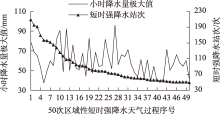
Fig. 3
Maximum values and station occurrences distribution of short-time heavy rainfall in eastern Gansu Province during the summers of 2010-2021"
Tab. 1
Distribution of affected areas in 50 regional short-time heavy rainfall events"
| 平均面积/km2 | 平均面积占河东 总面积的比例/% | 平均发生短时强 降水的县区/个 | 发生短时强降水的县区 占河东总县区的比例/% | |
|---|---|---|---|---|
| 高原槽东移型 | 6277.78 | 3.35 | 18 | 26.87 |
| 副高边缘西南气流型 | 6514.29 | 3.48 | 19 | 28.36 |
| 两高切变型 | 7430.00 | 3.97 | 23 | 34.33 |
| 西北气流型 | 4500.00 | 2.40 | 13 | 19.40 |
| 50次区域性短时强降水天气过程 | 5941.08 | 3.17 | 19 | 28.36 |

Fig. 4
Spatial distribution of 50 regional short-time heavy rainfall events"


Fig. 5
Temporal variations of 50 regional short-time heavy rainfall events"

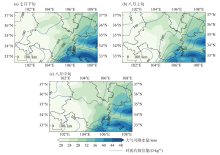
Fig. 6
Mean values of convective available potential energy and atmospheric precipitable water across different temporal intervals from 2010 to 2021"

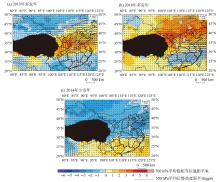
Fig. 7
The 500 hPa mean geopotential height anomaly field, and the 700 hPa mean pseudo-equivalent temperature anomaly field and mean wind field anomaly field during summer (June-August) in high- and low-frequency years of regional short-time heavy rainfall events"


Fig. 8
The 700 hPa mean specific humidity anomaly field and mean water vapor flux divergence anomaly field during summer (June-August) in high- and low-frequency years of regional short-time heavy rainfall events"

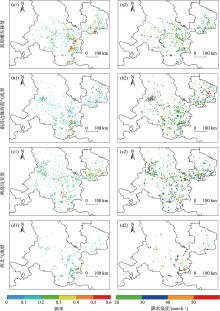
Fig. 9
Spatial distribution of 50 regional short-time heavy rainfall under different synoptic circulation patterns"

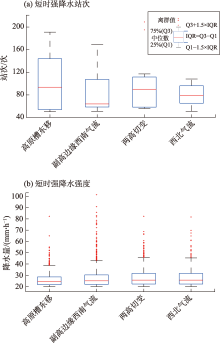
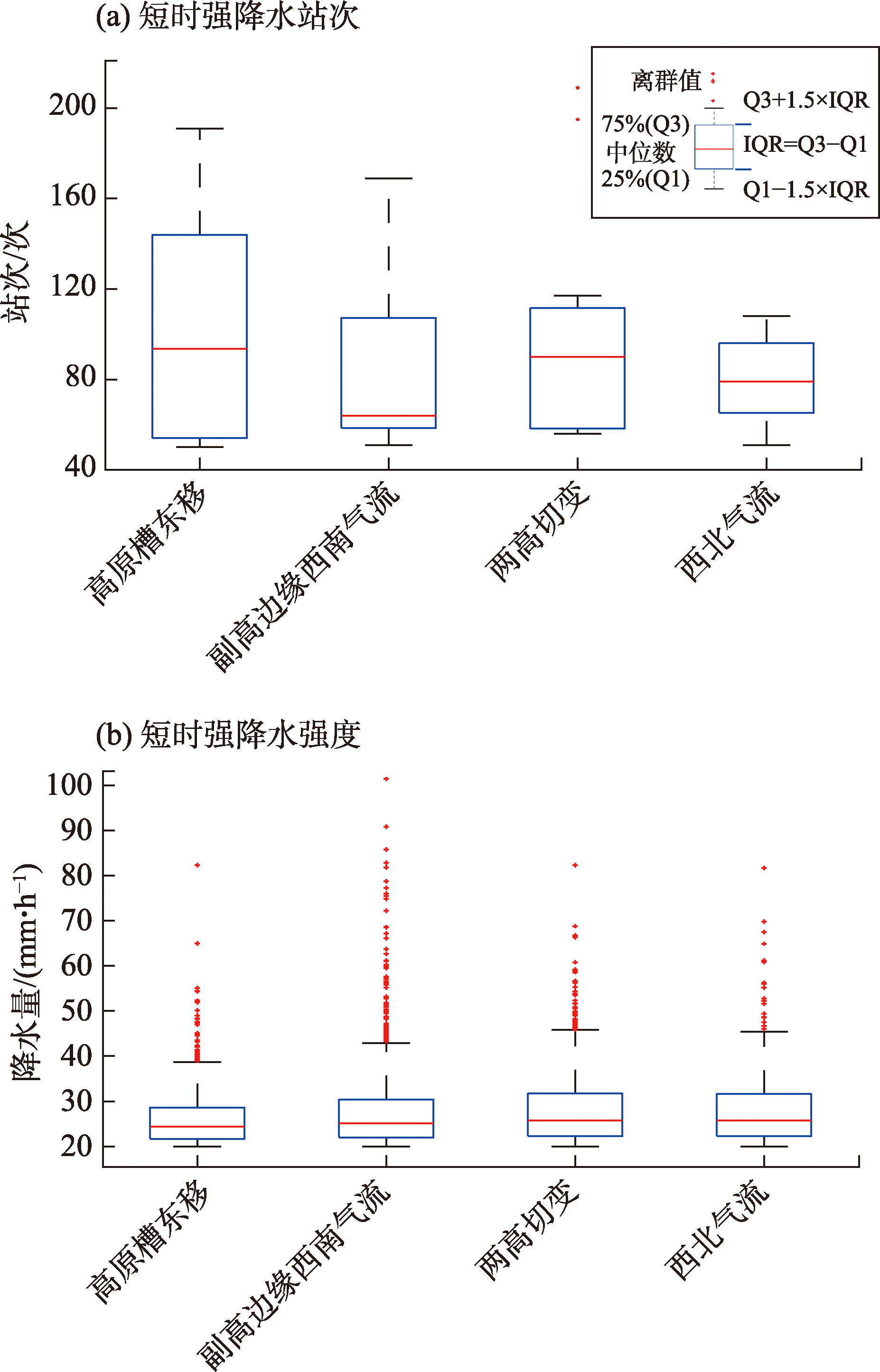
Fig. 10
Distribution of station occurrences and intensity for 50 regional short-time heavy rainfall under different synoptic circulation patterns"
| [1] | 俞小鼎. 短时强降水临近预报的思路与方法[J]. 暴雨灾害, 2013, 32(3): 202-209. |
| [Yu Xiaoding. Nowcasting thinking and method of flash heavy rain[J]. Torrential Rain and Disasters, 2013, 32(3): 202-209.] | |
| [2] | 张诗妍, 胡永云, 李智博. 我国西北降水变化趋势和预估[J]. 气候变化研究进展, 2022, 18(6): 683-694. |
| [Zhang Shiyan, Hu Yongyun, Li Zhibo. Recent changes and future projection of precipitation in Northwest China[J]. Climate Change Research, 2022, 18(6): 683-694.] | |
| [3] | 王澄海, 张晟宁, 李课臣, 等. 1961—2018年西北地区降水的变化特征[J]. 大气科学, 2021, 45(4): 713-724. |
| [Wang Chenghai, Zhang Shengning, Li Kechen, et al. Change characteristics of precipitation in Northwest China from 1961 to 2018[J]. Chinese Journal of Atmospheric Sciences, 2021, 45(4): 713-724.] | |
| [4] | 于淑秋, 林学椿, 徐祥德. 我国西北地区近50年降水和温度的变化[J]. 气候与环境研究, 2003, 8(1): 9-18. |
| [Yu Shuqiu, Lin Xuechun, Xu Xiangde. The climatic change in Northwest China in recent 50 years[J]. Climatic and Environmental Research, 2003, 8(1): 9-18.] | |
| [5] |
王澄海, 张晟宁, 张飞民, 等. 论全球变暖背景下中国西北地区降水增加问题[J]. 地球科学进展, 2021, 36(9): 980-989.
doi: 10.11867/j.issn.1001-8166.2021.087 |
|
[Wang Chenhai, Zhang Shengning, Zhang Feimin, et al. On the increase of precipitation in the northwestern China under the global warming[J]. Advances in Earth Science, 2021, 36(9): 980-989.]
doi: 10.11867/j.issn.1001-8166.2021.087 |
|
| [6] |
白晓平, 靳双龙, 王式功, 等. 中国西北地区东部短时强降水时空特征[J]. 中国沙漠, 2018, 38(2): 410-417.
doi: 10.7522/j.issn.1000-694X.2017.00006 |
|
[Bai Xiaoping, Jin Shuanglong, Wang Shigong, et al. Spatio-temporal characteristics of the short-time heavy rainfall in the East of Northwest China[J]. Journal of Desert Research, 2018, 38(2): 410-417.]
doi: 10.7522/j.issn.1000-694X.2017.00006 |
|
| [7] |
杨丽杰, 曹彦超, 刘维成, 等. 陇东黄土高原旱区短时强降水的时空分布特征及地形影响研究[J]. 干旱气象, 2022, 40(6): 945-953.
doi: 10.11755/j.issn.1006-7639(2022)-06-0945 |
| [Yang Lijie, Cao Yanchao, Liu Weicheng, et al. Research on spatio-temporal distribution characteristics of short-term heavy rainfall and terrain influence in the Loess Plateau arid region of eastern Gansu[J]. Journal of Arid Meteorology, 2022, 40(6): 945-953.] | |
| [8] | 薛啟, 唐亚平, 王丽娜, 等. 2015—2019年甘肃平凉地区夏季短时强降水时空分布及天气形势特征[J]. 气象与环境学报, 2022, 38(1): 57-64. |
| [Xue Qi, Tang Yaping, Wang Lina, et al. Spatiotemporal distribution of short-term heavy precipitation and characteristics of synoptic condition during summer in Pingliang, Gansu Province from 2015 to 2019[J]. Journal of Meteorology and Environment, 2022, 38(1): 57-64.] | |
| [9] | 苏军锋, 张锋, 黄玉霞, 等. 甘肃陇南市短时强降水时空分布特征及中尺度分析[J]. 干旱气象, 2021, 39(6): 966-973. |
| [Su Junfeng, Zhang Feng, Huang Yuxia, et al. Spatial-temporal distribution characteristics and mesoscale analysis of short-time heavy precipitation in Longnan of Gansu Province[J]. Journal of Arid Meteorology, 2021, 39(6): 966-973.] | |
| [10] |
孔祥伟, 李晨蕊, 杨秀梅, 等. 甘肃河东夏季区域性短时强降水环流形势分类特征[J]. 高原气象, 2024, 43(2): 329-341.
doi: 10.7522/j.issn.1000-0534.2023.00056 |
|
[Kong Xiangwei, Li Chenrui, Yang Xiumei, et al. Circulation situation characteristics of regional short-time heavy rainfall in eastern Gansu Province in summer[J]. Plateau Meteorology, 2024, 43(2): 329-341.]
doi: 10.7522/j.issn.1000-0534.2023.00056 |
|
| [11] | 黄玉霞, 王宝鉴, 王勇, 等. 甘肃省强对流天气中尺度分析业务技术规范[M]. 北京: 气象出版社, 2017: 20-31. |
| [Huang Yuxia, Wang Baojian, Wang Yong, et al. Technical Specifications for Mesoscale Analysis of Severe Convective Weather in Gansu Province[M]. Beijing: China Meteorological Press, 2017: 20-31.] | |
| [12] |
白晓平, 王式功, 赵璐, 等. 西北地区东部短时强降水概念模型[J]. 高原气象, 2016, 35(5): 1248-1256.
doi: 10.7522/j.issn.1000-0534.2015.00102 |
|
[Bao Xiaoping, Wang Shigong, Zhao Lu, et al. Conceptual models of short-time heavy rainfall in the east of Northwest China[J]. Plateau Meteorology, 2016, 35(5): 1248-1256.]
doi: 10.7522/j.issn.1000-0534.2015.00102 |
|
| [13] |
许东蓓, 许爱华, 肖玮, 等. 中国西北四省区强对流天气形势配置及特殊性综合分析[J]. 高原气象, 2015, 34(4): 973-981.
doi: 10.7522/j.issn.1000-0534.2014.00102 |
|
[Xu Dongbei, Xu Aihua, Xiao Wei, et al. Comprehensive analysis on the severe convective weather situation configuration and its particularity in Northwest China[J]. Plateau Meteorology, 2015, 34(4): 973-981.]
doi: 10.7522/j.issn.1000-0534.2014.00102 |
|
| [14] | 狄潇泓, 王小勇, 肖玮, 等. 高原边坡复杂地形下短时强降水的云型特征分类[J]. 气象, 2018, 44(11): 1445-1453. |
| [Di Xiaohong, Wang Xiaoyong, Xiao Wei, et al. Cloud features classification of short time heavy rainfall in complex topography of plateau slope[J]. Meteorological Monthly, 2018, 44(11): 1445-1453.] | |
| [15] |
孔祥伟, 杨建才, 李红, 等. 甘肃河东地区不同环流形势下短时强降水的雷达回波特征分析[J]. 高原气象, 2021, 40(5): 1057-1070.
doi: 10.7522/j.issn.1000-0534.2020.00084 |
|
[Kong Xiangwei, Yang Jiancai, Li Hong, et al. Analysis of radar echo characteristics of short-term heavy precipitation weather with different circulation pattern in East Gansu Province[J]. Plateau Meteorology, 2021, 40(5): 1057-1070.]
doi: 10.7522/j.issn.1000-0534.2020.00084 |
|
| [16] |
刘新伟, 叶培龙, 伏晶, 等. 高原切变线形态演变对高原边坡一次降水过程的影响分析[J]. 高原气象, 2020, 39(2): 245-253.
doi: 10.7522/j.issn.1000-0534.2019.00084 |
|
[Liu Xinwei, Ye Peilong, Fu Jing, et al. The influence of the morphological evolution of plateau shear line on a precipitation weather process over plateau slope[J]. Plateau Meteorology, 2020, 39(2): 245-253.]
doi: 10.7522/j.issn.1000-0534.2019.00084 |
|
| [17] |
刘新伟, 段海霞, 杨晓军, 等. 2010年7月甘肃大暴雨及其低涡结构分析[J]. 高原气象, 2013, 32(4): 1032-1041.
doi: 10.7522/j.issn.1000-0534.2012.00098 |
|
[Liu Xinwei, Duan Haixia, Yang Xiaojun, et al. Analyses on a heavy rainstorm and structure of low vortex in Gansu Province on July 2010[J]. Plateau Meteorology, 2013, 32(4): 1032-1041.]
doi: 10.7522/j.issn.1000-0534.2012.00098 |
|
| [18] |
王宝鉴, 孔祥伟, 傅朝, 等. 甘肃陇东南一次大暴雨的中尺度特征分析[J]. 高原气象, 2016, 35(6): 1551-1564.
doi: 10.7522/j.issn.1000-0534.2015.00114 |
|
[Wang Baojian, Kong Xiangwei, Fu Zhao, et al. Analysis on mesoscale characteristics of a rainstorm process in southeastern Gansu[J]. Plateau Meteorology, 2016, 35(6): 1551-1564.]
doi: 10.7522/j.issn.1000-0534.2015.00114 |
|
| [19] |
赵庆云, 傅朝, 刘新伟, 等. 西北东部暖区大暴雨中尺度系统演变特征[J]. 高原气象, 2017, 36(3): 697-704.
doi: 10.7522/j.issn.1000-0534.2016.00140 |
|
[Zhao Qingyun, Fu Zhao, Liu Xinwei, et al. Characteristics of mesoscale system evolution of torrential rain in warm sector over Northwest China[J]. Plateau Meteorology, 2017, 36(3): 697-704.]
doi: 10.7522/j.issn.1000-0534.2016.00140 |
|
| [20] |
赵庆云, 张武, 陈晓燕, 等. 一次六盘山两侧强对流暴雨中尺度对流系统的传播特征[J]. 高原气象, 2018, 37(3): 767-776.
doi: 10.7522/j.issn.1000-0534.2017.00068 |
|
[Zhao Qingyun, Zhang Wu, Chen Xiaoyan, et al. Propagation characteristics of mesoscale convection system in an event of severe convection rainstorm over both sides of Liupanshan Mountains[J]. Plateau Meteorology, 2018, 37(3): 767-776.]
doi: 10.7522/j.issn.1000-0534.2017.00068 |
|
| [21] | 傅朝, 杨晓军, 周晓军, 等. 2013年6月19—20日甘肃陇东南暖区暴雨多普勒雷达特征分析[J]. 气象, 2015, 41(9): 1095-1103. |
| [Fu Zhao, Yang Xiaojun, Zhou Xiaojun, et al. Analysis on doppler radar characteristics of warm area rainstorm in southeastern Gansu during 19-20 June 2013[J]. Meteorological Monthly, 2015, 41(9): 1095-1103.] | |
| [22] | 王宝鉴, 黄玉霞, 魏栋, 等. TRMM卫星对青藏高原东坡一次大暴雨强降水结构的研究[J]. 气象学报, 2017, 75(6): 966-980. |
| [Wang Baojian, Huang Yuxia, Wei Dong, et al. Structure analysis of heavy precipitation over the eastern slope of the Tibetan Plateau based on TRMM data[J]. Acta Meteorologica Sinica, 2017, 75(6): 966-980.] | |
| [23] | 杨波, 孙继松, 毛旭, 等. 北京地区短时强降水过程的多尺度环流特征[J]. 气象学报, 2016, 74(6): 919-934. |
| [Yang Bo, Sun Jisong, Mao Xu, et al. Multi-scale characteristics of atmospheric circulation related to short-time strong rainfall events in Beijing[J]. Acta Meteorologica Sinica, 2016, 74(6): 919-934.] | |
| [24] | 黄玉霞, 王宝鉴, 黄武斌, 等. 我国西北暴雨的研究进展[J]. 暴雨灾害, 2019, 38(5): 515-525. |
| [Huang Yuxia, Wang Baojian, Huang Wubin, et al. A review on rainstorm research in Northwest China[J]. Torrential Rain and Disasters, 2019, 38(5): 515-525.] | |
| [25] |
李栋梁, 邵鹏程, 王慧, 等. 中国东亚副热带夏季风北边缘带研究进展[J]. 高原气象, 2013, 32(1): 305-314.
doi: 10.7522/j.issn.1000-0534.2012.00030 |
|
[Li Dongliang, Shao Pengcheng, Wang Hui, et al. Advances in research of the north boundary belt of East Asia subtropical summer monsoon in China[J]. Plateau Meteorology, 2013, 32(1): 305-314.]
doi: 10.7522/j.issn.1000-0534.2012.00030 |
|
| [26] | 汪小康, 闵爱荣, 廖移山. 2018年4—10月我国主要暴雨天气过程简述[J]. 暴雨灾害, 2019, 38(2): 183-192. |
| [Wang Xiaokang, Min Airong, Liao Yishan. Major heavy rainfall events in China from April to October in 2018[J]. Torrential Rain and Disasters, 2019, 38(2): 183-192.] |
|
||
