
干旱区研究 ›› 2025, Vol. 42 ›› Issue (11): 2127-2141.doi: 10.13866/j.azr.2025.11.15
周建伟1,2( ), 张泽林2,3, 吴华1,2,3(), 孔祥运2,3, 陈兴旺2,3
收稿日期:2025-05-21
修回日期:2025-09-19
出版日期:2025-11-15
发布日期:2025-12-13
通讯作者:
吴华. E-mail: xzwhua@163.com作者简介:周建伟(1995-),男,藏族,博士研究生,主要从事高原生态学研究. E-mail: gesang3650@163.com
基金资助:
ZHOU Jianwei1,2(), ZHANG Zelin2,3, WU Hua1,2,3(), KONG Xiangyun2,3, CHEN Xingwang2,3
Received:2025-05-21
Revised:2025-09-19
Published:2025-11-15
Online:2025-12-13
摘要: 作为青藏高原东北缘粮食生产核心区,河湟谷地耕地的可持续利用对于区域保障粮食安全和生态安全具有重要意义。基于长时间序列高精度土地利用数据,运用地形梯度因子、核密度分析、PLUS模型和标准差椭圆理论相结合的方法,分析了1980—2020年河湟谷地耕地的时空变化、聚集特征、地形梯度分异规律和时空演变趋势,并探讨了耕地变化的驱动因素。结果表明:(1) 1980—2020年河湟谷地耕地总体呈减少趋势,共减少119.24 km2,主要转出为草地、水域和建设用地。(2) 耕地具有明显的“河谷密、山地疏”的空间分布格局,研究期内耕地空间分布的重心向西北方向整体移动了2.277 km,其分布范围总体在收缩。(3) 耕地集中分布于海拔低于2772 m、坡度小于15°的丘陵和平原的阳坡地带,这些区域受人类活动影响显著,耕地减少明显。(4) 人口密度为耕地面积变化的主导因子,其贡献度高达0.11,其次为距铁路距离、年均风速、海拔和地均GDP;耕地增加面积主要分布在大通河和黄河沿岸,湟水西宁市段的耕地面积急速减少。河湟谷地耕地的分布和变化具有显著的地形梯度分异,需秉承因地制宜原则,促进该地耕地资源的可持续发展。
周建伟, 张泽林, 吴华, 孔祥运, 陈兴旺. 基于地形梯度的河湟谷地耕地时空演变特征及其驱动因素[J]. 干旱区研究, 2025, 42(11): 2127-2141.
ZHOU Jianwei, ZHANG Zelin, WU Hua, KONG Xiangyun, CHEN Xingwang. Spatiotemporal evolution and driving factors of cultivated land in the Hehuang Valley derived from topographic gradient data[J]. Arid Zone Research, 2025, 42(11): 2127-2141.
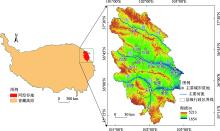
图1
河湟谷地地理位置示意图 注:底图采用自然资源部标准地图制作,审图号为GS(2020)4630号,对底图边界无修改。下同。"

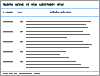
表1
河湟谷地地形因子的分级标准及面积占比"
| 分级 | 海拔范围/m,占比/% | 坡度范围/(°),占比/% | 坡向类型,占比/% | 地貌类型,占比/% |
|---|---|---|---|---|
| Ⅰ | [1654,2205],5.72 | [0.00,2.00],3.33 | 平面,0.09 | 平原,9.26 |
| Ⅱ | (2205,2503],11.24 | (2.00,6.00],10.92 | 北,12.10 | 阶地,1.04 |
| Ⅲ | (2503,2772],15.09 | (6.00,15.00],26.98 | 东北,13.00 | 台地,2.66 |
| Ⅳ | (2772,3029],15.12 | (15.00,25.00],30.03 | 东,13.69 | 丘陵,3.87 |
| Ⅴ | (3029,3281],14.43 | (25.00,76.60],28.74 | 东南,12.34 | 小起伏山地,16.66 |
| Ⅵ | (3281,3535],14.07 | 南,11.85 | 中起伏山地,39.88 | |
| Ⅶ | (3535,3810],12.13 | 西南,12.55 | 大起伏山地,26.64 | |
| Ⅷ | (3810,4144],8.58 | 西,12.56 | ||
| Ⅸ | (4144,5213],3.64 | 西北,11.82 |
表2
1980—2020年研究区各类土地利用类型的变化"
| 土地利用类型 | 1980年 | 1990年 | 2000年 | 2010年 | 2020年 |
|---|---|---|---|---|---|
| 耕地 | 5128.97 | 5135.79 | 5138.56 | 5061.43 | 5009.74 |
| 林地 | 7117.62 | 7118.23 | 7130.29 | 7127.87 | 7110.34 |
| 草地 | 19562.31 | 19497.71 | 19440.46 | 19968.39 | 19939.73 |
| 水域 | 354.14 | 346.50 | 367.33 | 390.16 | 413.74 |
| 建设用地 | 465.58 | 475.24 | 496.97 | 559.61 | 623.55 |
| 未利用地 | 2632.48 | 2687.65 | 2687.50 | 2153.64 | 2164.02 |
| 合计 | 35261.11 | 35261.11 | 35261.11 | 35261.11 | 35261.11 |
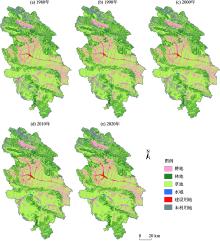
图2
研究期内土地利用的空间分布及变化"

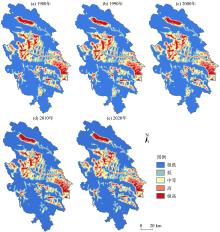
图3
研究区耕地不同核密度等级的空间变化"

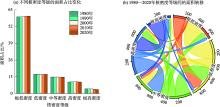
图4
河湟谷地不同耕地核密度等级的占比及变化(km2)"

表3
1980—2020年河湟谷地耕地与其他地类的转移情况"
| 时期 | 转移方式 | 林地 | 草地 | 水域 | 建设用地 | 未利用地 | 合计 |
|---|---|---|---|---|---|---|---|
| 1980—1990年 | 转出 | 0.01 | 0.12 | 0.09 | 6.59 | 0.00 | 6.81 |
| 转入 | 0.01 | 7.38 | 6.22 | 0.02 | 0.00 | 13.63 | |
| 1990—2000年 | 转出 | 0.04 | 0.22 | 11.55 | 20.65 | 0.88 | 33.34 |
| 转入 | 2.83 | 27.13 | 5.33 | 0.04 | 0.79 | 36.12 | |
| 2000—2010年 | 转出 | 4.94 | 120.33 | 19.03 | 60.67 | 0.27 | 205.24 |
| 转入 | 9.81 | 109.78 | 2.54 | 4.10 | 1.99 | 128.22 | |
| 2010—2020年 | 转出 | 8.89 | 58.24 | 7.14 | 65.71 | 0.49 | 140.47 |
| 转入 | 5.33 | 64.27 | 4.52 | 14.49 | 0.44 | 89.05 | |
| 1980—2020年 | 转出 | 12.44 | 162.40 | 34.92 | 151.07 | 1.55 | 362.38 |
| 转入 | 15.91 | 194.24 | 16.14 | 14.25 | 2.60 | 243.14 |
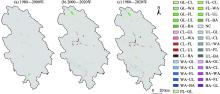
图5
研究期内河湟谷地耕地转移的空间分布 注:CL表示耕地;FL表示林地;GL表示草地;WA表示水域;BA表示建设用地;UL表示未利用地。NC表示未转变;CL-BA表示耕地转为建设用地;以此类推。"

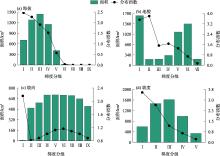
图6
研究区耕地的地形梯度分布"

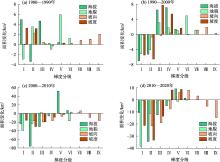
图7
研究期内耕地的地形梯度变化"

表4
耕地的标准差椭圆和重心参数变化"
| 年份 | 标准差椭圆 | 重心 | |||||
|---|---|---|---|---|---|---|---|
| 方位角/(°) | 长轴/km | 短轴/km | 扁率 | 经度 | 纬度 | ||
| 1980 | 148.662 | 86.361 | 46.291 | 1.866 | 102.028°E | 36.521°N | |
| 1990 | 148.733 | 86.409 | 46.382 | 1.863 | 102.028°E | 36.519°N | |
| 2000 | 148.691 | 86.417 | 46.514 | 1.858 | 102.028°E | 36.518°N | |
| 2010 | 147.638 | 86.959 | 45.911 | 1.894 | 102.023°E | 36.541°N | |
| 2020 | 147.771 | 87.367 | 45.998 | 1.899 | 102.024°E | 36.540°N | |
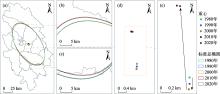
图8
耕地标准差椭圆和重心的变化"
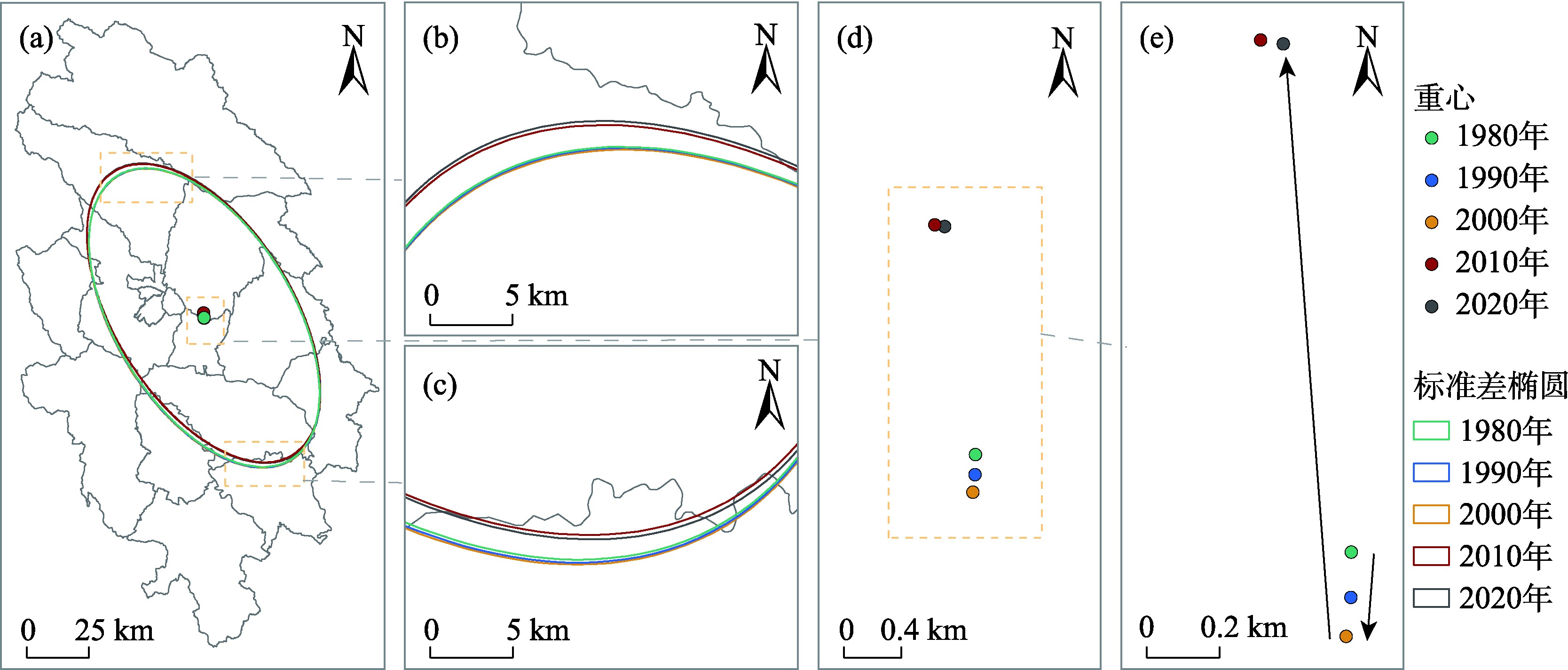
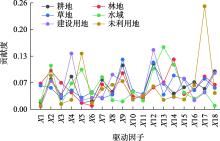
图9
驱动因子对各类土地利用面积变化的贡献度 注:X1表示坡向;X2表示海拔;X3表示年蒸发量;X4表示地均GDP;X5表示年均地温;X6表示≥10 ℃积温;X7表示NDVI;X8表示距居民点距离;X9表示距铁路距离;X10表示距河流距离;X11表示距公路距离;X12表示人口密度;X13表示年均降水;X14表示年均湿度;X15表示坡度;X16表示年日照时数;X17表示年均气温;X18表示年均风速。"

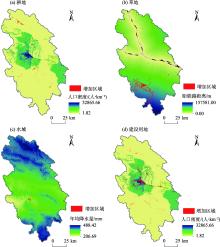
图10
土地利用类型的增加区域与其主导因子的叠加"

| [1] |
Ma L, Long H L, Tu S S, et al. Farmland transition in China and its policy implications[J]. Land Use Policy, 2020, 92: 104470.
doi: 10.1016/j.landusepol.2020.104470 |
| [2] |
Zhou Y, Li X H, Liu Y S. Cultivated land protection and rational use in China[J]. Land Use Policy, 2021, 106: 105454.
doi: 10.1016/j.landusepol.2021.105454 |
| [3] | 周建伟, 吴华, 赵鑫永, 等. 安宁河干旱河谷耕地地形梯度分异及其变化驱动因素[J]. 干旱地区农业研究, 2024, 42(4): 238-248. |
| [ Zhou Jianwei, Wu Hua, Zhao Xinyong, et al. Topographic gradient differentiation of cultivated land and driving factors of its change in the dry valley of Anning River[J]. Agricultural Research in the Arid Areas, 2024, 42(4): 238-248. ] | |
| [4] | 陈正发, 史东梅, 何伟, 等. 基于“要素-需求-调控”的云南坡耕地质量评价[J]. 农业工程学报, 2020, 36(12): 236-246. |
| [ Chen Zhengfang, Shi Dongmei, He Wei, et al. Quality evaluation of slope farmland in Yunnan Province based on “element-demand-regulation” framework[J]. Transactions of the Chinese Society of Agricultural Engineering, 2020, 36(12): 236-246. ] | |
| [5] | 陈睿山, 郭晓娜, 熊波, 等. 气候变化、土地退化和粮食安全问题: 关联机制与解决途径[J]. 生态学报, 2021, 41(7): 2918-2929. |
| [ Chen Ruishan, Guo Xiaona, Xiong Bo, et al. Climate change, land degradation, and food security: Linkages and potential solutions[J]. Acta Ecologica Sinica, 2021, 41(7): 2918-2929. ] | |
| [6] |
Liu J Y, Kuang W H, Zhang Z X, et al. Spatiotemporal characteristics, patterns, and causes of land-use changes in China since the late 1980s[J]. Journal of Geographical Sciences, 2014, 24(2): 195-210.
doi: 10.1007/s11442-014-1082-6 |
| [7] |
陈印军, 易小燕, 方琳娜, 等. 中国耕地资源与粮食增产潜力分析[J]. 中国农业科学, 2016, 49(6): 1117-1131.
doi: 10.3864/j.issn.0578-1752.2016.06.008 |
|
[ Chen Yinjun, Yi Xiaoyan, Fang Linna, et al. Analysis of cultivated land and grain production potential in China[J]. Scientia Agricultura Sinica, 2016, 49(6): 1117-1131. ]
doi: 10.3864/j.issn.0578-1752.2016.06.008 |
|
| [8] |
刘晶, 金晓斌, 徐伟义, 等. 1990—2020年中国耕地景观细碎化演变特征与趋势预判[J]. 地理学报, 2023, 78(9): 2163-2185.
doi: 10.11821/dlxb202309004 |
|
[ Liu Jing, Jin Xiaobin, Xu Weiyi, et al. Characteristic evolution and trend prediction of cultivated land landscape fragmentation in China from 1990 to 2020[J]. Acta Geographica Sinica, 2023, 78(9): 2163-2185. ]
doi: 10.11821/dlxb202309004 |
|
| [9] |
Long H L, Ge D Z, Zhang Y N, et al. Changing man-land interrelations in China’s farming area under urbanization and its implications for food security[J]. Journal of Environmental Management, 2018, 209: 440-451.
doi: 10.1016/j.jenvman.2017.12.047 |
| [10] | 万方, 邓清海, 刘莉, 等. 1990—2018年河湟谷地耕地的时空演变[J]. 水土保持通报, 2021, 41(3): 275-282. |
| [ Wan Fang, Deng Qinghai, Liu Li, et al. Spatiol and temporal evolution of cultivated land in the Hehuang Valley during 1990 to 2018[J]. Bulletin of Soil and Water Conservation, 2021, 41(3): 275-282. ] | |
| [11] | 李云路, 崔文刚, 陆清平, 等. 山区耕地破碎化时空演化分析——以贵州省为例[J]. 水土保持研究, 2022, 29(5): 301-309. |
| [ Li Yunlu, Cui Wengang, Lu Qingping, et al. Analysis on the spatiotemporal evolution of cultivated land fragmentation in mountainous areas—A case study of Guizhou Province[J]. Research of Soil and Water Conservation, 2022, 29(5): 301-309. ] | |
| [12] |
苏婉, 邱春霞, 赵镠. 西藏“一江两河”流域2000—2020年土地利用演变及多情景预测[J]. 测绘通报, 2024(6): 90-95.
doi: 10.13474/j.cnki.11-2246.2024.0616 |
|
[ Su Wan, Qiu Chunxia, Zhao Liu. Land use evolution and multi-scenario prediction of 2000-2020 “One River Two Rivers” basin in Xizang[J]. Bulletin of Surveying and Mapping, 2024(6): 90-95. ]
doi: 10.13474/j.cnki.11-2246.2024.0616 |
|
| [13] | 罗芳, 潘安, 陈忠升, 等. 四川省宜宾市1980—2018年耕地时空格局变化及其驱动因素[J]. 水土保持通报, 2021, 41(6): 336-344. |
| [ Luo Fang, Pan An, Chen Zhongsheng, et al. Spatiotemporal pattern change of cultivated land and its driving forces in Yibin City, Sichuan Province during 1980-2018[J]. Bulletin of Soil and Water Conservation, 2021, 41(6): 336-344. ] | |
| [14] | 金一诺, 王枫. 珠三角耕地利用转型的时空演化特征及其影响因素分析[J]. 水土保持研究, 2022, 29(4): 352-361. |
| [ Jin Yinuo, Wang Feng. Spatiotemporal evolution characteristics of cultivated land use transition and its influence factors in the Pearl River Delta[J]. Research of Soil and Water Conservation, 2022, 29(4): 352-361. ] | |
| [15] | 王千, 金晓斌, 周寅康, 等. 河北省耕地生态经济系统能值指标空间分布差异及其动因[J]. 生态学报, 2011, 31(1): 247-256. |
| [ Wang Qian, Jin Xiaobin, Zhou Yinkang, et al. Spatial differences and its driving factors of emergy indices on cultivated land eco-economic system in Hebei Province[J]. Acta Ecologica Sinica, 2011, 31(1): 247-256. ] | |
| [16] |
侯青青, 陈英, 裴婷婷, 等. 近25 a来甘肃省耕地资源时空变化及其影响因子[J]. 干旱区研究, 2022, 39(3): 955-967.
doi: 10.13866/j.azr.2022.03.29 |
|
[ Hou Qingqing, Chen Ying, Pei Tingting, et al. Analysis of cultivated land’s spatio-temporal changes and influencing factors in Gansu Province in recent 25 years[J]. Arid Zone Research, 2022, 39(3): 955-967. ]
doi: 10.13866/j.azr.2022.03.29 |
|
| [17] | 曹银贵, 袁春, 周伟, 等. 中国耕地变化的驱动因子及其省域差异分析[J]. 中国土地科学, 2008(2): 17-22. |
| [ Cao Yingui, Yuan Chun, Zhou Wei, et al. Analysis on driving forces and provincial differences of cultivated land change in China[J]. China Land Science, 2008(2): 17-22. ] | |
| [18] | 赵晓丽, 张增祥, 汪潇, 等. 中国近30 a耕地变化时空特征及其主要原因分析[J]. 农业工程学报, 2014, 30(3): 1-11. |
| [ Zhao Xiaoli, Zhang Zengxiang, Wang Xiao, et al. Analysis of Chinese cultivated land’s spatial-temporal changes and causes in recent 30 years[J]. Transactions of the Chinese Society of Agricultural Engineering, 2014, 30(3): 1-11. ] | |
| [19] |
Chen Q, Yang L E, Luo J, et al. The 300 years cropland changes reflecting climate impacts and social resilience at the Yellow River-Huangshui River Valley, China[J]. Environmental Research Letters, 2021, 16(6): 065006.
doi: 10.1088/1748-9326/abe82a |
| [20] |
罗静, 张镱锂, 刘峰贵, 等. 青藏高原东北部河湟谷地1726年耕地格局重建[J]. 地理研究, 2014, 33(7): 1285-1296.
doi: 10.11821/dlyj201407009 |
| [ Luo Jing, Zhang Yili, Liu Fenggui, et al. Reconstruction of cropland spatial patterns for 1726 on Yellow River-Huangshui River Valley in Northeast Qinghai-Xizang Plateau[J]. Geographical Research, 2014, 33(7): 1285-1296. ] | |
| [21] |
孙南沙, 陈琼, 刘峰贵, 等. 2000—2020年河湟谷地农业干旱研究[J]. 干旱区地理, 2023, 46(3): 437-447.
doi: 10.12118/j.issn.1000-6060.2022.367 |
|
[ Sun Nansha, Chen Qiong, Liu Fenggui, et al. Agricultural drought research in Yellow River-Huangshui River Valley from 2000 to 2020[J]. Arid Land Geography, 2023, 46(3): 437-447. ]
doi: 10.12118/j.issn.1000-6060.2022.367 |
|
| [22] |
郭蓉, 刘峰贵, 陈琼, 等. 北宋后期黄河上游地区耕地格局重建——以河湟谷地为例[J]. 自然资源学报, 2021, 36(1): 27-37.
doi: 10.31497/zrzyxb.20210102 |
|
[ Guo Rong, Liu Fenggui, Chen Qiong, et al. Reconstruction of cultivated land pattern in the upper reaches of the Yellow River in the late Northern Song Dynasty: Take Hehuang Valley as an example[J]. Journal of Natural Resources, 2021, 36(1): 27-37. ]
doi: 10.31497/zrzyxb.20210102 |
|
| [23] | 匡兵, 卢新海, 周敏. 中国城市土地经济密度的分布动态演进[J]. 中国土地科学, 2016, 30(10): 47-54. |
| [ Kuang Bin, Lu Xinhai, Zhou Min. Dynamic evolution of urban land economic density distribution in China[J]. China Land Science, 2016, 30(10): 47-54. ] | |
| [24] |
Qin Z L, Li W Y, Xiong X F. Estimating wind speed probability distribution using kernel density method[J]. Electric Power Systems Research, 2011, 81(12): 2139-2146.
doi: 10.1016/j.epsr.2011.08.009 |
| [25] |
张学斌, 罗君, 石培基, 等. 格网尺度下张掖生态系统服务价值时空演变及地形梯度分异特征[J]. 应用生态学报, 2020, 31(2): 543-553.
doi: 10.13287/j.1001-9332.202002.007 |
|
[ Zhang Xuebin, Luo Jun, Shi Peiji, et al. Spatial-temporal evolution pattern and terrain gradient differentiation of ecosystem service value in Zhangye, Northwest China at the grid scale[J]. Chinese Journal of Applied Ecology, 2020, 31(2): 543-553. ]
doi: 10.13287/j.1001-9332.202002.007 |
|
| [26] |
Zhou J W, Feng B, Wu H, et al. Spatio-temporal distribution characteristics and driving factors of forest land in the Da-Xiao Liangshan mountains based on topographic gradient[J]. Scientific Reports, 2025, 15: 7501.
doi: 10.1038/s41598-025-92129-y |
| [27] |
Qiu M L, Yuan C C, Yin G Y. Effect of terrain gradient on cadmium accumulation in soils[J]. Geoderma, 2020, 375: 114501.
doi: 10.1016/j.geoderma.2020.114501 |
| [28] | 陈利顶, 杨爽, 冯晓明. 土地利用变化的地形梯度特征与空间扩展——以北京市海淀区和延庆县为例[J]. 地理研究, 2008, 27(6): 1225-1234, 481. |
| [ Chen Liding, Yang Shuang, Feng Xiaoming. Topographic gradient characteristics and spatial expansion of land use change: A case study of Haidian District and Yanqing County in Beijing[J]. Geographical Research, 2008, 27(6): 1225-1234, 481. ] | |
| [29] | 郑准, 陈曦. 长江中游城市群城市创新潜力的分布动态与空间收敛性研究[J]. 长江流域资源与环境, 2024, 33(2): 271-284. |
| [ Zheng Zhun, Chen Xi. Study on the distribution dynamics and spatial convergence of urban innovation potential in the Yangtze River Middle Reaches Urban Agglomeration[J]. Resources and Environment in the Yangtze Basin, 2024, 33(2): 271-284. ] | |
| [30] |
Liang X, Guan Q F, Clarke K, et al. Understanding the drivers of sustainable land expansion using a patch-generating land use simulation (PLUS) model: A case study in Wuhan, China[J]. Computers, Environment and Urban Systems, 2021, 85: 101569.
doi: 10.1016/j.compenvurbsys.2020.101569 |
| [31] |
Yao Y, Liu X P, Li X, et al. Simulating urban land-use changes at a large scale by integrating dynamic land parcel subdivision and vector-based cellular automata[J]. International Journal of Geographical Information Science, 2017, 31(12): 2452-2479.
doi: 10.1080/13658816.2017.1360494 |
| [32] | 范昕. 黄河上游生态脆弱区土地利用/覆被变化及生态系统服务权衡与协同研究——以河湟谷地为例[D]. 武汉: 中国地质大学, 2022. |
| [ Fan Xin. Land use/Cover Change and the Tradeoff and Synergy of Ecosystem Services in Ecologically Fragile Regions of Upper Yellow River:A Case Study in Hehuang Valley[D]. Wuhan: China University of Geosciences, 2022. ] | |
| [33] | 林正雨, 何鹏, 李晓, 等. 基于耕地压力指数的四川省粮食安全状况研究[J]. 中国农业资源与区划, 2015, 36(7): 19-24. |
| [ Lin Zhengyu, He Peng, Li Xiao, et al. Food security of Sichuan Province based on cropland pressure index[J]. Chinese Journal of Agricultural Resources and Regional Planning, 2015, 36(7): 19-24. ] | |
| [34] |
张擂, 周煜明, 董杰谋, 等. 中国耕地非农化与非粮化时空分异及其治理策略[J]. 干旱区研究, 2025, 42(2): 372-383.
doi: 10.13866/j.azr.2025.02.16 |
|
[ Zhang Lei, Zhou Yuming, Dong Jiemou, et al. Spatiotemporal differentiation of nonagricultural and nongrain farmland in China and its management strategies[J]. Arid Zone Research, 2025, 42(2): 372-383. ]
doi: 10.13866/j.azr.2025.02.16 |
|
| [35] |
魏慧, 吕昌河, 尹旭. 青藏高原耕地的空间分异及其影响因素[J]. 地理科学, 2023, 43(3): 379-387.
doi: 10.13249/j.cnki.sgs.2023.03.001 |
| [ Wei Hui, Lyu Changhe, Yin Xu. Spatial differentiation of farmland and influencing factors on the Qinghai-Xizang Plateau[J]. Geographical Science, 2023, 43(3): 379-387. ] | |
| [36] | 方利, 姚敏, 于忠伟, 等. “三区三线”统筹划定中永久基本农田布局优化方法与实证[J]. 农业工程学报, 2022, 38(16): 42-50. |
| [ Fang Li, Yao Min, Yu Zhongwei, et al. Optimization method and empirical study on the layout of permanent basic farmland in the overall delimitation of “three land spaces and three control lines”[J]. Transactions of the Chinese Society of Agricultural Engineering, 2022, 38(16): 42-50. ] | |
| [37] |
易家林, 郭杰, 欧名豪, 等. 国土空间用途管制:制度变迁、目标导向与体系构建[J]. 自然资源学报, 2023, 38(6): 1415-1429.
doi: 10.31497/zrzyxb.20230603 |
|
[ Yi Jialin, Guo Jie, Ou Minghao, et al. Territorial space use regulation: Institutional change, goal orientation and system construction[J]. Journal of Natural Resources, 2023, 38(6): 1415-1429. ]
doi: 10.31497/zrzyxb.20230603 |
|
| [38] | 宦吉林, 王铁霖, 吴柏清. 岷江上游土地利用变化的地形梯度效应分析[J]. 人民长江, 2022, 53(7): 63-69. |
| [ Huan Jilin, Wang Tielin, Wu Baiqing. Terrain gradient effect analysis of land use change in upper reaches of Minjiang River[J]. Yangtze River, 2022, 53(7): 63-69. ] | |
| [39] | 周润芳, 孙建国, 张卓. 甘肃省榆中县地形对耕地分布影响[J]. 遥感信息, 2020, 35(4): 148-154. |
| [ Zhou Runfang, Sun Jianguo, Zhang Zhuo. Effeet of topography on cultivated land distribution in Yuzhong County of Gansu Province[J]. Remote Sensing Information, 2020, 35(4): 148-154. ] | |
| [40] |
Zhou J W, Feng B, Wu H, et al. Spatio-temporal evolution and topographic gradient effect of land use and ecosystem service value in the Lhasa River Basin[J]. Journal of Mountain Science, 2024, 21(6): 2059-2074.
doi: 10.1007/s11629-023-8570-z |
| [41] | 苟芳, 张立祯, 董宛麟, 等. 农牧交错带不同间套作模式的土地生产力[J]. 农业工程学报, 2013, 29(6): 129-141. |
| [ Gou Fang, Zhang Lizhen, Dong Wanlin, et al. Productivity of strip intercropping systems in agro-pastoral ecotone[J]. Transactions of the Chinese Society of Agricultural Engineering, 2013, 29(6): 129-141. ] | |
| [42] | 童菊儿, 严斌, 汪晖. 异地有偿补充耕地——土地发展权交易的浙江模式及政策启示[J]. 国际经济评论, 2012(2): 140-152, 8. |
| [ Tong Juer, Yan Bin, Wang Hui, et al. Land use right transfers— the Zhejiang model and its policy implications[J]. International Economic Review, 2012(2): 140-152, 8. ] |
| [1] | 张坤, 吴新萍, 刘永强, 张丽芳, 秦艳, 杨雨鹭, 淦惠. 基于PLUS-InVEST模型的新疆碳储量时空演变与预测[J]. 干旱区研究, 2025, 42(9): 1715-1725. |
| [2] | 刘小明, 郑世妍, 乔占明. 基于PLUS-InVEST模型的三江源土地利用变化动态模拟与生境质量[J]. 干旱区研究, 2025, 42(6): 1080-1092. |
| [3] | 邸彦峰, 段伟利, 周仪琪, 何超. 全球农作物虚拟水贸易可持续动态变化[J]. 干旱区研究, 2025, 42(6): 993-1003. |
| [4] | 刘玥, 郭强, 袁立敏, 党晓宏, 蒙仲举, 董菁. 三种植物基固沙剂对风沙土水分入渗和蒸发的影响[J]. 干旱区研究, 2025, 42(4): 658-667. |
| [5] | 巩小维, 周冬梅, 张军, 罗世玉, 陈建坤, 高雅娟. “三生空间”视角下庆阳市景观生态风险评价及耦合协调度[J]. 干旱区研究, 2025, 42(3): 556-567. |
| [6] | 张擂, 周煜明, 董杰谋, 李祥, 刘时栋, 徐丽萍. 中国耕地非农化与非粮化时空分异及其治理策略[J]. 干旱区研究, 2025, 42(2): 372-383. |
| [7] | 黄志溥, 王军德, 程玉菲, 周昊昊, 张展, 包志为, 杨传国. 疏勒河中下游生态脆弱区土地利用变化与未来生境质量评估[J]. 干旱区研究, 2025, 42(11): 2104-2116. |
| [8] | 吕宁, 国语, 彭琴, 尹飞虎, 张嘉淇, 刘杏认, 曾梅, 许子函. 新疆耕地利用碳源/汇效应时空演变特征及其贡献因子[J]. 干旱区研究, 2025, 42(1): 179-190. |
| [9] | 张文睿, 孙栋元, 王亦可, 杨俊, 兰立军, 靳虎甲, 徐裕. 河西走廊水资源-生态环境-社会经济系统耦合关系及时空分异[J]. 干旱区研究, 2024, 41(9): 1527-1537. |
| [10] | 吴思源, 郝利娜. 2001—2021年黄河流域植被覆盖变化及其驱动因素[J]. 干旱区研究, 2024, 41(8): 1373-1384. |
| [11] | 李冰洁, 范志韬, 曲芷程, 姚顺予, 宿夏姝, 刘东伟, 王立新. 基于InVEST-PLUS模型的黄河流域内蒙古段生态系统碳储量评价及预测[J]. 干旱区研究, 2024, 41(7): 1217-1227. |
| [12] | 张顺鑫, 吴子豪, 闫庆武, 李桂娥, 牟守国. 基于PLUS-InVEST模型的天山北坡生态系统碳储量时空变化与预测[J]. 干旱区研究, 2024, 41(7): 1228-1237. |
| [13] | 杨锁华, 李丽, 马江德, 郭文霞. “三生空间”视角下陕西省1990—2020年土地利用转型及梯度效应[J]. 干旱区研究, 2024, 41(7): 1249-1258. |
| [14] | 李沛尧, 王新军, 许世贤, 高胜寒, 薛智暄, 衡瑞. 基于PLUS土地利用模拟的阿克苏河流域NEP时空格局研究[J]. 干旱区研究, 2024, 41(6): 1059-1068. |
| [15] | 雷菲亚, 李小双, 陶冶, 尹本丰, 荣晓莹, 张静, 陆永兴, 郭星, 周晓兵, 张元明. 西北干旱区藓类结皮覆盖下土壤多功能性特征及影响因子[J]. 干旱区研究, 2024, 41(5): 812-820. |
|
||
