
干旱区研究 ›› 2025, Vol. 42 ›› Issue (4): 695-707.doi: 10.13866/j.azr.2025.04.11
王立媛( ), 张勇()
收稿日期:2024-11-12
修回日期:2025-02-13
出版日期:2025-04-15
发布日期:2025-04-10
通讯作者:
张勇. E-mail: happy5401260@126.com作者简介:王立媛(2001-),女,硕士研究生,主要从事土地利用相关研究. E-mail: wly0764@163.com
基金资助:
WANG Liyuan(), ZHANG Yong()
Received:2024-11-12
Revised:2025-02-13
Published:2025-04-15
Online:2025-04-10
摘要:
对兼具重要生态功能的欠发达地区土地利用转型态势进行探究,对于推动城乡融合、实现区域可持续发展具有重要意义。本文基于甘肃省2000—2020年5期土地利用数据,从时空维度分析土地利用类型数量分布、空间布局及相互转移情况,并采用FLUS模型,模拟了2035年惯性发展、城乡融合、规划约束和生态修复四种情景下土地利用转型情况。结果表明:(1) 2000—2020年,甘肃省土地利用类型以耕地、草地和未利用地为主,且不同地类在空间分布上呈现出显著的区域异质性;其综合土地利用动态度呈先上升后下降再上升的趋势。(2) 受到西部大开发战略的持续推进和退耕还林还草等政策的影响,甘肃省土地利用转型主要表现在耕地向草地、林地转移,以及建设用地向耕地、草地转移。(3) 在城乡融合和规划约束两种情景下,土地利用模拟结果较为合理,兼顾了耕地保护和区域生态环境修复,可满足未来发展需求,为甘肃省未来国土空间治理提供了参考。
王立媛, 张勇. 甘肃省土地利用转型时空格局演化及多情景模拟[J]. 干旱区研究, 2025, 42(4): 695-707.
WANG Liyuan, ZHANG Yong. Evolution of spatiotemporal patterns and multiscenario simulation of land use transition in Gansu Province[J]. Arid Zone Research, 2025, 42(4): 695-707.
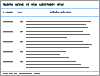
表1
数据来源"
| 数据类型 | 数据名称 | 数据精度 | 数据来源 |
|---|---|---|---|
| 土地利用数据 | 土地利用数据 | 30 m | 中国科学院资源环境科学与数据中心 ( |
| 限制因子 | 水域 | 1 km | |
| 自然保护区 | 1 km | ||
| 社会经济因素 | 人口密度 | 1 km | |
| GDP | 1 km | ||
| 自然环境因素 | 高程(DEM) | 30 m | 地理空间数据云( |
| 坡度 | 30 m | 根据DEM数据由ArcGIS生成 | |
| 坡向 | 30 m | ||
| 年降水量 | 1 km | 国家青藏高原科学数据中心 | |
| 年平均气温 | 1 km | ||
| 交通可达因素 | 到河流距离 | 1 km | 1:1000000全国基础地理数据库,由ArcGIS生成 |
| 到国道距离 | 1 km | ||
| 到省道距离 | 1 km | ||
| 到高速距离 | 1 km | ||
| 到铁路距离 | 1 km | ||
| 行政区划数据 | 甘肃省行政边界 | - | 地理空间数据云( |
表2
甘肃省土地利用类型面积变化"
| 土地利用 类型 | 2000年 | 2005年 | 2010年 | 2015年 | 2020年 | |||||||||
|---|---|---|---|---|---|---|---|---|---|---|---|---|---|---|
| 面积/km2 | 占比/% | 面积/km2 | 占比/% | 面积/km2 | 占比/% | 面积/km2 | 占比/% | 面积/km2 | 占比/% | |||||
| 耕地 | 65595 | 15.42 | 65509 | 15.39 | 65057 | 15.29 | 64888 | 15.25 | 63883 | 15.01 | ||||
| 林地 | 37636 | 8.84 | 38156 | 8.97 | 38530 | 9.05 | 38533 | 9.06 | 38517 | 9.05 | ||||
| 草地 | 142700 | 33.54 | 142923 | 33.59 | 143014 | 33.61 | 142952 | 33.59 | 143664 | 33.76 | ||||
| 水域 | 3304 | 0.78 | 3293 | 0.77 | 3545 | 0.83 | 3535 | 0.83 | 3841 | 0.90 | ||||
| 建设用地 | 3541 | 0.83 | 3770 | 0.89 | 4283 | 1.01 | 4745 | 1.12 | 5564 | 1.31 | ||||
| 未利用地 | 172744 | 40.60 | 171870 | 40.39 | 171092 | 40.21 | 170868 | 40.16 | 170031 | 39.96 | ||||
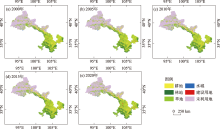
图1
2000—2020年甘肃省土地利用类型分布"

表3
甘肃省土地利用动态变化度"
| 土地利用类型 | 耕地 | 林地 | 草地 | 水域 | 建设用地 | 未利用地 | 综合动态度 |
|---|---|---|---|---|---|---|---|
| 2000—2005年 | -0.03 | 0.28 | 0.03 | -0.06 | 1.29 | -0.10 | 1.79 |
| 2005—2010年 | -0.14 | 0.20 | 0.01 | 1.53 | 2.73 | -0.09 | 4.69 |
| 2010—2015年 | -0.05 | 0.007 | -0.01 | -0.06 | 2.15 | -0.03 | 2.30 |
| 2015—2020年 | -0.31 | -0.01 | 0.10 | 1.73 | 3.46 | -0.10 | 5.70 |
表4
2000—2020年不同阶段甘肃省土地利用转移矩阵"
| 耕地 | 林地 | 草地 | 水域 | 建设用地 | 未利用地 | |
|---|---|---|---|---|---|---|
| 2000—2005年 | ||||||
| 耕地 | 63890.9 | 250.9 | 1208.1 | 10.8 | 171.5 | 61.1 |
| 林地 | 83.9 | 37399.5 | 147.3 | 1.7 | 13.2 | 8.3 |
| 草地 | 828.3 | 503.2 | 141155.3 | 13.2 | 29.8 | 135.5 |
| 水域 | 14.0 | 1.3 | 29.4 | 3220.7 | 1.9 | 35.6 |
| 建设用地 | 12.0 | 1.4 | 6.8 | 0.6 | 3547.7 | 0.6 |
| 未利用地 | 677.1 | 18.2 | 339.9 | 45.2 | 33.5 | 171622.8 |
| 2005—2010年 | ||||||
| 耕地 | 62075.8 | 305.5 | 2343.0 | 36.4 | 512.6 | 232.5 |
| 林地 | 176.5 | 37613.1 | 268.7 | 22.9 | 18.1 | 74.8 |
| 草地 | 1753.7 | 545.8 | 138923.2 | 63.9 | 112.0 | 1486.5 |
| 水域 | 42.2 | 6.6 | 35.5 | 3100.1 | 6.8 | 100.8 |
| 建设用地 | 221.3 | 8.3 | 26.0 | 1.5 | 3517.2 | 23.1 |
| 未利用地 | 785.4 | 69.2 | 1377.9 | 318.7 | 145.2 | 169165.4 |
| 2010—2015年 | ||||||
| 耕地 | 63944.2 | 60.0 | 678.3 | 24.6 | 287.7 | 59.5 |
| 林地 | 60.7 | 38238.7 | 222.1 | 4.4 | 6.3 | 15.5 |
| 草地 | 627.5 | 213.7 | 141814.9 | 28.5 | 61.7 | 227.5 |
| 水域 | 12.1 | 2.1 | 18.7 | 3389.0 | 2.7 | 118.5 |
| 建设用地 | 40.0 | 2.0 | 12.2 | 0.9 | 4254.7 | 2.1 |
| 未利用地 | 202.8 | 15.9 | 203.5 | 86.7 | 131.7 | 170441.7 |
| 2015—2020年 | ||||||
| 耕地 | 61238.6 | 199.9 | 2362.3 | 54.7 | 558.9 | 468.1 |
| 林地 | 139.3 | 37711.9 | 576.2 | 13.7 | 44.9 | 40.9 |
| 草地 | 1716.1 | 489.7 | 139259.5 | 66.8 | 296.5 | 1098.8 |
| 水域 | 38.1 | 11.1 | 58.9 | 3313.5 | 17.0 | 92.0 |
| 建设用地 | 270.2 | 14.5 | 104.3 | 8.0 | 4252.3 | 95.4 |
| 未利用地 | 477.8 | 84.5 | 1291.0 | 381.0 | 394.8 | 168223.2 |
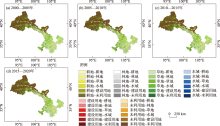
图2
2000—2020年甘肃省土地利用转换格局"


图3
2020年土地利用实际情况与模拟结果对比"

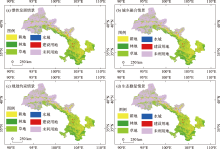
图4
甘肃省2035年土地利用多情景模拟结果"

| [1] |
龙花楼. 论土地利用转型与乡村转型发展[J]. 地理科学进展, 2012, 31(2): 131-138.
doi: 10.11820/dlkxjz.2012.02.001 |
|
[Long Hualou. Land use transition and rural transformation development[J]. Progress in Geography, 2012, 31(2): 131-138.]
doi: 10.11820/dlkxjz.2012.02.001 |
|
| [2] | Li X Y, Wang L Z, Pijanowski B, et al. The spatio-temporal pattern and transition mode of recessive cultivated land use morphology in the huaibei region of the Jiangsu Province[J]. Land, 2022, 11(11): 1978. |
| [3] | 孙善良, 张小平. 陕西省土地利用转型时空演变及其生态环境效应分析[J]. 水土保持研究, 2021, 28(6): 356-363, 370. |
| [Sun Shanliang, Zhang Xiaoping. Analysis on the spatiotemporal evolution of land use transformation and its ecological environment effect in Shaanxi Province[J]. Research of Soil and Water Conservation, 2021, 28(6): 356-363, 370.] | |
| [4] | Wang Z L, Ye H, Zhang L Y. Understanding the characteristics and mechanism of land use transition in mountainous economic zone: A case study of the Chengdu-Chongqing region in southwestern China[J]. Frontiers in Environmental Science, 2022, 10: 963197. |
| [5] | Long H, Zhang Y, Ma L, et al. Land use transitions: Progress, challenges and prospects[J]. Land, 2021, 10(9): 903. |
| [6] | Lambin E, Meyfroidt P. Land use transitions: Socio-ecological feedback versus socio-economic change[J]. Land Use Policy, 2010, 27(2): 108-118. |
| [7] | Turner B, Lambin E, Reenberg A. Land change science special feature: The emergence of land change science for global environmental change and sustainability[J]. Proceedings of the National Academy of Sciences of the United States of America, 2007, 105(7): 2751. |
| [8] |
Long H, Qu Y, Tu S, et al. Development of land use transitions research in China[J]. Journal of Geographical Sciences, 2020, 30(7): 1195-1214.
doi: 10.1007/s11442-020-1777-9 |
| [9] |
范清瑶, 夏卫生, 莫成鑫, 等. 基于“三生空间”的土地利用转型时空演变及其碳排放效应研究——以福建省为例[J]. 生态环境学报, 2023, 32(12): 2183-2193.
doi: 10.16258/j.cnki.1674-5906.2023.12.010 |
| [Fan Qingyao, Xia Weisheng, Mo Chengxin, et al. Study on transition of land use function and its carbon emission effect repose based on the conception of “production, living and ecological space”: A case study of Fujian Province[J]. Ecology and Environmental Sciences, 2023, 32(12): 2183-2193.] | |
| [10] | Wang M, Qin K, Jia Y, et al. Land use transition and eco-environmental effects in Karst Mountain Area based on production-living-ecological space: A case study of Longlin Multinational Autonomous County, Southwest China[J]. International Journal of Environmental Research and Public Health, 2022, 19(13): 7587. |
| [11] |
张梦圆, 荣丽华, 李伊彤, 等. 基于“三生”空间的农牧交错区城市土地利用转型及生态环境效应分析——以包头市为例[J]. 干旱区地理, 2023, 46(6): 958-967.
doi: 10.12118/j.issn.1000-6060.2022.328 |
|
[Zhang Mengyuan, Rong Lihua, Li Yitong, et al. Land use function transformation in the agro-pastoral ecotone based on ecological-production-living spaces and associated ecoenvironment effects: A case of Baotou City[J]. Arid Land Geography, 2023, 46(6): 958-967.]
doi: 10.12118/j.issn.1000-6060.2022.328 |
|
| [12] | 董冬, 罗毅, 顾康康. “三生空间”视角下长三角城市群土地利用转型生态环境效应时空分异及驱动力[J]. 长江流域资源与环境, 2023, 32(8): 1664-1676. |
| [Dong Dong, Luo Yi, Gu Kangkang. Spatio-temporal differentiation and driving forces of eco-environ-mental effects of land use transformation in Yangtze River Delta Economic Zone: A perspective of “production-living-ecological” spaces[J]. Resources and Environment in the Yangtze Basin, 2023, 32(8): 1664-1676.] | |
| [13] | 张超正, 陈丹玲, 靳亚亚, 等. 基于经济社会发展阶段转型的土地利用变化驱动因素识别——以长江中游地区为例[J]. 长江流域资源与环境, 2023, 32(12): 2528-2541. |
| [Zhang Chaozheng, Chen Danling, Jin Yaya, et al. Identification of driving forces of land use change based on transition of economic-social development stage: Evidence from middle reaches of Yangtze River[J]. Resources and Environment in the Yangtze Basin, 2023, 32(12): 2528-2541.] | |
| [14] | 刘宝涛. 长三角城市群建设用地转型时空分异及驱动因子识别[J]. 南通大学学报(社会科学版), 2023, 39(3): 43-56. |
| [Liu Baotao. Spatio-temporal differentiation and driving factors identification of construction land transformation in Yangtze River Delta Urban Agglomeration[J]. Journal of Nantong University(Social Sciences Edition), 2023, 39(3): 43-56.] | |
| [15] | 瞿诗进, 李全峰, 胡守庚. 突变视角下城镇建设用地形态演变与转型分区——以长江中游地区为例[J]. 地理与地理信息科学, 2023, 39(1): 38-46. |
| [Qu Shijin, Li Quanfeng, Hu Shougeng. Morphology evolution and transition zones of urban construction land use from the perspective of abrupt changes: A case study in the middle reaches of the Yangtze River[J]. Geography and Geo-Information Science, 2023, 39(1): 38-46.] | |
| [16] | 马丽君, 程久苗, 程建, 等. 土地利用隐性转型影响因素分析[J]. 中国土地科学, 2019, 33(7): 81-90. |
| [Ma Lijun, Cheng Jiumiao, Cheng Jian, et al. Analysis of the influencing factors for recessive transformation of land use[J]. China Land Science, 2019, 33(7): 81-90.] | |
| [17] | 宋家鹏, 陈松林. 福建省土地利用隐性形态与土地生态安全耦合协调分析[J]. 水土保持研究, 2020, 27(4): 301-307. |
| [Song Jiapeng, Chen Songlin. Coupling relationship and coordination between recessive land use morphology and land eco-security in Fujian Province[J]. Research of Soil and Water Conservation, 2020, 27(4): 301-307.] | |
| [18] | 冯新惠, 李艳, 余迩, 等. 环太湖城市群土地利用转型及其生态环境效应[J]. 长江流域资源与环境, 2023, 32(6): 1238-1253. |
| [Feng Xinhui, Li Yan, Yu Er, et al. Land use transition and associated eco-environmental effects in the Taihu Lake City Cluster[J]. Resources and Environment in the Yangtze Basin, 2023, 32(6): 1238-1253.] | |
| [19] | 汤江龙, 朱健计, 王林燕, 等. 贵溪市土地利用转型对生态系统服务价值影响的多情景模拟[J]. 环境科学与技术, 2022, 45(6): 212-223. |
| [Tang Jianglong, Zhu Jianji, Wang Linyan, et al. Multi-scenario simulation of impact of landuse transition on ecosystem service value in Guixi City[J]. Environmental Science & Technology, 2022, 45(6): 212-223.] | |
| [20] | 龚亚男, 韩书成, 时晓标, 等. 广东省“三生空间”用地转型的时空演变及其生态环境效应[J]. 水土保持研究, 2020, 27(3): 203-209. |
| [Gong Yanan, Han Shucheng, Shi Xiaobiao, et al. Temporal and spatial evolution and associated eco-environment effects of the land use transformation of ecological-production-living spaces in Guangdong Province[J]. Research of Soil and Water Conservation, 2020, 27(3): 203-209.] | |
| [21] | 田俊峰, 王彬燕, 王士君. 东北地区土地利用转型特征测度与机制探索[J]. 经济地理, 2020, 40(9): 184-195. |
| [Tian Junfeng, Wang Binyan, Wang Shijun. Land use transition in Northeast China: Features measurement and mechanism exploration[J]. Economic Geography, 2020, 40(9): 184-195.] | |
| [22] | Jessica P, Slobodan D, Albert S. Using public participation within land use change scenarios for analysing environmental and socioeconomic drivers[J]. Environmental Research Letters, 2022, 17: 025002. |
| [23] | Liu X, Liang X, Li X, et al. A future land use simulation model (FLUS) for simulating multiple land use scenarios by coupling human and natural effects[J]. Landscape and Urban Planning, 2017, 168: 94-116. |
| [24] |
刘强, 杨众养, 陈毅青, 等. 基于CA-Markov多情景模拟的海南岛土地利用变化及其生态环境效应[J]. 生态环境学报, 2021, 30(7): 1522-1531.
doi: 10.16258/j.cnki.1674-5906.2021.07.021 |
| [Liu Qiang, Yang Zhongyang, Chen Yiqing, et al. Multi-scenario simulation of land use change and its eco-environmental effect in Hainan Island based on CA-Markov model[J]. Ecology and Environmental Sciences, 2021, 30(7): 1522-1531.] | |
| [25] |
张晓荣, 李爱农, 南希, 等. 基于FLUS模型和SD模型耦合的中巴经济走廊土地利用变化多情景模拟[J]. 地球信息科学学报, 2020, 22(12): 2393-2409.
doi: 10.12082/dqxxkx.2020.190618 |
| [Zhang Xiaorong, Li Ainong, Nan Xi, et al. Multi-scenario simulation of land use change along China-Pakistan economic corridor through coupling FLUS model with SD model[J]. Journal of Geo-information Science, 2020, 22(12): 2393-2409.] | |
| [26] |
王端睿, 毛德华, 王宗明, 等. 东北地区土地覆被格局变化模拟: 基于CLUE-S和Markov-CA模型的对比分析[J]. 地理科学, 2024, 44(2): 329-339.
doi: 10.13249/j.cnki.sgs.20221043 |
|
[Wang Duanrui, Mao Dehua, Wang Zongming, et al. Simulation of land cover pattern change in Northeast China: A comparativeanalysis based on CLUE-S and Markov-CA models[J]. Scientia Geographica Sinica, 2024, 44(2): 329-339.]
doi: 10.13249/j.cnki.sgs.20221043 |
|
| [27] | 常铭鑫, 曾晨, 解鹏, 等. 多情景下的土地利用模拟与特征分析: 以武汉市为例[J]. 华中农业大学学报, 2023, 42(4): 74-85. |
| [Chang Mingxin, Zeng Chen, Xie Peng, et al. Land use simulation and characteristic analysis in multiple scenarios: A case study in Wuhan[J]. Journal of Huazhong Agricultural University, 2023, 42(4): 74-85.] | |
| [28] |
张潇, 谷人旭. 土地利用冲突的时空格局刻画与多情景模拟研究——以长江三角洲城市群为例[J]. 地理研究, 2022, 41(5): 1311-1326.
doi: 10.11821/dlyj020210375 |
| [Zhang Xiao, Gu Renxu. Spatio-temporal pattern and multi-scenario simulation of land use conflict: A case study of the Yangtze River Delta urban agglomeration[J]. Geographical Research, 2022, 41(5): 1311-1326.] | |
| [29] | 杜文星, 赵志忠, 吕晓, 等. 城乡土地利用转型研究进展及展望[J]. 土壤通报, 2021, 52(2): 493-504. |
| [Du Wenxing, Zhao Zhizhong, Lyu Xiao, et al. A review on urban-rural land use transition in China[J]. Chinese Journal of Soil Science, 2021, 52(2): 493-504.] | |
| [30] | 商梦雅, 李江. 农村宅基地制度对农户主观获得感、幸福感、安全感的影响[J]. 西北农林科技大学学报(社会科学版), 2022, 22(4): 60-71. |
| [Shang Mengya, Li Jiang. Effect of rural residential land system on farmers’ subjective sense of gain, happiness and security[J]. Journal of Northwest A & F University (Social Science Edition), 2022, 22(4): 60-71.] | |
| [31] |
魏乐, 周亮, 孙东琪, 等. 黄河流域城市群扩张的时空格局演化及情景模拟——以呼包鄂榆城市群为例[J]. 地理研究, 2022, 41(6): 1610-1622.
doi: 10.11821/dlyj020210566 |
| [Wei Le, Zhou Liang, Sun Dongqi, et al. The evolution of spatio-temporal pattern and scenario simulation of urban agglomeration expansion in the Yellow River Basin: A case study in the Hohhot-Baotou-Ordos-Yulin Urban Agglomeration[J]. Geographical Research, 2022, 41(6): 1610-1622.] | |
| [32] |
张恩月, 郑君焱, 苏迎庆, 等. 基于情景模拟的流域低碳土地利用格局优化研究——以汾河流域为例[J]. 干旱区研究, 2023, 40(2): 203-212.
doi: 10.13866/j.azr.2023.02.05 |
|
[Zhang Enyue, Zheng Junyan, Su Yingqing, et al. Optimization of low-carbon land use pattern based on scenario simulation: A case study of Fenhe River Basin[J]. Arid Zone Research, 2023, 40(2): 203-212.]
doi: 10.13866/j.azr.2023.02.05 |
|
| [33] |
金梦婷, 徐丽萍, 徐权. 基于FLUS-Markov模型的多情景景观生态风险评价与预测——以南疆克州为例[J]. 干旱区研究, 2021, 38(6): 1793-1804.
doi: 10.13866/j.azr.2021.06.31 |
|
[Jin Mengting, Xu Liping, Xu Quan. FLUS-Markov model-based multiscenario evaluation and prediction of the landscape ecological risk in Kezhou, South Xinjiang[J]. Arid Zone Research, 2021, 38(6): 1793-1804.]
doi: 10.13866/j.azr.2021.06.31 |
|
| [34] |
刘小琼, 何鹏飞, 韩继财, 等. 长江经济带生态安全格局演化及多情景模拟预测[J]. 经济地理, 2023, 43(12): 192-203.
doi: 10.15957/j.cnki.jjdl.2023.12.019 |
|
[Liu Xiaoqiong, He Pengfei, Han Jicai, et al. Evolution of ecological security pattern of Yangtze River Economic Belt and its multi-scenario simulation[J]. Economic Geography, 2023, 43(12): 192-203.]
doi: 10.15957/j.cnki.jjdl.2023.12.019 |
|
| [35] |
苏泽琛, 邵战林. 干旱区土地利用变化对耕地空间的影响及预测——以昌吉市为例[J]. 干旱区研究, 2024, 41(11): 1936-1945.
doi: 10.13866/j.azr.2024.11.13 |
|
[Su Zechen, Shao Zhanlin. Influence and prediction of land use change on the space of arable land in arid zones: Taking Changji City as an example[J]. Arid Zone Research, 2024, 41(11): 1936-1945.]
doi: 10.13866/j.azr.2024.11.13 |
| [1] | 张艳, 杨维新, 吕韬. 基于GeoDetector-MCCA的土地利用变化驱动因素分析与多情景模拟——以黄河流域甘肃段为例[J]. 干旱区研究, 2025, 42(4): 668-681. |
| [2] | 李常亮, 雒天峰, 康燕霞. 甘肃省内陆河流域水资源承载能力[J]. 干旱区研究, 2025, 42(1): 63-71. |
| [3] | 杨锁华, 李丽, 马江德, 郭文霞. “三生空间”视角下陕西省1990—2020年土地利用转型及梯度效应[J]. 干旱区研究, 2024, 41(7): 1249-1258. |
| [4] | 李若楠, 李均力, 李爽爽, 刘帅琪, 都伟冰. 基于Sentinel-2的依连哈比尔尕冰川变化监测[J]. 干旱区研究, 2024, 41(6): 940-950. |
| [5] | 唐维春, 刘小娥, 苏世平, 田晓娟, 唐庆童, 张婧. 甘肃兴隆山不同演替阶段群落土壤氮素矿化对温度的响应[J]. 干旱区研究, 2024, 41(6): 984-997. |
| [6] | 李文秀, 燕振刚. 基于地理探测器的甘肃农牧交错带土地利用时空演化及其驱动机制[J]. 干旱区研究, 2024, 41(4): 590-602. |
| [7] | 包佳玉, 李祥龙, 胡启文, 李涛. 新疆能源消费碳排放时空特征及能源结构调整路径探讨[J]. 干旱区研究, 2024, 41(3): 490-498. |
| [8] | 杨斐, 张文韬, 张飞民, 王澄海. 1961—2022年祁连山气候特征及其变化[J]. 干旱区研究, 2024, 41(10): 1627-1638. |
| [9] | 戴文渊, 玛久草, 陈亦晨, 郑志祥, 张芮, 张江科. 黄河流域甘肃段水生态安全驱动力分析及动态演变[J]. 干旱区研究, 2024, 41(10): 1662-1671. |
| [10] | 周子涵, 王基鑫, 刘维成, 王勇, 张君霞, 郭润霞. 甘肃省暖季降水日变化特征[J]. 干旱区研究, 2024, 41(1): 1-12. |
| [11] | 王基鑫, 黎倩, 栗晗, 张君霞, 刘新雨. WQSRTP方法在甘肃省高低温客观预报中的应用[J]. 干旱区研究, 2023, 40(7): 1052-1064. |
| [12] | 赵玉娟, 路亚奇, 张洪芬, 张可心, 周忠文, 刘英. 基于模糊数学的甘肃河东地区短时暴雨的大气环境参数综合评价研究[J]. 干旱区研究, 2023, 40(4): 543-551. |
| [13] | 胡亚男, 裴浩, 姜艳丰, 苗百岭, 贾成朕. 1991—2021年内蒙古降水酸碱度时空变化特征分析[J]. 干旱区研究, 2023, 40(4): 552-562. |
| [14] | 王娟, 王钊, 郭斌, 何慧娟, 董金芳. 陕西黄河流域植被碳利用率时空特征及对气候的敏感性研究[J]. 干旱区研究, 2023, 40(12): 1959-1968. |
| [15] | 邬晓丹,罗敏,孟凡浩,萨楚拉,尹超华,包玉海. 气候暖湿化背景下新疆极端气候事件时空演变特征分析[J]. 干旱区研究, 2022, 39(6): 1695-1705. |
|
||
