
Arid Zone Research ›› 2025, Vol. 42 ›› Issue (1): 154-165.doi: 10.13866/j.azr.2025.01.14
• Ecology and Environment • Previous Articles Next Articles
ZHANG Ying1( ), ZHAO Yuanyuan1(), LIU Rulong1, WANG Yue, DING Guodong1
Received:2024-07-14
Revised:2024-09-18
Online:2025-01-15
Published:2025-01-17
Contact:
ZHAO Yuanyuan
E-mail:2770981924@qq.com;yuanyuan0402@bjfu.edu.cn
ZHANG Ying, ZHAO Yuanyuan, LIU Rulong, WANG Yue, DING Guodong. Spatiotemporal evolution and scenario simulation of habitat quality in the agro-pastoral ecotone of northern China[J].Arid Zone Research, 2025, 42(1): 154-165.
Add to citation manager EndNote|Reference Manager|ProCite|BibTeX|RefWorks
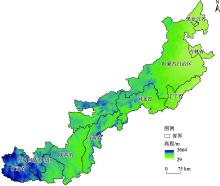
Fig. 1
Location of the study area"

Tab. 1
Impact range and weight of habitat constraint factors"
| 威胁源 | 权重 | 最大影响距离/km | 衰退类型 |
|---|---|---|---|
| 耕地 | 0.21 | 2 | 线性衰退 |
| 城乡居民点 | 0.32 | 5 | 指数衰退 |
| 未利用地 | 0.32 | 10 | 线性衰退 |
Tab. 2
Habitat suitability and relative sensitivity under different threat factors"
| 土地利用类型 | 生境适宜度 | 敏感度 | ||
|---|---|---|---|---|
| 耕地 | 城乡居民点 | 未利用地 | ||
| 耕地 | 0.5 | 0.3 | 0.4 | 0.3 |
| 林地 | 0.9 | 0.6 | 0.8 | 0.8 |
| 草地 | 0.5 | 0.5 | 0.55 | 0.6 |
| 水域 | 0.8 | 0.7 | 0.8 | 0.9 |
| 城乡居民点 | 0 | 0 | 0 | 5 |
| 未利用地 | 0 | 0 | 0 | 0 |
Tab. 3
Restricted transfer matrix setting for the various land-use types under the four scenarios"
| 类型 | 趋势发展 | 经济发展 | |||||||||||
|---|---|---|---|---|---|---|---|---|---|---|---|---|---|
| 耕地 | 林地 | 草地 | 水域 | 建设用地 | 未利用地 | 耕地 | 林地 | 草地 | 水域 | 建设用地 | 未利用地 | ||
| 耕地 | 1 | 0 | 1 | 0 | 1 | 1 | 1 | 0 | 1 | 0 | 1 | 1 | |
| 林地 | 0 | 1 | 1 | 0 | 1 | 1 | 1 | 1 | 1 | 0 | 0 | 0 | |
| 草地 | 1 | 1 | 1 | 1 | 1 | 1 | 1 | 1 | 1 | 1 | 1 | 1 | |
| 水域 | 0 | 1 | 1 | 1 | 1 | 1 | 1 | 0 | 1 | 1 | 0 | 1 | |
| 建设用地 | 1 | 0 | 1 | 0 | 1 | 1 | 0 | 0 | 0 | 0 | 1 | 0 | |
| 未利用地 | 1 | 1 | 1 | 0 | 1 | 1 | 1 | 1 | 1 | 0 | 1 | 1 | |
| 类型 | 耕地保护 | 生态保护 | |||||||||||
| 耕地 | 林地 | 草地 | 水域 | 建设用地 | 未利用地 | 耕地 | 林地 | 草地 | 水域 | 建设用地 | 未利用地 | ||
| 耕地 | 1 | 0 | 0 | 0 | 0 | 0 | 1 | 0 | 0 | 0 | 0 | 0 | |
| 林地 | 1 | 1 | 1 | 0 | 0 | 1 | 0 | 1 | 0 | 0 | 0 | 0 | |
| 草地 | 1 | 1 | 1 | 0 | 1 | 1 | 0 | 1 | 1 | 1 | 0 | 0 | |
| 水域 | 1 | 0 | 0 | 1 | 0 | 1 | 0 | 0 | 0 | 1 | 0 | 0 | |
| 建设用地 | 0 | 0 | 0 | 0 | 1 | 0 | 0 | 0 | 0 | 0 | 1 | 0 | |
| 未利用地 | 1 | 1 | 1 | 1 | 1 | 1 | 1 | 1 | 1 | 1 | 1 | 1 | |
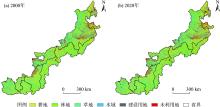
Fig. 2
Land use distribution of the agro-pastoral ecotone of northern China in 2000 and 2020"

Tab. 4
Land use change matrix in the agro-pastoral ecotone of northern China from 2000 to 2020 /km2"
| 2000年 | 2020年 | |||||
|---|---|---|---|---|---|---|
| 耕地 | 林地 | 草地 | 水域 | 建设用地 | 未利用地 | |
| 耕地 | 206085 | 6804 | 16922 | 810 | 5610 | 871 |
| 林地 | 3359 | 99784 | 4880 | 175 | 722 | 186 |
| 草地 | 13991 | 9789 | 263569 | 445 | 2874 | 2354 |
| 水域 | 852 | 178 | 340 | 9226 | 152 | 1185 |
| 建设用地 | 1226 | 170 | 323 | 37 | 11859 | 46 |
| 未利用地 | 1436 | 273 | 2873 | 288 | 537 | 35977 |
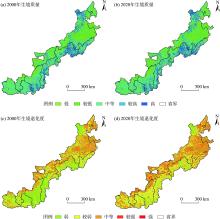
Fig. 3
The spatial-temporal development of habitat quality and degradation in the agro-pastoral ecotone of northern China from 2000 to 2020"

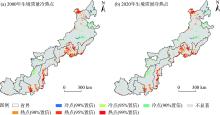
Fig. 4
The critical areas of habitat quality in the agro-pastoral ecotone of northern China from 2000 to 2020"

Tab. 5
The land use areas under different scenarios in 2020 and 2040 in the agro-pastoral ecotone of northern China /km2"
| 土地利用类型 | 2020年 | 2040年 | |||
|---|---|---|---|---|---|
| 趋势发展 | 生态保护 | 经济发展 | 耕地保护 | ||
| 耕地 | 226956 | 223700 | 227286 | 223700 | 227146 |
| 林地 | 117012 | 100628 | 119175 | 104986 | 101452 |
| 草地 | 288918 | 306667 | 288756 | 306665 | 306665 |
| 水域 | 10983 | 10578 | 10985 | 10886 | 10968 |
| 建设用地 | 21756 | 26424 | 21791 | 21756 | 21761 |
| 未利用地 | 40619 | 38247 | 38251 | 38251 | 38252 |
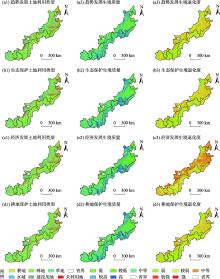
Fig. 5
Simulation results of land use, habitat quality and degradation in the agro-pastoral ecotone of northern China in 2040"

Tab. 6
Different levels of habitat quality under different scenarios in 2040 and 2020 in the agro-pastoral ecotone of northern China /km2"
| 生境质量 | 2020年 | 2040年 | |||
|---|---|---|---|---|---|
| 趋势发展 | 生态保护 | 经济发展 | 耕地保护 | ||
| 低 | 62375 | 64671 | 60042 | 60007 | 60013 |
| 较低 | 144609 | 105034 | 107312 | 145490 | 107416 |
| 中等 | 380003 | 438444 | 423420 | 392848 | 439357 |
| 较高 | 24608 | 25162 | 27122 | 22523 | 23719 |
| 高 | 94649 | 72933 | 88348 | 85376 | 75739 |
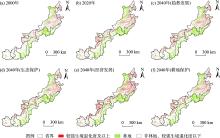
Fig. 6
Depicts significant habitat deterioration and forest spread the ecotone zone in northern China"

| [1] | 赵哈林, 周瑞莲, 张铜会, 等. 我国北方农牧交错带的草地植被类型、特征及其生态问题[J]. 中国草地, 2003, 25(3): 2-9. |
| [Zhao Halin, Zhou Ruilian, Zhang Tonghui, et al. Grassland vegetation types characteristics and ecological problems in the agriculture-pastoral ecotone in northern China[J]. Grassland in China, 2003, 25(3): 2-9. ] | |
| [2] | 苏志珠, 马义娟, 刘梅. 中国北方农牧交错带形成之探讨[J]. 山西大学学报(自然科学版), 2003, 26(3): 269-273. |
| [Su Zhizhu, Ma Yijuan, Liu Mei. Study on the formation of transitional belt between agriculture and animal husbandry in northern China[J]. Journal of Shanxi University (Natural Science Edition), 2003, 26(3): 269-273. ] | |
| [3] | 崔潇, 王永生, 施琳娜. 北方农牧交错带人地系统耦合协调的时空特征及障碍因子[J]. 农业资源与环境学报, 2023, 40(1): 206-217. |
| [Cui Xiao, Wang Yongsheng, Shi Linna. Spatio-temporal characteristics and obstacle factors of human-land system coupling coordination in farming pastoral ecotone of northern China[J]. Journal of Agricultural Resources and Environment, 2023, 40(1): 206-217. ] | |
| [4] |
任涵, 张静静, 朱文博, 等. 太行山淇河流域土地利用变化对生境的影响[J]. 地理科学进展, 2018, 37(12): 1693-1704.
doi: 10.18306/dlkxjz.2018.12.011 |
| [Ren Han, Zhang Jingjing, Zhu Wenbo, et al. Impact of land use change on habitat in the Qihe River Basin of Taihang Mountains[J]. Advances in Geography Science, 2018, 37(12): 1693-1704. ] | |
| [5] | Ray T C, Dickson G B, Sisk D T, et al. Spatial application of a predictive wildlife occurrence model to assess alternative forest management scenarios in northern Arizona[J]. Forest Ecology and Management, 2014, 322(39): 117-126. ] |
| [6] | 吴健生, 曹祺文, 石淑芹, 等. 基于土地利用变化的京津冀生境质量时空演变[J]. 应用生态学报, 2015, 26(11): 3457-3466. |
|
[Wu Jiansheng, Cao Qiwen, Shi Shuqin, et al. Spatio-temporal variability of habitat quality in Beijing-Tianjin-Hebei Area based on land use change[J] Chinese Journal of Applied Ecology, 2015, 26(11): 3457-3466. ]
pmid: 26915203 |
|
| [7] | Dai L, Li S, Lewis B J, et al. The influence of land use change on the spatial-temporal variability of habitat quality between 1990 and 2010 in Northeast China[J]. Journal of Forestry Research, 2019, 30(6): 2227-2236. |
| [8] | 王志强, 陈志超, 郝成元. 基于HSI模型的扎龙国家级自然保护区丹顶鹤繁殖生境适宜性评价[J]. 湿地科学, 2009, 7(3): 197-201. |
| [Wang Zhiqiang, Chen Zhichao, Hao Chengyuan. Breeding habitat suitability evaluation of Red-crown Crane in Zhalong National Nature Reserve by the Method of Habitat Suitability Index[J]. Wetland Science, 2009, 7(3): 197-201. ] | |
| [9] | 白晓娟, 陈海, 刘迪, 等. 基于MaxEnt模型的生态系统服务需求及其簇的空间分异——以陕西省米脂县为例[J]. 生态学报, 2023, 43(7): 2745-2755. |
| [Bai Xiaojuan, Chen Hai, Liu Di, et al. Spatial differentiation of ecosystem services demand and its bundles based on MaxEnt model: A case study of Mizhi County, Shaanxi Province, China[J]. Acta Ecologica Sinica, 2023, 43(7): 2745-2755. ] | |
| [10] | 谢怡凡, 姚顺波, 邓元杰, 等. 延安市退耕还林(草)工程对生境质量时空格局的影响[J]. 中国生态农业学报, 2020, 28(4): 575-586. |
| [Xie Yifan, Yao Shunbo, Deng Yuanjie, et al. Impact of the ‘Grain for Green’ project on the spatial and temporal pattern of habitat quality in Yan’an City, China[J]. Chinese Journal of Eco-Agriculture, 2020, 28(4): 575-586. ] | |
| [11] | 郑亚平, 张俊华, 田惠文, 等. 大别山区生境质量时空特征及自然—人为因素驱动机制[J]. 环境科学, 2024, 45(4): 2268-2279. |
| [Zheng Yaping, Zhang Junhua, Tian Huiwen, et al. Spatio-temporal characteristics of habitat quality and natural-human driven mechanism in Dabie Mountain Area[J]. Environmental Science, 2024, 45(4): 2268-2279. ] | |
| [12] |
王鹏, 秦思彤, 胡慧蓉. 近30 a拉萨河流域土地利用变化和生境质量的时空演变特征[J]. 干旱区研究, 2023, 40(3): 492-503.
doi: 10.13866/j.azr.2023.03.15 |
|
[Wang Peng, Qin Sitong, Hu Huirong. Spatial-temporal evolution characteristics of land use change and habitat quality in the Lhasa River Basin over the past three decades[J]. Arid Zone Research, 2023, 40(3): 492-503. ]
doi: 10.13866/j.azr.2023.03.15 |
|
| [13] |
苏迎庆, 刘庚, 赵景波, 等. 基于FLUS模型的汾河流域生态空间多情景模拟预测[J]. 干旱区研究, 2021, 38(4): 1152-1161.
doi: 10.13866/j.azr.2021.04.27 |
|
[Su Yingqing, Liu Geng, Zhao Jingbo, et al. Multi-scenario simulation prediction of ecological space in the Fenhe River Basin using the FLUS model[J]. Arid Zone Research, 2021, 38(4): 1152-1161. ]
doi: 10.13866/j.azr.2021.04.27 |
|
| [14] | 荣月静, 张慧, 王岩松. 基于Logistic-CA-Markov与InVEST 模型对南京市土地利用与生物多样性功能模拟评价[J]. 水土保持研究, 2016, 23(3): 82-89. |
| [Rong Yuejing, Zhang Hui, Wang Yansong. Assessment on land use and biodiversity in Nanjing based on Logistic-CA-Markov and InVEST Model[J]. Research of Soil and Water Conservation, 2016, 23(3): 82-89. ] | |
| [15] | 刘孟竹, 张红娟, 任贺宇, 等. 退耕还林背景下北方农牧交错带土壤保持功能时空变化[J]. 水土保持研究, 2021, 28(5): 172-178. |
| [Liu Mengzhu, Zhang Hongjuan, Ren Heyu, et al. Spatio-temporal variations of the soil conservation function in the Agro-pastoral Ecotone of northern China Under grain for green program[J]. Research of Soil and Water Conservation, 2021, 28(5): 172-178. ] | |
| [16] | 邱嘉琦, 于德永. 中国北方农牧交错带生态系统服务空间格局及影响因子—以内蒙古中西部地区为例[J]. 生态学报, 2023, 43(18): 7598-7609. |
| [Qiu Jiaqi, Yu Deyong. Spatial patterns and influence factors of ecosystem services in the agro-pastoral ecotone of northern China: Taking the central and western regions of the Inner Mongolia as an example[J]. Acta Ecologica Sinica, 2023, 43(18): 7598-7609. ] | |
| [17] | 白舒婷. 中国北方农牧交错带生态系统服务时空变化及权衡与协同研究[D]. 北京: 中国科学院大学, 2023. |
| [Bai Shuting. Spatio-temporal Changes,Trade-offs and Synergies of Ecosystem Services in Farming-Pastoral Ecotone of Northern China[D]. Beijing: University of Chinese Academy of Science, 2023. ] | |
| [18] | 石晓丽, 史文娇. 北方农牧交错带界线的变迁及其驱动力研究进展[J]. 农业工程学报, 2018, 34(20): 1-11. |
| [Shi Xiaoli, Shi Wenjiao. Review on boundary shift of farming-pastoral ecotone in northern China and its driving forces[J]. Transactions of the Chinese Society of Agricultural Engineering, 2018, 34(20): 1-11. ] | |
| [19] | 徐新良, 刘纪远, 张树文, 等. 中国多时期土地利用土地覆被遥感监测数据集(CNLUCC)[DB/OL]. 资源与环境数据云平台, 2018. |
| [Xu Xinliang, Liu Jiyuan, Zhang Shuwen, et al. China’s multi-period land use land cover remote sensing monitoring data set (CNLUCC)[DB/OL]. Resource and Environment Data Cloud Platform, 2018. ] | |
| [20] |
徐苏, 张永勇, 窦明, 等. 长江流域土地利用时空变化特征及其径流效应[J]. 地理科学进展, 2017, 36(4): 426-436.
doi: 10.18306/dlkxjz.2017.04.004 |
|
[Xu Su, Zhang Yongyong, Dou Ming, et al. Spatial distribution of land use change in the Yangtze River Basin and the impact on runoff[J]. Progress in Geography, 2017, 36(4): 426-436. ]
doi: 10.18306/dlkxjz.2017.04.004 |
|
| [21] | Sharp R, Douglass J, et al. InVEST 3. 8. 9. User’s Guide[M]. The Natural Capital Project, Stanford University, 2020. |
| [22] |
王琦琨, 武玮, 杨雪琪, 等. 陕西省生境质量时空演变及驱动机制分析[J]. 干旱区研究, 2022, 39(5): 1684-1694.
doi: 10.13866/j.azr.2022.05.32 |
|
[Wang Qikun, Wu Wei, Yang Xueqi, et al. Spatial-temporal changes and driving factors of habitat quality in Shanxi Province during the past 20 years[J]. Arid Zone Research, 2022, 39(5): 1684-1694. ]
doi: 10.13866/j.azr.2022.05.32 |
|
| [23] |
张晓东, 武丹, 王莹, 等. 耦合InVEST与Geodetector模型的银川市生境质量时空演变特征及影响因子研究[J]. 干旱区地理, 2024, 47(7): 1242-1251.
doi: 10.12118/j.issn.1000-6060.2023.563 |
|
[Zhang Xiaodong, Wu Dan, Wang Ying, et al. Spatiotemporal evolution characteristics and influencing factors of habitat quality in Yinchuan City by coupling InVEST and Geodetector models[J]. Arid Land Geography, 2024, 47(7): 1242-1251. ]
doi: 10.12118/j.issn.1000-6060.2023.563 |
|
| [24] | Fang L, Liu Y, Li C, et al. Spatiotemporal characteristics and future scenario simulation of the trade-offs and synergies of mountain ecosystem services: A case study of the Dabie Mountains Area, China[J]. Chinese Geographical Science, 2023, 33(1): 144-160. |
| [25] | Wang J F, Li X H, Christakos G, et al. Geographical detectors-based health risk assessment and its application in the neural tube defects study of the Heshun Region, China[J]. International Journal of Geographical Information Science, 2010, 24(1): 107-127. |
| [26] |
奥勇, 蒋嶺峰, 白召弟, 等. 基于格网GIS的黄河流域土地生态质量综合评价[J]. 干旱区地理, 2022, 45(1): 164-175.
doi: 10.12118/j.issn.1000–6060.2021.127 |
|
[Ao Yong, Jiang Lingfeng, Bai Zhaodi, et al. Comprehensive evaluation of land ecological quality in the Yellow River Basin based on Grid-GIS[J]. Arid Land Geography, 2022, 45(1): 164-175. ]
doi: 10.12118/j.issn.1000–6060.2021.127 |
|
| [27] | Liu X P, Liang X, Li X, et al. A future land use simulation model (FLUS) for simulating multiple land use scenarios by coupling human and natural effects[J]. Landscape and Urban Planning, 2017, 168(32): 94-116. |
| [28] | Qi B, Yu M, Li Y. Multi-scenario prediction of land-use changes and ecosystem service values in the Lhasa River Basin based on the FLUS-Markov Model[J]. Land, 2024, 13(5): 597-621. |
| [29] | 李井浩, 柳书俊, 王志杰. 基于FLUS和InVEST模型的云贵高原土地利用与生态系统服务时空变化多情景模拟研究[J]. 水土保持研究, 2024, 31(3): 287-298. |
| [Li Jinghao, Liu Shujun, Wang Zhijie. Multi-scenario simulation of spatio-temporal changes of land use and ecosystem services in Yunnan-Guizhou Plateau based on FLUS and InVEST Models[J]. Research of Soil and Water Conservation, 2024, 31(3): 287-298. ] | |
| [30] | 史志刚. 大别山区水土保持工作探析[J]. 中国水利, 2012, 62(12): 31-32. |
| [Shi Zhigang. Analysis of soil and water conservation in Dabie Mountains[J]. China Water Resources, 2012, 62(12): 31-32. ] | |
| [31] | Terrado M, Sabater S, Chaplin-Kramer B, et al. Model development for the assessment of terrestrial and aquatic habitat quality in conservation planning[J]. Science of The Total Environment, 2016, 540(47): 63-70. |
| [32] | 张晓龙, 周继华, 刘焱序, 等. 气候变化和人类活动对内蒙古灌木林分布的影响[J]. 生态学报, 2020, 40(10): 3237-3248. |
| [Zhang Xiaolong, Zhou Jihua, Liu Yanxu, et al. Impacts of climate change and human activities on the distribution of shrubbery in Inner Mongolia[J]. Acta Ecologica Sinica, 2020, 40(10): 3237-3248. ] | |
| [33] | 苏军德, 赵晓冏, 李国霞, 等. 祁连山国家自然保护区生境质量时空特征及驱动因素分析[J]. 中国环境科学, 2024, 44(5): 2595-2605. |
| [Su Dejun, Zhao Xiaojiong, Li Guoxia, et al. Spatial and temporal characteristics and driving factors of habitat quality in Qilian Mountain National Nature Reserve[J]. China Environmental Science, 2024, 44(5): 2595-2605. ] |
|
||
