
Arid Zone Research ›› 2025, Vol. 42 ›› Issue (6): 1103-1113.doi: 10.13866/j.azr.2025.06.13
• Ecology and Environment • Previous Articles Next Articles
LI Zhiming1( ), ZHANG Guofei2(), XING Jie1, YANG Lei1,3, WANG Weidong1,3, CAO Juan1,3
Received:2024-07-14
Revised:2025-03-25
Online:2025-06-15
Published:2025-06-11
Contact:
ZHANG Guofei
E-mail:lzhm216@163.com;zhangguofei@lzu.edu.cn
LI Zhiming, ZHANG Guofei, XING Jie, YANG Lei, WANG Weidong, CAO Juan. Spatiotemporal evolution of the ecological security pattern in Longnan City based on the MSPA-InVEST model[J].Arid Zone Research, 2025, 42(6): 1103-1113.
Add to citation manager EndNote|Reference Manager|ProCite|BibTeX|RefWorks
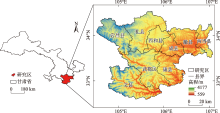
Fig. 1
Geographical location of Longnan City"

Tab. 1
Data source"
| 数据名称 | 分辨率 | 数据用途 | 数据来源 |
|---|---|---|---|
| 土地覆盖类型 | 30 m | 量化生态系统服务、识别潜在生态源地 | 武汉大学中国土地覆盖数据集(CLCD)( |
| 高程(DEM) | 30 m | 计算坡度、地形起伏度等地形因子 | 地理空间数据云网站( |
| Landsat 7 TM+、Landsat 8 OLI遥感影像 | 30 m | 计算植被覆盖度(NDVI) | |
| 降水量 | 1 km | 计算平均的年降水量、降雨侵蚀力因子等 | 国家地球系统科学数据中心( |
| 潜在蒸散发量 | 1 km | 计算平均的潜在蒸散发量 | |
| 土壤数据 | 1 km | 计算土壤侵蚀因子、土壤最大根系埋藏深度等 | 世界土壤数据库( |
| 交通道路 | - | 构建综合阻力面 | 开放街道地图(OSM)开源数据( |
| 河流 | - | 构建综合阻力面 | 开放街道地图(OSM)开源数据( |
| 居民点 | - | 构建综合阻力面 | |
| 自然保护区边界 | - | 后续结果分析 |
Tab. 2
The total area of ecological source areas in each district and county from 2000 to 2022"
| 区县 | 2000年 | 2005年 | 2010年 | 2015年 | 2020年 | 2022年 | 面积变化/km2 | |||||||||||
|---|---|---|---|---|---|---|---|---|---|---|---|---|---|---|---|---|---|---|
| 面积/km2 | 占比/% | 面积/km2 | 占比/% | 面积/km2 | 占比/% | 面积/km2 | 占比/% | 面积/km2 | 占比/% | 面积/km2 | 占比/% | |||||||
| 武都区 | 1041.47 | 12.04 | 1063.70 | 12.02 | 1093.48 | 12.01 | 1058.38 | 11.64 | 1350.36 | 13.05 | 1190.7 | 11.59 | 149.23 | |||||
| 成县 | 422.60 | 4.89 | 519.49 | 5.87 | 538.66 | 5.91 | 495.01 | 5.44 | 664.96 | 6.43 | 713.30 | 6.94 | 290.70 | |||||
| 文县 | 2849.99 | 32.96 | 2838.50 | 32.07 | 2860.18 | 31.40 | 2846.87 | 31.30 | 3011.10 | 29.11 | 3000.56 | 29.20 | 150.57 | |||||
| 宕昌县 | 599.12 | 6.93 | 619.09 | 6.99 | 631.06 | 6.93 | 658.59 | 7.24 | 670.13 | 6.48 | 690.84 | 6.72 | 91.72 | |||||
| 康县 | 1303.71 | 15.08 | 1365.79 | 15.43 | 1433.83 | 15.74 | 1453.08 | 15.97 | 1811.91 | 17.52 | 1792.16 | 17.44 | 488.45 | |||||
| 西和县 | 192.51 | 2.22 | 196.98 | 2.23 | 203.96 | 2.24 | 210.88 | 2.32 | 289.76 | 2.80 | 257.28 | 2.50 | 64.77 | |||||
| 礼县 | 172.86 | 2.00 | 176.17 | 1.99 | 181.71 | 1.99 | 186.61 | 2.05 | 76.99 | 0.74 | 77.28 | 0.75 | -95.58 | |||||
| 徽县 | 1156.97 | 13.38 | 1160.63 | 13.11 | 1238.55 | 13.60 | 1248.12 | 13.72 | 1510.17 | 14.60 | 1540.43 | 14.99 | 383.46 | |||||
| 两当县 | 907.56 | 10.50 | 910.58 | 10.29 | 927.04 | 10.18 | 938.29 | 10.32 | 959.17 | 9.27 | 1014.57 | 9.87 | 107.01 | |||||
| 合计 | 8646.79 | 100 | 8850.94 | 100 | 9108.48 | 100 | 9095.82 | 100 | 10344.55 | 100 | 10277.10 | 100 | 1630.31 | |||||

Fig. 2
Spatial distribution of ecological sources in Longnan City from 2000 to 2022"

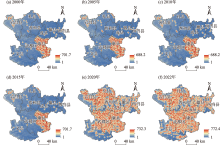
Fig. 3
Comprehensive resistance surface of Longnan City from 2000 to 2022"

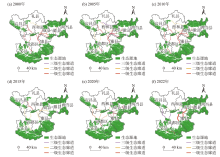
Fig. 4
Spatial distribution of ecological corridors in Longnan City from 2000 to 2022"

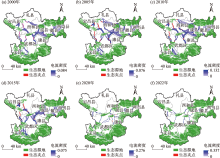
Fig. 5
Spatial distribution of ecological pinch points in Longnan City from 2000 to 2022"

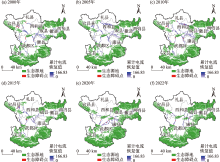
Fig. 6
Spatial distribution of ecological barriers in Longnan City from 2000 to 2022"

Tab. 3
Area of ecological obstacle points in each district and county of Longnan City from 2000 to 2022"
| 区县 | 生态障碍点面积/km | |||||
|---|---|---|---|---|---|---|
| 2000年 | 2005年 | 2010年 | 2015年 | 2020年 | 2022年 | |
| 武都区 | 16.49 | - | 14.65 | 25.86 | 11.97 | 3.76 |
| 成县 | - | - | - | - | - | 2.38 |
| 文县 | - | 1.17 | - | - | 3.56 | - |
| 宕昌县 | 35.16 | - | 24.14 | 27.04 | - | - |
| 康县 | - | - | - | - | 3.44 | 1.15 |
| 西和县 | 3.54 | - | 4.92 | - | - | - |
| 礼县 | 8.03 | 1.46 | 5.56 | - | - | 1.01 |
| 徽县 | - | - | - | - | - | - |
| 两当县 | - | - | - | - | - | - |
| 合计 | 63.21 | 2.62 | 49.27 | 52.90 | 18.98 | 8.30 |
| [1] | 覃彬桂, 林伊琳, 赵俊三, 等. 基于InVEST模型和电路理论的昆明市国土空间生态修复关键区域识别[J]. 中国环境科学, 2023, 43(2): 809-820. |
| [Qin Bingui, Lin Yilin, Zhao Junsan, et al. Identification of key areas for the ecological restoration of territorial space in Kunming based on the InVEST model and circuit theory[J]. China Environmental Science, 2023, 43(2): 809-820.] | |
| [2] | 刘凤莲, 刘艳. 基于生态安全格局的高原城市生态修复关键区域识别——以昆明市为例[J]. 国土资源科技管理, 2023, 40(3): 17-30. |
| [Liu Fenglian, Liu Yan. Identification of key areas for ecological restoration in plateau cities based on the ecological security pattern: A case study of Kunming[J]. Scientific and Technological Management of Land and Resources, 2023, 40(3): 17-30.] | |
| [3] |
包玉斌, 王耀宗, 路锋, 等. 六盘山区国土空间生态安全格局构建与分区优化[J]. 干旱区研究, 2023, 40(7): 1172-1183.
doi: 10.13866/j.azr.2023.07.14 |
|
[Bao Yubin, Wang Yaozong, Lu Feng, et al. Construction of an ecological security pattern and zoning optimization for territorial space in the Liupan Mountain Area[J]. Arid Zone Research, 2023, 40(7): 1172-1183.]
doi: 10.13866/j.azr.2023.07.14 |
|
| [4] | 付凤杰, 刘珍环, 刘海. 基于生态安全格局的国土空间生态修复关键区域识别——以贺州市为例[J]. 生态学报, 2021, 41(9): 3406-3414. |
| [Fu Fengjie, Liu Zhenhuan, Liu Hai. Identifying key areas of ecosystem restoration for territorial space based on ecological security pattern: A case study in Hezhou City[J]. Acta Ecologica Sinica, 2021, 41(9): 3406-3414.] | |
| [5] | 屠越, 刘敏, 高婵婵, 等. 大都市区生态源地识别体系构建及国土空间生态修复关键区诊断[J]. 生态学报, 2022, 42(17): 7056-7067. |
| [Tu Yue, Liu Min, Gao Chanchan, et al. Construction of ecological sources identification system for metropolitan areas and diagnosis of key areas for ecological restoration in nationally spatial areas[J]. Acta Ecologica Sinica, 2022, 42(17): 7056-7067.] | |
| [6] |
陈南南, 康帅直, 赵永华, 等. 基于MSPA和MCR模型的秦岭(陕西段)山地生态网络构建[J]. 应用生态学报, 2021, 32(5): 1545-1553.
doi: 10.13287/j.1001-9332.202105.012 |
|
[Chen Nannan, Kang Shuaizhi, Zhao Yonghua, et al. Construction of ecological network in Qinling Mountains of Shaanxi, China based on MSPA and MCR model[J]. Chinese Journal of Applied Ecology, 2021, 32(5): 1545-1553.]
doi: 10.13287/j.1001-9332.202105.012 |
|
| [7] | 杨鸿辉, 余娇, 耿建伟, 等. 基于遥感生态指数和电路理论的生态安全格局构建——以广州市为例[J]. 北京林业大学学报, 2023, 45(10): 127-139. |
| [Yang Honghui, Yu Jiao, Geng Jianwei, et al. Construction of ecological security pattern based on remote sensing urban ecological index and circuit theory: A case study of Guangzhou City[J]. Journal of Beijing Forestry University, 2023, 45(10): 127-139.] | |
| [8] | 陆禹, 佘济云, 陈彩虹, 等. 基于粒度反推法的景观生态安全格局优化——以海口市秀英区为例[J]. 生态学报, 2015, 35(19): 6384-6393. |
| [Lu Yu, She Jiyun, Chen Caihong, et al. Landscape ecological security pattern optimization based on the granularity inverse method: A case study in Xiuying District, Haikou[J]. Acta Ecologica Sinica, 2015, 35(19): 6384-6393.] | |
| [9] | 汪沁, 於冉, 储昭君, 等. 基于生态评价与电路理论的生态安全格局构建及关键区域识别——以安徽省为例[J]. 水土保持通报, 2023, 43(6): 209-216, 226. |
| [Wang Qin, Yu Ran, Chu Zhaojun, et al. Construction of ecological security pattern and identification of key regions based on ecological assessment and circuit theory: A case study in Anhui Province[J]. Bulletin of Soil and Water Conservation, 2023, 43(6): 209-216, 226.] | |
| [10] | 姚材仪, 何艳梅, 程建兄, 等. 岷江流域生态安全格局评价与优化——基于最小累积阻力模型和重力模型[J]. 生态学报, 2023, 43(17): 7083-7096. |
| [Yao Caiyi, He Yanmei, Cheng Jianxiong, et al. Evaluation of ecological security pattern and optimization suggestions in Minjiang River Basin based on MCR model and gravity model[J]. Acta Ecologica Sinica, 2023, 43(17): 7083-7096.] | |
| [11] | 杜雨阳, 王征强, 于庆和, 等. 基于生境质量模型和电路理论的区域生态安全格局构建——以秦岭(陕西段)为例[J]. 农业资源与环境学报, 2022, 39(5): 1069-1078. |
| [Du Yuyang, Wang Zhenqiang, Yu Qinghe, et al. Construction of a regional ecological security pattern based on a habitat quality model and circuit theory a case study of the Qinling Mountains (Shaanxi section)[J]. Journal of Agricultural Resources and Environment, 2022, 39(5): 1069-1078.] | |
| [12] | 李瑞发, 崔旺来. 长三角城市群生态安全的时空演变及影响因素[J]. 水土保持研究, 2025, 32(2): 377-386. |
| [Li Ruifa, Cui Wanglai. Temporal-spatial evolution and influencing factors of ecological security in the city cluster of Yangtze River Delta[J]. Research of Soil and Water Conservation, 2025, 32(2): 377-386.] | |
| [13] |
田柳兰, 王珊珊, 毋兆鹏. 基于多时相遥感数据的乌鲁木齐市生态安全格局构建[J]. 干旱区地理, 2023, 46(7): 1155-1165.
doi: 10.12118/j.issn.1000-6060.2022.473 |
|
[Tian Liulan, Wang Shanshan, Wu Zhaopeng. Construction of ecological security pattern in Urumqi based on multi-temporal remote sensing data[J]. Arid Land Geography, 2023, 46(7): 1155-1165.]
doi: 10.12118/j.issn.1000-6060.2022.473 |
|
| [14] | 王争磊, 乔家君, 刘海龙, 等. 黄河中游地区生态安全格局时空演变及优化策略[J]. 农业工程学报, 2024, 40(19): 231-239. |
| [Wang Zhenglei, Qiao Jiajun, Liu Hailong, et al. Spatio-temporal evolution and optimization strategy of ecological security pattern in the Middle Reaches of the Yellow River of China[J]. Transactions of the Chinese Society of Agricultural Engineering, 2024, 40(19): 231-239.] | |
| [15] | 贾玉婷, 赵雪雁, 介永庆. 脱贫山区农户生计转型的低碳效应研究——以陇南山区为例[J]. 地球环境学报, 2023, 14(6): 740-752. |
| [Jia Yuting, Zhao Xueyan, Jie Yongqing. A study on low carbon effect of livelihood transition of farmers in the mountainous area out of poverty: Taking Longnan mountainous area as an example[J]. Journal of Earth Environment, 2023, 14(6): 740-752.] | |
| [16] | 李文青, 赵雪雁, 何小风. 重点生态功能区农户相对贫困程度及影响因素——以陇南山区为例[J]. 生态学报, 2023, 43(19): 8206-8218. |
| [Li Wenqing, Zhao Xueyan, He Xiaofeng. Relative poverty degree and influencing factors of farmers in key ecological function areas: A case study of Longnan mountain area[J]. Acta Ecologica Sinica, 2023, 43(19): 8206-8218.] | |
| [17] |
孙彦, 赵雪雁. 山区农户的生计干预效率及其影响因素——以陇南山区为例[J]. 地理研究, 2023, 42(7): 1874-1891.
doi: 10.11821/dlyj020220867 |
| [Sun Yan, Zhao Xueyan. Efficiency and influencing factors of livelihood interventions of farming households in mountainous areas: A case study of Longnan mountainous areas[J]. Geographical Research, 2023, 42(7): 1874-1891.] | |
| [18] |
严莉, 曹广超, 康利刚, 等. 基于InVEST模型的共和县生境质量时空变化及驱动因素[J]. 干旱区研究, 2024, 41(2): 314-325.
doi: 10.13866/j.azr.2024.02.14 |
|
[Yan Li, Cao Guangchao, Kang Ligang, et al. Analysis of spatial and temporal changes in habitat quality and driving factors in Gonghe County using the InVEST model[J]. Arid Zone Research, 2024, 41(2): 314-325.]
doi: 10.13866/j.azr.2024.02.14 |
|
| [19] | 杜婕, 韩佩杰. 基于ArcGIS区统计的陇南市生态敏感性评价[J]. 测绘与空间地理信息, 2018, 41(7): 99-102. |
| [Du Jie, Han Peijie. Evaluation of ecological sensitivity of Longnan City based on ArcGIS area statistics[J]. Geomatics & Spatial Information Technology, 2018, 41(7): 99-102.] | |
| [20] | Yang J, Huang X. The 30 m annual land cover datasets and its dynamics in China from 1985 to 2022[DB/OL]. Earth System Science Data, 2023, 13(8): 3907-3925. |
| [21] | Zhang R, Zhang Q P, Zhang L, et al. Identification and extraction of a current urban ecological network in Minhang District of Shanghai based on an optimization method[J]. Ecological Indicators, 2022, 136: 108647. |
| [22] | 杨志广, 蒋志云, 郭程轩, 等. 基于形态空间格局分析和最小累积阻力模型的广州市生态网络构建[J]. 应用生态学报, 2018, 29(10): 3367-3376. |
| [Yang Zhiguang, Jiang Zhiyun, Guo Chengxuan, et al. Construction of ecological network using morphological spatial pattern analysis and minimal cumulative resistance models in Guangzhou City[J]. Chinese Journal of Applied Ecology, 2018, 29(10): 3367-3376.] | |
| [23] | 王晓峰, 朱梦娜, 张欣蓉, 等. 基于“源地-阻力-廊道”的三江源区生态安全格局构建[J]. 生态学报, 2024, 44(11): 4609-4623. |
| [Wang Xiaofeng, Zhu Mengna, Zhang Xinrong, et al. Ecological security pattern construction of the Three-river Source Region based on Source-Resistance-Corridor[J]. Acta Ecologica Sinica, 2024, 44(11): 4609-4623.] | |
| [24] | 李月, 刘静兰, 李静静, 等. 基于生态廊道识别的喀斯特流域生态安全格局构建——以贵州南明河流域为例[J/OL]. 环境科学, 1-23. [2025-03-20]. https://doi.org/10.13227/j.hjkx.202404038. |
| [Li Yue, Liu Jinglan, Li Jingjing, et al. Construction of an ecological security pattern in Karst Watersheds based on ecological corridor identification: A case study of the Nanming River Basin in Guizhou[J/OL]. Environmental Science, 1-23. [2025-03-20].] | |
| [25] | 钟味蓉, 魏雯. 基于生态安全格局的大理州国土空间生态修复关键区域识别[J]. 生态学杂志, 2024, 43(10): 3211-3222. |
|
[Zhong Weirong, Wei Wen. Identification of key areas of ecological restoration of land space in Dali Prefecture based on ecological security pattern[J]. Chinese Journal of Ecology, 2024, 43(10): 3211-3222.]
doi: 10.13292/j.1000-4890.202410.017 |
|
| [26] | Peng J, Pan Y J, Liu Y X, et al. Linking ecological degradation risk to identify ecological security patterns in a rapidly urbanizing landscape[J]. Habitat International, 2018, 71: 110-124. |
| [27] | Dong J Q, Peng J, Liu Y X, et al. Integrating spatial continuous wavelet transform and kernel density estimation to identify ecological corridors in megacities[J]. Landscape and Urban Planning, 2020, 199: 103815. |
| [28] | 李彤, 贾宝全, 刘文瑞, 等. 宜昌市生态安全网络要素时空动态及其影响因素[J]. 生态学报, 2023, 43(15): 6154-6169. |
| [Li Tong, Jia Baoquan, Liu Wenrui, et al. Spatio-temporal dynamics and influencing factors of ecological security network elements in Yichang, Hubei Province[J]. Acta Ecologica Sinica, 2023, 43(15): 6154-6169.] | |
| [29] | 吴艳霞, 魏志斌, 王爱琼. 基于DPSIR模型的黄河流域生态安全评价及影响因素研究[J]. 水土保持通报, 2022, 42(6): 322-331. |
| [Wu Yanxia, Wei Zhibin, Wang Aiqiong. Ecological safety evaluation and influencing factors of Yellow River basin based on DPSIR model[J]. Bulletin of Soil and Water Conservation, 2022, 42(6): 322-331.] | |
| [30] | 王争磊, 刘海龙, 丁娅楠, 等. 山西省生态安全时空演变特征及影响因素[J]. 生态学报, 2022, 42(18): 7470-7483. |
| [Wang Zhenglei, Liu Hailong, Ding Yanan, et al. Spatio-temporal evolution characteristics and influencing factors of ecological security in Shanxi Province[J]. Acta Ecologica Sinica, 2022, 42(18): 7470-7483.] |
| [1] | LIU Xiaoming, ZHENG Shiyan, QIAO Zhanming. Dynamic simulation of land use change and habitat quality in the Three River Source Region based on the PLUS-InVEST models [J]. Arid Zone Research, 2025, 42(6): 1080-1092. |
| [2] | WU Zhaoqiao, LIN Fei, NIU Junjie, GENG Tianwei. Response of ecosystem service to land use pattern change in the Shanxi central urban agglomeration [J]. Arid Zone Research, 2024, 41(7): 1153-1166. |
| [3] | LI Bingjie, FAN Zhitao, QU Zhicheng, YAO Shunyu, SU Xiashu, LIU Dongwei, WANG Lixin. Evaluation and prediction of ecosystem carbon storage in the Inner Mongolia section of the Yellow River Basin based on the InVEST-PLUS model [J]. Arid Zone Research, 2024, 41(7): 1217-1227. |
| [4] | ZHANG Shunxin, WU Zihao, YAN Qingwu, LI Gui’e, MU Shouguo. Spatiotemporal changes in the ecosystem carbon storage on the northern slope of the Tianshan Mountains and simulations based on the PLUS-InVEST model [J]. Arid Zone Research, 2024, 41(7): 1228-1237. |
| [5] | ZHOU Jianwei, LUO Jun, MA Xueyang. Spatio-temporal evolution and driving factors of land use and ecosystem service value in the Lhasa River Basin, China [J]. Arid Zone Research, 2024, 41(6): 1021-1031. |
| [6] | DONG Pengbei, REN Zongping, LI Peng, WANG Kaibo, HE Guokai, WANG Pu. Ecosystem services trade-offs and synergies drived by landuse changes in Ningxia [J]. Arid Zone Research, 2024, 41(6): 1032-1044. |
| [7] | GAO Yayu, SONG Yu, ZHAO Tinghong, GAO Jinfang, HE Wenbo, LI Zexia. Spatiotemporal evolution of water yield in the lower Malian River Basin [J]. Arid Zone Research, 2024, 41(5): 776-787. |
| [8] | LIU Rulong, ZHAO Yuanyuan, CHEN Guoqing, CHI Wenfeng, LIU Zhengjia. Assessment of habitat quality in the Yellow River Basin in Inner Mongolia from 1990 to 2020 [J]. Arid Zone Research, 2024, 41(4): 674-683. |
| [9] | XU Mingjing, FENG Qiang, LYU Meng. Tradeoffs of ecosystem services and their influencing factors: A case study of the Shanxi Section of the Yellow River Basin [J]. Arid Zone Research, 2024, 41(3): 467-479. |
| [10] | LI Jiake, SHAO Zhanlin. Spatiotemporal evolution and prediction of carbon stock in Urumqi City based on PLUS and InVEST models [J]. Arid Zone Research, 2024, 41(3): 499-508. |
| [11] | YAN Li, CAO Guangchao, KANG Ligang, LIU Menglin, YE Deli. Analysis of spatial and temporal changes in habitat quality and driving factors in Gonghe County using the InVEST model [J]. Arid Zone Research, 2024, 41(2): 314-325. |
| [12] | SHEN Cao,REN Zongping,LI Peng,WANG Kaibo,LU Kexin,REN Zhengyan,WEI Xiaoyan. Identification of priority areas for ecological compensation under soil and water conservation in Ningxia [J]. Arid Zone Research, 2023, 40(9): 1527-1536. |
| [13] | ZHANG Xiaomin, ZHANG Dongmei, ZHANG Wei. Effects of human activities on carbon storage in the Irtysh River Basin [J]. Arid Zone Research, 2023, 40(8): 1333-1345. |
| [14] | BAO Yubin,WANG Yaozong,LU Feng,LIU Zizeng,MA Dawei,YANG Yong,WU Juan,ZHANG Yongkang. Construction of an ecological security pattern and zoning optimization for territorial space in the Liupan Mountain Area [J]. Arid Zone Research, 2023, 40(7): 1172-1183. |
| [15] | YAN Yujiang, LI Jiangui, LI Junli, Jiang Teng. Construction of ecological security patterns in the Kaidu-Kongque River Basin based on the supply and demand of ecosystem services [J]. Arid Zone Research, 2023, 40(5): 829-839. |
|
||
