
Arid Zone Research ›› 2025, Vol. 42 ›› Issue (10): 1851-1859.doi: 10.13866/j.azr.2025.10.09
• Plant Ecology • Previous Articles Next Articles
ZHAO Yanfen1( ), WANG Chuncheng2, PAN Borong3()
Received:2025-01-02
Revised:2025-06-16
Online:2025-10-15
Published:2025-10-22
Contact:
PAN Borong
E-mail:zhaoyanfenhappy@163.com;brpan@ms.xjb.ac.cn
ZHAO Yanfen, WANG Chuncheng, PAN Borong. Predicting the suitable distribution areas of Panzerina lanata in China under climate change[J].Arid Zone Research, 2025, 42(10): 1851-1859.
Add to citation manager EndNote|Reference Manager|ProCite|BibTeX|RefWorks
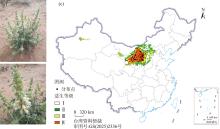
Fig. 1
Current distribution points and potential distribution areas of Panzerina lanata in China"

Tab. 1
Contribution rate and permutation importance of the environmental factors"
| 代码 | 环境变量 | 贡献率/% | 置换重要值/% |
|---|---|---|---|
| Bio5 | 最暖月最高温 | 30.4 | 22.6 |
| Bio13 | 最湿月降水量 | 26.7 | 39.2 |
| Ele | 海拔 | 20.5 | 15.5 |
| Bio4 | 温度季节性变化 | 18.7 | 14.7 |
| Bio15 | 降水量季节性变化 | 2.0 | 4.5 |
| Bio2 | 平均日较差 | 1.0 | 3.3 |
| Bio14 | 最干月降水量 | 0.6 | 0.2 |

Fig. 2
Precision validation with ROC in MaxEnt prediction model"

Tab. 2
Suitable areas of Panzerina lanata in China in different periods /104 km2"
| 时期 | 情景 | 总适生区 | 高适生区 | 中适生区 | 低适生区 |
|---|---|---|---|---|---|
| 当前 | 58.00 | 21.04 | 12.11 | 24.86 | |
| 2041—2060年 | SSP1-2.6 | 56.95 | 21.49 | 10.91 | 24.55 |
| SSP5-8.5 | 58.51 | 20.68 | 12.25 | 25.58 | |
| 2081—2100年 | SSP1-2.6 | 65.32 | 22.29 | 14.22 | 28.81 |
| SSP5-8.5 | 60.69 | 22.37 | 13.09 | 25.22 |

Fig. 3
Regularized training gain of environmental variables on distribution of Panzerina lanata"
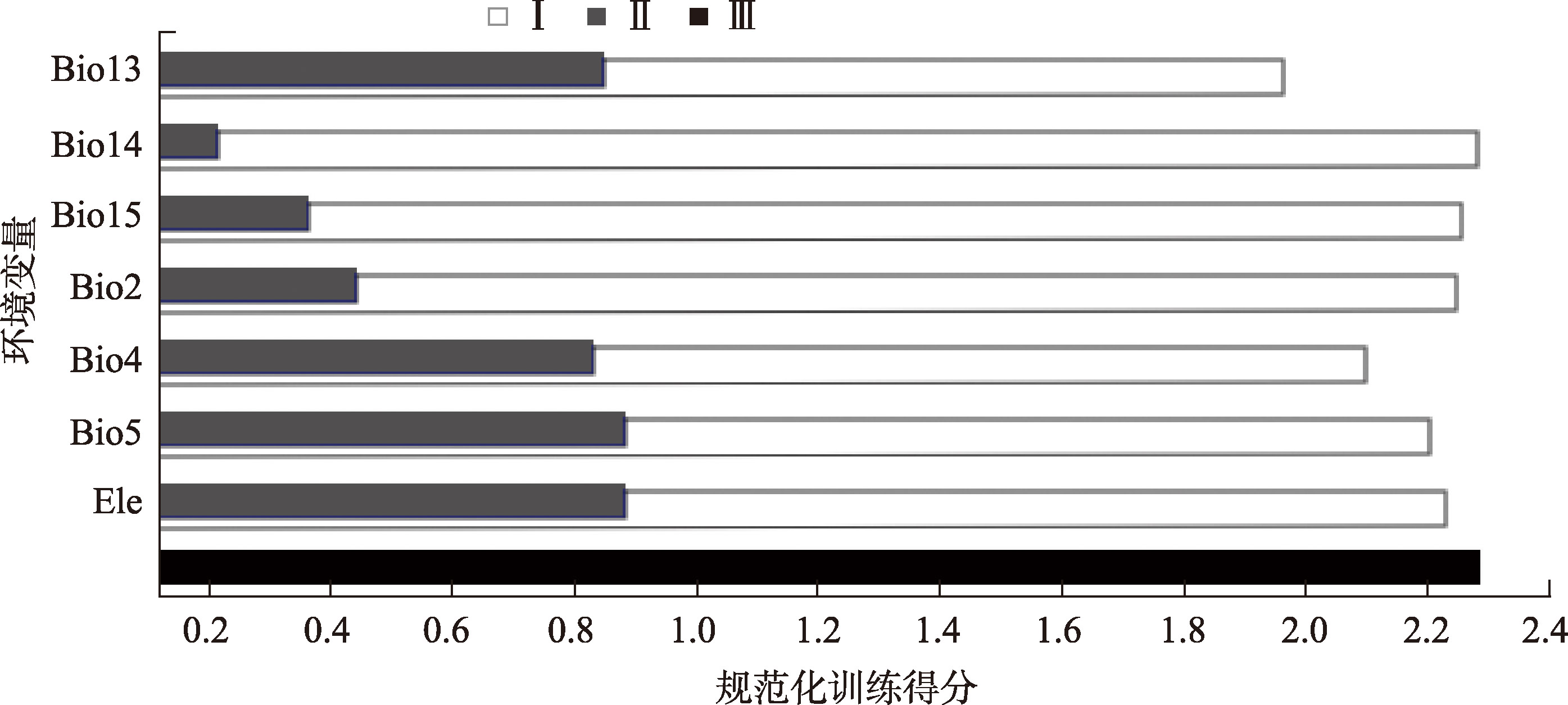

Fig. 4
Potential distribution areas of Panzerina lanata in China under future climate scenarios"


Fig. 5
Centroid migration of suitable areas of Panzerina lanata under different scenarios"
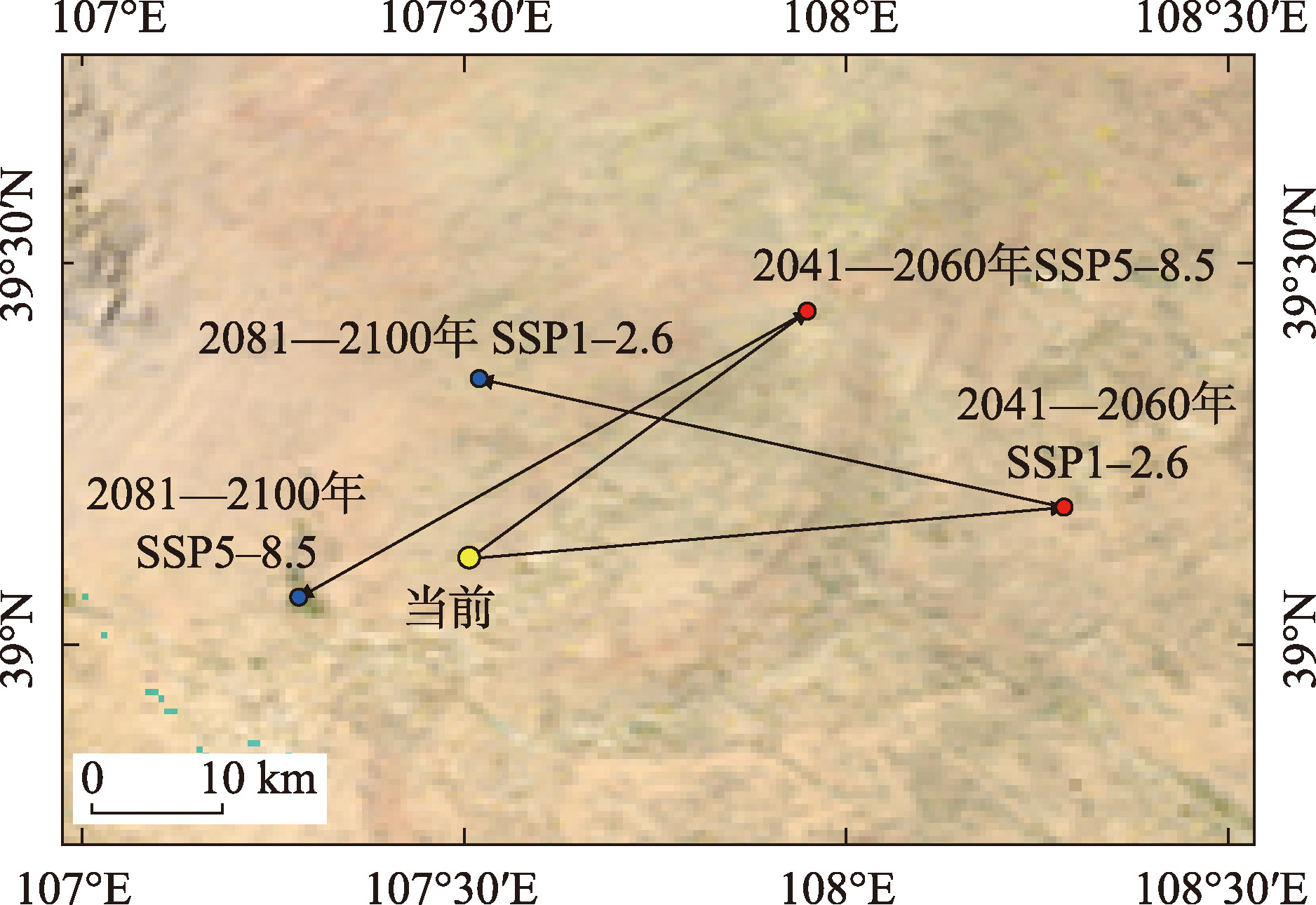
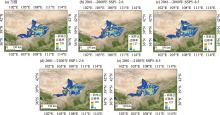
Fig. 6
The migration and diffusion paths of Panzerina lanata in different periods"

| [1] | 方精云, 朱江玲, 石岳. 生态系统对全球变暖的响应[J]. 科学通报, 2018, 63(2): 136-140. |
| [Fang Jingyun, Zhu Jiangling, Shi Yue. The responses of ecosystems to global warming[J]. Chinese Science Bulletin, 2018, 63(2): 136-140. ] | |
| [2] |
Urban M C. Climate change extinctions[J]. Science, 2024, 386(6726): 1123-1128.
doi: 10.1126/science.adp4461 pmid: 39636977 |
| [3] | 周天军, 陈梓明, 陈晓龙, 等. IPCC AR6报告解读: 未来的全球气候——基于情景的预估和近期信息[J]. 气候变化研究进展, 2021, 17(6): 652-663. |
| [Zhou Tianjun, Chen Ziming, Chen Xiaolong, et al. Interpreting IPCC AR6: Future global climate based on projection under scenarios and on near-term information[J]. Climate Change Research, 2021, 17(6): 652-663. ] | |
| [4] | 孙萌, 张子龙. 药用植物对气候变化响应研究进展[J]. 生物学杂志, 2015, 32(5): 84-88. |
| [Sun Meng, Zhang Zilong. Research progress in medicinal plants response to climate change[J]. Journal of Biology, 2015, 32(5): 84-88. ] | |
| [5] | 张亮, 魏彦强, 王金牛, 等. 气候变化情景下黑果枸杞的潜在地理分布[J]. 应用与环境生物学报, 2020, 26(4): 969-978. |
| [Zhang Liang, Wei Yanqiang, Wang Jinniu, et al. The potential geographical distribution of Lycium ruthenicum Murr. under different climate change scenarios[J]. Chinese Journal of Applied and Environmental Biology, 2020, 26(4): 969-978. ] | |
| [6] |
查苏娜, 琪波热, 胡红霞, 等. 气候变化背景下濒危药用植物手参在中国潜在适生区预测[J]. 应用生态学报, 2024, 35(11): 3023-3030.
doi: 10.13287/j.1001-9332.202411.023 |
|
[Cha Suna, Qi Bore, Hu Hongxia, et al. Prediction of the potential distribution area of endangered medicinal plant Gymnadenia conopsea in China under the background of climate change[J]. Chinese Journal of Applied Ecology, 2024, 35(11): 3023-3030. ]
doi: 10.13287/j.1001-9332.202411.023 |
|
| [7] | 李国庆, 刘长成, 刘玉国, 等. 物种分布模型理论研究进展[J]. 生态学报, 2013, 33(16): 4827-4835. |
| [Li Guoqing, Liu Changcheng, Liu Yuguo, et al. Advances in theoretical issues of species distribution models[J]. Acta Ecologica Sinica, 2013, 33(16): 4827-4835. ] | |
| [8] | 欧阳泽怡, 欧阳硕龙, 吴际友, 等. 最大熵模型在植物适生区预测应用中的研究进展[J]. 湖南林业科技, 2022, 49(1): 83-88. |
| [Ouyang Zeyi, Ouyang Shuolong, Wu Jiyou, et al. Progress of the application of prediction of potential suitable distribution of plants based on Maxent[J]. Hunan Forestry Science & Technology, 2022, 49(1): 83-88. ] | |
| [9] |
樊玉科, 任菊, 王润龙, 等. 气候变化背景下白皮松在中国潜在适宜分布预测[J]. 干旱区研究, 2024, 41(10): 1719-1730.
doi: 10.13866/j.azr.2024.10.10 |
|
[Fan Yuke, Ren Ju, Wang Runlong, et al. Prediction of potential suitable distribution area of Pinus bungeana in China under the background of climate change[J]. Arid Zone Research, 2024, 41(10): 1719-1730. ]
doi: 10.13866/j.azr.2024.10.10 |
|
| [10] | Yang Z B, Bai Y, Alatalo J M, et al. Spatio-temporal variation in potential habitats for rare and endangered plants and habitat conservation based on the maximum entropy model[J]. Science of the Total Environment, 2021, 784: 147080. |
| [11] | Rana H K, Luo D, Rana S K, et al. Geological and climatic factors affect the population genetic connectivity in Mirabilis himalaica(Nyctaginaceae): Insight from phylogeography and dispersal corridors in the Himalaya-Hengduan biodiversity hotspot[J]. Frontiers in Plant Science, 2020, 10: 1721. |
| [12] |
瞿宇阳, 文田田, 刘佳敏, 等. 气候变化下菟丝子属3种植物在中国的潜在地理分布[J]. 干旱区研究, 2025, 42(1): 97-107.
doi: 10.13866/j.azr.2025.01.09 |
|
[Qu Yuyang, Wen Tiantian, Liu Jiamin, et al. Potential geographic distribution of the three species of Cuscuta in China under climate scenarios[J]. Arid Zone Research, 2025, 42(1): 97-107. ]
doi: 10.13866/j.azr.2025.01.09 |
|
| [13] | 于海彬, 张镱锂, 李士成, 等. 基于GIS和物种分布模型的高山植物长花马先蒿迁移路线模拟[J]. 应用生态学报, 2014, 25(6): 1669-1673. |
|
[Yu Haibin, Zhang Yili, Li Shicheng, et al. Predicting the dispersal routes of alpine plant Pedicularis longiflora (Orobanchaceae) based on GIS and species distribution models[J]. Chinese Journal of Applied Ecology, 2014, 25(6): 1669-1673. ]
pmid: 25223022 |
|
| [14] |
郭彦龙, 赵泽芳, 乔慧捷, 等. 物种分布模型面临的挑战与发展趋势[J]. 地球科学进展, 2020, 35(12): 1292-1305.
doi: 10.11867/j.issn.1001-8166.2020.110 |
|
[Guo Yanlong, Zhao Zefang, Qiao Huijie, et al. Challenges and development trend of species distribution model[J]. Advances in Earth Science, 2020, 35(12): 1292-1305. ]
doi: 10.11867/j.issn.1001-8166.2020.110 |
|
| [15] | 赵一之, 赵利清, 曹瑞. 内蒙古植物志[M]. 呼和浩特: 内蒙古人民出版社, 2020: 220-221. |
| [Zhao Yizhi, Zhao Liqing, Cao Rui. Flora Intramongolica[M]. Hohhot: Inner Mongolia People’s Press, 2020: 220-221. ] | |
| [16] | 雷啟芬, 赵湘培, 朱丹. 蒙药白益母草的化学成分研究及临床应用进展[J]. 中华中医药杂志, 2017, 32(7): 3083-3085. |
| [Lei Qifen, Zhao Xiangpei, Zhu Dan. Progress of Mongolian herb Panzeria alaschanica Kupr. in chemical components and clinical application[J]. China Journal of Traditional Chinese Medicine and Pharmacy, 2017, 32(7): 3083-3085. ] | |
| [17] | 郑亚夫, 尹伟, 林莉莉, 等. 白益母草的研究进展[J]. 中草药, 2007, 38(9): 1434-1436. |
| [Zheng Yafu, Yin Wei, Lin Lili, et al. Advances in studies on Panzeria alaschanica[J]. Chinese Traditional and Herbal Drugs, 2007, 38(9): 1434-1436. ] | |
| [18] | 赵一之. 内蒙古珍稀濒危植物图谱[M]. 北京: 中国农业科技出版社, 1992: 56. |
| [Zhao Yizhi. Rare and Endangered Plants in Inner Mongolia[M]. Beijing: China Agricultural Science and Technology Press, 1992: 56. ] | |
| [19] | 米盈盈. 蒙药白益母草生药学及抗炎活性研究[D]. 北京: 中央民族大学, 2021. |
| [Mi Yingying. Study on Pharmacognosy and Anti-inflammatory Activity of Mongolian Medicine Panzerina alaschanica[D]. Beijing: Minzu University of China, 2021. ] | |
| [20] | Zhao Y F, Zhang H X, Pan B R, et al. Intraspecific divergences and phylogeography of Panzerina lanata (Lamiaceae) in Northwest China[J]. Peer J, 2019, 7: e6264. |
| [21] | 杨康, 赵湘培, 张恂, 等. 基于MaxEnt生态位模型预测蒙药白益母草潜在分布研究[J]. 中药材, 2021, 44(8): 1827-1831. |
| [Yang Kang, Zhao Xiangpei, Zhang Xun, et al. Prediction of potential distribution of Mongolian medicine Panzerina lanata var. alaschanica based on MaxEnt niche model[J]. Journal of Chinese Medicinal Materials, 2021, 44(8): 1827-1831. ] | |
| [22] |
王庆莉, 王茹琳, 张利平, 等. 基于MaxEnt模型的川西高原松茸气候生态适宜性与潜在分布[J]. 应用生态学报, 2021, 32(7): 2525-2533.
doi: 10.13287/j.1001-9332.202107.013 |
|
[Wang Qingli, Wang Rulin, Zhang Liping, et al. Climatic ecological suitability and potential distribution of Tricholoma matsutake in western Sichuan Plateau, China based on MaxEnt model[J]. Chinese Journal of Applied Ecology, 2021, 32(7): 2525-2533. ]
doi: 10.13287/j.1001-9332.202107.013 |
|
| [23] | Phillips S J, Dudík M. Modeling of species distributions with Maxent: New extensions and a comprehensive evaluation[J]. Ecography, 2008, 31(2): 161-175. |
| [24] |
陈禹光, 乐新贵, 陈宇涵, 等. 基于MaxEnt模型预测气候变化下杉木在中国的潜在地理分布[J]. 应用生态学报, 2022, 33(5):1207-1214.
doi: 10.13287/j.1001-9332.202205.024 |
|
[Chen Yuguang, Le Xingui, Chen Yuhan, et al. Identification of potential distribution area of Cunninghamia lanceolata in China under climate change based on the MaxEnt model[J]. Chinese Journal of Applied Ecology, 2022, 33(5): 1207-1214. ]
doi: 10.13287/j.1001-9332.202205.024 |
|
| [25] | Zhuo Z H, Xu D P, Pu B, et al. Predicting distribution of Zanthoxylum bungeanum Maxim. in China[J]. BMC Ecology, 2020, 20(1): 46. |
| [26] | Zhao X F, Lei M, Wei C H, et al. Assessing the suitable regions and the key factors for three Cd-accumulating plants (Sedum alfredii, Phytolacca americana, and Hylotelephium spectabile) in China using MaxEnt model[J]. Science of the Total Environment, 2022, 852: 158202. |
| [27] | Brown J L, Bennett J R, French C M. SDMtoolbox 2.0: The next generation python-based GIS toolkit for landscape genetic, biogeographic and species distribution model analyses[J]. Peer J, 2017, 5: e4095. |
| [28] | Yao S R, Wei G H, Ming F J, et al. Distribution, species richness, and relative importance of different plant life forms across drylands in China[J]. Plant Diversity, 2025, 47(2): 273-281. |
| [29] | 王思雨, 吴建国. 未来气候变化情景下中国植物物种地理分布变化趋势研究进展[J]. 广西植物, 2025, 45(3): 500-516. |
| [Wang Siyu, Wu Jianguo. Research progress on the changes in geographical distributions of plant species under future climate change scenarios in China[J]. Guihaia, 2025, 45(3): 500-516. ] | |
| [30] | Cheryomushkina V A, Astashenkov A Y. Morphological adaptation of Panzerina sojak (Lamiaceae) species to various ecological conditions[J]. Contemporary Problems of Ecology, 2014, 7(5): 520-525. |
| [31] | Sun Y, Sun Y, Yao S R, et al. Impact of climate change on plant species richness across drylands in China: From past to present and into the future[J]. Ecological Indicators, 2021, 132: 108288. |
| [32] |
Qiu J S, Zhang J W, Wang Y N. PPDC: An online platform for the prediction of plant distributions in China[J]. Journal of Plant Ecology, 2024, 17(6): 1-11.
doi: 10.1093/jpe/rtae094 |
| [33] | 朱飙. 西北地区气候暖湿化背景下水汽、潜在蒸散及极端温度和降水的变化特征[D]. 兰州: 兰州大学, 2023. |
| [Zhu Biao. Variation Characteristics of Vapor, Potential Evapotranspiration and Extreme Temperature and Precipitation under the Background of Warming-wetting in Northwest China[D]. Lanzhou: Lanzhou University, 2023. ] | |
| [34] |
丁一汇, 柳艳菊, 徐影, 等. 全球气候变化的区域响应: 中国西北地区气候“暖湿化”趋势、成因及预估研究进展与展望[J]. 地球科学进展, 2023, 38(6): 551-562.
doi: 10.11867/j.issn.1001-8166.2023.027 |
|
[Ding Yihui, Liu Yanju, Xu Ying, et al. Regional responses to global climate change: Progress and prospects for trend, causes, and projection of climatic warming-wetting in Northwest China[J]. Advances in Earth Science, 2023, 38(6): 551-562. ]
doi: 10.11867/j.issn.1001-8166.2023.027 |
|
| [35] | 张丹, 马松梅, 魏博, 等. 中国梭梭属植物历史分布格局及其驱动机制[J]. 生物多样性, 2022, 30(1): 42-51. |
| [Zhang Dan, Ma Songmei, Wei Bo, et al. Historical distribution pattern and driving mechanism of Haloxylon in China[J]. Biodiversity Science, 2022, 30(1): 42-51. ] | |
| [36] | Ma S M, Nie Y B, Jiang X L, et al. Genetic structure of the endangered, relict shrub Amygdalus mongolica (Rosaceae) in arid Northwest China[J]. Australian Journal of Botany, 2019, 67(2): 128-139. |
| [37] | 孙志霞. 基于遗传和地理数据的鄱阳湖流域植物迁移通道研究[D]. 南昌: 江西农业大学, 2017. |
| [Sun Zhixia. Dispersal Corridors for Plant Species in Poyang Lake Basin Identified by Integration of Genetic and Geospatial Data[D]. Nanchang: Jiangxi Agricultural University, 2017. ] |
|
||
