
干旱区研究 ›› 2025, Vol. 42 ›› Issue (4): 600-612.doi: 10.13866/j.azr.2025.04.03
石霞1,2( ), 刘维成1(), 陈晓燕1, 黄玉霞2, 谭丹2, 伍继业3
收稿日期:2024-07-31
修回日期:2025-01-01
出版日期:2025-04-15
发布日期:2025-04-10
通讯作者:
刘维成. E-mail: cnliuwc@163.com作者简介:石霞(1996-),女,硕士,助理研究员,主要从事极端降水和西北区域数值模式研究. E-mail: shixia210044@163.com
基金资助:
SHI Xia1,2(), LIU Weicheng1(), CHEN Xiaoyan1, HUANG Yuxia2, TAN Dan2, WU Jiye3
Received:2024-07-31
Revised:2025-01-01
Published:2025-04-15
Online:2025-04-10
摘要:
利用2020年7月10日甘肃省陇南市站点逐小时降水观测及ERA5再分析资料,分析了强降水时空分布、环流形势及水汽输送等特征,并引入大气湿位能(Moist Static Energy,MSE)研究了对流活动的不稳定能量来源。结果表明:(1) 此次强降水过程具有强度大、局地性明显和对流性强等特征;500 hPa受高原短波槽影响,冷暖空气交汇明显,700 hPa为偏南气流并配合有气旋性切变,具备较好的水汽和动力抬升条件。(2) 强降水发生伴随MSE充放能过程,强降水到达峰值前MSE不断累积,大气处于充能状态;到达峰值后MSE明显减弱,大气处于放能状态。(3) 不同垂直高度的大气充能机制存在差异,对流层低层MSE垂直输送起正贡献,水平平流为负贡献;中层水平平流为正贡献,且以经向平流为主,垂直输送为负贡献;高层MSE增加主要由纬向平流引起。(4) 对流层低层MSE受水汽垂直输送的影响;中层MSE受水汽相关的潜热能控制,MSE增加主要为偏南风异常造成水汽经向平流;高层MSE由内能项主导,MSE增加主要由西风叠加西暖东冷的温度梯度造成纬向平流所致。
石霞, 刘维成, 陈晓燕, 黄玉霞, 谭丹, 伍继业. 西北东部一次强降水形成机制及能量来源[J]. 干旱区研究, 2025, 42(4): 600-612.
SHI Xia, LIU Weicheng, CHEN Xiaoyan, HUANG Yuxia, TAN Dan, WU Jiye. Formation mechanism and energy source of a heavy rainfall event in the eastern northwest region[J]. Arid Zone Research, 2025, 42(4): 600-612.

图1
甘肃省陇南市地形及站点分布"


图2
2020年7月10日08:00—11日08:00陇南市24 h累积降水量(a)及降水量逐小时变化(b) 注:黑色矩形代表强降水中心,本文线图、柱状图均以该中心为研究对象。下同。"


图3
2020年7月10日500 hPa高度场及风场(a~c)、700 hPa(d)风场及散度 注:蓝色矩形框表示陇南市。"


图4
2020年7月10日700 hPa水汽通量及水汽通量散度"

表1
700 hPa强降水中心的水汽经向、纬向及净通量"
| 时刻 | 经向通量 | 纬向通量 | 净通量 |
|---|---|---|---|
| 08:00 | -8.9×10⁴ | +5.9×10⁴ | -3.0×10⁴ |
| 12:00 | +1.1×10⁵ | +9.6×10⁴ | +2.0×10⁵ |
| 16:00 | -1.3×10⁵ | -3.0×10⁴ | -1.6×10⁵ |

图5
2020年7月10日12:00沿33°N、105°E的垂直环流及水汽通量散度 注:黑色阴影代表地形。下同。"
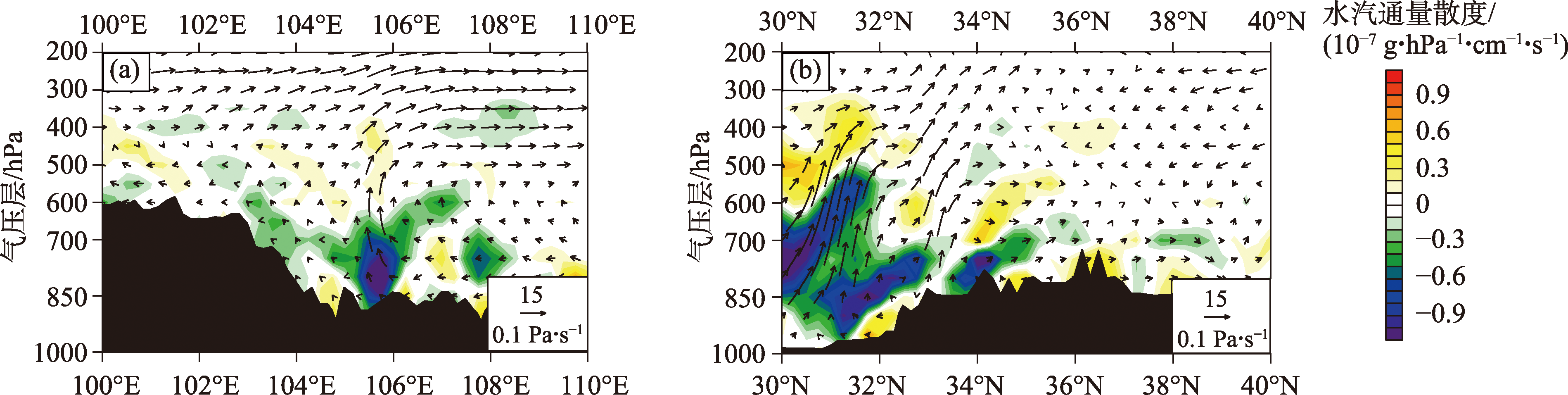
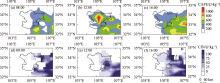
图6
2020年7月10日对流有效位能(CAPE)、对流抑制能(CIN)分布"

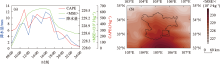
图7
2020年7月10日能量与降水量逐小时变化、充能阶段大气湿位能〈MSE〉分布 注:充能阶段为08:00—15:00。"
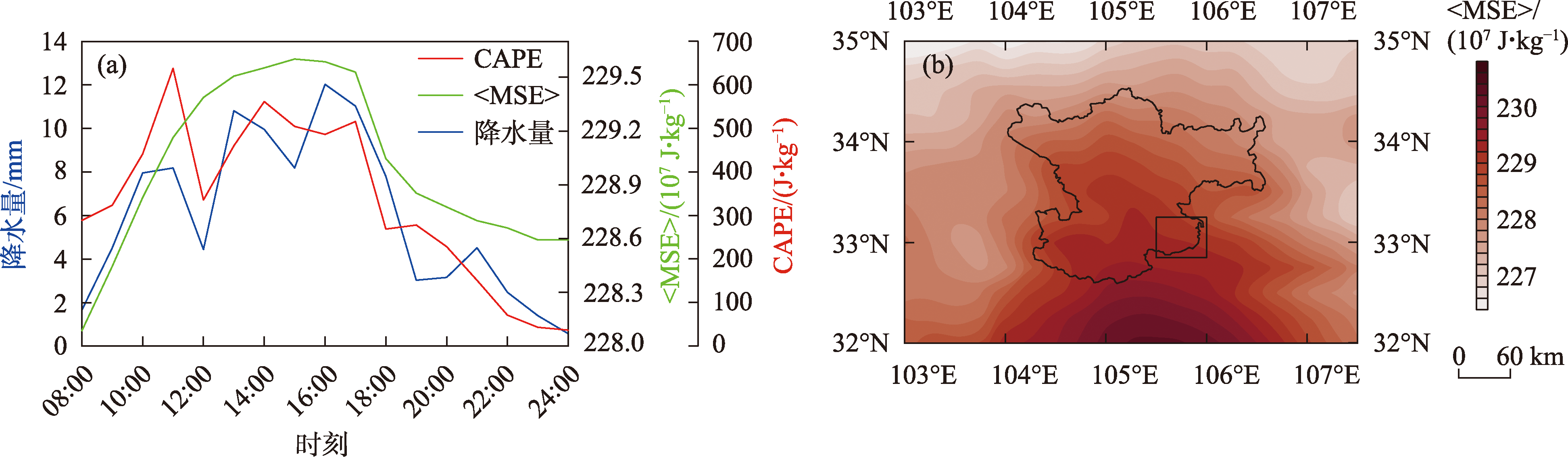

图8
2020年7月10日〈MSE〉各项趋势(a)、〈MSE〉趋势及其贡献(b) 注:趋势表示随时间变化趋势。下同。"
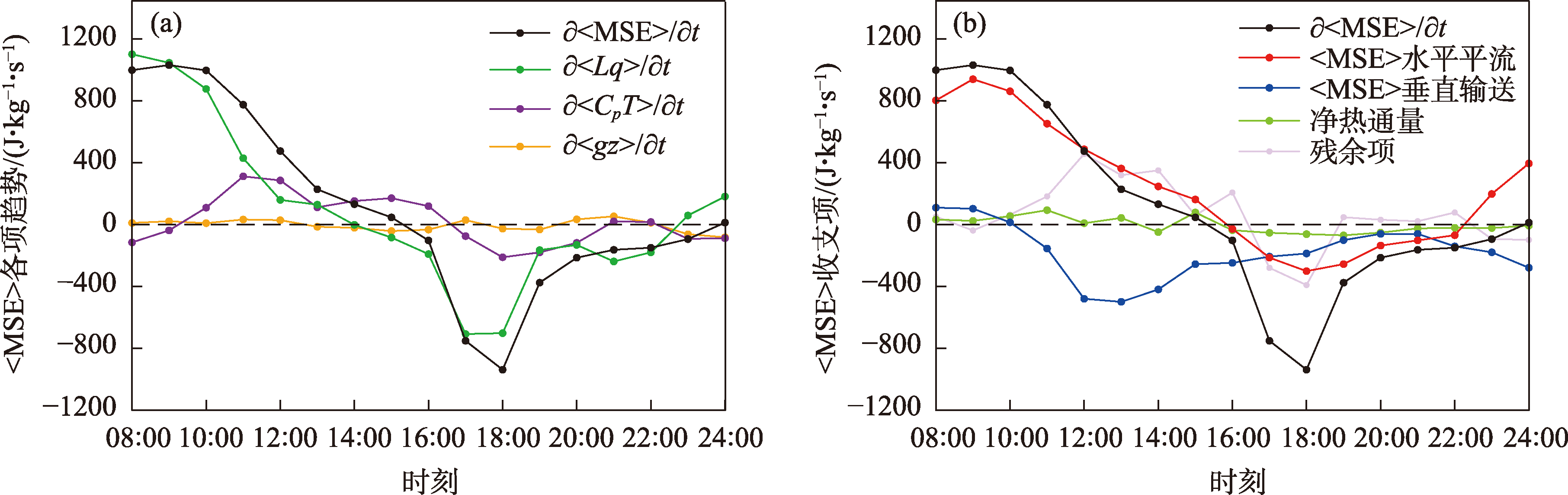

图9
2020年7月10日08:00—13:00〈MSE〉收支方程各项贡献(a)、MSE各项趋势垂直变化(b)、MSE趋势及贡献项垂直变化(c)"


图10
2020年7月10日08:00—13:00沿33°N、105°E的垂直环流与MSE趋势(a~b)、纬向风速与MSE(c~d)、600 hPa潜热项(e)及250 hPa内能项(f)分布"


图11
2020年7月10日08:00—13:00 〈MSE〉各项趋势分布 注:图(a)~图(d)分别代表〈MSE〉、潜热能、内能及势能趋势。"

| [1] | 白肇烨, 徐国昌, 夏建平, 等. 中国西北天气[M]. 北京: 气象出版社, 1988. |
| [Bai Zhaoye, Xu Guochang, Xia Jianping, et al. Northwest China Weather[M]. Beijing: Meteorological Press, 1988.] | |
| [2] |
张之贤, 张强, 赵庆云, 等. 陇东南地区短历时降水特征及其分布规律[J]. 中国沙漠, 2013, 33(4): 1184-1190.
doi: 10.7522/j.issn.1000-694X.2013.00167 |
|
[Zhang Zhixian, Zhang Qiang, Zhao Qingyun, et al. Character and distribution of short-duration precipitation in Southeast Gansu, China[J]. Journal of Desert Research, 2013, 33(4): 1184-1190.]
doi: 10.7522/j.issn.1000-694X.2013.00167 |
|
| [3] |
白晓平, 王式功, 赵璐, 等. 西北地区东部短时强降水概念模型[J]. 高原气象, 2016, 35(5): 1248-1256.
doi: 10.7522/j.issn.1000-0534.2015.00102 |
|
[Bai Xiaoping, Wang Shigong, Zhao Lu, et al. Conceptual models of short-time heavy rainfall in the east of Northwest China[J]. Plateau Meteorology, 2016, 35(5): 1248-1256.]
doi: 10.7522/j.issn.1000-0534.2015.00102 |
|
| [4] |
王宝鉴, 孔祥伟, 傅朝, 等. 甘肃陇东南一次大暴雨的中尺度特征分析[J]. 高原气象, 2016, 35(6): 1551-1564.
doi: 10.7522/j.issn.1000-0534.2015.00114 |
|
[Wang Baojian, Kong Xiangwei, Fu Zhao, et al. Analysis on mesoscale characteristics of a rainstorm process in Southeastern Gansu[J]. Plateau Meteorology, 2016, 35(6): 1551-1564.]
doi: 10.7522/j.issn.1000-0534.2015.00114 |
|
| [5] | 樊晓春, 王若升, 李常德, 等. 2010年7月甘肃东部一次致灾大暴雨诊断[J]. 干旱气象, 2013, 31(2): 342-347. |
| [Fan Xiaochun, Wang Ruosheng, Li Changde, et al. Diagnostic analysis of a heavy rainstorm in the east of Gansu[J]. Journal of Arid Meteorology, 2013, 31(2): 342-347.] | |
| [6] | 徐东坡, 李金明, 周祖昊, 等. 1956—2018年中国降水特征的时空分布规律研究[J]. 水利水电技术, 2020, 51(10): 20-27. |
| [Xu Dongpo, Li Jinming, Zhou Zuhao, et al. Study on the spatial and temporal distribution of precipitation characteristics in China from 1956 to 2018[J]. Water Resources and Hydropower Engineering, 2020, 51(10): 20-27.] | |
| [7] |
卢珊, 胡泽勇, 王百朋, 等. 近56年中国极端降水事件的时空变化格局[J]. 高原气象, 2020, 39(4): 683-693.
doi: 10.7522/j.issn.1000-0534.2019.00058 |
|
[Lu Shan, Hu Zeyong, Wang Baipeng, et al. Spatio-temporal patterns of extreme precipitation events over China in recent 56 years[J]. Plateau Meteorology, 2020, 39(4): 683-693.]
doi: 10.7522/j.issn.1000-0534.2019.00058 |
|
| [8] |
李娟, 闫会平, 朱志伟. 中国夏季极端气温与降水事件日数随平均气温变化的定量分析[J]. 高原气象, 2020, 39(3): 532-542.
doi: 10.7522/j.issn.1000-0534.2019.00042. |
|
[Li Juan, Yan Huiping, Zhu Zhiwei. Quantitative analysis of changes in summer extreme temperatures and precipitation days relative to mean temperature increase in China[J]. Plateau Meteorology, 2020, 39(3): 532-542.]
doi: 10.7522/j.issn.1000-0534.2019.00042. |
|
| [9] |
马莉, 杨晓军, 王勇, 等. 1990—2019年甘肃汛期极端小时降水特征[J]. 高原气象, 2023, 42(4): 993-1004.
doi: 10.7522/j.issn.1000-0534.2022.00053 |
|
[Ma Li, Yang Xiaojun, Wang Yong, et al. Characteristics of extreme hourly precipitation during the flood season in Gansu Province from 1990 to 2019[J]. Plateau Meteorology, 2023, 42(4): 993-1004.]
doi: 10.7522/j.issn.1000-0534.2022.00053 |
|
| [10] |
刘新伟, 王澄海, 郭润霞, 等. 1981—2018年甘肃省极端暴雨天气过程的气候与环流特征[J]. 干旱气象, 2021, 39(5): 750-758.
doi: 10.11755/j.issn.1006-7639(2021)-05-0750 |
| [Liu Xinwei, Wang Chenghai, Guo Runxia, et al. Climate and circulation characteristics of extreme rainstorm processes in Gansu from 1981 to 2018[J]. Journal of Arid Meteorology, 2021, 39(5): 750-758.] | |
| [11] | 苏军锋, 张锋, 黄玉霞, 等. 甘肃陇南市短时强降水时空分布特征及中尺度分析[J]. 干旱气象, 2021, 39(6): 966-973. |
| [Su Junfeng, Zhang Feng, Huang Yuxia, et al. Spatial-temporal distribution characteristics and mesoscale analysis of short-term heavy precipitation in Longnan, Gansu[J]. Journal of Arid Meteorology, 2021, 39(6): 966-973.] | |
| [12] |
刘新伟, 段海霞, 杨晓军, 等. 甘肃东部两次短时强降水天气过程对比分析[J]. 干旱气象, 2017, 35(5): 868-873.
doi: 10.11755/j.issn.1006-7639(2017)-05-0868 |
| [Liu Xinwei, Duan Haixia, Yang Xiaojun, et al. Comparative analysis of two short-term strong rainfall processes in eastern Gansu[J]. Journal of Arid Meteorology, 2017, 35(5): 868-873.] | |
| [13] |
许东蓓, 许爱华, 肖玮, 等. 中国西北四省区强对流天气形势配置及特殊性综合分析[J]. 高原气象, 2015, 34(4): 973-981.
doi: 10.7522/j.issn.1000-0534.2014.00102 |
|
[Xu Dongbei, Xu Aihua, Xiao Wei, et al. Comprehensive analysis on the severe convective weather situation configuration and its particularity in Northwest China[J]. Plateau Meteorology, 2015, 34(4): 973-981.]
doi: 10.7522/j.issn.1000-0534.2014.00102 |
|
| [14] |
孔祥伟, 李晨蕊, 杨秀梅, 等. 甘肃河东夏季区域性短时强降水环流形势分类特征[J]. 高原气象, 2024, 43(2): 329-341.
doi: 10.7522/j.issn.1000-0534.2023.00056 |
|
[Kong Xiangwei, Li Chenrui, Yang Xiumei, et al. Circulation situation characteristics of regional short-time heavy rainfall in eastern Gansu during summer[J]. Plateau Meteorology, 2024, 43(2): 329-341.]
doi: 10.7522/j.issn.1000-0534.2023.00056 |
|
| [15] |
赵庆云, 傅朝, 刘新伟, 等. 西北东部暖区大暴雨中尺度系统演变特征[J]. 高原气象, 2017, 36(3): 697-704.
doi: 10.7522/j.issn.1000-0534.2016.00140 |
|
[Zhao Qingyun, Fu Zhao, Liu Xinwei, et al. Characteristics of mesoscale system evolution of torrential rain in warm sectors over Northwest China[J]. Plateau Meteorology, 2017, 36(3): 697-704.]
doi: 10.7522/j.issn.1000-0534.2016.00140 |
|
| [16] | 傅朝, 杨晓军, 周晓军, 等. 2013年6月19—20日甘肃陇东南暖区暴雨多普勒雷达特征分析[J]. 气象, 2015, 41(9): 1095-1103. |
| [Fu Zhao, Yang Xiaojun, Zhou Xiaojun, et al. Analysis on Doppler radar characteristics of warm-area rainstorms in southeastern Gansu during June 19-20, 2013[J]. Meteorological Monthly, 2015, 41(9): 1095-1103.] | |
| [17] |
沙宏娥, 傅朝, 刘维成, 等. 西北东部半干旱区一次极端特大暴雨的触发和维持机制[J]. 干旱气象, 2022, 40(6): 933-944.
doi: 10.11755/j.issn.1006-7639(2022)-06-0933 |
| [Sha Honge, Fu Zhao, Liu Weicheng, et al. Mechanism of trigger and maintenance during an extremely torrential rain in semi-arid region of eastern Northwest China[J]. Journal of Arid Meteorology, 2022, 40(6): 933-944.] | |
| [18] |
樊李苗, 俞小鼎. 中国短时强对流天气的若干环境参数特征分析[J]. 高原气象, 2013, 32(1): 156-165.
doi: 10.7522/j.issn.1000-0534.2012.00016 |
|
[Fan Limiao, Yu Xiaoding. Characteristic analyses on environmental parameters in short-term severe convective weather in China[J]. Plateau Meteorology, 2013, 32(1): 156-165.]
doi: 10.7522/j.issn.1000-0534.2012.00016 |
|
| [19] | Iii C A D. The distinction between large-scale and mesoscale contribution to severe convection: A case study example[J]. Weather & Forecasting, 1987, 2(1): 3-16. |
| [20] | Yang M, Shi X, Yuan C, et al. Summer extreme precipitation in Southern China from the perspective of moisture static energy[J]. Journal of Climate, 2023, 36(15): 4967-4986. |
| [21] | Luo Yali, Zhang Renhe, Wan Qilin, et al. The Southern China Monsoon Rainfall Experiment (SCMREX)[J]. Bulletin of the American Meteorological Society, 2017, 98(5): 999-1013. |
| [22] | 郑永光, 黄振强, 陈炯, 等. 对流风暴大气不稳定机制研究的若干问题[J]. 暴雨灾害, 2024, 43(3): 266-275. |
| [Zheng Yongguang, Huang Zhenqiang, Chen Jiong, et al. Some issues in studies on the atmospheric instability of convective storms[J]. Torrential Rain and Disasters, 2024, 43(3): 266-275.] | |
| [23] | 郑永光, 陶祖钰, 俞小鼎. 强对流天气预报的一些基本问题[J]. 气象, 2017, 43(6): 641-652. |
| [Zheng Yongguang, Tao Zuyu, Yu Xiaoding. Some essential issues of severe convective weather forecasting[J]. Meteorological Monthly, 2017, 43(6): 641-652.] | |
| [24] | Crook Andrew N. Sensitivity of moist convection forced by boundary layer processes to low-level thermodynamic fields[J]. Monthly Weather Review, 1996, 124(8): 1767. |
| [25] | Ninomiya K. Large- and mesoscale features of Meiyu-Baiu front associated with intense rainfall[J]. East Asian Monsoon, 2004, 2: 404-435. |
| [26] | 李俊, 王东海, 王斌. 中尺度对流系统中的湿中性层结结构特征[J]. 气候与环境研究, 2012, 17(5): 617-627. |
| [Li Jun, Wang Donghai, Wang Bin. Structure characteristics of moist neutral stratification in mesoscale convective systems[J]. Climatic and Environmental Research, 2012, 17(5): 617-627.] | |
| [27] | Chen Guixing, Yoshida R, Sha Weiming, et al. Convective instability associated with the eastward-propagating rainfall episodes over Eastern China during the warm season[J]. Journal of Climate, 2014, 27(6): 2331-2339. |
| [28] | 王秀明, 俞小鼎, 周小刚. 雷暴潜势预报中几个基本问题的讨论[J]. 气象, 2014, 40(4): 389-399. |
| [Wang Xiuming, Yu Xiaoding, Zhou Xiaogang. Discussion on basic issues of thunderstorm potential forecasting[J]. Meteorological Monthly, 2014, 40(4): 389-399.] | |
| [29] | Neelin J D, Held I M. Modeling tropical convergence based on the moist static energy budget[J]. Monthly Weather Review, 1987, 115(1): 3-12. |
| [30] | Hendon H H, Liebmann B. Organization of convection within the Madden-Julian oscillation[J]. Journal of Geophysical Research Atmospheres, 1994, 99(D4): 8073-8083. |
| [31] | Bladé Ileana, Hartmann D L. Tropical intraseasonal oscillations in a simple nonlinear model[J]. Journal of Atmospheric Sciences, 1993, 50(17): 2922-2939. |
| [32] | Maloney Eric D. The moist static energy budget of a composite tropical intraseasonal oscillation in a climate model[J]. Journal of Climate, 2009, 22(3): 711-729. |
| [33] | Sobel A, Wang S, Kim D. Moist static energy budget of the MJO during DYNAMO[J]. Journal of the Atmospheric Sciences, 2014, 71(11): 4276-4291. |
| [34] | Feng T, Yu J Y, Yang X Q, et al. Convective coupling in tropical-depression-type waves. Part II: Moisture and moist static energy budgets[J]. Journal of the Atmospheric Sciences, 2020, 77(10): 3423-3440. |
| [1] | 沙贝宁, 杨余辉, 黄佛君, 叶茂. 中国西北地区逆温时空变化[J]. 干旱区研究, 2025, 42(3): 397-408. |
| [2] | 曹译丹, 马敏劲, 康国强, 陈然. 西北一次强沙尘天气的数值模拟及其诊断[J]. 干旱区研究, 2025, 42(1): 1-13. |
| [3] | 山建安, 朱睿, 尹振良, 杨华庆, 张薇, 方春爽. 基于CMIP6模式的中国西北地区干旱时空变化[J]. 干旱区研究, 2024, 41(5): 717-729. |
| [4] | 王若凡, 刘雨欣, 李佩钢, 唐悦, 谢微. 黄河兰州段河岸带沉积物磷的形态分布及释放风险[J]. 干旱区研究, 2024, 41(12): 2035-2044. |
| [5] | 王娜娜,韩磊,柳利利,彭苓,周鹏,马云蕾,马军. 银川平原夏半年不同等级降雨水汽输送机制[J]. 干旱区研究, 2023, 40(9): 1404-1413. |
| [6] | 张红丽, 韩富强, 张良, 王莉霞, 孙源, 李富民. 西北地区气候暖湿化空间与季节差异分析[J]. 干旱区研究, 2023, 40(4): 517-531. |
| [7] | 张雯, 马阳, 王岱, 杨建玲, 崔洋. 不同时间尺度海温因子对西北地区东部夏季降水的影响及预测[J]. 干旱区研究, 2023, 40(4): 532-542. |
| [8] | 李菲菲, 周霞, 周玉玺. 西北地区农业干旱脆弱性评估及时空分布特征[J]. 干旱区研究, 2023, 40(4): 663-669. |
| [9] | 邵建,张肃诏,陈敏,李强,郑友炯,程瑶,马宁. FY-4A卫星在宁夏短时强降水中的适用性研究[J]. 干旱区研究, 2023, 40(2): 163-172. |
| [10] | 陈庭兴,吕海深,朱永华. 基于GEV分布的西营河流域洪水特性分析[J]. 干旱区研究, 2021, 38(6): 1563-1569. |
| [11] | 付双喜,张洪芬,杨丽杰,赵玉娟,张可心,陈祺. 地形影响下祁连山北麓不同类型降水特征对比分析[J]. 干旱区研究, 2021, 38(5): 1226-1234. |
| [12] | 刘义花,李红梅,温婷婷,申红艳,韩忠全,朱宝文. 柴达木盆地夏季暴雨灾害风险区划及其影响[J]. 干旱区研究, 2021, 38(3): 757-763. |
| [13] | 杨霞,周鸿奎,许婷婷,华烨. 南疆夏季不同类型暴雨精细化特征对比分析[J]. 干旱区研究, 2021, 38(3): 747-756. |
| [14] | 韩永贵,韩磊,黄晓宇,高阳. 基于指数平滑和ARIMA模型的西北地区饱和水汽压差预测[J]. 干旱区研究, 2021, 38(2): 303-313. |
| [15] | 姬凯, 王士新, 左洪超, 王一璞, 丁瑞强. 东亚副热带急流经向位置对中国西北东部盛夏降水的影响[J]. 干旱区研究, 2020, 37(1): 10-17. |
|
||
