
Arid Zone Research ›› 2025, Vol. 42 ›› Issue (7): 1323-1332.doi: 10.13866/j.azr.2025.07.15
• Ecology and Environment • Previous Articles Next Articles
HUANG Long1( ), Gusiletu 2, ZHOU Caiting1, YANG Xiayao1, SI Yuejun1, HUANG Rihui1, HANG Xiaoju2, NIU Dongfeng1()
Received:2024-10-11
Revised:2025-04-30
Online:2025-07-15
Published:2025-07-07
Contact:
NIU Dongfeng
E-mail:huanglong@lingnan.edu.cn;niudongfeng@lingnan.edu.cn
HUANG Long, Gusiletu , ZHOU Caiting, YANG Xiayao, SI Yuejun, HUANG Rihui, HANG Xiaoju, NIU Dongfeng. Optically stimulated luminescence dating of aeolian sediment profiles in the sandy areas of northeastern China near the edge of the monsoon zone and its paleoenvironmental significance[J].Arid Zone Research, 2025, 42(7): 1323-1332.
Add to citation manager EndNote|Reference Manager|ProCite|BibTeX|RefWorks
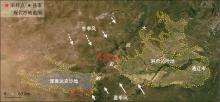
Fig. 1
Schematic map of the study area"


Fig. 2
Schematic diagram of the sampling profiles"

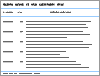
Tab. 1
Deposits division, characterization and sampling depth in the study profile"
| 剖面 | 深度/m | 地层沉积学特征描述 |
|---|---|---|
| KE | 0~4.3 | 浅灰色砂质古土壤,较松散,颗粒较粗,125 μm粒径较多,有植物根系穿插其中,采样KE-1,采样深度为2 m |
| 4.3~8.3 | 深黑色砂质古土壤,较松散,颗粒较细,90 μm粒径较多,于该层顶部和底部分别采样KE-2(4.3 m)和KE-3(8.3 m) | |
| >8.3 | 浅灰色砂质古土壤,较松散,颗粒较粗,未见底 | |
| HS | 0~0.3 | 灰黄色风沙层,有大量植物根系穿插其中,沉积物非常松散,颗粒粗 |
| 0.3~0.7 | 浅灰色砂质古土壤,较松散,颗粒较粗,125 μm粒径较多,采样HS-1(0.6 m) | |
| 0.7~0.9 | 灰黄色风沙层,较松散,颗粒粗 | |
| 0.9~1.6 | 浅灰色砂质古土壤,较松散,颗粒较粗,125 μm粒径较多,采样HS-2(1.1 m) | |
| 1.6~2.6 | 深黑色砂质古土壤,较松散,颗粒较细,90 μm粒径较多,于该层顶部和底部采样HS-3(1.7 m)和HS-4(2.6 m) | |
| >2.6 | 灰黄色风沙层,较松散,颗粒粗,125~150 μm粒径较多,采样HS-5(3.1 m),未见底 |
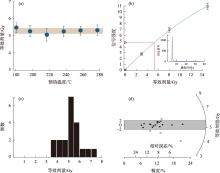
Fig. 3
Preheat plateau test (a), OSL decay curve and dose response curve (b), equivalent dose distributions in histogram (c) and radial plot (d) for a typical sample HS-3"

Tab. 2
OSL dating results for two profiles from Horqin Sandy Land and Otindag Sandy Land"
| 样品号 | Th/(μg·g-1)a | U/(μg·g-1)a | K/%a | 含水量/%b | 宇宙射线/(Gy·ka-1)c | 埋藏深度/m | 年剂量率/(Gy·ka-1) | 等效剂量/Gy | 年龄/ka |
|---|---|---|---|---|---|---|---|---|---|
| KE-1 | 4.16 | 0.98 | 2.08 | 5 | 0.18 | 2.0 | 2.64±0.11 | 0.46±0.03 | 0.2±0.1 |
| KE-2 | 4.54 | 1.00 | 1.92 | 5 | 0.14 | 4.3 | 2.47±0.11 | 7.37±0.33 | 3.0±0.2 |
| KE-3 | 4.93 | 1.23 | 2.33 | 5 | 0.09 | 8.3 | 2.89±0.13 | 28.37±1.34 | 9.8±0.6 |
| HS-1 | 2.33 | 0.71 | 2.07 | 5 | 0.24 | 0.6 | 2.51±0.11 | 1.29±0.10 | 0.5±0.1 |
| HS-2 | 2.00 | 0.53 | 2.08 | 5 | 0.23 | 1.1 | 2.44±0.10 | 2.87±0.23 | 1.2±0.1 |
| HS-3 | 3.32 | 0.93 | 2.09 | 5 | 0.21 | 1.7 | 2.61±0.11 | 5.08±0.18 | 1.9±0.1 |
| HS-4 | 2.64 | 0.82 | 2.14 | 5 | 0.19 | 2.6 | 2.56±0.11 | 29.78±2.60 | 11.6±1.1 |
| HS-5 | 1.71 | 0.62 | 2.19 | 5 | 0.18 | 3.1 | 2.49±0.11 | 33.25±2.26 | 13.4±1.1 |
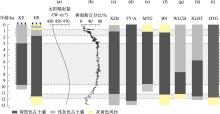
Fig. 4
Comparison of stratigraphic sequences in the study profiles with other related records"


Fig. 5
Topographic map of the study area"

| [1] | Liu T S, An Z S, Yuan B Y. Eolian process and dust mantle (loess) in China[J]. Quaternary Sciences, 1985, 6(1): 113-125. |
| [2] | 夏玉梅. 科尔沁沙地南缘虻石沟黄土地层孢粉分析与古环境的探讨[J]. 中国沙漠, 1989, 9(4): 22-29. |
| [Xia Yumei. A study on the pollen analysis and paleoenvironment of loess stratigraphy in Menshigou in South Edge of Horgin Sandy Land[J]. Journal of Desert Research, 1989, 9(4): 22-29.] | |
| [3] | 董光荣, 金炯, 高尚玉, 等. 晚更新世以来我国北方沙漠地区的气候变化[J]. 第四纪研究, 1990, 10(3): 213-222. |
| [Dong Guangrong, Jin Jiong, Gao Shangyu, et al. Climatic changes since the Late Pleistocene in deserts of Northern China[J]. Quaternary Sciences, 1990, 10(3): 213-222.] | |
| [4] | 裘善文. 试论科尔沁沙地的形成与演变[J]. 地理科学, 1989, 9(4): 317-328, 97. |
|
[Qiu Shanwen. Study on the formation and evolution of Horqin Sandy Land[J]. Scientia Geographica Sinica, 1989, 9(4): 317-328, 97.]
doi: 10.13249/j.cnki.sgs.1989.04.317 |
|
| [5] | 李森, 孙武, 李孝泽, 等. 浑善达克沙地全新世沉积特征与环境演变[J]. 中国沙漠, 1995, 15(4): 323-331. |
| [Li Sen, Sun Wu, Li Xiaoze, et al. Sedimentary characteristics and environmental evolution of Otindag land in Holocene[J]. Journal of Desert Research, 1995, 15(4): 323-331.] | |
| [6] | 李明启, 靳鹤龄, 张洪, 等. 浑善达克沙地磁化率和有机质揭示的全新世气候变化[J]. 沉积学报, 2005, 23(4): 683-689. |
| [Li Mingqi, Jin Heling, Zhang Hong, et al. Climate change revealed by magnetic susceptibility and organic matter during the Holocene in Hunshandak Desert[J]. Acta Sedimentologica Sinica, 2005, 23(4): 683-689.] | |
| [7] | 鹿化煜, 弋双文, 徐志伟, 等. 末次盛冰期和全新世大暖期中国沙漠沙地的空间格局[J]. 科学通报, 2013, 58(23): 2775-2783. |
| [Lu Huayu, Yi Shuangwen, Xu Zhiwei, et al. Chinese deserts and sand fields in Last Glacial Maximum and Holocene Optimum[J]. Chinese Science Bulletin, 2013, 58(23): 2775-2783.] | |
| [8] | 周亚利, 鹿化煜, 张家富, 等. 高精度光释光测年揭示的晚第四纪毛乌素和浑善达克沙地沙丘的固定与活化过程[J]. 中国沙漠, 2005, 25(3): 342-350. |
| [Zhou Yali, Lu Huayu, Zhang Jiafu, et al. Active and inactive phases of sand-dune in Mu Us and Otindag Sandlands during late Quaternary suggested by OSL dating[J]. Journal of Desert Research, 2005, 25(3): 342-350.] | |
| [9] | 弋双文, 鹿化煜, 周亚利, 等. 晚第四纪科尔沁沙地干湿变化的黄土记录[J]. 中国沙漠, 2006, 26(6): 869-874. |
| [Yi Shuangwen, Lu Huayu, Zhou Yali, et al. The wet-dry variations of the Horqin Sandy field recorded by loess deposit of the late Quaternary[J]. Journal of Desert Research, 2006, 26(6): 869-874.] | |
| [10] | 赵爽, 夏敦胜, 靳鹤龄, 等. 科尔沁沙地过去近5000年高分辨率气候演变[J]. 第四纪研究, 2013, 33(2): 283-292. |
| [Zhao Shuang, Xia Dunsheng, Jin Heling, et al. High-resolution climate evolution record of the Horqin Sandy Land since about 5000 cal.aB.P.[J]. Quaternary Sciences, 2013, 33(2): 283-292.] | |
| [11] | 刘冰, 靳鹤龄, 孙忠. 近6 ka以来科尔沁沙地东部气候变化记录[J]. 中国沙漠, 2011, 31(6): 1398-1405. |
| [Liu Bing, Jin Heling, Sun Zhong. Climate change in East Horqin Sandy Land since 6.0 ka BP[J]. Journal of Desert Research, 2011, 31(6): 1398-1405.] | |
| [12] |
薛文萍, 靳鹤龄, 刘冰, 等. 中国季风边缘区全新世沙地演化及其驱动机制研究进展[J]. 中国沙漠, 2019, 39(3): 163-171.
doi: 10.7522/j.issn.1000-694X.2018.00084 |
|
[Xue Wenping, Jin Heling, Liu Bing, et al. Advances in the study of sandy land evolution and driving mechanism in the monsoonal marge in area in China during the Holocene Epoch[J]. Journal of Desert Research, 2019, 39(3): 163-171.]
doi: 10.7522/j.issn.1000-694X.2018.00084 |
|
| [13] | Xu Z W, Mason J A, Xu C, et al. Critical transitions in Chinese dunes during the past 12000 years[J]. Science Advances, 2020, 6(9): eaay8020 |
| [14] | Zhong H E, Jie Z, Linhai Y, et al. Holocene dune mobility and forcing mechanisms at the Northern margin of the East Asian Monsoon[J]. Acta Geologica Sinica-English Edition, 2013, 87(4): 1168-1178. |
| [15] | 周亚利, 鹿化煜, Mason J A, 等. 浑善达克沙地的光释光年代序列与全新世气候变化[J]. 中国科学(D辑: 地球科学), 2008, 38(4): 452-462. |
| [Zhou Yali, Lu Huayu, Mason J A, et al. Photoluminescence chronosequence and Holocene climate change in the Hunsandak Sandy Area[J]. Science China (Series D: Earth Sciences), 2008, 38(4): 452-462.] | |
| [16] | Zhao H, Lu Y, Yin J. Optical dating of Holocene sand dune activities in the Horqin sand-fields in Inner Mongolia, China, using the SAR protocol[J]. Quaternary Geochronology, 2007, 2(1-4): 29-33. |
| [17] | 韩鹏, 孙继敏. 浑善达克沙地的光释光测年研究[J]. 第四纪研究, 2004, 24(4): 480. |
| [Han Peng, Sun Jimin. Photoluminescence photometric dating study of the Hunsandak sands[J]. Quaternary Sciences, 2004, 24(4): 480.] | |
| [18] | 杨小平, 梁鹏, 方伊曼, 等. 中国沙漠与环境演变[M]. 北京: 科学出版社, 2024. |
| [Yang Xiaoping, Liang Peng, Fang Yiman, et al. Chinese Desserts and Environmental Changes[M]. Beijing: Science Press, 2024.] | |
| [19] | 李思慧. 1961—2018年科尔沁沙地气候变化特征[J]. 内蒙古气象, 2019(5): 8-10. |
| [Li Sihui. Characteristics of climate change in Horqin Sandy Land from 1961 to 2018[J]. Meteorology Journal of Inner Mongolia, 2019(5): 8-10.] | |
| [20] | 杨晓刚, 宝音, 张静, 等. 克什克腾旗加强草原生态保护与修复促进草原资源可持续发展[J]. 内蒙古林业, 2022(7): 9-11. |
| [Yang Xiaogang, Baoyin, Zhang Jing, et al. Strengthening grassland ecological protection and restoration in Keshiketeng Banner to promote the sustainable development of grassland resources[J]. Inner Mongolia Forestry, 2022(7): 9-11.] | |
| [21] | Yang X, Wang X, Liu Z, et al. Initiation and variation of the dune fields in semi-arid China-with a special reference to the Hunshandake Sandy Land, Inner Mongolia[J]. Quaternary Science Reviews, 2013, 78: 369-380. |
| [22] | Murray A S, Wintle A G. Luminescence dating of quartz using an improved single-aliquot regenerative dose protocol[J]. Radiation Measurements, 2000, 32(1): 57-73. |
| [23] | Wintle A G, Murray A S. A review of quartz optically stimulated luminescence characteristics and their relevance in single-aliquot regeneration dating protocols[J]. Radiation Measurements, 2006, 41(4): 369-391. |
| [24] | Prescott J R, Hutton J T. Cosmic ray contributions to dose rates for luminescence and ESR dating: Large depths and long-term time variations[J]. Radiation Measurements, 1994, 23(2): 497-500. |
| [25] | Lu H Y, Mason J A, Stevens T, et al. Response of surface processes to climatic change in the dune fields and Loess Plateau of North China during the late Quaternary[J]. Earth Surface Processes and Landforms, 2011, 36(12): 1590-1603. |
| [26] | Ding Z L, Derbyshire E, Yang S L, et al. Stepwise expansion of desert environment across northern China in the past 3.5 Ma and implications for monsoon evolution[J]. Earth and Planetary Science Letters, 2005, 237(1-2): 45-55. |
| [27] |
徐志伟, 鹿化煜. 毛乌素沙地风沙环境变化研究的理论和新认识[J]. 地理学报, 2021, 76(9): 2203-2223.
doi: 10.11821/dlxb202109012 |
|
[Xu Zhiwei, Lu Huayu. Aeolian environmental change studies in the Mu Us Sandy Land, north-central China: Theory and recent progress[J]. Acta Geographica Sinica, 2021, 76(9): 2203-2223.]
doi: 10.11821/dlxb202109012 |
|
| [28] | Laskar J, Robutel P, Joutel F, et al. A long-term numerical solution for the insolation quantities of the Earth[J]. Astronomy & Astrophysics, 2004, 428(1): 261-285. |
| [29] | Chen F H, Xu Q H, Chen J H, et al. East Asian summer monsoon precipitation variability since the last deglaciation[J]. Scientific Reports, 2015, 5(1): 1-11. |
| [30] | 弋双文, 鹿化煜, 曾琳, 等. 末次盛冰期以来科尔沁沙地古气候变化及其边界重建[J]. 第四纪研究, 2013, 33(2): 206-217. |
| [Yi Shuangwen, Lu Huayu, Zeng Lin, et al. Paleoclimate changes and reconstruction of the border of Horqin dune field (Northeastern China) since the Last Glacial maximum[J]. Quaternary Sciences, 2013, 33(2): 206-217.] | |
| [31] | 杨萍. 中国东部沙区全新世砂质古土壤与古气候变化[D]. 金华: 浙江师范大学, 2014. |
| [Yang Ping. Paleoclimate Changes of Deserts of Eastern China Recorded by Sandy Paleosol[D]. Jinhua: Zhejiang Normal Univesity, 2014.] | |
| [32] | 田娅琪, 周亚利, 孙晓巍, 等. 末次盛冰期以来浑善达克沙地光释光年代学及气候变化研究[J/OL]. 沉积学报, 1-20 [2024-07-15]. |
| [Tian Yaqi, Zhou Yali, Sun Xiaowei, et al. Optically stimulated luminescence chronology and climate change in the Otindag Sandy and since the Last Glacial Maximum[J/OL]. Acta Sedimentologica Sinica, 1-20 [2024-07-15].] | |
| [33] | 杨小平, 梁鹏, 张德国, 等. 中国东部沙漠/沙地全新世地层序列及其古环境[J]. 中国科学: 地球科学, 2019, 49(8): 1293-1307. |
| [Yang Xiaoping, Liang Peng, Zhang Deguo, et al. Holocene aeolian stratigraphic sequences in the eastern portion of the desert belt (sand seas and sandy lands) in northern China and their palaeoenvironmental implications[J]. Science China Earth Sciences, 2019, 49(8): 1293-1307.] | |
| [34] | 杨利荣, 岳乐平. 浑善达克沙地末次冰期晚期到全新世的环境转型[J]. 地球环境学报, 2011, 2(1): 301-306. |
| [Yang Lirong, Yue Leping. The environmental transformation from late last glacial to Holocene of Otindag Sandy Land[J]. Journal of Earth Environment, 2011, 2(1): 301-306.] | |
| [35] | 郑琳, 谢东, 于尧, 等. 1961—2018年浑善达克沙地气候变化分析[J]. 现代农业科技, 2024(19): 117-120. |
| [Zheng Lin, Xie Dong, Yu Yao, et al. Analysis of climate change in Otindag Sandy Land from 1961 to 2018[J]. Modern Agricultural Science and Technology, 2024(19): 117-120.] | |
| [36] | 姚淑珍, 王补生, 杜瑛红, 等. 克什克腾旗自然降水资源分析[J]. 内蒙古农业科技, 2012(3): 108-109. |
| [Yao Shuzhen, Wang Busheng, Du Yinghong, et al. Analysis of precipitation resources in the Kashketeng Banner[J]. Journal of Northern Agriculture, 2012(3): 108-109.] | |
| [37] | 周亚利, 鹿化煜, 张小艳, 等. 末次盛冰期和全新世大暖期浑善达克沙地边界的变化[J]. 第四纪研究, 2013, 33(2): 228-242. |
| [Zhou Yali, Lu Huayu, Zhang Xiaoyan, et al. Changes of the before of Otindag Sand field (northern China) during the last glacial maximum and Holocene optimum[J]. Quaternary Sciences, 2013, 33(2): 228-242.] |
| [1] | GAO Haiyan, ZHANG Shengnan, YANG Zhiguo, ZHANG Lei, HUANG Haiguang, YAN Deren. Structure and function of soil fungal community in Pinus tabuliformis sand-fixing forests in Horqin Sandy Land [J]. Arid Zone Research, 2025, 42(1): 118-126. |
| [2] | JIJI Jiamen, CHENG Yiben, CHEN Linglong, WAN Pengxiang, ZHANG Yihui, YANG Wenbin, BAI Xuying, WANG Tao. Dynamic changes in soil moisture and its response to rainfall in Pinus sylvestris var. mongolica plantation in Horqin Sandy Land [J]. Arid Zone Research, 2023, 40(5): 756-766. |
| [3] | MA Haowen, WANG Yongfang, GUO Enliang. Remote sensing monitoring of aeolian desertification in Ongniud Banner based on GEE [J]. Arid Zone Research, 2023, 40(3): 504-516. |
| [4] | WU Rui, CAO Hongyu, GAO Guanglei, YU Minghan, DING Guodong, ZHANG Ying, ZHAO Peishan. Effects of irrigation and salinity treatments on the soil bacterial community and plant physiological characteristics of Cyperus esculentus farmland in Horqin Sandy Land [J]. Arid Zone Research, 2023, 40(12): 1938-1948. |
| [5] | CHEN Zhenqi,ZHANG Jing,ZHANG Yilong,LIU Rui. Spatio-temporal patterns variation of ecological vulnerability in Otindag Sandy Land based on a vulnerability scoping diagram [J]. Arid Zone Research, 2021, 38(5): 1464-1473. |
| [6] | CUI Zhenzhen,MA Chao,CHEN Dengkui. Spatiotemporal variation of vegetation in the Horqin Sandy Land and its response to climate change from 1982-2015 [J]. Arid Zone Research, 2021, 38(2): 536-544. |
| [7] | CAO Wenmei,LIU Tingxi,WANG Xixi,WANG Guanli,LI Dongfang,TONG Xing. Land use and land cover classifications of Horqin Sandy Land dune-meadow areas [J]. Arid Zone Research, 2021, 38(2): 526-535. |
| [8] | SUN Shan-shan, LIU Xin-ping, WEI Shui-lian, ZHANG Tong-hui, HE Yu-hui, Chelmeg, LYU Peng, WANG Ming-ming. Response of Plant Seedling Growth to the Changes in Precipitation and Wind Velocity in Horqin Sandy Land [J]. Arid Zone Research, 2019, 36(4): 870-877. |
| [9] | BAO Yong-zhi, LIU Ting-xi, DUAN Li-min, WANG Guan-li, QI Xiu-jiao, HUANG Tian-Yu, LI Ming-Yang. Photosynthetic Traits of Caragana microphylla and Populus spp. and Their Responses to Climate in the Horqin Sandy Land [J]. Arid Zone Research, 2019, 36(2): 420-429. |
| [10] | ZHANG Jing, ZUO Xiao-An, 吕Peng , YUE Xi-Yuan, ZHANG Jing. Plant Functional Traits and Interrelationships of Dominant Species on Typical Grassland in Horqin Sandy Land, China [J]. , 2018, 35(01): 137-143. |
| [11] | JIANG De-ming, ZHANG Na, A Lamusa,ZHOU Quan-lai,WANG Yong-cui,MIAO Ren-hui,Toshio Oshid. Optimized Modes of Planted Sand-fixing Vegetation in the Horqin Sandy Land [J]. , 2014, 31(1): 149-156. |
| [12] | MIAO Chun-Ping, LI Xue-Hua, JIANG De-Ming. Spatial Distribution and Interspecific Association of Plants in Ecotone between Mobile Sand Dunes and Interdune Lowlands in the Horqin Sandy Land [J]. , 2013, 30(5): 832-837. |
| [13] | WANG Hai-Yan, LIU Ting-Xi, WANG Li, WU Yao, WANG Tian-Shuai, TONG Xin. Spatial Variation of Soil Moisture Content in the Dune-meadow Ecotone in the Horqin Sandy Land [J]. , 2013, 30(3): 438-443. |
| [14] | MIAO Ren-Hui, JIANG De-Ming, WANG Yong-Cui. Change and Mechanism of Vegetation in the Fenced Sandy Grassland in Horqin Sandy Land [J]. , 2013, 30(2): 264-270. |
| [15] | MIAO Chun-Ping, LI Xue-Hua, JIANG De-Ming. Response of Growth of Salix gordejevii Seedling to Sand Burial Depth in the Semiarid Aeolian Sand Field [J]. , 2012, 29(2): 208-212. |
|
||
