
Arid Zone Research ›› 2025, Vol. 42 ›› Issue (8): 1394-1403.doi: 10.13866/j.azr.2025.08.04
• Weather and Climate • Previous Articles Next Articles
YANG Xiaoling1,2( ), CHEN Jing1(), ZHAO Huihua1, MA Zhonghua1, WU Wen1
Received:2025-03-14
Revised:2025-05-25
Online:2025-08-15
Published:2025-11-24
YANG Xiaoling, CHEN Jing, ZHAO Huihua, MA Zhonghua, WU Wen. Temporal and spatial variation characteristics of extreme precipitation in the eastern Hexi Corridor[J].Arid Zone Research, 2025, 42(8): 1394-1403.
Add to citation manager EndNote|Reference Manager|ProCite|BibTeX|RefWorks
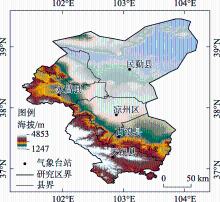
Fig. 1
Distrbution of meteorological stations in the eastern Hexi Corridor"
Tab. 1
Precipitation indices and their definitions"
| 指数 | 定义 | 单位 |
|---|---|---|
| 总降水量 | 年内日降水量≥0.1 mm的累计量 | mm |
| 日降水强度 | 年内总降水量与年日降水量≥0.1 mm日数的比 | mm·d-1 |
| 日最大降水量 | 年内最大日降水量 | mm |
| 湿日 | 年内日降水量≥1 mm的日数 | d |
| 中雨及以上降水量 | 年内日降水量≥10 mm的累计量 | mm |
| 中雨及以上降水强度 | 年内日降水量≥10 mm的年累计量与其日数的比 | mm·d-1 |
| 强降水量 | 年内日降水量>95%分位值的累计量 | mm |
| 特强降水量 | 年内日降水量>99%分位值的累计量 | mm |
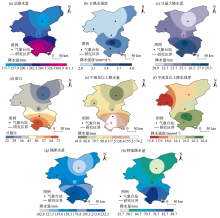
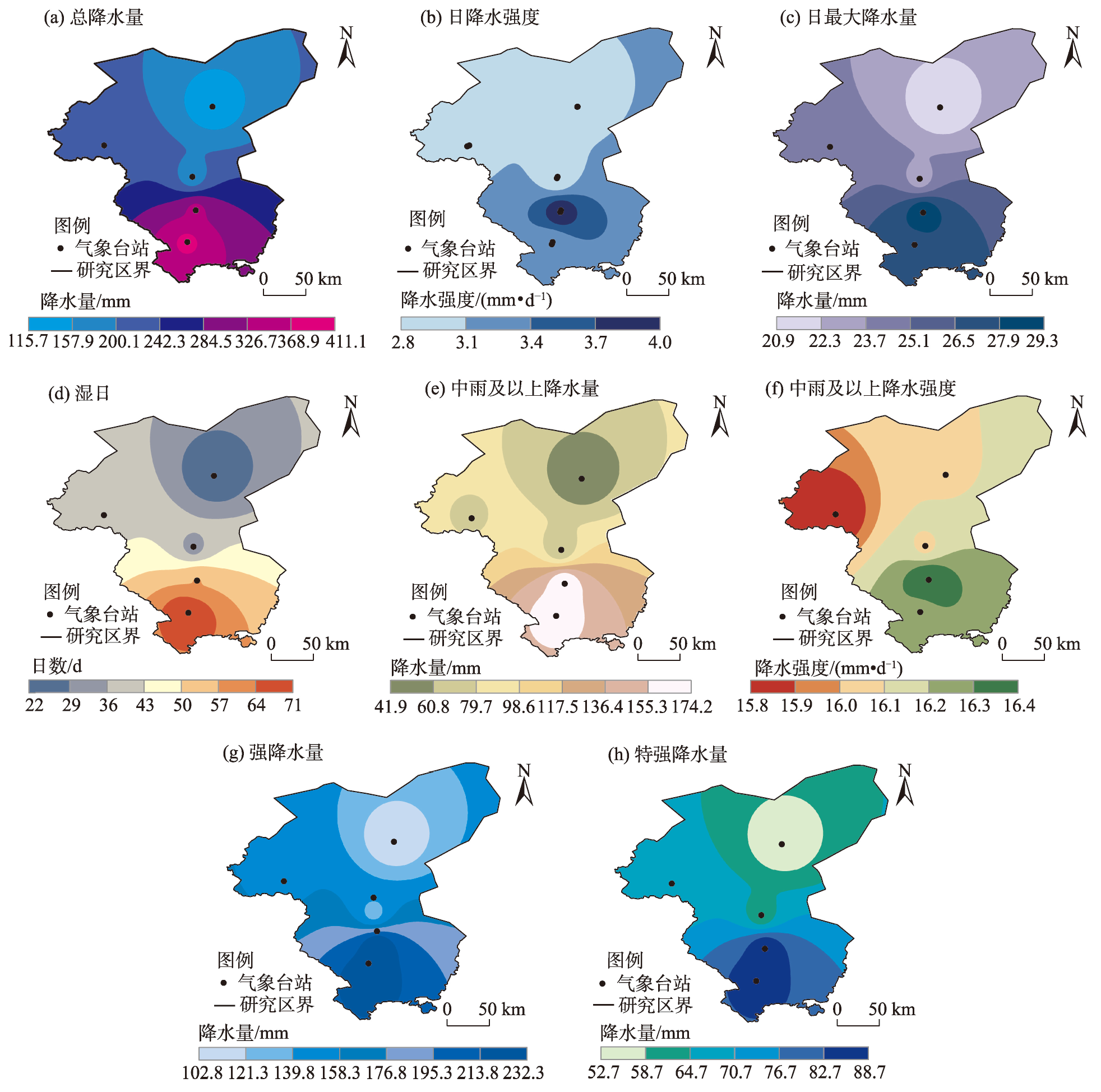
Fig. 2
Spatial distribution of each extreme precipitation index in the eastern Hexi Corridor during 1961-2023"
Tab. 2
The decadal extreme precipitation index anomalies in the eastern Hexi Corridor during 1961-2023"
| 极端降水指标 | 1961—1970年 | 1971—1980年 | 1981—1990年 | 1991—2000年 | 2001—2010年 | 2011—2023年 |
|---|---|---|---|---|---|---|
| 总降水量/mm | -17.3 | -4.9 | -9.8 | 0.5 | 0.0 | 24.2 |
| 日降水强度/(mm·d-1) | 0.0 | 0.0 | -0.3 | 0.1 | 0.0 | 0.2 |
| 日最大降水量/mm | -2.1 | -2.6 | -0.7 | 1.5 | -0.3 | 3.2 |
| 湿日/d | -2.8 | -0.1 | 0.7 | -1.7 | 1.5 | 1.9 |
| 中雨及以上降水量/mm | -8.4 | -4.5 | -12.4 | 5.9 | -6.1 | 19.7 |
| 中雨及以上降水强度/(mm·d-1) | -0.6 | -0.6 | 0.0 | 0.6 | 0.0 | 0.5 |
| 强降水量/mm | -7.4 | -3.9 | -10.8 | 5.4 | -2.7 | 14.8 |
| 特强降水量/mm | -2.4 | -4.8 | -4.0 | 3.4 | -1.3 | 7.0 |

Fig. 3
Annual variation of each extreme precipitation index in the eastern Hexi Corridor during 1961-2023"

Tab. 3
Mean value, extreme value and its occurrence year of each extreme precipitation index in the eastern Hexi Corridor during 1961-2023"
| 极端降水指标 | 总降水量/mm | 日降水强度/(mm·d-1) | 日最大降水量/mm | 湿日/d | 中雨及以上降水量/mm | 中雨及以上降水强度(mm·d-1) | 强降水量/mm | 特强降水量/mm |
|---|---|---|---|---|---|---|---|---|
| 平均值 | 254.1 | 3.2 | 24.9 | 45.4 | 104.6 | 16.1 | 170.0 | 70.8 |
| 最大值 | 354.7(2019年) | 4.1(2021年) | 37.5(2012年) | 58.4(1988年) | 170.8(2019年) | 22.2(1985年) | 218.3(2019年) | 99.8(2012年) |
| 最小值 | 147.4 (1962年) | 2.1 (1962年) | 13.8 (1962年) | 33.2 (1965年) | 30.9 (1962年) | 12.6 (1962年) | 98.9 (1962年) | 38.3 (1962年) |
Tab. 4
Correlation coefficients and trend similarity coefficients between total precipitation and other extreme precipitation indices in the eastern Hexi Corridor during 1961-2023"
| 日降水强度 | 日最大降水量 | 湿日 | 中雨及以上降水量 | 中雨及以上降水强度 | 强降水量 | 特强降水量 | |
|---|---|---|---|---|---|---|---|
| 相关系数 | 0.747 | 0.584 | 0.810 | 0.905 | 0.380 | 0.925 | 0.725 |
| 趋势相似系数 | 0.994 | 0.984 | 0.995 | 0.987 | 0.986 | 0.998 | 0.991 |
| [1] | IPCC. Climate Change 2021:The Physical Science Basis. Contribution of Working Group I to the Sixth Assessment Report of the IPCC[R]. New York: Cambridge University Press, 2021. |
| [2] |
Donat M G, Lowry A L, Alexander L V, et al. More extreme precipitation in the world’s dry and wet regions[J]. Nature Climate Change, 2016, 6(5): 508-513.
doi: 10.1038/nclimate2941 |
| [3] |
姚彦伶, 王悦, 陈权亮, 等. 青藏高原中东部极端降水的时空变化特征[J]. 干旱气象, 2023, 41(5): 714-722.
doi: 10.11755/j.issn.1006-7639(2023)-05-0714 |
| [Yao Yanling, Wang Yue, Chen Quanliang, et al. Temporal and spatial variation characteristics of extreme precipitation in central and eastern Tibetan Plateau[J]. Journal of Arid Meteorology, 2023, 41(5): 714-722.] | |
| [4] |
Goswami B N, Venugopal V, Sengupta D, et al. Increasing trend of extreme rain events over India in a warming environment[J]. Science, 2006, 314(5804): 1442-1445.
pmid: 17138899 |
| [5] |
Griffiths M L, Bradley R S. Variations of twentieth-century temperature and precipitation extreme indicators in the northeast United States[J]. Journal of Climate, 2007, 20(21): 5401-5417.
doi: 10.1175/2007JCLI1594.1 |
| [6] |
Moberg A, Jones P D. Trends in indices for extremes in daily temperature and precipitation in central and western Europe, 1901-99[J]. International Journal of Climatology, 2005, 25(9): 1149-1171.
doi: 10.1002/(ISSN)1097-0088 |
| [7] | Cinco T A, de Guzman R G, Orteza A M, et al. Long-term trends and extremes in observed daily precipitation and near surface air temperature in the Philippines for the period 1951-2010[J]. International Journal of Climatology, 2015, 35(7): 1550-1563. |
| [8] |
Zhang W X, Zhou T J. Significant increases in extreme precipitation and the associations with global warming over the global land monsoon regions[J]. Journal of Climate, 2019, 32(24): 8465-8488.
doi: 10.1175/JCLI-D-18-0662.1 |
| [9] |
黄鑫, 焦黎, 马晓飞, 等. 基于RClimDex模型的近60 a中亚极端降水事件变化特征[J]. 干旱区地理, 2023, 46(7): 1039-1051.
doi: 10.12118/j.issn.1000-6060.2022.511 |
|
[Huang Xin, Jiao Li, Ma Xiaofei, et al. Change characteristics of extreme precipitation events in Central Asia in recent 60 years based on RClimDex model[J]. Arid Land Geography, 2023, 46(7): 1039-1051.]
doi: 10.12118/j.issn.1000-6060.2022.511 |
|
| [10] | 杨银, 李岩瑛, 陈豫英, 等. 基于Copula函数的甘肃河东短时强降水特征分析[J]. 气象, 2019, 45(5): 632-640. |
| [Yang Yin, Li Yanying, Chen Yuying, et al. Characteristics of short-time heavy rainfall in Hedong area of Gansu based on Copula-function[J]. Meteorological Monthly, 2019, 45(5): 632-640.] | |
| [11] | 左洪超, 吕世华, 胡隐樵. 中国近50年气温及降水量的变化趋势分析[J]. 高原气象, 2004, 23(2): 240-243. |
| [Zuo Hongchao, Lü Shihua, Hu Yinqiao. Variations trend of yearly mean air temperature and precipitation in China in the last 50 years[J]. Plateau Meteorology, 2004, 23(2): 240-243.] | |
| [12] | 黄玉霞, 李栋梁, 王宝鉴, 等. 西北地区近40年年降水异常的时空特征分析[J]. 高原气象, 2004, 23(2): 245-252. |
| [Huang Yuxia, Li Dongliang, Wang Baojian, et al. Analysis on temporal-spatial features of annual precipitation in Northwest China in 1961-2000[J]. Plateau Meteorology, 2004, 23(2): 245-252.] | |
| [13] | 赵传成, 王雁, 丁永建, 等. 西北地区近50年气温及降水的时空变化[J]. 高原气象, 2011, 30(2): 385-390. |
| [Zhao Chuancheng, Wang Yan, Ding Yongjian, et al. Spatial-temporal variations of temperature and precipitation in Northwest China in recent 50 years[J]. Plateau Meteorology, 2011, 30(2): 385-390.] | |
| [14] |
栗忠魁, 胡卓玮, 魏铼, 等. 1951—2013年华北地区极端降水事件的变化[J]. 遥感技术与应用, 2016, 31(4): 773-783.
doi: 10.11873/j.issn.1004-0323.2016.3.0773 |
| [Li Zhongkui, Hu Zhuowei, Wei Lai, et al. Changes of extreme precipitation events in North China from 1951 to 2013[J]. Remote Sensing Technology and Application, 2016, 31(4): 773-783.] | |
| [15] |
张林梅, 苗运玲, 李健丽, 等. 新疆阿勒泰地区近50 a夏季极端降水事件变化特征[J]. 冰川冻土, 2015, 37(5): 1199-1208.
doi: 10.7522/j.isnn.1000-0240.2015.0134 |
|
[Zhang Linmei, Miao Yunling, Li Jianli, et al. Variations of summer extreme precipitation events in Altay Prefecture, Xinjiang region, from 1961 to 2010[J]. Journal of Glaciology and Geocryology, 2015, 37(5): 1199-1208.]
doi: 10.7522/j.isnn.1000-0240.2015.0134 |
|
| [16] | 龙妍妍, 范广洲, 段炼, 等. 中国近54年来夏季极端降水事件特征研究[J]. 气候与环境研究, 2016, 21(4): 429-438. |
| [Long Yanyan, Fan Guangzhou, Duan Lian, et al. A study on the characteristics of summertime extreme precipitation events over China in recent 54 years[J]. Climate and Environmental Research, 2016, 21(4): 429-438.] | |
| [17] | 周雅蔓, 孙迪, 赵勇, 等. 新疆北部夏季大范围极端降水及其环流异常特征[J]. 干旱气象, 2021, 39(2): 215-224. |
| [Zhou Yaman, Sun Di, Zhao Yong, et al. Characteristics of wide-range extreme precipitation in summer and its circulation anomalies in northern Xinjiang[J]. Journal of Arid Meteorology, 2021, 39(2): 215-224.] | |
| [18] | 靳泽辉, 苗峻峰, 张永瑞, 等. 华北地区极端降水变化特征及多模式模拟评估[J]. 气象科技, 2017, 45(1): 92-100. |
| [Jin Zehui, Miao Junfeng, Zhang Yongrui, et al. Characteristics of extreme precipitation and its multi-mode simulation evaluation in North China[J]. Meteorological Science and Technology, 2017, 45(1): 92-100.] | |
| [19] |
马伟东, 刘峰贵, 周强, 等. 1961—2017年青藏高原极端降水特征分析[J]. 自然资源学报, 2020, 35(12): 3039-3050.
doi: 10.31497/zrzyxb.20201218 |
|
[Ma Weidong, Liu Fenggui, Zhou Qiang, et al. Characteristics of extreme precipitation over the Qinghai-Tibet Plateau from 1961 to 2017[J]. Journal of Natural Resources, 2020, 35(12): 3039-3050.]
doi: 10.31497/zrzyxb.20201218 |
|
| [20] | 汤秋鸿, 刘宇博, 张弛, 等. 青藏高原及其周边地区降水的水汽来源变化研究进展[J]. 大气科学学报, 2020, 43(6): 1002-1009. |
| [Tang Qiuhong, Liu Yubo, Zhang Chi, et al. A review on the study of moisture source of precipitation and its variation over the Xizang Plateau and surroundings[J]. Transactions of Atmospheric Science, 2020, 43(6): 1002-1009.] | |
| [21] | 杨晓玲, 丁文魁, 郭丽梅. 河西走廊东部的降水特征[J]. 干旱区研究, 2010, 27(5): 663-668. |
| [Yang Xiaoling, Ding Wenkui, Guo Limei. Analysis on the basic characteristics of precipitation in the east Hexi Corridor[J]. Arid Zone Research, 2010, 27(5): 663-668.] | |
| [22] | 孟秀敬, 张士锋, 张永勇. 河西走廊57年来气温和降水时空变化特征[J]. 地理学报, 2012, 67(11): 1482-1492. |
|
[Meng Xiujing, Zhang Shifeng, Zhang Yongyong. The temporal and spatial change of temperature and precipitation in Hexi Corridor in recent 57 years[J]. Acta Geographica Sinica, 2012, 67(11): 1482-1492.]
doi: 10.11821/xb201211005 |
|
| [23] |
杨晓玲, 周华, 张春松. 武威市雨日的变化趋势及特征分析[J]. 中国农学通报, 2015, 31(32): 154-160.
doi: 10.11924/j.issn.1000-6850.casb15060036 |
|
[Yang Xiaoling, Zhou Hua, Zhang Chunsong. Variation trend and characteristic analysis of rain days in Wuwei City[J]. Chinese Agricultural Science Bulletin, 2015, 31(32): 154-160.]
doi: 10.11924/j.issn.1000-6850.casb15060036 |
|
| [24] | 杨晓玲, 丁文魁, 钱沛泉, 等. 2012年7月29日武威市大到暴雨天气过程分析[J]. 干旱区研究, 2013, 30(5): 789-795. |
| [Yang Xiaoling, Ding Wenkui, Qian Peiquan, et al. A rainstorm weather in Wuwei City on July 29, 2012[J]. Arid Zone Research, 2013, 30(5): 789-795.] | |
| [25] | 陈海贝, 杨晓玲, 赵慧华, 等. 河西走廊东部一次突发性暴雨天气分析[J]. 中南农业科技, 2023, 44(5): 174-178. |
| [Chen Haibei, Yang Xiaoling, Zhao Huihua, et al. Analysis of a sudden rainstorm weather in east of Hexi Corridor[J]. South-Central Agricultural Science and Technology, 2023, 44(5): 174-178.] | |
| [26] | 白肇烨, 徐国昌, 孙学筠, 等. 中国西北天气[M]. 北京: 气象出版社, 1991. |
| [Bai Zhaoye, Xu Guochang, Sun Xuejun, et al. Weather over Northwest China[M]. Beijing: Meteorological Press, 1991.] | |
| [27] | 李庆祥, 黄嘉佑. 对我国极端高温事件阈值的探讨[J]. 应用气象学报, 2011, 22(2): 138-144. |
| [Li Qingxiang, Huang Jiayou. Threshold values on extreme high temperature events in China[J]. Journal of Applied Meteorological Science, 2011, 22(2): 138-144.] | |
| [28] |
冯晓莉, 申红艳, 李万志, 等. 1961—2017年青藏高原暖湿季节极端降水时空变化特征[J]. 高原气象, 2020, 39(4): 694-705.
doi: 10.7522/j.issn.1000-0534.2020.00029 |
|
[Feng Xiaoli, Shen Hongyan, Li Wanzhi, et al. Spatiotemporal changes for extreme precipitation in wet season over the Qinghai-Tibetan Plateau and the surroundings during 1961-2017[J]. Plateau Meteorology, 2020, 39(4): 694-705.]
doi: 10.7522/j.issn.1000-0534.2020.00029 |
|
| [29] | 汤国安, 杨昕. ArcGIS地理信息系统空间分析实验教程(第二版)[M]. 北京: 科学出版社, 2012. |
| [Tang Guo’an, Yang Xin. ArcGIS Geographic Information Systemspatial Analysis Experiment Course[M]. 2nd ed. Beijing: Science Press, 2012.] | |
| [30] | 魏凤英. 现代气候统计诊断与预测技术(第二版)[M]. 北京: 气象出版社, 2007. |
| [Wei Fengying. Modern Climate Statistical Diagnosis and Prediction Technology[M]. 2nd ed. Beijing: Meteorological Press, 2007.] | |
| [31] |
Livezey R E, Chen W Y. Statistical field significance and its determination by Monte Carlo techniques[J]. Monthly Weather Review, 1983, 111(1): 46-59.
doi: 10.1175/1520-0493(1983)111<0046:SFSAID>2.0.CO;2 |
| [32] | 张建勇, 高冉, 胡骏, 等. 灰色关联度和Pearson相关系数的应用比较[J]. 赤峰学院学报(自然科学版), 2014, 30(11): 1-2. |
| [Zhang Jianyong, Gao Ran, Hu Jun, et al. Application comparison of grey correlation degree and Pearson correlation coefficient[J]. Journal of Chifeng University (Natural Science Edition), 2014, 30(11): 1-2.] | |
| [33] | 谭云娟, 邱新法, 曾燕, 等. 近50 a来中国不同流域降水的变化趋势分析[J]. 气象科技, 2016, 36(4): 494-501. |
| [Tan Yunjuan, Qiu Xinfa, Zeng Yan, et al. Variation trend of precipitation in different river basins in recent 50 years[J]. Journal of the Meteorological Science, 2016, 36(4): 494-501.] | |
| [34] | 杨晓玲, 丁文魁, 刘明春, 等. 河西走廊东部近50年气温变化特征及其对比分析[J]. 干旱区资源与环境, 2011, 25(8): 76-81. |
| [Yang Xiaoling, Ding Wenkui, Liu Mingchun, et al. Change characteristics of temperature in eastern Hexi Corridor in recent 50 years[J]. Journal of Arid Land Resources and Environment, 2011, 25(8): 76-81.] | |
| [35] | 施雅风, 沈永平, 胡汝骥. 西北气候由暖干向暖湿转型的信号、影响和前景初步探讨[J]. 冰川冻土, 2002, 24(3): 219-226. |
| [Shi Yafeng, Shen Yongping, Hu Ruji. Preliminary study on signal, impact and foreground of climatic shift from warm-dry to warm-humid in Northwest China[J]. Journal of Glaciology and Geocryology, 2002, 24(3): 219-226.] | |
| [36] |
李奇虎, 马庆勋. 1960—2010年西北干旱区极端降水特征研究[J]. 地理科学, 2014, 34(9): 1134-1138.
doi: 10.13249/j.cnki.sgs.2014.09.1134 |
|
[Li Qihu, Ma Qingxun. Extreme precipitation features of arid regions in Northwest of China[J]. Scientia Geographica Sinica, 2014, 34(9): 1134-1138.]
doi: 10.13249/j.cnki.sgs.2014.09.1134 |
|
| [37] |
王少平, 姜逢清, 吴小波, 等. 1961—2010年西北干旱区极端降水指数的时空变化分析[J]. 冰川冻土, 2014, 36(2): 318-326.
doi: 10.7522/j.issn.1000-0240.2014.0039 |
|
[Wang Shaoping, Jiang Fengqing, Wu Xiaobo, et al. Temporal and spatial variatility of the extreme precipitation indices over the arid regions in Northwest China from 1961 to 2010[J]. Journal of Glaciology and Geocryology, 2014, 36(2): 318-326.]
doi: 10.7522/j.issn.1000-0240.2014.0039 |
|
| [38] |
孔祥伟, 李晨蕊, 邸文婧, 等. 甘肃河东夏季区域性短时强降水特征[J]. 干旱区研究, 2025, 42(6): 970-980.
doi: 10.13866/j.azr.2025.06.02 |
|
[Kong Xiangwei, Li Chenrui, Di Wenjing, et al. Characteristics of regional heavy rain showers in eastern Gansu Province[J]. Arid Zone Research, 2025, 42(6): 970-980.]
doi: 10.13866/j.azr.2025.06.02 |
|
| [39] |
Liu R, Liu S C, Ralph J, et al. Trends of extreme precipitation in eastern China and their possible causes[J]. Advances in Atmospheric Sciences, 2015, 32(8): 1027-1037.
doi: 10.1007/s00376-015-5002-1 |
| [40] |
高涛, 谢立安. 近50年来中国极端降水趋势与物理成因研究综述[J]. 地球科学进展, 2014, 29(5): 577-589.
doi: 10.11867/j.issn.1001-8166.2014.05.0577 |
|
[Gao Tao, Xie Li’an. Study on progress of the trends and physical causes of extreme precipitation in China during the last 50 years[J]. Advances in Earth Science, 2014, 29(5): 577-589.]
doi: 10.11867/j.issn.1001-8166.2014.05.0577 |
|
| [41] |
杨霞, 江远安, 张林梅, 等. 哈密市伊吾县峡沟水库集水区汛期降水特征[J]. 干旱区研究, 2024, 41(5): 753-764.
doi: 10.13866/j.azr.2024.05.04 |
|
[Yang Xia, Jiang Yuan’an, Zhang Linmei, et al. Analysis of precipitation characteristics in the Xiagou reservoir watershed in Yiwu County, Hami City, during the rainy season[J]. Arid Zone Research, 2024, 41(5): 753-764.]
doi: 10.13866/j.azr.2024.05.04 |
|
| [42] | 马爱华, 岳大鹏, 赵景波, 等. 近60 a来内蒙古极端降水时空变化及其影响[J]. 干旱区研究, 2020, 37(1): 74-85. |
| [Ma Aihua, Yue Dapeng, Zhao Jingbo, et al. Spatiotemporal variation and effect of extreme precipitation in Inner Mongolia in recent 60 years[J]. Arid Zone Research, 2020, 37(1): 74-85.] | |
| [43] |
崔凤琪, 唐海萍, 张钦, 等. 1960—2017年呼伦贝尔草原极端气候事件时空变化[J]. 干旱区研究, 2018, 35(6): 1382-1391.
doi: 10.13866/j.azr.2018.06.15 |
|
[Cui Fengqi, Tang Haiping, Zhang Qin, et al. Spatiotemporal variation of extreme climate events in Hulunbuir grassland during the period of 1960-2017[J]. Arid Zone Research, 2018, 35(6): 1382-1391.]
doi: 10.13866/j.azr.2018.06.15 |
| [1] | LI Shanjia, LI Laizhou, MIAO Yingxiang, GOU Wei, SU Peixi. Variation and trade-offs in leaf functional traits of dominant desert plant species in Hexi Corridor [J]. Arid Zone Research, 2025, 42(3): 480-488. |
| [2] | LI Ji, WANG Jing. Evolutionary characteristics of spatiotemporal patterns of resilience in oasis social-ecological systems in the Hexi Corridor [J]. Arid Zone Research, 2025, 42(10): 1887-1898. |
| [3] | ZHANG Wenrui, SUN Dongyuan, WANG Yike, YANG Jun, LAN Lijun, JIN Hujia, XU Yu. Coupling relationship and spatiao-temporal differentiation of the water resources-ecological environment-social economic system in the Hexi Corridor [J]. Arid Zone Research, 2024, 41(9): 1527-1537. |
| [4] | YANG Xiaoling, ZHOU Hua, CHEN Jing, ZHAO Huihua, WU Wen. Temperature in different climate states and their influence on climate evaluation in the Hexi Corridor Eastern [J]. Arid Zone Research, 2024, 41(7): 1089-1098. |
| [5] | AN Ning, GUO Bin, ZHANG Dongmei, YANG Qiyue, LUO Weicheng. Desert vegetation composition and spatial distribution of soil nutrients in the middle section of Hexi Corridor [J]. Arid Zone Research, 2024, 41(3): 432-443. |
| [6] | CHAI Qiaodi, MA Rui, WANG Anlin, ZHANG Fu, LIU Teng, TIAN Yongsheng. Leaf functional traits of typical desert plants in the sand-blocking and sand-fixing belt of the Hexi Corridor [J]. Arid Zone Research, 2024, 41(11): 1898-1907. |
| [7] | MA Junmei, MA Jianping, MAN Duoqing, GUO Chunxiu, ZHANG Yunian, ZHAO Peng, WANG Fei, LI Yuanxing. Distribution and regeneration characteristics of natural Populus euphratica forests in Hexi Corridor and their relationship with soil factors [J]. Arid Zone Research, 2023, 40(2): 224-234. |
| [8] | MAN Duoqing, LI Delu, LIU Mingcheng, ZHANG Dekui, TANG Jinnian, CHEN Fang, FU Guiquan, YANG Xuemei, DING feng. Vegetation change characteristic research of different evolution stages in Minqin Xishawo desert areas [J]. Arid Zone Research, 2023, 40(12): 1949-1958. |
| [9] | YAO Jia,CHEN Qihui,LI Qiongfang,CUI Gang,ZHANG Liangjing. Spatial and temporal variability of evapotranspiration and influencing factors in the Ili River-Balkhash Lake Basin [J]. Arid Zone Research, 2022, 39(5): 1564-1575. |
| [10] | DING Wenkui,LI Xingyu,YANG Xiaoling,MA Zhonghua,LI Yanying. Drought characteristics and effects on grain production in Wuwei, Gansu Province [J]. Arid Zone Research, 2022, 39(2): 656-664. |
| [11] | ZOU Lei,YU Jiangyou,WANG Feiyu,ZHANG Yan. Spatial-temporal variations of extreme precipitation indices and their response to atmospheric circulation factors in the Weihe River Basin [J]. Arid Zone Research, 2021, 38(3): 764-774. |
| [12] | LI Ling-ping, LI Yan-ying, SUN Zhan-feng, WANG Rong-zhe. Sandstorm and Its Affecting Meteorological Factors in East Hexi Corridor [J]. Arid Zone Research, 2019, 36(6): 1457-1465. |
| [13] | GOU Qian-qian, LI Qiao-qiao, QU Jian-jun, WANG Guo-hua. Variation of Soil Temperature in the Desert-Oasis Ecotone [J]. Arid Zone Research, 2019, 36(4): 809-815. |
| [14] | GUO Xiao-qin. Quantitative Evaluation of Climate Quality Based on Multiple Indicators:A Case Study on Lycium chinense Growth in East Hexi Corridor [J]. Arid Zone Research, 2019, 36(3): 677-683. |
| [15] | YANG Xiao-ling, WANG Zong-cheng, YANG Mei, WANG He-ling. Climatic Characteristics of Rainfall and Snowfall Days in the East Hexi Corridor [J]. Arid Zone Research, 2018, 35(2): 404-411. |
|
||
