
Arid Zone Research ›› 2025, Vol. 42 ›› Issue (4): 613-621.doi: 10.13866/j.azr.2025.04.04
• Weather and Climate • Previous Articles Next Articles
HUO Binyu( ), GUO Benhong, LIU Chengying(), XU Hengming, JIANG Yuqiang
Received:2024-12-16
Revised:2025-03-03
Online:2025-04-15
Published:2025-04-10
Contact:
LIU Chengying
E-mail:220220903521@lzu.edu.cn;cyliu@lzu.edu.cn
HUO Binyu, GUO Benhong, LIU Chengying, XU Hengming, JIANG Yuqiang. Significance of surface soil magnetic susceptibility in the Tengger Desert[J].Arid Zone Research, 2025, 42(4): 613-621.
Add to citation manager EndNote|Reference Manager|ProCite|BibTeX|RefWorks

Fig. 1
Geographical location map of the study area[30] (a), sampling localities in the Tengger Desert and relevant samples (b)"


Fig. 2
Spatial variation and correlation analysis of magnetic susceptibility parameters for surface soil in the Tengger Desert and surface sediments of the Shiyang River"


Fig. 3
Correlation analysis between magnetic susceptibility parameters of surface soil in the Tengger Desert and mean annual precipitation (MAP)"


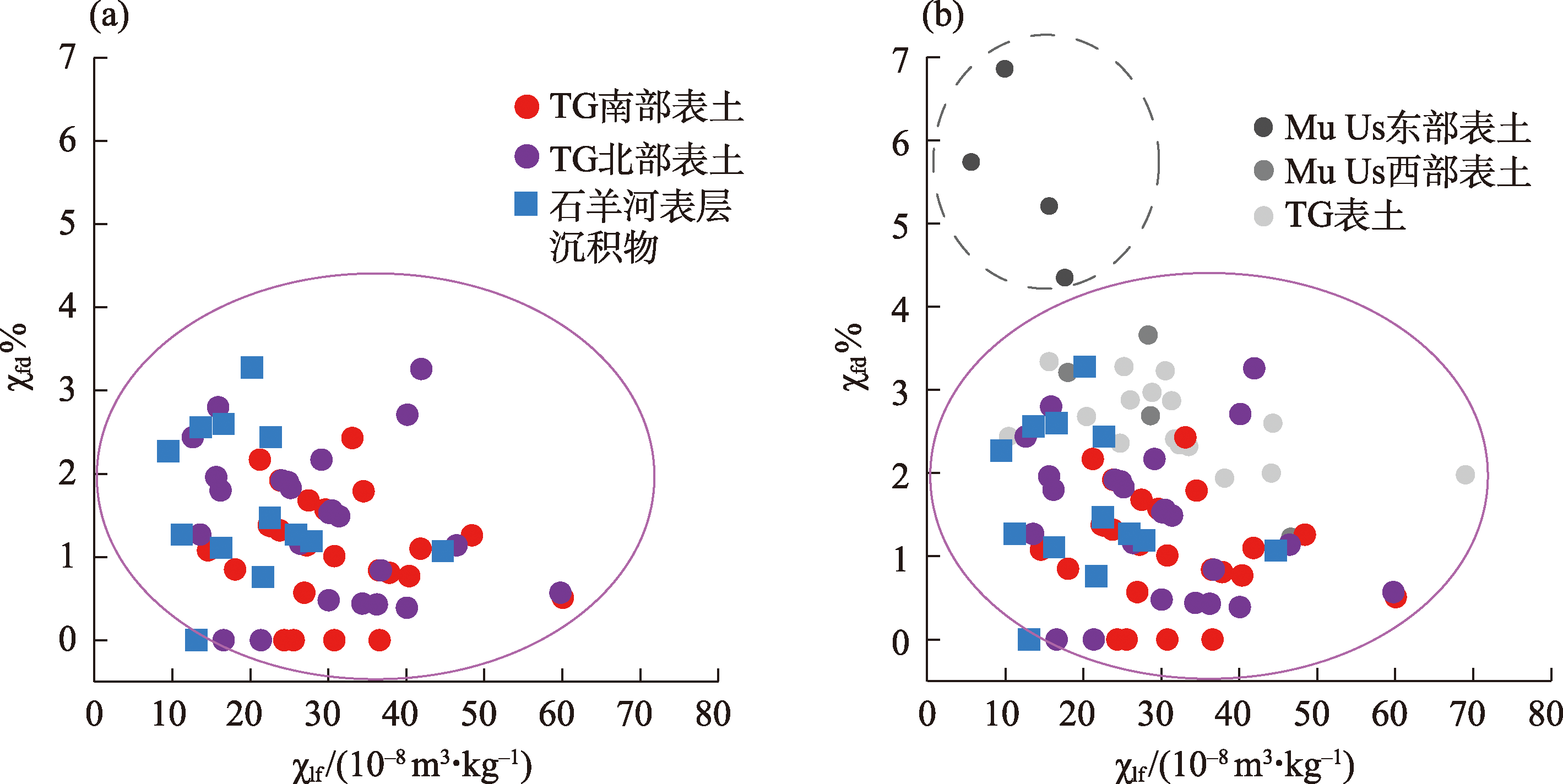
Fig. 4
Plot of χlf vs χfd% for surface soil from the Tengger Desert/Mu Us Desert and surface sediments of the Shiyang River"
| [1] | 黄建平, 季明霞, 刘玉芝, 等. 干旱半干旱区气候变化研究综述[J]. 气候变化研究进展, 2013, 9(1): 9-14. |
| [Huang Jianpin, Ji Mingxia, Liu Yuzhi, et al. An overview of arid and semi-arid climate change[J]. Climate Change Research, 2013, 9(1): 9-14.] | |
| [2] |
陈亚宁, 李玉朋, 李稚, 等. 全球气候变化对干旱区影响分析[J]. 地球科学进展, 2022, 37(2): 111-119.
doi: 10.11867/j.issn.1001-8166.2022.006 |
|
[Chen Yaning, Li Yupeng, Li Zhi, et al. Analysis of the impact of global climate change on dryland areas[J]. Advances in Earth Science, 2022, 37(2): 111-119.]
doi: 10.11867/j.issn.1001-8166.2022.006 |
|
| [3] | Feng S, Fu Q. Expansion of global drylands under a warming climate[J]. Atmospheric Chemistry and Physics, 2013, 13(19): 10081-10094. |
| [4] |
Kok J F, Adebiyi A A, Albani S, et al. Improved representation of the global dust cycle using observational constraints on dust properties and abundance[J]. Atmospheric Chemistry and Physics, 2021, 21(10): 8127-8167.
doi: 10.5194/acp-21-8127-2021 pmid: 37649640 |
| [5] | Uno I, Eguchi K, Yumimoto K, et al. Asian dust transported one full circuit around the globe[J]. Nature Geoscience, 2009, 2(8): 557- 560. |
| [6] | Újvári G, Klötzli U, Stevens T, et al. Greenland ice core record of last glacial dust sources and atmospheric circulation[J]. Journal of Geophysical Research: Atmospheres, 2022, 127(15): e2022JD036597. |
| [7] | Liu Q S, Roberts A P, Larrasoaña J C, et al. Environmental magnetism: principles and applications[J]. Reviews of Geophysics, 2012, 50(4): RG4002. |
| [8] | 邓成龙, 刘青松, 潘永信, 等. 中国黄土环境磁学[J]. 第四纪研究, 2007, 27(2): 193-209. |
| [Deng Chenglong, Liu Qingsong, Pan Yongxin, et al. Environmental magnetism of Chinese Loess-Paleosol sequences[J]. Quaternary Sciences, 2007, 27(2): 193-209.] | |
| [9] | Zan J B, Fang X M, Kang J, et al. Spatial and altitudinal variations in the magnetic properties of eolian deposits in the Northern Tibetan Plateau and its adjacent regions: Implications for delineating the climatic boundary[J]. Earth Science Reviews, 2020, 208: 103271. |
| [10] | Liu C Y, Nie J S, Li Z J, et al. Eccentricity forcing of East Asian monsoonal systems over the past 3 million years[J]. Proceedings of the National Academy of Sciences, 2021, 118(43): e2107055118. |
| [11] |
谷永建, 李玉梅, 韩龙, 等. 中国东部表土磁化率与现代气候因子的关系及其环境意义[J]. 中国科学院大学学报, 2019, 36(4): 498-509.
doi: 10.7523/j.issn.2095-6134.2019.04.009 |
|
[Gu Yongjian, Li Yumei, Han Long, et al. Relationships between surface soil magnetic susceptibility and modern climatic factors in Eastern China and their environmental significance[J]. Journal of University of Chinese Academy of Sciences, 2019, 36(4): 498-509.]
doi: 10.7523/j.issn.2095-6134.2019.04.009 |
|
| [12] | 郭凤战, 迟云平, 谢远云, 等. 浑善达克沙地地表沉积物空间变化特征及其环境意义[J/OL]. 沉积学报, [2024-12-23]. http://www.cjxb.ac.cn/cn/article/doi/10.14027/j.issn.1000-0550.2024.070. |
| [Guo Fengzhan, Chi Yunpin, Xie Yuanyun, et al. The meridional variation characteristics of Iron-bearing minerals in surface sediments of Otindag Sandy Land and its environmental significance[J/OL]. Acta Sedimentologica Sinica, [2024-12-23]. http://www.cjxb.ac.cn/cn/article/doi/10.14027/j.issn.1000-0550.2024.070.] | |
| [13] | 王蜜娇, 迟云平, 谢远云, 等. 松嫩沙地地表沉积物气候代用指标变化特征及其气候意义[J]. 地质科学, 2024, 59(6): 1759-1774. |
| [Wang Mijiao, Chi Yunping, Xie Yuanyun, et al. Variation characteristics and climatic significance of climate proxy indexes of surface sediments in Songnen sandy land[J]. Chinese Journal of Geology, 2024, 59(6): 1759-1774.] | |
| [14] | Long H, Lai Z P, Fuchs M, et al. Timing of Late Quaternary palaeolake evolution in Tengger Desert of Northern China and its possible forcing mechanisms[J]. Global and Planetary Change, 2012, 92: 119-129. |
| [15] | Zhang H Z, Lu H Y, Xu X S, et al. Quantitative estimation of the contribution of dust sources to Chinese Loess using detrital zircon U-Pb age patterns[J]. Journal of Geophysical Research: Earth Surface, 2016, 121(11): 2085-2099. |
| [16] | Jiang Q D, Li Z J, Hao Q Z. Modern sand supply of the Tengger Desert and temporal variations in sand provenance driven by Northern Hemisphere glaciation[J]. Catena, 2022, 214: 106278. |
| [17] | Sun Y B, Tada R, Chen J, et al. Distinguishing the sources of Asian dust based on electron spin resonance signal intensity and crystallinity of quartz[J]. Atmospheric Environment, 2007, 41(38): 8537-8548. |
| [18] | Hällberg L P, Stevens T, Almqvist B, et al. Magnetic susceptibility parameters as proxies for desert sediment provenance[J]. Aeolian Research, 2020, 46: 100615. |
| [19] | 高尚玉, 陈渭南, 靳鹤龄, 等. 全新世中国季风区西北缘沙漠演化初步研究[J]. 中国科学(B辑), 1993, 23(2): 202-208. |
| [Gao Shangyu, Chen Weinan, Jin Heling, et al. Preliminary study on the evolution of deserts at the northwestern margin of the Chinese monsoon region during the Holocene[J]. Science in China (Series B), 1993, 23(2): 202-208.] | |
| [20] | Chen F H, Chen J H, Huang W, et al. Westerlies Asia and monsoonal Asia: Spatiotemporal differences in climate change and possible mechanisms on decadal to sub-orbital timescales[J]. Earth Science Reviews, 2019, 192: 337-354. |
| [21] | 杨小平, 刘东生. 距今30 ka前后我国西北沙漠地区古环境[J]. 第四纪研究, 2003, 23(1): 25-30. |
| [Yang Xiaoping, Liu Dongsheng. Palaeoenvironments in desert regions of Northwest China around 30 ka B. P.[J]. Quaternary Sciences, 2003, 23(1): 25-30.] | |
| [22] | 王萍, 王增光. 阿拉善活动块体的划分及归宿[J]. 地震, 1997, 17(1): 103-112. |
| [Wang Ping, Wang Zengguang. Division of the Alxa block and its attribution[J]. Earthquake, 1997, 17(1): 103-112.] | |
| [23] | 吴正. 中国沙漠及其治理[M]. 北京: 科学出版社, 2009. |
| [Wu Zheng. Sandy Deserts and Its Control in China[M]. Beijing: Science Press, 2009.] | |
| [24] | Peng J, Wang X L, Yin G M, et al. Accumulation of aeolian sediments around the Tengger Desert during the Late Quaternary and its implications on interpreting chronostratigraphic records from drylands in North China[J]. Quaternary Science Reviews, 2022, 275: 107288. |
| [25] | 李育, 张占森, 周雪如, 等. 石羊河流域晚冰期以来环境变化与人类活动[J]. 科学通报, 2023, 68(Z2): 3869-3884. |
| [Li Yu, Zhang Zhansen, Zhou Xueru, et al. Paleo-environmental changes and human activities in Shiyang River Basin since the Late Glacial[J]. Chinese Science Bulletin, 2023, 68(Z2): 3869-3884.] | |
| [26] | Liu B, Zhao H, Yang F, et al. A new aeolian activity proxy based on analysis of the grain size characteristics of surface soils across the Tengger Desert, Northwest China, and its application to a Quaternary aeolian succession[J]. Palaeogeography, Palaeoclimatology, Palaeoecology, 2023, 622: 111594. |
| [27] | Zhang K C, Qu J J, An Z S. Characteristics of wind-blown sand and near-surface wind regime in the Tengger Desert, China[J]. Aeolian Research, 2012, 6: 83-88. |
| [28] | 李再军. 腾格里沙漠腹地钻孔揭示的沙漠形成与古环境演化历史[D]. 兰州: 兰州大学, 2013. |
| [Li Zaijun. Paleoenvironmental Evolution of the Tengger Desert from a Drill Core in Its Interior[D]. Lanzhou: Lanzhou University, 2013.] | |
| [29] |
王颖, 弋双文, 徐志伟, 等. 腾格里沙漠两万年以来典型沉积物钾长石和石英光释光测年对比研究[J]. 中国沙漠, 2023, 43(3): 69-85.
doi: 10.7522/j.issn.1000-694X.2022.00136 |
|
[Wang Ying, Yi Shuangwen, Xu Zhiwei, et al. Quartz OSL and K-feldspar PIRIR dating of typical sediments over the past 20000 years from the Tengger Desert, Northern China[J]. Journal of Desert Research, 2023, 43(3): 69-85.]
doi: 10.7522/j.issn.1000-694X.2022.00136 |
|
| [30] | Li Z J, Sun D H, Chen F H, et al. Chronology and paleoenvironmental records of a drill core in the central Tengger Desert of China[J]. Quaternary Science Reviews, 2014, 85: 85-98. |
| [31] | 刘青松, 邓成龙. 磁化率及其环境意义[J]. 地球物理学报, 2009, 52(4): 1041-1048. |
| [Liu Qingsong, Deng Chenglong. Magnetic susceptibility and its environmental significances[J]. Chinese Journal of Geophysics, 2009, 52(4): 1041-1048.] | |
| [32] | 彭守璋. 中国1 km分辨率逐月降水量数据集(1901—2023)[DB/OL]. 国家青藏高原数据中心, 2020. |
| [Peng Shouzhang. 1 km monthly precipitation dataset for China (1901-2023)[DB/OL]. National Tibetan Plateau/Third Pole Environment Data Center, 2020.] | |
| [33] | 吕厚远, 韩家懋, 吴乃琴, 等. 中国现代土壤磁化率分析及其古气候意义[J]. 中国科学(B辑), 1994, 24(12): 1290-1297. |
| [Lv Houyuan, Han Jiamao, Wu Naiqin, et al. Analysis of magnetic susceptibility of modern soils in China and its paleoclimate significance[J]. Science in China (Series B), 1994, 24(12): 1290-1297.] | |
| [34] | Balsam W L, Ellwood B B, Ji J F, et al. Magnetic susceptibility as a proxy for rainfall: Worldwide data from tropical and temperate climate[J]. Quaternary Science Reviews, 2011, 30(19-20): 2732-2744. |
| [35] | Liu Z F, Liu Q, S Torrent J, et al. Testing the magnetic proxy χFD/HIRM for quantifying paleoprecipitation in modern soil profiles from Shaanxi Province, China[J]. Global and Planetary Change, 2013, 110: 368-378. |
| [36] | Song Y, Hao Q Z, Ge J Y, et al. Quantitative relationships between magnetic enhancement of modern soils and climatic variables over the Chinese Loess Plateau[J]. Quaternary International, 2014, 334: 119-131. |
| [37] | 孙东怀, 周杰, 吴锡浩. 全新世气候适宜期黄土高原及黄土/沙漠过渡区年降水量的初步恢复[J]. 中国沙漠, 1995, 15(4): 339-344. |
| [Sun Donghuai, Zhou Jie, Wu Xihao. Preliminary reconstruction of annual rainfall in loess plateau and loess-desert transitional regions in suitable climatic period of Holocene[J]. Journal of Desert Research, 1995, 15(4): 339-344.] | |
| [38] | 宋扬, 郝青振, 葛俊逸, 等. 黄土高原表土磁化率与气候要素的定量关系研究[J]. 第四纪研究, 2012, 32(4): 679-689. |
| [Song Yang, Hao Qingzhen, Ge Junyi, et al. Quantitative relationships between modern soil magnetic susceptibility and climatic variables of the Chinese Loess Plateau[J]. Quaternary Sciences, 2012, 32(4): 679-689.] | |
| [39] | Geiss C E, Zanner C W. Sediment magnetic signature of climate in modern loessic soils from the Great Plains[J]. Quaternary International, 2007, 162: 97-110. |
| [40] | Maher B A, Alekseev A, Alekseeva T. Variation of soil magnetism across the Russian steppe: Its significance for use of soil magnetism as a palaeorainfall proxy[J]. Quaternary Science Reviews, 2002, 21(14-15): 1571-1576. |
| [41] | Liu Q S, Torrent J, Maher B A, et al. Quantifying grain size distribution of pedogenic magnetic particles in Chinese Loess and its significance for pedogenesis[J]. Journal of Geophysical Research: Solid Earth, 2005, 110(B11): B11102. |
| [42] | Liu Q S, Jackson M J, Yu Y, et al. Grain size distribution of pedogenic magnetic particles in Chinese Loess/Paleosols[J]. Geophysical Research Letters, 2004, 31(22): L22603. |
| [43] | Dearing J A, Dann R J L, Hay K, et al. Frequency-dependent susceptibility measurements of environmental materials[J]. Geophysical Journal International, 1996, 124(1): 228-240. |
| [44] | Maher B A, Thompson R. Paleorainfall reconstructions from pedogenic magnetic susceptibility variations in the Chinese Loess and Paleosols[J]. Quaternary Research, 1995, 44(3): 383-391. |
| [45] | Long X Y, Ji J F, Balsam W L. Rainfall-dependent transformations of iron oxides in a tropical saprolite transect of Hainan Island, South China: Spectral and magnetic measurements[J]. Journal of Geophysical Research: Earth Surface, 2011, 116(F3): F03015. |
| [46] | 胡鹏翔, 刘青松. 磁性矿物在成土过程中的生成转化机制及其气候意义[J]. 第四纪研究, 2014, 34(3): 458-473. |
| [Hu Pengxiang, Liu Qingsong. The production and transformation of magnetic minerals during pedogenesis and its paleoclimate significance[J]. Quaternary Sciences, 2014, 34(3): 458-473.] | |
| [47] | Jiang Z X, Liu Q S, Roberts A P, et al. A new model for transformation of ferrihydrite to hematite in soils and sediments[J]. Geology, 2018, 46(11): 987-990. |
| [48] | Chen T H, Xu H F, Xie Q Q, et al. Characteristics and genesis of maghemite in Chinese Loess and Paleosols: Mechanism for magnetic susceptibility enhancement in paleosols[J]. Earth and Planetary Science Letters, 2005, 240(3-4): 790-802. |
| [49] | 刘秀铭, 夏敦胜, 刘东生, 等. 中国黄土和阿拉斯加黄土磁化率气候记录的两种模式探讨[J]. 第四纪研究, 2007, 27(2): 210-220. |
| [Liu Xiuming, Xia Dunsheng Liu Dongsheng, et al. Discussion on two models of paleoclimatic records of magnetic susceptibility of Alaskan and Chinese loess[J]. Quaternary Sciences, 2007, 27(2): 210-220.] | |
| [50] | Chlachula J, Evans M E, Rutter N W. A magnetic investigation of a Late Quaternary Loess/Palaeosol record in Siberia[J]. Geophysical Journal International, 1998, 132(1): 128-132. |
| [51] | Orgeira M J, Walther A M, Vásquez C A, et al. Mineral magnetic record of paleoclimate variation in Loess and Paleosol from the Buenos Aires formation (Buenos Aires, Argentina)[J]. Journal of South American Earth Sciences, 1998, 11(6): 561-570. |
| [52] | 魏海涛, 夏敦胜, 陈发虎, 等. 黄土高原及相邻地区表土磁化率与降水量的关系[J]. 冰川冻土, 2008, 30(3): 433-439. |
| [Wei Haitao, Xia Dunsheng, Chen Fahu, et al. Relationship between the magnetic susceptibility of surface soil and precipitation of Loess Plateau and adjacent area[J]. Journal of Glaciology and Geocryology, 2008, 30(3): 433-439.] | |
| [53] | 李平原, 刘秀铭, 郭雪莲, 等. 西北戈壁沙漠-黄土高原区表土磁化率特征及其意义[J]. 第四纪研究, 2013, 33(2): 360-367. |
| [Li Pingyuan, Liu Xiuming, Guo Xuelian, et al. The magnetic susceptibility properties of top soil’s in Gobi-Loess Plateau, Northwest China[J]. Quaternary Sciences, 2013, 33(2): 360-367.] | |
| [54] | 张占森, 李育, 高铭君, 等. 祁连山及周边地区沉积物磁化率指示意义[J]. 兰州大学学报(自然科学版), 2023, 59(4): 489-499. |
| [Zhang Zhansen, Li Yu, Gao Mingjun, et al. Magnetic susceptibility indicators of sediments in the Qilian Mountains and the surrounding areas[J]. Journal of Lanzhou University (Natural Sciences), 2023, 59(4): 489-499.] | |
| [55] | Thompson R, Oldfield F. Environmental Magnetism[M]. London: Allen and Unwin, 1986: 1-227. |
| [56] | Wei H T, Xia D S, Chen F H, et al. Magnetic characteristics of topsoil from Xinjiang, Northwestern China, and their implications[J]. Frontiers of Earth Science in China, 2009, 3: 259-265. |
| [57] | 罗超, 郑妍, 郑洪波, 等. 长江流域悬浮物磁性特征及其物源指示意义[J]. 第四纪研究, 2013, 33(4): 684-696. |
| [Luo Chao, Zheng Yan, Zheng Hongbo, et al. Magnetic properties of suspended sediment in the Yangtze River and its provenance implications[J]. Quaternary Sciences, 2013, 33(4): 684-696.] | |
| [58] | 肖春凤, 孙启顺, 陈亮, 等. 南海西北部 16 kaBP 以来沉积物的环境磁学特征及其物源指示意义[J]. 海洋地质与第四纪地质, 2023, 43(1): 13-26. |
| [Xiao Chunfeng, Sun Qishun, Chen Liang, et al. Environmental magnetic characteristics and provenance significance of sediments in NW South China Sea since the past 16 ka[J]. Marine Geology and Quaternary Geology, 2023, 43(1): 13-26.] | |
| [59] | 昝金波, 方小敏, 聂军胜, 等. 塔里木盆地风积物表土磁学特征及其与物源物质、气候条件的关系[J]. 科学通报, 2011, 56(2): 153-160. |
| [Zan Jinbo, Fang Xiaomin, Nie Junsheng, et al. Magnetic characteristics of surface soils in aeolian deposits of the Tarim Basin and their relationship with provenance materials and climatic conditions[J]. Chinese Science Bulletin, 2011, 56(2): 153-160.] | |
| [60] | Liu Q S, Sun Y B, Qiang X K, et al. Characterizing magnetic mineral assemblages of surface sediments from major Asian dust sources and implications for the Chinese Loess magnetism[J]. Earth, Planets and Space, 2015, 67: 1-17. |
| [61] | Stevens T, Carter A, Watson T P, et al. Genetic linkage between the Yellow River, the Mu Us Desert and the Chinese Loess Plateau[J]. Quaternary Science Reviews, 2013, 78: 355-368. |
| [62] | Bird A, Stevens T, Rittner M, et al. Quaternary dust source variation across the Chinese Loess Plateau[J]. Palaeogeography, Palaeoclimatology, Palaeoecology, 2015, 435: 254-264. |
| [63] | Licht A, Dupont-Nivet G, Pullen A, et al. Resilience of the Asian atmospheric circulation shown by Paleogene dust provenance[J]. Nature Communications, 2016, 7(1): 12390. |
| [64] | Nie J S, Stevens T, Rittner M, et al. Loess plateau storage of Northeastern Tibetan Plateau-derived Yellow River sediment[J]. Nature Communications, 2015, 6(1): 8511. |
| [65] | Li M T, Nie J S, Li Z J, et al. A middle Pleistocene to Holocene perspective on sediment sources for the Tengger Desert, China[J]. Catena, 2023, 228: 107119. |
| [66] | 张瀚之, 鹿化煜, 弋双文, 等. 中国北方沙漠/沙地锆石形态特征及其对物源的指示[J]. 第四纪研究, 2013, 33(2): 334-344. |
| [Zhang Hanzhi, Lu Huayu, Yi Shuangwen, et al. Zircon typological analyses of the major deserts/sand fields in Northern China and its implication for identifying sediment source[J]. Quaternary Sciences, 2013, 33(2): 334-344.] | |
| [67] | Fan Y X, Li Z J, Wang F, et al. Provenance variations of the Tengger Desert since 2.35 Ma and its linkage with the Northern Tibetan Plateau: Evidence from U-Pb age spectra of detrital zircons[J]. Quaternary Science Reviews, 2019, 223: 105916. |
| [68] | Pullen A, Kapp P, McCallister A T, et al. Qaidam Basin and Northern Tibetan Plateau as dust sources for the Chinese Loess Plateau and paleoclimatic implications[J]. Geology, 2011, 39(11): 1031-1034. |
| [69] | 李平原, 刘秀铭, 刘植, 等. 腾格里沙漠边缘表土磁学性质及其意义[J]. 第四纪研究, 2012, 32(4): 771-776. |
| [Li Pingyuan, Liu Xiuming, Liu Zhi, et al. The magnetic properties of topsoil from the edge of Tengger Desert, and its environmental significance[J]. Quaternary Sciences, 2012, 32(4): 771-776.] | |
| [70] |
李育, 王乃昂, 李卓仑, 等. 猪野泽中全新世干旱事件时空范围和机制[J]. 地理科学, 2012, 32(6): 731-738.
doi: 10.13249/j.cnki.sgs.2012.06.731 |
|
[Li Yu, Wang Nai’ang, Li Zhuolun, et al. The spatial and time scales for the dry Mid-Holocene event in Zhuye Lake[J]. Scientia Geographica Sinica, 2012, 32(6): 731-738.]
doi: 10.13249/j.cnki.sgs.2012.06.731 |
|
| [71] |
Wang Z, Wei J, Peng W, et al. Contents and spatial distribution patterns of heavy metals in the hinterland of the Tengger Desert, China[J]. Journal of Arid Land, 2022, 14(10): 1086-1098.
doi: 10.1007/s40333-022-0027-7 |
| [72] | 王友郡. 基于铁磁性矿物证据的中国黄土高原西部黄土物源解析[D]. 兰州: 兰州大学, 2019. |
| [Wang Youjun. Provenance Tracing of Loess in Western Chinese Loess Plateau Evidence from the Iron Mineralogy[D]. Lanzhou: Lanzhou University, 2019.] | |
| [73] | 杨仁超, 李进步, 樊爱萍, 等. 陆源沉积岩物源分析研究进展与发展趋势[J]. 沉积学报, 2013, 31(1): 99-107. |
| [Yang Renchao, Li Jinbu, Fan Aiping, et al. Research progress and development tendency of provenance analysis on terrigenous sedimentary rocks[J]. Acta Sedimentologica Sinica, 2013, 31(1): 99-107.] | |
| [74] | 王双, 王永红. 黄渤海表层沉积物环境磁学特征分类及物源诊断[J]. 第四纪研究, 2016, 36(1): 216-226. |
| [Wang Shuang, Wang Yonghong. Magnetic properties and provenance of surface sediments in the Bohai and Yellow Seas[J]. Quaternary Sciences, 2016, 36(1): 216-226.] | |
| [75] | 张国程. 天山山地表土磁性空间分异特征探究[D]. 杭州: 浙江师范大学, 2023. |
| [Zhang Guocheng. Study on Magnetic Differentiation of Topsoil in Tianshan Mountains[D]. Hangzhou: Zhejiang Normal University, 2023.] | |
| [76] | 刘东生, 安芷生, 袁宝印. 中国的黄土与风尘堆积[J]. 第四纪研究, 1985, 6(1): 113-125. |
| [Liu Dongsheng, An Zhisheng, Yuan Baoyin. Eolian process and dust mantle (Loess) in China[J]. Quaternary Sciences, 1985, 6(1): 113-125.] | |
| [77] | Sun J M. Source regions and formation of the Loess sediments on the high mountain regions of Northwestern China[J]. Quaternary Research, 2002, 58(3): 341-351. |
| [78] | Liu C Q, Masuda A, Okada A, et al. Isotope geochemistry of Quaternary deposits from the arid lands in Northern China[J]. Earth and Planetary Science Letters, 1994, 127(1-4): 25-38. |
| [79] | Chen J, Li G J, Yang J D, et al. Nd and Sr isotopic characteristics of Chinese deserts: Implications for the provenances of Asian dust[J]. Geochimica et Cosmochimica Acta, 2007, 71(15): 3904-3914. |
|
||
