
干旱区研究 ›› 2025, Vol. 42 ›› Issue (8): 1536-1548.doi: 10.13866/j.azr.2025.08.16 cstr: 10.13866/j.azr.2025.08.16
• 农业生态 • 上一篇
张乐1,2( ), 韩云飞1,3,4, 李保成1,3,4, 杜二小1,3, 张鹏1,3, 白梓辰1, 王艳莉5, 赵沛义1,2,3, 任永峰1,3,4()
收稿日期:2024-11-28
修回日期:2025-03-25
出版日期:2025-08-15
发布日期:2025-11-24
通讯作者:
任永峰. E-mail: renyongfeng_1984@163.com作者简介:张乐(1999-),女,硕士研究生,主要从事旱地作物栽培与生理生态研究. E-mail: LeLeLe@email.imau.edu.cn
基金资助:
ZHANG Le1,2(), HAN Yunfei1,3,4, LI Baocheng1,3,4, DU Erxiao1,3, ZHANG Peng1,3, BAI Zichen1, WANG Yanli5, ZHAO Peiyi1,2,3, REN Yongfeng1,3,4()
Received:2024-11-28
Revised:2025-03-25
Published:2025-08-15
Online:2025-11-24
摘要: 针对内蒙古阴山北麓旱作区作物水分利用率低和土壤保水能力差等问题,探求旱作区有机培肥改土管理措施,对马铃薯土壤蓄水和作物耗水形成优化方案。通过两年田间随机区组试验,设置传统施肥(CK)、化肥减量配施羊粪(NPK+SD)、化肥减量配施生物炭(NPK+B)、化肥减量配施微生物菌肥(NPK+MF)共4个处理,分析化肥减量配施有机肥对促进马铃薯生长发育、优化生育阶段耗水比例、提升水分利用效率的影响。结果表明:(1) NPK+MF处理下干物质积累量在淀粉积累期达到最大,较CK显著提升41.58%;NPK+MF处理下,增加了0~60 cm土层的土壤含水率,提高了土壤贮水量,同时增大了马铃薯生育期耗水量6.56%;播种-苗期阶段NPK+MF处理下平均耗水量、耗水模系数和耗水强度分别较CK显著降低14.61%、21.84%和14.60%;在块茎形成-膨大阶段耗水达到最大,该阶段NPK+MF处理下平均耗水量、耗水模系数和耗水强度比CK显著提高9.17%、3.34%和9.17%。(2) 相比于CK,NPK+MF处理下平均单薯重、单株结薯重和商品薯率分别显著增加了15.42%、25.57%和29.67%。NPK+MF处理下与CK相比产量、水分利用效率和经济效益分别显著提高了25.52%、17.81%和30.59%;较NPK+SD处理下分别显著提高13.26%、8.72%和14.41%,较NPK+B处理下分别显著提高了12.26%、8.42%和7.52%。可见,在内蒙古阴山北麓旱作区马铃薯生产中,化肥减量配施微生物菌肥措施不仅能调节马铃薯生育阶段耗水比例,一定程度上缓解马铃薯植株后期对水分的需求,还可以增加单位耗水下的产量。
张乐, 韩云飞, 李保成, 杜二小, 张鹏, 白梓辰, 王艳莉, 赵沛义, 任永峰. 有机培肥措施对马铃薯耗水特性及水分利用的影响——以内蒙古阴山北麓旱作区为例[J]. 干旱区研究, 2025, 42(8): 1536-1548.
ZHANG Le, HAN Yunfei, LI Baocheng, DU Erxiao, ZHANG Peng, BAI Zichen, WANG Yanli, ZHAO Peiyi, REN Yongfeng. Effects of organic fertilization measures on potato water consumption characteristics and water use efficiency: A case study from the rainfed agricultural region at the northern foot of Yinshan Mountain, Inner Mongolia[J]. Arid Zone Research, 2025, 42(8): 1536-1548.
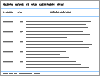
表1
试验地农田土壤养分状况"
| 土层/cm | 碱解氮/(mg∙kg-1) | 有效磷/(mg∙kg-1) | 速效钾/(mg∙kg-1) | 有机质/(g∙kg-1) | pH值 |
|---|---|---|---|---|---|
| 0~20 | 36.7 | 9.2 | 117.1 | 11.6 | 8.38 |
表2
试验地农田土壤容重"
| 土层/cm | 2022年土壤容重/(g∙cm-3) | 2023年土壤容重/(g∙cm-3) |
|---|---|---|
| 0~10 | 1.35 | 1.36 |
| 10~20 | 1.34 | 1.35 |
| 20~30 | 1.36 | 1.36 |
| 30~40 | 1.36 | 1.37 |
| 40~50 | 1.36 | 1.37 |
| 50~60 | 1.37 | 1.38 |
| 60~70 | 1.38 | 1.39 |
| 70~80 | 1.39 | 1.40 |
| 80~90 | 1.40 | 1.42 |
| 90~100 | 1.43 | 1.44 |
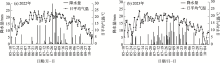
图1
2022—2023年马铃薯生长季降雨及气温"

表3
不同处理马铃薯干物质积累量变化"
| 年份 | 处理 | 苗期/(g∙株-1) | 块茎形成期/(g∙株-1) | 块茎膨大期/(g∙株-1) | 淀粉积累期/(g∙株-1) | 成熟期/(g∙株-1) |
|---|---|---|---|---|---|---|
| 2022年 | CK | 15.01±0.19c | 36.42±0.19c | 97.45±2.15d | 152.11±2.21d | 132.48±3.03c |
| NPK+SD | 17.91±0.31b | 46.50±0.54b | 118.44±1.54b | 175.54±2.35c | 151.34±4.23b | |
| NPK+B | 17.02±0.21b | 44.09±0.68b | 109.24±2.54c | 187.15±2.35b | 158.46±2.92b | |
| NPK+MF | 19.53±0.90a | 51.92±0.46a | 126.44±2.69a | 208.14±2.64a | 181.79±3.52a | |
| 2023年 | CK | 18.12±0.13c | 47.77±0.51c | 101.46±0.96d | 150.78±3.54d | 139.64±3.73d |
| NPK+SD | 19.88±0.10b | 57.88±1.45b | 113.58±0.59b | 196.69±1.40b | 176.57±2.12b | |
| NPK+B | 18.64±0.28c | 57.39±1.10b | 110.88±1.47c | 182.84±4.04c | 158.24±3.53c | |
| NPK+MF | 21.01±0.33a | 62.92±1.25a | 117.96±2.83a | 220.66±4.02a | 192.08±5.47a |
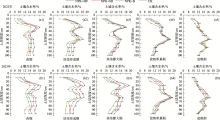
图2
培肥措施对马铃薯农田土壤含水率的影响注:图中误差棒为标准误差。"

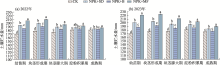
图3
培肥措施对马铃薯农田土壤贮水量的影响注:误差棒为准确误差;不同小写字母表示同一生育时期不同施肥措施差异显著(P<0.05),多重比较采用Duncan法。下同。"
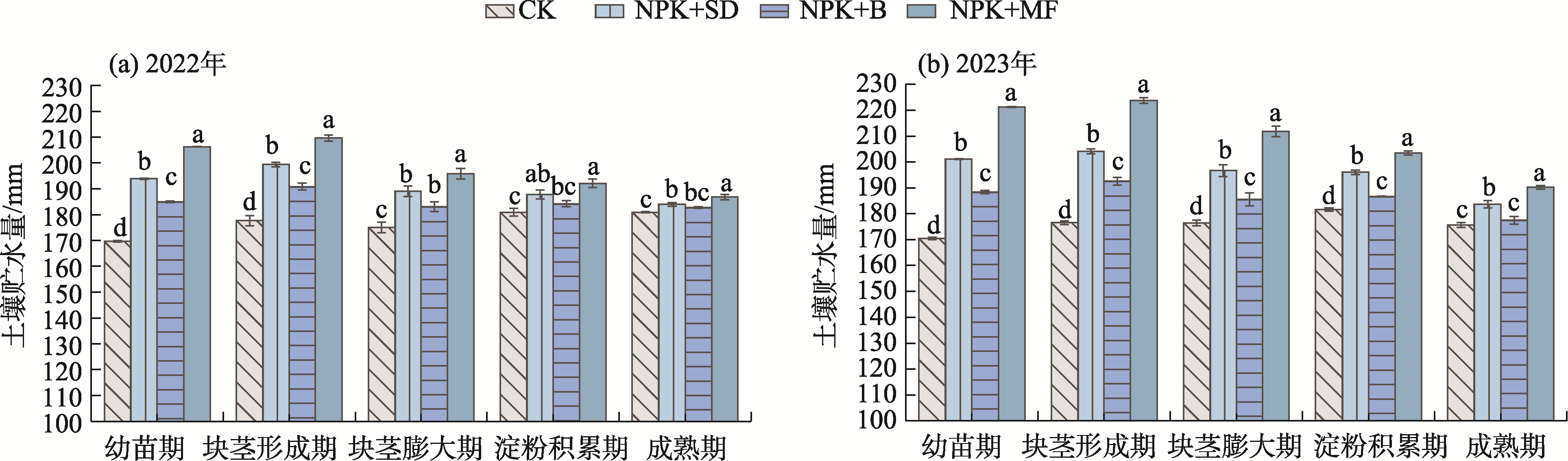
表4
培肥措施对马铃薯总耗水量及其分配的影响"
| 年份 | 处理 | 总耗水量/mm | 降雨量/mm | 降水比例/% | 灌溉量/mm | 灌溉比例/% | 土壤贮水消耗/mm | 土壤贮水消耗比例/% |
|---|---|---|---|---|---|---|---|---|
| 2022年 | CK | 349.26±0.51d | 247.9 | 70.98±0.10a | 90 | 25.77±0.07a | 11.36±0.51c | 3.25±0.14d |
| NPK+SD | 366.76±1.27b | 247.9 | 67.59±0.23b | 90 | 24.54±0.09c | 28.86±1.27b | 7.87±0.32b | |
| NPK+B | 360.36±1.01c | 247.9 | 68.79±0.19c | 90 | 24.98±0.07b | 22.46±1.00c | 6.23±0.26c | |
| NPK+MF | 375.29±1.46a | 247.9 | 66.06±0.26d | 90 | 23.98±0.09d | 37.39±1.46d | 9.96±0.35a | |
| 2023年 | CK | 388.94±1.26c | 282.3 | 72.58±0.23a | 90 | 23.14±0.08a | 16.64±1.26c | 4.28±0.31c |
| NPK+SD | 405.57±0.74b | 282.3 | 69.61±0.13b | 90 | 22.19±0.04b | 33.27±0.74b | 8.20±0.17b | |
| NPK+B | 402.02±1.91b | 282.3 | 70.22±0.33b | 90 | 22.39±0.11b | 29.72±1.91bc | 7.39±0.44b | |
| NPK+MF | 411.31±0.67a | 282.3 | 68.63±0.11c | 90 | 21.88±0.04c | 39.01±0.67a | 9.49±0.15a |
表5
培肥措施对马铃薯生育阶段耗水量及其耗水模系数的影响"
| 指标 | 年份 | 处理 | 播种-苗期 | 苗期-块茎形成期 | 块茎形成期-块茎膨大期 | 块茎膨大期-淀粉积累期 | 淀粉积累期-成熟期 |
|---|---|---|---|---|---|---|---|
| 阶段耗水量/mm | 2022年 | CK | 60.85±0.43a | 45.22±2.14a | 121.81±0.22c | 80.77±0.82d | 40.61±0.96c |
| NPK+SD | 56.91±0.34bc | 47.87±1.12a | 129.40±1.18b | 87.99±0.34b | 44.60±1.02ab | ||
| NPK+B | 58.26±0.99b | 47.35±1.03a | 126.96±0.64b | 85.56±0.61c | 42.23±0.96bc | ||
| NPK+MF | 55.92±0.32c | 50.07±1.18a | 132.84±1.10a | 90.36±0.57a | 46.09±0.70a | ||
| 2023年 | CK | 77.84±1.41a | 42.59±0.36b | 127.92±0.54c | 98.40±0.54b | 42.19±1.08b | |
| NPK+SD | 73.14±0.74b | 45.85±0.84a | 135.22±1.43b | 104.08±1.64b | 47.28±0.92a | ||
| NPK+B | 76.16±1.84ab | 44.57±1.03ab | 134.78±1.23b | 102.45±2.42b | 44.05±0.83b | ||
| NPK+MF | 65.09±0.78c | 46.07±1.07a | 139.80±1.16a | 111.85±2.71a | 48.50±0.61a | ||
| 耗水模系数/% | 2022年 | CK | 17.42±0.10a | 12.95±0.56a | 34.87±0.02a | 23.13±0.27b | 11.63±0.48a |
| NPK+SD | 15.52±0.05c | 13.05±0.26a | 35.28±0.20a | 23.99±0.18a | 12.16±0.32a | ||
| NPK+B | 16.16±0.22b | 13.14±0.25a | 35.23±0.13a | 23.75±0.24ab | 11.72±0.29a | ||
| NPK+MF | 14.90±0.04d | 13.34±0.27a | 35.40±0.19a | 24.08±0.22a | 12.28±0.23a | ||
| 2023年 | CK | 20.01±0.30a | 10.95±0.09b | 32.89±0.16b | 25.30±0.22a | 10.85±0.28c | |
| NPK+SD | 18.03±0.17c | 11.31±0.21a | 33.34±0.31ab | 25.67±0.42a | 11.65±0.23ab | ||
| NPK+B | 18.94±0.37b | 11.09±0.21a | 33.52±0.18ab | 25.49±0.72a | 10.96±0.18bc | ||
| NPK+MF | 15.82±0.17d | 11.20±0.25a | 33.99±0.22a | 27.20±0.70a | 11.79±0.13a |
表6
培肥措施对马铃薯各生育期耗水强度的影响"
| 年份 | 处理 | 耗水强度/(mm·d-1) | ||||
|---|---|---|---|---|---|---|
| 播种-苗期 | 苗期-块茎形成期 | 块茎形成期-块茎膨大期 | 块茎膨大期-淀粉积累期 | 淀粉积累期-成熟期 | ||
| 2022年 | CK | 1.96±0.01a | 1.51±0.074c | 3.93±0.01c | 2.61±0.03c | 1.36±0.05c |
| NPK+SD | 1.84±0.01b | 1.60±0.04a | 4.17±0.04b | 2.84±0.01b | 1.49±0.04a | |
| NPK+B | 1.88±0.03bc | 1.58±0.04b | 4.10±0.01b | 2.76±0.02b | 1.41±0.03b | |
| NPK+MF | 1.80±0.01c | 1.67±0.04a | 4.28±0.04a | 2.92±0.02a | 1.54±0.03a | |
| 2023年 | CK | 2.51±0.05a | 1.42±0.02b | 4.13±0.02c | 3.17±0.02b | 1.41±0.04b |
| NPK+SD | 2.36±0.02b | 1.53±0.03a | 4.36±0.05b | 3.36±0.05b | 1.58±0.03a | |
| NPK+B | 2.46±0.06ab | 1.49±0.03ab | 4.35±0.04b | 3.21±0.07b | 1.47±0.03b | |
| NPK+MF | 2.10±0.02c | 1.54±0.04a | 4.51±0.04a | 3.61±0.09a | 1.62±0.02a | |
表7
不同培肥方式对马铃薯产量和水分利用效率的影响"
| 年份 | 处理 | 产量/(kg∙hm-2) | 单薯重/g | 单株结薯数/个 | 单株结薯/g | 商品薯率/% | 水分利用效率/(kg∙hm-2∙mm-1) | 单位耗水下增产量/(kg∙hm-2∙mm-1) |
|---|---|---|---|---|---|---|---|---|
| 2022年 | CK | 30905c | 149.49c | 4a | 650.28c | 39.18c | 88.49c | - |
| NPK+SD | 35915b | 161.46b | 5a | 747.56b | 46.53b | 97.94b | 286.42b | |
| NPK+B | 34389b | 156.03b | 5a | 713.06b | 43.71b | 95.44b | 314.13a | |
| NPK+MF | 39375a | 171.27a | 5a | 837.51a | 50.95a | 104.92a | 325.59a | |
| 2023年 | CK | 32916c | 163.88c | 5a | 771.87c | 40.69c | 84.63c | - |
| NPK+SD | 36368b | 183.42b | 5a | 893.26b | 47.92b | 89.67b | 207.58c | |
| NPK+B | 37256b | 178.98b | 5a | 857.31b | 45.11b | 92.67b | 331.88a | |
| NPK+MF | 40732a | 190.41a | 5a | 948.24a | 52.62a | 99.03a | 349.32a |
表8
不同培肥措施下马铃薯经济效益"
| 年份 | 处理 | 产量收入/(元·hm-2) | 农业投入 | 经济效益/(元·hm-2) | 产投比 | |
|---|---|---|---|---|---|---|
| 肥料/(元·hm-2) | 其他/(元·hm-2) | |||||
| 2022年 | CK | 49448c | 4084c | 27450a | 17914c | 1.57b |
| NPK+SD | 57464b | 8040b | 27450a | 21974b | 1.62a | |
| NPK+B | 55022b | 8876b | 27450a | 18696c | 1.51c | |
| NPK+MF | 63000a | 11140a | 27450a | 24410a | 1.63a | |
| 2023年 | CK | 52665c | 4084c | 27450a | 21132c | 1.67b |
| NPK+SD | 58188b | 8040b | 27450a | 22699b | 1.64b | |
| NPK+B | 59609b | 8876b | 27450a | 23284b | 1.64b | |
| NPK+MF | 65171a | 11140a | 27450a | 26581a | 1.69a | |
表9
马铃薯干物质积累量速率与阶段耗水间的回归方程"
| 处理 | 回归方程 | R2 |
|---|---|---|
| CK | y=-0.0002x2+0.0504x-1.7517 | 0.7068 |
| NPK+SD | y=-0.0004x2+0.0899x-3.3007 | 0.6814 |
| NPK+B | y=-0.0005x2+0.1111x-4.0604 | 0.6889 |
| NPK+MF | y=-0.0007x2+0.1514x-5.6281 | 0.7155 |
图4
马铃薯干物质积累量速率与阶段耗水间关系 注:图中拟合线表示各处理下的数据散点,通过回归分析拟合的连续曲线。"
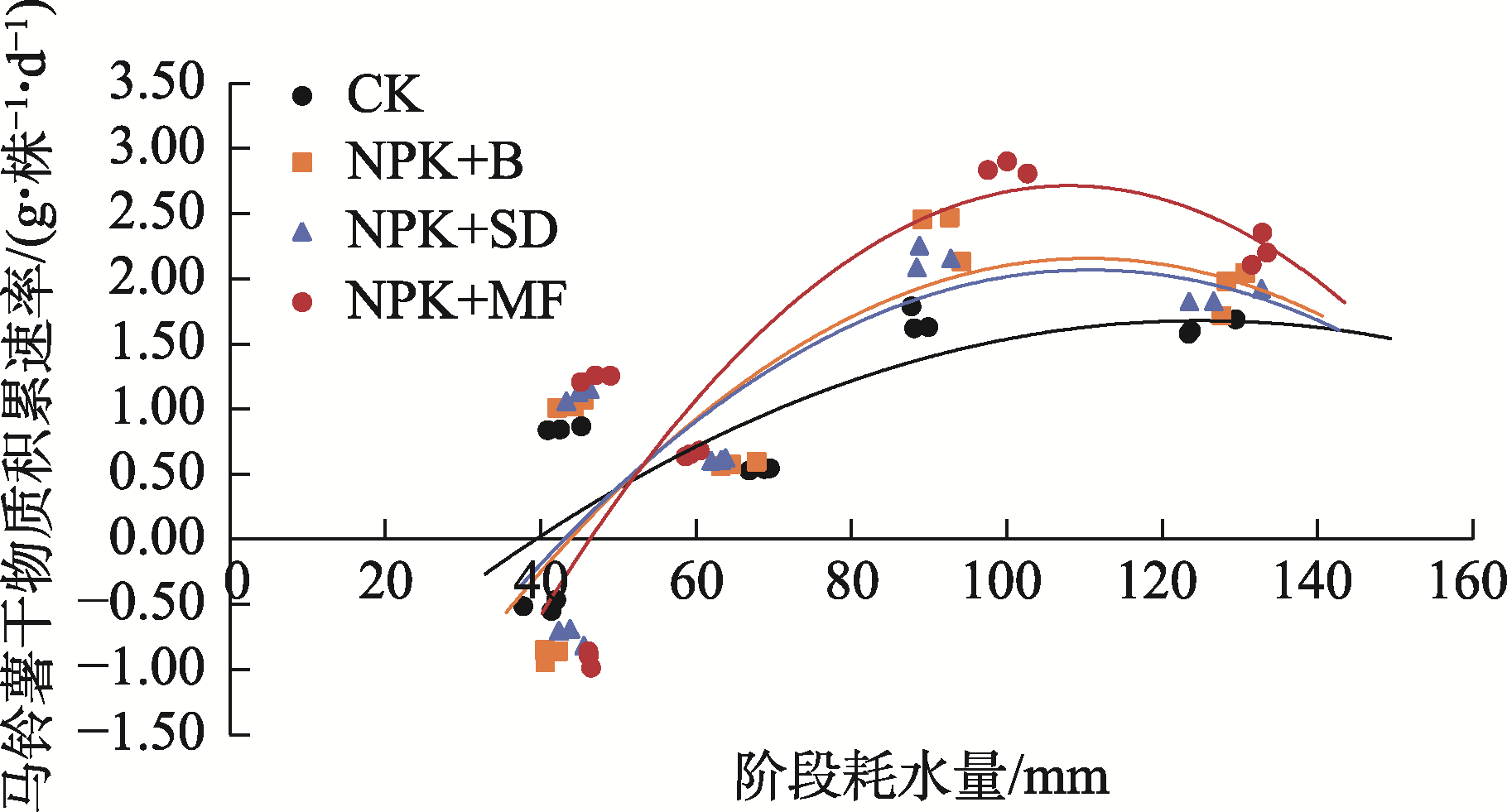
表10
马铃薯耗水量、水分利用效率与产量的相关性"
| 相关系数 | 单薯重 | 单株结薯数 | 单株结薯重 | 商品薯率 | 干物质量 | 产量 |
|---|---|---|---|---|---|---|
| 耗水量 | 0.997** | 0.979* | 0.991** | 0.989* | 0.984* | 0.977* |
| 水分利用效率 | 0.971* | 0.982* | 0.978* | 0.969* | 0.992** | 0.998** |
| [1] | 何蒲明, 狄书非. 生态安全与粮食安全并重导向下马铃薯主粮化发展路径研究[J]. 农业经济, 2019, 39(6): 12-14. |
| [He Puming, Di Shufei. Research on the development path of potato as a staple food under the dual guidance of ecological security and food security[J]. Agricultural Economy, 2019, 39(6): 12-14.] | |
| [2] | 龙蔚, 张德亮, 李淑萍, 等. 中国马铃薯产业竞争力实证分析[J]. 世界农业, 2018, 40(8): 189-196. |
| [Long Wei, Zhang Deliang, Li Shuping, et al. Empirical analysis on competitiveness of potato industry in China[J]. World Agriculture, 2018, 40(8): 189-196.] | |
| [3] | 杨永海. 内蒙古马铃薯产业高质量发展探索[J]. 现代农业, 2022, 48(6): 74-76. |
| [Yang Yonghai. Exploration on high-quality development of potato industry in Inner Mongolia[J]. Modern Agriculture, 2022, 48(6): 74-76.] | |
| [4] | 石晓华, 段跃, 杨慧民, 等. 内蒙古阴山北麓地区马铃薯生产制约因素分析及对策研究[J]. 农业科技通讯, 2015(3): 220-224. |
| [Shi Xiaohua, Duan Yue, Yang Huimin, et al. Analysis and countermeasure research on restrictive factors of potato production in the northern foot of Yinshan Mountain in Inner Mongolia[J]. Bulletin of Agricultural Science and Technology, 2015(3): 220-224.] | |
| [5] | 王进, 戴爱国, 刘必友. 推动化肥农药减量使用的途径与措施[J]. 农业科技通讯, 2020, 51(12): 20-22. |
| [Wang Jin, Dai Aiguo, Liu Biyou. Ways and measures to promote the reduction of chemical fertilizer and pesticide use[J]. Bulletin of Agricultural Science and Technology, 2020, 51(12): 20-22.] | |
| [6] | 张龙华. 探析农业可持续发展中的土壤肥料问题与对策[J]. 种子科技, 2019, 37(18): 115-118. |
| [Zhang Longhua. Analysis of soil fertilizer problems and countermeasures in agricultural sustainable development[J]. Seed Science & Technology, 2019, 37(18): 115-118.] | |
| [7] | 杜二小, 赵沛义, 韩云飞, 等. 内蒙古阴山北麓地区马铃薯施肥模式研究[J]. 安徽农业科学, 2024, 52(20): 118-122. |
| [Du Erxiao, Zhao Peiyi, Han Yunfei, et al. Fertilization model study of potato in the north foot of Yinshan Mountain, Inner Mongolia[J]. Journal of Anhui Agricultural Sciences, 2024, 52(20): 118-122.] | |
| [8] | 李瑞, 樊明寿, 郑海春, 等. 基于产量水平的内蒙古阴山地区马铃薯施肥评价[J]. 中国土壤与肥料, 2020, 57(6): 181-188. |
| [Li Rui, Fan Mingshou, Zheng Haichun, et al. Evaluation of potato fertilization based on yield level in Yinshan region of Inner Mongolia[J]. Soil and Fertilizer Sciences in China, 2020, 57(6): 181-188.] | |
| [9] | 孙得翔, 石铭福, 王勇, 等. 有机肥部分替代化肥对马铃薯农艺性状、产量和品质的影响[J]. 甘肃农业大学学报, 2022, 57(6): 43-51. |
| [Sun Dexiang, Shi Mingfu, Wang Yong, et al. Effects of partial substitution of chemical fertilizer with organic fertilizer on potato agronomic traits, yield and quality[J]. Journal of Gansu Agricultural University, 2022, 57(6): 43-51.] | |
| [10] |
Kerré B, Willaert B, Cornelis Y, et al. Long-term presence of charcoal increases maize yield in Belgium due to increased soil water availability[J]. European Journal of Agronomy, 2017, 91(1): 10-15.
doi: 10.1016/j.eja.2017.09.003 |
| [11] |
景宇鹏, 赵沛义, 康文钦, 等. 不同施肥处理对阴山北麓旱作区土壤肥力及马铃薯产量的影响[J]. 北方农业学报, 2021, 49(2): 36-43.
doi: 10.12190/j.issn.2096-1197.2021.02.06 |
|
[Jing Yupeng, Zhao Peiyi, Kang Wenqin, et al. Effects of different fertilization measures on soil fertility and potato yield in the dry farming area at the northern piedmont of Yinshan Mountain[J]. Journal of Northern Agriculture, 2021, 49(2): 36-43.]
doi: 10.12190/j.issn.2096-1197.2021.02.06 |
|
| [12] | 万磊, 肖锋, 陈文, 等. 羊粪对马铃薯产量和经济效益的影响[J]. 农业技术与装备, 2021, 37(7): 74-75. |
| [Wan Lei, Xiao Feng, Chen Wen, et al. The effect of sheep manure on potato yield and economic benefit[J]. Agricultural Technology & Equipment, 2021, 37(7): 74-75.] | |
| [13] | 冶秀香, 刘亚军, 李越, 等. 不同培肥方式对马铃薯生长及土壤性状的影响[J]. 农业科学研究, 2016, 37(1): 25-30. |
| [Ye Xiuxiang, Liu Yajun, Li Yue, et al. Effects of different fertilization methods on potato growth and soil properties[J]. Journal of Agricultural Sciences, 2016, 37(1): 25-30.] | |
| [14] | 徐茜, 肖波, 宗洪霞, 等. 生物炭有机肥对马铃薯主要性状及生产效益的影响[J]. 中国马铃薯, 2021, 35(6): 562-567. |
| [Xu Qian, Xiao Bo, Zong Hongxia, et al. Effects of biochar organic fertilizer on potato main traits and production benefit[J]. Chinese Potato Journal, 2021, 35(6): 562-567.] | |
| [15] | 龚静. 生物质炭和有机肥对连作马铃薯生长及土壤生化环境的影响研究[D]. 雅安: 四川农业大学, 2020. |
| [Gong Jing. Effects of Biomass Charcoal and Organic Fertilizer on Potato Growth and Soil Biochemical Environment of Continuous Cropping[D]. Ya’an: Sichuan Agricultural University, 2020.] | |
| [16] | 李大春, 郝苗, 杨国才, 等. 微生物增效肥料对马铃薯产量及光合特性的影响[C]// 屈冬玉, 金黎平, 陈伊里. 马铃薯产业与健康消费. 哈尔滨: 黑龙江科学技术出版社, 2019: 355-359. |
| [Li Dachun, Hao Miao, Yang Guocai, et al. Effects of microbial synergistic fertilizer on yield and photosynthetic characteristics of potato[C]// Qu Dongyu, Jin Liping, Chen Yili. Potato industry and healthy consumption. Harbin:Heilongjiang Science and Technology Press, 2019: 355-359.] | |
| [17] | 刘拴成, 穆俊祥, 曹兴明, 等. 新型微生物菌肥对马铃薯品质的影响[J]. 黑龙江农业科学, 2017, 40(5): 50-54. |
| [Liu Shuancheng, Mu Junxiang, Cao Xingming, et al. Effect of new microbial fertilizer on quality of potato[J]. Heilongjiang Agricultural Sciences, 2017, 40(5): 50-54.] | |
| [18] | 徐畅, 刘景辉, 杨彦明, 等. 菌肥与氮磷肥配施对覆膜马铃薯抗旱生理指标及产量的影响[J]. 作物杂志, 2017, 33(1): 94-99. |
| [Xu Chang, Liu Jinghui, Yang Yanming, et al. Effects of bacterial manure and nitrogen and phosphorus fertilizer combination on drought resistance physiological indexes and yield of potato under plastic-mulching[J]. Crops, 2017, 33(1): 94-99.] | |
| [19] | 李雅飞, 冯琰, 祁利潘, 等. 减施化肥配施不同生物有机肥对马铃薯的影响[J]. 江苏农业科学, 2024, 52(9): 65-71. |
| [Li Yafei, Feng Yan, Qi Lipan, et al. Impacts of reducing chemical fertilizer combined with different bio-organic fertilizers on potato[J]. Jiangsu Agricultural Science, 2024, 52(9): 65-71.] | |
| [20] | 崔长珍, 王鹏. 微生物菌肥对马铃薯生长发育和产量的影响[J]. 农技服务, 2021, 38(6): 21-22. |
| [Cui Changzhen, Wang Peng. Effects of microbial fertilizer on growth and yield of potato[J]. Agricultural Technology Service, 2021, 38(6): 21-22.] | |
| [21] | 马晓楠. 长期施肥褐土旱作农田水分利用研究[D]. 太原: 山西农业大学, 2023. |
| [Ma Xiaonan. Study on Water Use of Long-term Fertilization of Brown Soil Dry Farmlad[D]. Taiyuan: Shanxi Agricultural University, 2023.] | |
| [22] | 刘小月, 高日平, 韩云飞, 等. 生物炭配施有机肥对阴山北麓旱作燕麦生长及水分利用的影响[J]. 中国土壤与肥料, 2023, 60(3): 46-54. |
| [Liu Xiaoyue, Gao Riping, Han Yunfei, et al. Effects of biochar combined with organic manure on growth and water use of dryland oat in northern foothill of Yinshan Mountain[J]. Soil and Fertilizer Sciences in China, 2023, 60(3): 46-54.] | |
| [23] | Dawerasha S S, Nebiyu A, Ahmed M, et al. Effect of coffee husk biochar and inorganic NP fertilizer on soil properties, growth and yield of potato (Solanum tuberosum L.) on acidic soil of southwest Ethiopia[J]. CABI Agriculture and Bioscience, 2024, 5: 56. |
| [24] | 杜二小, 李焕春, 任永峰, 等. 减氮结合不同肥料配施对农田土壤温室气体排放强度及马铃薯产量的影响[J]. 中国马铃薯, 2023, 37(5): 440-451. |
| [Du Erxiao, Li Huanchun, Ren Yongfeng, et al. Effects of nitrogen reduction combined with different fertilizers on greenhouse gas emission intensity of farmland soil and potato yield[J]. Chinese Potato Journal, 2023, 37(5): 440-451.] | |
| [25] |
Geng Y H, Cao G J, Wang L C, et al. Effects of equal chemical fertilizer substitutions with organic manure on yield, dry matter, and nitrogen uptake of spring maize and soil nitrogen distribution[J]. Plos One, 2019, 14(7): e0219512.
doi: 10.1371/journal.pone.0219512 |
| [26] |
Kumar R, Kumar J, Brar A, et al. Effect of straw mulch and integrated nitrogen management on yield and quality of turmeric under North Indian Plains[J]. Indian Journal of Horticulture, 2017, 74(2): 240-244.
doi: 10.5958/0974-0112.2017.00049.4 |
| [27] | 张建鹏. 化肥减量配施微生物菌肥及土壤调理剂对重茬马铃薯生长发育和土壤质量的影响[J]. 江苏农业科学, 2023, 51(7): 205-212. |
| [Zhang Jianpeng. Influences of chemical fertilizer reduction combined with microbial fertilizer and soil conditioner on growth and soil quality of continuous potatoes[J]. Jiangsu Agricultural Sciences, 2023, 51(7): 205-212.] | |
| [28] | 肖强. 肥料配施对马铃薯生育、水分利用效率和土壤养分的影响[D]. 呼和浩特: 内蒙古农业大学, 2014. |
| [Xiao Qiang. Effects of Fertilizer Application on Potato Growth, Water Use Efficiency and Soil Nutrient Content[D]. Hohhot: Inner Mongolia Agricultural University, 2014.] | |
| [29] |
万佳怡, 矢佳昱, 张华敏, 等. 三江源区不同覆被类型高寒草甸土壤水分变化特征[J]. 干旱区研究, 2024, 41(8): 1343-1353.
doi: 10.13866/j.azr.2024.08.08 |
|
[Wan Jiayi, Shi Jiayu, Zhang Huamin, et al. Soil moisture variation characteristics of alpine meadow with differentcover types in the Three-River Source Region[J]. Arid Zone Research, 2024, 41(8): 1343-1353.]
doi: 10.13866/j.azr.2024.08.08 |
|
| [30] | 于显枫, 张绪成, 黄伟, 等. 有机肥替代化肥对立式深旋松耕马铃薯产量及水肥利用效率的影响[J]. 西北农业学报, 2024, 33(10): 1872-1882. |
| [Yu Xianfeng, Zhang Xucheng, Huang Wei, et al. Effects of substituting chemical fertilizer with organic fertilizeron yield, water-fertilizer use efficiency of potato under deep rotary tillage[J]. Acta Agriculturae Boreali-Occidentalis Sinica, 2024, 33(10): 1872-1882.] | |
| [31] | 于小彬, 蒙美莲, 刘素军, 等. 施肥对马铃薯农田土壤水分时空变化及产量的影响[J]. 作物杂志, 2016, 32(3): 151-157. |
| [Yu Xiaobin, Meng Meilian, Liu Sujun, et al. Effects of fertilization on soil moisture temporal and spatial variation and yield of potato[J]. Crops, 2016, 32(3): 151-157.] | |
| [32] |
石建周, 刘贤德, 田青, 等. 六盘山半干旱区华北落叶松林坡面土壤含水量的降雨响应[J]. 干旱区研究, 2023, 40(4): 594-604.
doi: 10.13866/j.azr.2023.04.08 |
|
[Shi Jianzhou, Liu Xiande, Tian Qing, et al. Rainfall response of soil water content on a slope of Larix principis-rupprechtii plantation in the semi-arid Liupan Mountains[J]. Arid Zone Research, 2023, 40(4): 594-604.]
doi: 10.13866/j.azr.2023.04.08 |
|
| [33] | 李晶, 张恒嘉, 周宏. 土壤水分调亏处理膜下滴灌马铃薯耗水特征及生长动态[J]. 干旱地区农业研究, 2017, 35(3): 80-87. |
| [Li Jing, Zhang Hengjia, Zhou Hong. Water consumption characteristics and growth dynamics of potato undermulched drip irrigation with soil water deficit regulation[J]. Agricultural Research in the Arid Areas, 2017, 35(3): 80-87.] | |
| [34] | 李晓爽. 掺沙及施用生物有机肥对盐碱地水盐运移和冬小麦生长发育影响的研究[D]. 北京: 中国农业科学院, 2020. |
| [Li Xiao-shuang. Study on the Influence of Yellow River Sediment Mixed and Application Biological Fertilizer on Water and Salt Transport, Winter Wheat Growth in Saline-Alkali Land[D]. Beijing: Chinese Academy of Agricultural Sciences, 2020.] | |
| [35] | 钱彩霞, 宁进, 余丽燕, 等. 微生物菌剂对马铃薯产量及干物质积累的影响[J]. 中国农业文摘-农业工程, 2023, 35(3): 39-43. |
| [Qian Caixia, Ning Jin, Yu Liyan, et al. Effects of microbial agents on potato yield and dry matter accumulation[J]. Agricultural Science and Engineering in China, 2023, 35(3): 39-43.] | |
| [36] |
张君, 潘志华, 段玉, 等. 长期定位轮作施肥对马铃薯产量和水肥利用效率的影响[J]. 中国农学通报, 2020, 36(4): 36-43.
doi: 10.11924/j.issn.1000-6850.casb18110011 |
|
[Zhang Jun, Pan Zhihua, Duan Yu, et al. The effects of long-term positioning fertilizer on yield, waterand fertilizer use efficiency of rotation potato[J]. Chinese Agricultural Science Bulletin, 2020, 36(4): 36-43.]
doi: 10.11924/j.issn.1000-6850.casb18110011 |
|
| [37] | 付强, 张平良, 刘晓伟, 等. 有机肥替代部分化肥对半干旱区马铃薯产量、水分和氮素利用率的影响[J]. 中国土壤与肥料, 2023, 60(10): 143-149. |
| [Fu Qiang, Zhang Pingliang, Liu Xiaowei, et al. Effects of organic fertilizers partial replacing chemical fertilizers on potato yield, water and nitrogen utilization in semi-arid areas[J]. Soil and Fertilizer Sciences in China, 2023, 60(10): 143-149.] | |
| [38] | 樊仙, 李勇成, 曾丽, 等. 有机肥替代化肥对马铃薯产量及经济效益的影响[J]. 云南农业科技, 2024(4): 4-7. |
| [Fan Xian, Li Yongcheng, Zeng Li, et al. Effect of replacing chemical fertilizer by organic fertilizer on yield and economic benefit of potato[J]. Yunnan Agricultural Science and Technology, 2024(4): 4-7.] | |
| [39] | 肖强, 蒙美莲, 陈有君, 等. 肥料配施对阴山北麓旱区马铃薯产量和水分利用效率的影响[J]. 干旱地区农业研究, 2014, 32(6): 112-118. |
| [Xiao Qiang, Meng Meilian, Chen Youjun, et al. Effects of fertilizer application on potato yield and water use efficiency in dry areas at northern foot of Yinshan Mountain[J]. Agricultural Research in the Arid Areas, 2014, 32(6): 112-118.] | |
| [40] | 张平良, 刘晓伟, 郭天文, 等. 长期施肥与覆膜对半干旱区马铃薯产量及其水分利用效率和有机碳的影响[J]. 中国土壤与肥料, 2023, 60(6): 115-121. |
| [Zhang Pingliang, Liu Xiaowei, Guo Tianwen, et al. Effects of long-term fertilization and plastic-mulching on yield and water use efficiency of potato and soil organic carbon in semi arid area[J]. Soil and Fertilizer Sciences in China, 2023, 60(6): 115-121.] | |
| [41] | 何万春, 令鹏, 李鹏程, 等. 有机肥氮替代部分化肥氮对马铃薯产量和水分利用效率的影响[J]. 中国农业文摘-农业工程, 2021, 33(3): 23-26. |
| [He Wanchun, Ling Peng, Li Pengcheng, et al. Effects of partial replacement of chemical fertilizer nitrogen by organic fertilizer nitrogen on potato yield and water use efficiency[J]. Agricultural Science and Engineering in China, 2021, 33(3): 23-26.] |
| [1] | 顾虎利, 周海, 何志斌, 陈国鹏, 任珩, 范明彦. 盐碱胁迫对四翅滨藜幼苗细根生长与光合生理特性的影响[J]. 干旱区研究, 2025, 42(5): 852-865. |
| [2] | 方锋, 王静, 贾建英, 王兴, 黄鹏程, 殷菲, 林婧婧. 中国区域作物气象产量统计预报研究进展[J]. 干旱区研究, 2025, 42(4): 730-753. |
| [3] | 马龙龙, 易志远, 魏采用, 周峰, 李明涛, 乔成龙, 杜灵通. 宁夏盐池县生态系统水分利用效率时空特征及其影响因素[J]. 干旱区研究, 2024, 41(4): 650-660. |
| [4] | 赖虹雨, 吕德生, 朱艳, 王振华, 温越, 宋利兵, 齐浩. 生物炭施加对微咸水滴灌棉田土壤水热盐及棉花生长的影响[J]. 干旱区研究, 2024, 41(2): 326-338. |
| [5] | 解玉彩, 刘浩, 赵丰年, 张磊, 赵鑫, 师卓, 王兴鹏. 灌溉水矿化度和钠吸附比互作对膜下滴灌棉花生长及产量的影响[J]. 干旱区研究, 2024, 41(12): 2071-2082. |
| [6] | 曹秭琦, 路战远, 任永峰, 赵小庆, 王建国, 侯智慧, 韩云飞, 王登云, 尚学燕, 段锐. 不同施氮水平对油莎豆农田土壤养分表观平衡和块茎产量的影响[J]. 干旱区研究, 2024, 41(1): 71-79. |
| [7] | 吕锦心, 梁康, 刘昌明, 张仪辉, 刘璐. 无定河流域土地覆被空间分异机制及相关水碳变量变化[J]. 干旱区研究, 2023, 40(4): 563-572. |
| [8] | 马怡璠, 吕德生, 王振华, 李燕强, 刘健, 温越, 朱艳. 磁氮耦合对膜下滴灌加工番茄产量及水肥利用效率的影响[J]. 干旱区研究, 2023, 40(11): 1855-1864. |
| [9] | 郭晓雯,刘佳炜,郑志玉,闵伟. 全生育期咸水滴灌对土壤盐分累积和棉花生长的影响[J]. 干旱区研究, 2022, 39(6): 1952-1965. |
| [10] | 张康,聂志刚,王钧,李广. 温度升高下降水和施氮对旱地春小麦产量和生物量影响的模拟与分析[J]. 干旱区研究, 2022, 39(6): 1966-1975. |
| [11] | 丁雅,杨建明,李利,张志浩,曾凡江. 南疆盆地亏缺灌溉和覆膜对油莎豆生物量及产量的影响[J]. 干旱区研究, 2022, 39(3): 883-892. |
| [12] | 丁文魁,李兴宇,杨晓玲,马中华,李岩瑛. 气象干旱变化特征及其对粮食产量的影响——以甘肃武威市为例[J]. 干旱区研究, 2022, 39(2): 656-664. |
| [13] | 祁小平,李广,袁建钰,常海刚. 保护性耕作对陇中旱作麦田蓄水保墒效果和产量的影响[J]. 干旱区研究, 2022, 39(1): 312-321. |
| [14] | 陈斐,闫霜,王鹤龄,张凯,赵福年,黄小燕. 不同水分胁迫下的春小麦叶片气体交换参数和水分利用效率研究[J]. 干旱区研究, 2021, 38(3): 821-832. |
| [15] | 朱金儒,李文昊,王振华,宗睿,王天宇. 覆膜滴灌棉田地膜残留量对棉花生长的影响[J]. 干旱区研究, 2021, 38(2): 570-579. |
|
||
