
干旱区研究 ›› 2025, Vol. 42 ›› Issue (5): 944-956.doi: 10.13866/j.azr.2025.05.16 cstr: 32277.14.AZR.20250516
• 生态与环境 • 上一篇
杨艳艳( ), 陈兴, 王泽(), 柯奕豪, 李青林, 郝祥雪, 王若昕, 孙灿
收稿日期:2024-12-10
修回日期:2025-02-09
出版日期:2025-05-15
发布日期:2025-10-22
通讯作者:
王泽. E-mail: wz@xjau.edu.cn作者简介:杨艳艳(1993-),女,硕士研究生,主要从事重金属的污染修复研究. E-mail: yangyy@xjau.edu.cn
基金资助:
YANG Yanyan(), CHEN Xing, WANG Ze(), KE Yihao, LI Qinglin, HAO Xiangxue, WANG Ruoxin, SUN Can
Received:2024-12-10
Revised:2025-02-09
Published:2025-05-15
Online:2025-10-22
摘要:
本研究以准东五彩湾矿区周边表层土壤为研究对象,采用克里金插值法、内梅罗综合污染指数法、潜在生态风险指数法和正定矩阵因子模型等多种方法,系统揭示了研究区Hg、Cr、As、Pb、Cu、Zn、Cd 7种重金属的空间分布、污染水平、生态风险及来源。研究结果表明:7种重金属的污染水平从高到低依次是Hg>Cr>As>Pb>Cu>Zn>Cd。其中,Hg、As、Cr和Pb分别有100%、100%、98%和86%的点位高于新疆土壤背景值,显示出明显的潜在污染风险。进一步解析污染源发现,研究区表层土壤重金属的主要来源包括工业排放源(23.3%)、交通排放源(14.6%)、燃烧源(19.0%)、自然源(19.9%)和大气沉降源(23.2%)。研究结果可为新疆煤矿开采区重金属污染土壤的修复与治理提供理论依据与数据支撑。
杨艳艳, 陈兴, 王泽, 柯奕豪, 李青林, 郝祥雪, 王若昕, 孙灿. 准东五彩湾矿区周边土壤重金属分布特征与来源[J]. 干旱区研究, 2025, 42(5): 944-956.
YANG Yanyan, CHEN Xing, WANG Ze, KE Yihao, LI Qinglin, HAO Xiangxue, WANG Ruoxin, SUN Can. Distribution characteristics and sources of heavy metals in soil around Wucaiwan mining area in Zhundong[J]. Arid Zone Research, 2025, 42(5): 944-956.

图1
研究区采样点分布示意图"
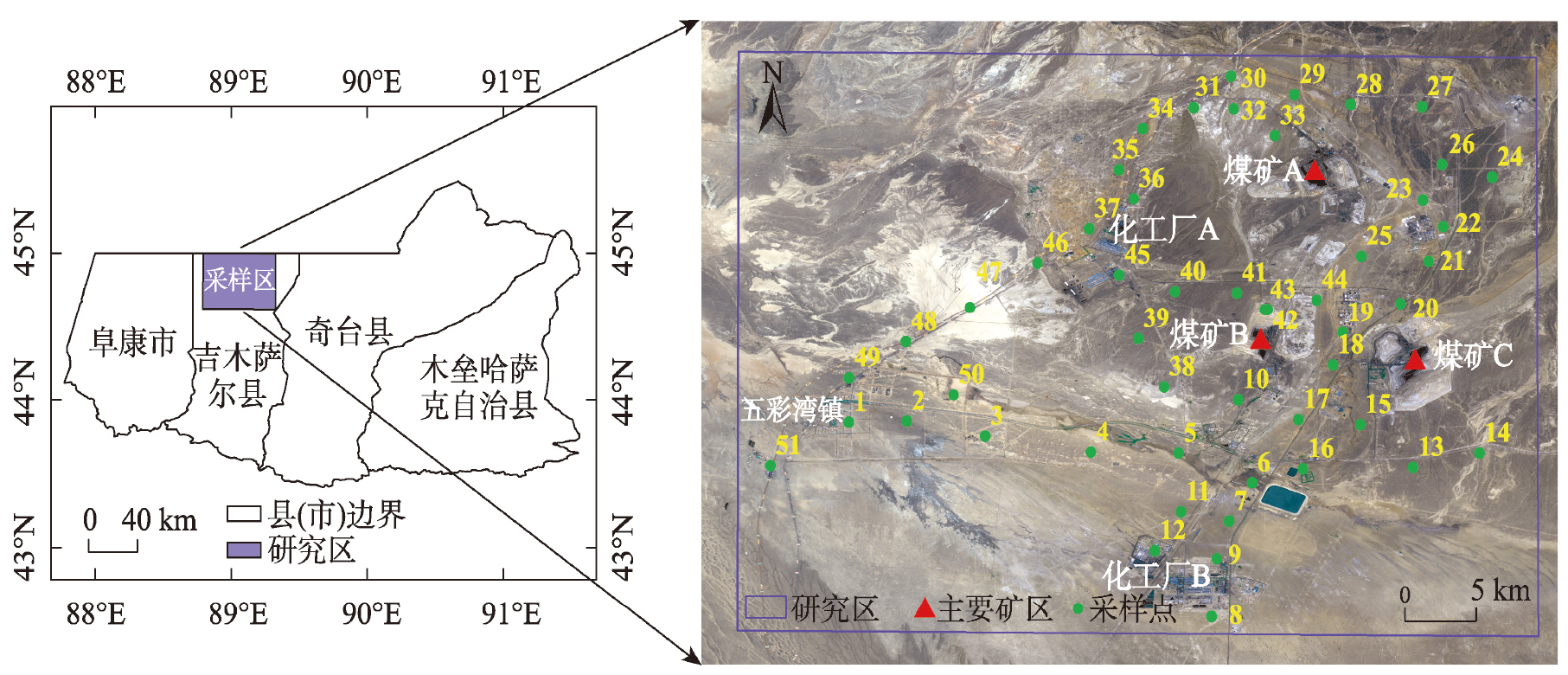
表1
土壤重金属污染水平和生态风险评价等级"
| 单因子指数 | 内梅罗综合污染指数 | 地累积指数 | 潜在生态风险指数 | ||||||||
|---|---|---|---|---|---|---|---|---|---|---|---|
| Pi | 污染水平 | PN | 污染水平 | Igeo | 污染程度 | RI | 风险等级 | ||||
| Pi<1 | 清洁 | PN≤0.7 | 安全 | Igeo≤0 | 无污染 | RI<150 | 轻微风险 | ||||
| 1≤Pi<2 | 轻微污染 | 0.7<PN≤1 | 警戒 | 0<Igeo≤1 | 轻度污染 | 40≤ | 150≤RI<300 | 中等风险 | |||
| 2≤Pi<3 | 轻度污染 | 1<PN≤2 | 轻污染 | 1<Igeo≤2 | 偏中度污染 | 80≤ | 300≤RI<600 | 强风险 | |||
| 3≤Pi<5 | 中度污染 | 2<PN≤3 | 中污染 | 2<Igeo≤3 | 中度污染 | 160≤ | 600≤RI<1200 | 很强风险 | |||
| Pi≥5 | 重污染 | PN>3 | 重污染 | 3<Igeo≤4 | 偏重污染 | RI≥1200 | 极强风险 | ||||
| 4<Igeo≤5 | 重度污染 | ||||||||||
| Igeo>5 | 严重污染 | ||||||||||
表2
土壤重金属含量描述性统计"
| 元素 | 土壤重金属浓度ω/(mg·kg-1) | 标准偏差 | Cv/% | 背景值 超标率/% | 筛选值 超标率/% | |||||
|---|---|---|---|---|---|---|---|---|---|---|
| 最小值 | 最大值 | 平均值 | 中值 | 背景值 | 筛选值 | |||||
| Cu | 16.10 | 122.27 | 29.73 | 24.65 | 26.70 | 100 | 18.96 | 63.75 | 36 | 2 |
| Zn | 43.72 | 297.26 | 73.37 | 67.73 | 66.80 | 300 | 34.35 | 46.81 | 54 | 0 |
| Pb | 16.49 | 29.49 | 22.86 | 22.16 | 19.40 | 170 | 3.50 | 15.32 | 86 | 0 |
| Cd | 0.02 | 0.18 | 0.08 | 0.07 | 0.12 | 0.6 | 0.03 | 41.36 | 10 | 0 |
| Cr | 47.68 | 205.94 | 80.77 | 75.96 | 49.30 | 250 | 25.14 | 31.12 | 98 | 0 |
| As | 12.40 | 25.53 | 16.93 | 16.60 | 11.20 | 25 | 3.00 | 17.69 | 100 | 4 |
| Hg | 0.11 | 1.12 | 0.44 | 0.40 | 0.017 | 3.4 | 0.20 | 44.52 | 100 | 0 |

图2
土壤重金属含量的空间分布"

表3
土壤重金属的单因子污染指数(Pi)和内梅罗综合污染指数(PN)"
| 元素 | 最小值 | 最大值 | 均值 | 方差 | 标准差 | Cv/% | 峰度 | 偏度 | |
|---|---|---|---|---|---|---|---|---|---|
| Pi | Cu | 0.60 | 4.58 | 1.11 | 0.50 | 0.71 | 63.79 | 14.57 | 3.60 |
| Zn | 0.65 | 4.45 | 1.10 | 0.27 | 0.51 | 46.81 | 38.44 | 5.84 | |
| Pb | 0.85 | 1.52 | 1.18 | 0.03 | 0.18 | 15.28 | -0.86 | 0.26 | |
| Cd | 0.18 | 1.46 | 0.62 | 0.06 | 0.26 | 41.45 | 1.40 | 0.97 | |
| Cr | 0.97 | 4.18 | 1.64 | 0.26 | 0.51 | 31.12 | 11.98 | 2.78 | |
| As | 1.11 | 2.28 | 1.51 | 0.07 | 0.27 | 17.67 | 1.15 | 1.06 | |
| Hg | 6.17 | 65.72 | 25.83 | 132.30 | 11.50 | 44.52 | 2.76 | 1.36 | |
| PN | 4.55 | 47.06 | 18.57 | 67.41 | 8.21 | 44.21 | 2.76 | 1.36 | |

图3
研究区土壤重金属污染评价结果"

表4
土壤重金属潜在生态风险指数(${E}_{r}^{i}$)"
| 元素 | 最小值 | 最大值 | 均值 | 方差 | 标准差 | Cv/% | 峰度 | 偏度 |
|---|---|---|---|---|---|---|---|---|
| Cu | 3.02 | 22.90 | 5.57 | 12.60 | 3.55 | 63.76 | 14.59 | 3.60 |
| Zn | 0.65 | 4.45 | 1.10 | 0.26 | 0.51 | 46.81 | 38.50 | 5.85 |
| Pb | 4.25 | 7.60 | 5.89 | 0.82 | 0.90 | 15.32 | -0.84 | 0.26 |
| Cd | 5.00 | 45.00 | 18.55 | 62.27 | 7.89 | 42.54 | 1.68 | 1.11 |
| Cr | 1.93 | 8.36 | 3.28 | 1.04 | 1.02 | 31.12 | 11.89 | 2.79 |
| As | 11.07 | 22.79 | 15.11 | 7.15 | 2.67 | 17.69 | 1.13 | 1.05 |
| Hg | 235.29 | 2635.29 | 1032.94 | 211064.19 | 459.42 | 44.48 | 2.82 | 1.36 |
| RI | 290.73 | 2681.96 | 1082.44 | 210545.59 | 458.85 | 42.39 | 2.81 | 1.37 |

图4
土壤理化性质与重金属含量相关性分析 注:*表示在0.05的水平上呈显著相关。"

表5
研究区重金属元素主成分旋转载荷"
| 元素 | PC1 | PC2 | PC3 | PC4 | PC5 |
|---|---|---|---|---|---|
| Cu | 0.39 | 0.79 | -0.17 | 0.08 | 0.19 |
| Zn | 0.15 | 0.01 | 0.91 | 0.17 | -0.01 |
| Pb | 0.32 | -0.77 | -0.22 | 0.28 | 0.11 |
| Cd | -0.05 | -0.12 | 0.19 | 0.93 | -0.07 |
| Cr | 0.89 | -0.01 | 0.09 | -0.15 | 0.10 |
| As | 0.64 | 0.10 | 0.46 | 0.36 | -0.12 |
| Hg | 0.05 | 0.05 | -0.03 | -0.07 | 0.99 |
| 特征值 | 1.49 | 1.23 | 1.16 | 1.13 | 1.05 |
| 方差贡献率/% | 21.30 | 17.63 | 16.51 | 16.07 | 14.95 |
| 累计方差贡献率/% | 21.30 | 38.93 | 55.44 | 71.51 | 86.46 |

图5
重金属的PMF因子贡献率及PCA和PMF的源解析结果对比"

| [1] | 李军, 吴小飞, 乔中鹏. 国内外煤炭经济形势分析[J]. 国际商务财会, 2024(21): 22-27. |
| [Li Jun, Wu Xiaofei, Qiao Zhongpeng. Analysis of coal economic situation at home and abroad[J]. Finance and Accounting for International Commerce, 2024(21): 22-27.] | |
| [2] | Zhong X, Chen Z, Li Y, et al. Factors influencing heavy metal availability and risk assessment of soils at typical metal mines in Eastern China[J]. Journal of Hazardous Materials, 2020, 400: 123289. |
| [3] | Zhang Y, Song B, Zhou Z. Pollution assessment and source apportionment of heavy metals in soil from lead-zinc mining areas of south China[J]. Journal of Environmental Chemical Engineering, 2023, 11(2): 109320. |
| [4] | Zhang H, Zhang F, Song J, et al. Pollutant source, ecological and human health risks assessment of heavy metals in soils from coal mining areas in Xinjiang, China[J]. Environmental Research, 2021, 202: 111702. |
| [5] | Ran H, Guo Z, Yi L, et al. Pollution characteristics and source identification of soil metal (loid)s at an abandoned arsenic-containing mine, China[J]. Journal of Hazardous Materials, 2021, 413: 125382. |
| [6] | 李瑞明, 周梓欣, 张伟, 等. “十四五”以来新疆煤炭地质工作进展及发展方向[J]. 新疆地质, 2024, 42(1): 7-13. |
| [Li Ruiming, Zhou Zixin, Zhang Wei, et al. The progress and development direction of coal geological work in Xinjiang during the 14th five year plan period[J]. Xinjiang Geology, 2024, 42(1): 7-13.] | |
| [7] | Qin D, Wang X, Zhang D, et al. Occurrence characteristic and mining technology of ultra-thick coal seam in Xinjiang, China[J]. Sustainability, 2019, 11(22): 6470. |
| [8] | 袁婷婷, 王志强, 汪溪远, 等. 准东红沙泉矿区重金属生态风险缓冲区分析[J]. 土壤通报, 2020, 51(1): 227-233. |
| [Yuan Tingting, Wang Zhiqiang, Wang Xiyuan, et al. Buffer analysis of heavy metal ecological risk in the Hongshaquan mining area of east Junggar Basin[J]. Chinese Journal of Soil Science, 2020, 51(1): 227-233.] | |
| [9] | 许紫峻, 汪溪远, 师庆东, 等. 准东煤矿区土壤镉污染风险评价及敏感性分析[J]. 生态毒理学报, 2018, 13(2): 159-170. |
| [Xu Zijun, Wang Xiyuan, Shi Qingdong, et al. Risk assessment and sensitivity analysis of soil cadmium pollution in Zhundong coal mining area[J]. Asian Journal of Ecotoxicology, 2018, 13(2): 159-170.] | |
| [10] | 李晓航, 张飞, 夏楠, 等. 新疆准东煤矿土壤重金属污染方法评价与分析[J]. 中国矿业, 2016, 25(10): 74-80. |
| [Li Xiaohang, Zhang Fei, Xia Nan, et al. The method of evaluation and analysis of heavy mental pollution of soil in Xinjiang Zhundong surface coal mine[J]. China Mining Magazine, 2016, 25(10): 74-80.] | |
| [11] | 刘巍, 杨建军, 汪君, 等. 准东煤田露天矿区土壤重金属污染现状评价及来源分析[J]. 环境科学, 2016, 37(5): 1938-1945. |
| [Liu Wei, Yang Jianjun, Wang Jun, et al. Contamination assessment and sources analysis of soil heavy metals in opencast mine of east Junggar Basin in Xinjiang[J]. Environmental Science, 2016, 37(5): 1938-1945.] | |
| [12] | 比拉力·依明, 阿不都艾尼·阿不里, 师庆东, 等. 基于PMF模型的准东煤矿周围土壤重金属污染及来源解析[J]. 农业工程学报, 2019, 35(9): 185-192. |
| [Bilal Imin, Abdugheni Abliz, Shi Qingdong, et al. Pollution and source identification of heavy metals in surrounding soils of eastern Junggar coalfield based on PMF model[J]. Transactions of the Chinese Society of Agricultural Engineering, 2019, 35(9): 185-192.] | |
| [13] | 叶盼青, 阿不都艾尼·阿不里, 孙小丽, 等. 天山北坡经济带土壤重金属来源及污染评价[J]. 中国环境科学, 2022, 42(10): 4704-4712. |
| [Ye Panqing, Abdugheni Abliz, Sun Xiaoli, et al. Source analysis and pollution assessment of soil heavy metals in the economic belt on the northern slope of Tianshan Mountains[J]. China Environmental Science, 2022, 42(10): 4704-4712.] | |
| [14] | 于昊辰. 新疆荒漠矿区土地生态系统退化评价及调控策略研究[D]. 徐州: 中国矿业大学, 2022. |
| [Yu Haochen. Measurement and Regulation Strategies of Land Ecosystem Degradation for Desert Mining Area in Xinjiang[D]. Xuzhou: China University of Mining and Technology, 2022.] | |
| [15] | 张少彬, 冯钟钟. 重铬酸钾容量法测定广东省部分地区土壤中有机质含量的研究[J]. 广东化工, 2023, 50(4): 189-191, 213. |
| [Zhang Shaobin, Feng Zhongzhong. Study on determination of organic matter content in soil in some areas of Guangdong Province by potassium dichromate volumetric method[J]. Guangdong Chemical Industry, 2023, 50(4): 189-191, 213.] | |
| [16] | 中国环境监测总站. 中国土壤元素背景值[M]. 北京: 中国环境科学出版社, 1990. |
| [China National Environmental Monitoring Centre. Background Value of Soil Elements in China[M]. Beijing: China Environmental Science Press, 1990.] | |
| [17] | 贾晗, 刘军省, 王晓光, 等. 安徽典型硫铁矿集中开采区土壤重金属污染特征及来源解析[J]. 环境科学, 2023, 44(9): 5275-5287. |
| [Jia Han, Liu Junxing, Wang Xiaoguang, et al. Pollution characteristics and sources of heavy metals in soil of a typical pyrite concentrated mining area in Anhui Province[J]. Environmental Science, 2023, 44(9): 5275-5287.] | |
| [18] | Mueller G. Heavy metals in the sediments of the Rhine River: Variations since 1971[J]. Umsch Wiss Tech, 1978, 79: 778-783. |
| [19] | Hakanson L. An ecological risk index for aquatic pollution control:A sedimentological approach[J]. Water Research, 1980, 14(8): 975-1001. |
| [20] | Zhang P, Qin C, Hong X, et al. Risk assessment and source analysis of soil heavy metal pollution from lower reaches of Yellow River irrigation in China[J]. Science of the Total Environment, 2018, 633: 1136-1147. |
| [21] | 王海洋, 韩玲, 谢丹妮, 等. 矿区周边农田土壤重金属分布特征及污染评价[J]. 环境科学, 2022, 43(4): 2104-2114. |
| [Wang Haiyang, Han Ling, Xie Danni, et al. Distribution characteristics of heavy metals in farmland soils around mining areas and pollution assessment[J]. Environmental Science, 2022, 43(4): 2104-2114.] | |
| [22] | Paatero P, Tapper U. Positive matrix factorization: A non-negative factor model with optimal utilization of error estimates of data values[J]. Environmentrics, 1994, 5(2): 111-126. |
| [23] | Pan H, Lu X, Lei K. A comprehensive analysis of heavy metals in urban road dust of Xi’an, China: Contamination, source apportionment and spatial distribution[J]. Science of the Total Environment, 2017, 609: 1361-1369. |
| [24] | Ma W, Tai L, Qiao Z, et al. Contamination source apportionment and health risk assessment of heavy metals in soil around municipal solid waste incinerator: A case study in North China[J]. Science of the Total Environment, 2018, 631: 348-357. |
| [25] | 夏子书, 白一茹, 王幼奇, 等. 基于PMF模型的宁南山区小流域土壤重金属空间分布及来源解析[J]. 环境科学, 2022, 43(1): 432-441. |
| [Xia Zishu, Bai Yiru, Wang Youqi, et al. Spatial distribution and source analysis of soil heavy metals in a small watershed in the mountainous area of southern Ningxia based on PMF model[J]. Environmental Science, 2022, 43(1): 432-441.] | |
| [26] | 赵晓光, 张亦扬, 杜华栋. 陕北矿区不同土地类型下土壤重金属污染评价[J]. 环境工程, 2019, 37(9): 188-193. |
| [Zhao Xiaoguang, Zhang Yiyang, Du Huadong. Evaluation of heavy metal pollution in soils under different land use types in the northern mining area of Shaanxi Province[J]. Environmental Engineering, 2019, 37(9): 188-193.] | |
| [27] | 张宏泽, 崔文刚, 黄月美, 等. 黔中喀斯特地区临近矿区耕地土壤重金属污染评价及其源解析[J]. 环境科学学报, 2022, 42(4): 412-421. |
| [Zhang Hongze, Cui Wengang, Huang Yuemei, et al. Evaluation and source analysis of heavy metal pollution of farmland soil around the mining area of karst region of central Guizhou Province[J]. Acta Scientiae Circumstantiae, 2022, 42(4): 412-421.] | |
| [28] | 王哲, 宓展盛, 郑春丽, 等. 生物炭对矿区土壤重金属有效性及形态的影响[J]. 化工进展, 2019, 38(6): 2977-2985. |
| [Wang Zhe, Mi Zhansheng, Zheng Chunli, et al. Effect of biochar on the bioavailability and transformation of heavy metals in soil of mining area[J]. Chemical Industry and Engineering Progress, 2019, 38(6): 2977-2985.] | |
| [29] | 蔡奎, 段亚敏, 栾文楼, 等. 河北平原农田土壤重金属元素Pb、Hg地球化学行为的影响因素[J]. 中国地质, 2016, 43(4): 1420-1428. |
| [Cai Kui, Duan Yamin, Luan Wenlou, et al. Geochemical behavior of heavy metals Pb and Hg in the farmland soil of Hebei Plain[J]. Geology in China, 2016, 43(4): 1420-1428.] | |
| [30] | Wu Q, Hu W, Wang H, et al. Spatial distribution, ecological risk and sources of heavy metals in soils from a typical economic development area, Southeastern China[J]. Science of the Total Environment, 2021, 780: 146557. |
| [31] | 廖泽源, 李杰芹, 沈智杰, 等. 重庆某铁矿区周边耕地土壤重金属污染评价及来源解析[J]. 环境科学, 2024, 45(4): 2450-2460. |
| [Liao Zeyuan, Li Jieqin, Shen Zhijie, et al. Assessment and source analysis of heavy metal pollution in arable land around an iron ore mining area in Chongqing[J]. Environmental Science, 2024, 45(4): 2450-2460.] | |
| [32] | 逯雨, 李琴, 张越, 等. 磷化工厂及周边农田土壤重金属污染与来源解析[J]. 环境污染与防治, 2022, 44(11): 1514-1518, 1525. |
| [Lu Yu, Li Qin, Zhang Yue, et al. Heavy metals pollution and source apportionment in a phosphorus chemical site and surrounding farmland soils[J]. Environmental Pollution & Control, 2022, 44(11): 1514-1518, 1525.] | |
| [33] | 王乔林, 宋云涛, 王成文, 等. 滇西地区土壤重金属来源解析及空间分布[J]. 中国环境科学, 2021, 41(8): 3693-3703. |
| [Wang Qiaolin, Song Yuntao, Wang Chengwen, et al. Source identification and spatial distribution of soil heavy metals in western Yunnan[J]. China Environmental Science, 2021, 41(8): 3693-3703.] | |
| [34] | Glaubitz F, Vogel A R, Kolberg Y, et al. Detailed insights in adsorption process of heavy metals on tire wear particles[J]. Environmental Pollution, 2023, 335: 122293. |
| [35] | 张罡, 叶芝祥, 杨怀金, 等. 高速公路大气细颗粒物污染特征研究[J]. 环境科学与技术, 2017, 40(2): 158-162, 167. |
| [Zhang Gang, Ye Zhixiang, Yang Huaijin, et al. Characteristics of fine particulate matter pollution from highway[J]. Environmental Science & Technology, 2017, 40(2): 158-162, 167.] | |
| [36] | 陈其永, 郜允兵, 倪润祥, 等. 2000—2018年我国大气重金属沉降通量时空变化特征[J]. 环境科学, 2022, 43(9): 4413-4424. |
| [Chen Qiyong, Gao Yunbing, Ni Runxiang, et al. Temporal and spatial variation characteristics of heavy metal in atmospheric deposition in China from 2000 to 2018[J]. Environmental Science, 2022, 43(9): 4413-4424.] |
| [1] | 汪彩琴, 邵佳时, 扶黛叶, 张道勇, 潘响亮. 干旱区微塑料污染来源、迁移规律与生态风险[J]. 干旱区研究, 2025, 42(9): 1599-1611. |
| [2] | 刘亮, 董江伟, 周金龙, 李江. 且末县绿洲区地表水与地下水中硼的分布特征及其影响因素[J]. 干旱区研究, 2025, 42(7): 1222-1235. |
| [3] | 孟庆帅, 巩钰, 刘小燕, 童新, 王东民, 谢国英, 刘廷玺. 水资源-社会经济-生态环境耦合协调度关系研究及预测——以黄河流域内蒙古段为例[J]. 干旱区研究, 2025, 42(4): 682-694. |
| [4] | 巩小维, 周冬梅, 张军, 罗世玉, 陈建坤, 高雅娟. “三生空间”视角下庆阳市景观生态风险评价及耦合协调度[J]. 干旱区研究, 2025, 42(3): 556-567. |
| [5] | 王婷, 沈赣华, 刘兵, 孙莹琳, 汪再光. 天山北坡经济带水库群时空变化特征及驱动机制[J]. 干旱区研究, 2024, 41(9): 1456-1467. |
| [6] | 高鹏程, 岳艳妮, 鄢继选, 王世杰, 别强. 甘南藏族自治州土地利用与生态风险时空演变及驱动因素[J]. 干旱区研究, 2024, 41(7): 1140-1152. |
| [7] | 杨荣钦, 肖玉磊, 池苗苗, 穆振侠. 近20 a塔里木河流域人类活动及景观生态风险时空变化[J]. 干旱区研究, 2024, 41(6): 1010-1020. |
| [8] | 司琪, 樊浩然, 董文明, 刘新平. 新疆叶尔羌河流域景观生态风险评价及预测[J]. 干旱区研究, 2024, 41(4): 684-696. |
| [9] | 王成武, 尧良杰, 汪宙峰, 张荞, 谢亮. 2000—2020年三江源地区景观生态风险评价及驱动因素[J]. 干旱区研究, 2024, 41(11): 1908-1920. |
| [10] | 陈爱军,张寅,楚志刚. 基于FY-4A QPE的中亚五国降水时空分布特征[J]. 干旱区研究, 2023, 40(9): 1369-1381. |
| [11] | 马继龙, 史军辉, 王新英, 阿丽亚·拜都热拉, 刘茂秀, 艾吉尔·阿不拉. 洪水漫溢对塔里木河中游河岸胡杨林土壤有机碳及活性组分的影响[J]. 干旱区研究, 2023, 40(8): 1248-1257. |
| [12] | 赵克明, 孙鸣婧, 李霞, 施俊杰, 安大维, 许婷婷. 两种典型大气扩散指数在新疆的分布特征及其适用性对比[J]. 干旱区研究, 2023, 40(5): 691-702. |
| [13] | 胡长通,杨涛,万旭昊,孙来康,郑奕文,严雪溶. 西安市河流沉积物重金属分布特征及其与土地利用类型关系[J]. 干旱区研究, 2022, 39(4): 1270-1281. |
| [14] | 骆成彦,陈伏龙,何朝飞,龙爱华,乔长录. CMADS在玉龙喀什河径流模拟中的适用性研究[J]. 干旱区研究, 2022, 39(4): 1090-1101. |
| [15] | 张林,张云玲,马松梅,张丹,贺凌云. 准噶尔盆地大赖草分布格局及关键因子分析[J]. 干旱区研究, 2022, 39(3): 863-871. |
|
||
