
干旱区研究 ›› 2025, Vol. 42 ›› Issue (5): 875-884.doi: 10.13866/j.azr.2025.05.10 cstr: 32277.14.AZR.20250510
王广权1( ), 木古丽·木哈西1,2(), 吾尔恩·阿合别尔迪1,2, 玛依拉·吐尔地别克1,2, 张雪梅1,2, 庞克坚1,3
收稿日期:2025-02-26
修回日期:2025-03-30
出版日期:2025-05-15
发布日期:2025-10-22
通讯作者:
木古丽·木哈西. E-mail: muguli@163.com作者简介:王广权(2001-),男,硕士研究生,主要从事干旱区植物内生菌研究. E-mail: 18139353160@163.com
基金资助:
WANG Guangquan1(), Muguli MUHAXI1,2(), Oren AKHBERDI1,2, Mayira TURDIBEK1,2, ZHANG Xuemei1,2, PANG Kejian1,3
Received:2025-02-26
Revised:2025-03-30
Published:2025-05-15
Online:2025-10-22
摘要: 为揭示伊犁野生阿魏菇(Pleurotus ferulae)根际土壤细菌群落特征及其与土壤环境因子的互作机制,突破人工驯化阿魏菇的瓶颈,本研究通过整合土壤理化性质分析、土壤酶活性检测及Illumina高通量测序技术,对比阿魏菇根际与非根际土壤的微生态差异。结果显示:(1) 阿魏菇根际土壤pH值显著低于非根际土壤(P<0.05),而有机质、速效氮磷及酶活性均显著高于非根际土壤(P<0.05),表明宿主与微生物协同调控养分循环。(2) 测序共获得1895个细菌分类操作单元(Operational Taxonomic Units,OTUs),其中,阿魏菇根际土壤中独有的OTUs数为156个,非根际土壤中独有的OTUs数为102个。根际土壤细菌群落中拟杆菌门(14.26%)、芽单胞菌门(4.87%)和疣微菌门(1.24%)显著富集,假单胞菌属、黄杆菌属等特有菌属可能通过有机质降解和植物促生功能支持阿魏菇生长。(3) 冗余分析(Redundancy Aanalysis,RDA)表明,根际土壤有机质、速效氮磷及β-葡萄糖苷酶是驱动群落结构的关键因子(累计解释率>70%),拟杆菌门与酸杆菌门响应碳氮循环,而变形菌门与绿弯菌门关联pH适应性。因此,人工栽培中需模拟根际中性环境、增施有机质肥并接种功能菌群以优化菌丝定殖效率。相关结果可为阿魏菇保育及资源可持续利用提供理论依据。
王广权, 木古丽·木哈西, 吾尔恩·阿合别尔迪, 玛依拉·吐尔地别克, 张雪梅, 庞克坚. 新疆伊犁野生阿魏菇根际土壤环境因子与细菌群落组成特征[J]. 干旱区研究, 2025, 42(5): 875-884.
WANG Guangquan, Muguli MUHAXI, Oren AKHBERDI, Mayira TURDIBEK, ZHANG Xuemei, PANG Kejian. Characterization of environmental factors and bacterial community composition in rhizosphere soil of wild Pleurotus ferulae in Xinjiang Ili[J]. Arid Zone Research, 2025, 42(5): 875-884.
表1
土壤样本的基本信息"
| 土壤类型 | 生境特征 | 样本编号 | 经纬度 | 海拔/m | 土壤取样深度/cm |
|---|---|---|---|---|---|
| 根际土壤 | 保护区内,3 a生以上新疆阿魏植株根茎部土 壤(设为I_A) | I_A1 | 43°44′49″N,82°07′27″E | 1092 | 10~20 |
| I_A2 | 43°44′48″N,82°07′32″E | 1192 | 10~20 | ||
| I_A3 | 43°44′48″N,82°07′37″E | 1191 | 10~20 | ||
| 非根际土壤 | 保护区外,无新疆阿魏和阿魏菇生长的土壤 (设为C) | C1 | 43°44′50″N,82°06′38″E | 1090 | 10~20 |
| C2 | 43°44′23″N,82°06′46″E | 1092 | 10~20 | ||
| C3 | 43°44′54″N,82°07′00″E | 1089 | 10~20 |
表2
不同土壤样本的化学性质及酶活性分析"
| 土壤样品 | I_A1 | I_A2 | I_A3 | C1 | C2 | C3 |
|---|---|---|---|---|---|---|
| 土壤样本来源 | 保护区内 | 保护区内 | 保护区内 | 保护区外 | 保护区外 | 保护区外 |
| 根际土壤 | 根际土壤 | 根际土壤 | 非根际土壤 | 非根际土壤 | 非根际土壤 | |
| pH | 7.87±0.14b | 8.12±0.16b | 7.96±0.04b | 8.51±0.14a | 8.68±0.21a | 8.77±0.09a |
| MC/% | 8.92±0.04b | 8.49±0.03c | 11.64±0.06a | 1.16±0.02d | 1.28±0.06d | 1.24±0.003d |
| OM/(g·kg-1) | 36.9±0.07a | 42.23±3.99a | 44.23±4.99a | 20.28±2.55b | 16.64±1.67b | 19.22±1.84b |
| AN/(mg·kg-1) | 46.23±0.07a | 35.32±1.78b | 34.55±1.72b | 31.16±0.27c | 27.28±1.06d | 32.24±1.29bc |
| AP/(mg·kg-1) | 3.87±0.06a | 3.59±0.19b | 4.26±0.40a | 3.01±0.04c | 2.81±0.70c | 3.45±0.22b |
| AK/(mg·kg-1) | 163.58±3.65b | 176.23±6.61a | 136.21±5.35d | 175.86±5.74a | 180.11±1.67a | 156.61±3.04c |
| POD/(U·g-1) | 108.82±4.49b | 114.60±4.88b | 132.96±7.87a | 107.89±3.61b | 100.12±2.58c | 98.66±5.00c |
| UE/(U·g-1) | 898.45±11.04b | 915.22±12.24b | 937.91±2.98a | 747.58±46.78c | 700.11±0.57c | 658.62±3.86d |
| β-GC/(U·g-1) | 37.59±3.87cd | 67.31±4.16a | 55.29±3.31b | 45.48±3.07c | 26.17±1.97d | 30.65±1.55d |
表3
土壤中细菌群落的α多样性"
| 土壤类型 | Sobs 指数 | Chao 指数 | Simpson 指数 | Shannon 指数 | 文库覆盖度指数/% |
|---|---|---|---|---|---|
| I_A | 1339±111.88a | 1495.1±111.88a | 0.011646±0.004771a | 5.7692±0.19297a | 0.9950 |
| C | 1462±64.09a | 1597.6±111.88a | 0.007126±0.000549a | 6.0022±0.06794a | 0.9949 |
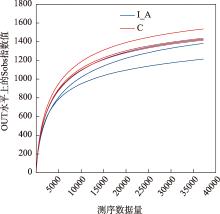
图1
土壤细菌OTU稀释曲线分析"

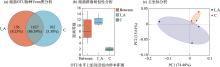
图2
两种土壤类型样本比较分析"

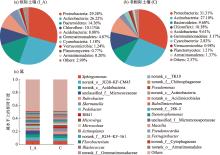
图3
两类土壤细菌在门和属水平上的分类比较"

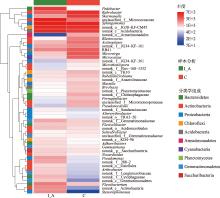
图4
由两类土壤间的丰度差异属性构建热度图和聚类关系图"

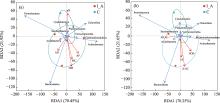
图5
土壤细菌群落与环境因子间的相关性RDA分析 注:MC为含水率;OM为有机质;AP为速效磷;AN为速效氮;AK为速效钾;POD为过氧化物酶;UE为脲酶;β-GC为β-葡萄糖苷酶;红色箭头代表环境因子在水平面上的相对位置,箭头与排序轴的夹角不同,则其余弦值不同,即二者的相关性强度也不同。夹角越小,相关性越大。箭头的长度越长,代表该环境因子发挥的作用越大;蓝色箭头代表门水平上的物种分布,箭头越长代表该物种在该土壤中的影响越大。"

| [1] | Fuhrman J A. Microbial community structure and its functional implications[J]. Nature, 2009, 459(7244): 193-199. |
| [2] | Naeem S, Li S. Biodiversity enhances ecosystem reliability[J]. Nature, 1997, 390(6659): 507-509. |
| [3] | Shi S, Nuccio E, Herman D J, et al. Successional trajectories of rhizosphere bacterial communities over consecutive seasons[J]. MBio, 2015, 6(4): 1-8. |
| [4] | 余炎炎, 李梦莎, 刘啸林, 等. 大兴安岭典型永久冻土土壤细菌群落组成和多样性[J]. 微生物学通报, 2020, 47(9): 2759-2770. |
| [Yu Yanyan, Li Mengsha, Liu Xiaolin, et al. Composition and diversity of soil bacterial communities in typical permafrost regions of the Greater Khingan Mountains[J]. Microbiology China, 2020, 47(9): 2759-2770.] | |
| [5] | 王晓波. 我国北方草地土壤微生物群落的空间格局及其驱动机制[D]. 沈阳: 中国科学院沈阳应用生态研究所, 2016. |
| [Wang Xiaobo. Spatial Patterns and Driving Mechanisms of Soil Microbial Communities in Grasslands of Northern China[D]. Shenyang: Shenyang Institute of Applied Ecology, Chinese Academy of Sciences, 2016.] | |
| [6] | 黄俊杰, 陆雅海. 土壤拟杆菌与梭菌分解多糖类有机物质的研究进展与展望[J]. 微生物学通报, 2022, 49(3): 1147-1157. |
| [Huang Junjie, Lu Yahai. Research progress and prospects on the decomposition of polysaccharides by soil Bacteroidetes and Clostridia[J]. Microbiology China, 2022, 49(3): 1147-1157.] | |
| [7] |
斯林林, 徐静, 曹凯, 等. 绿肥种植对红壤旱地生土细菌群落结构的影响[J]. 浙江农业学报, 2023, 35(8): 1864-1875.
doi: 10.3969/j.issn.1004-1524.20221096 |
|
[Si Linlin, Xu Jing, Cao Kai, et al. Effects of green manure cultivation on bacterial community structure in raw soil of red soil dryland[J]. Acta Agriculturae Zhejiangensis, 2023, 35(8): 1864-1875.]
doi: 10.3969/j.issn.1004-1524.20221096 |
|
| [8] | Jones R T, Robeson M S, Lauber C L, et al. A comprehensive survey of soil acidobacterial diversity using pyrosequencing and clone library analyses[J]. The ISME Journal Emultidisciplinary Journal of Microbial Ecology, 2009, 3(4): 442-453. |
| [9] | 秦杰, 姜昕, 周晶, 等. 长期不同施肥黑土细菌和古菌群落结构及主效影响因子分析[J]. 植物营养与肥料学报, 2015, 21(6): 1590-1598. |
| [Qin Jie, Jiang Xin, Zhou Jing, et al. Analysis of bacterial and archaeal community structure and main influencing factors in black soil under long-term different fertilization practices[J]. Journal of Plant Nutrition and Fertilizers, 2015, 21(6): 1590-1598.] | |
| [10] |
Janssen P H. Identifying the dominant soil bacterial taxa in libraries of 16S rRNA and 16S rRNA genes[J]. Applied and Environmental Microbiology, 2006, 72(3): 1719-1728.
doi: 10.1128/AEM.72.3.1719-1728.2006 pmid: 16517615 |
| [11] |
Ranjard L, Poly F, Nazaret S. Monitoring complex bacterial communities using culture-independent molecular techniques: Application to soil environment[J]. Research in Microbiology, 2000, 151(3): 167-177.
doi: 10.1016/s0923-2508(00)00136-4 pmid: 10865943 |
| [12] | 武华周, 娄德钊, 涂娜娜, 等. 抗感青枯病桑树根际细菌群落结构与多样性[J]. 福建农业学报, 2020, 35(9): 1004-1011. |
| [Wu Huazhou, Lou Dezhao, Tu Nana, et al. Structure and diversity of bacterial communities in the rhizosphere of mulberry trees resistant to bacterial wilt disease[J]. Fujian Journal of Agricultural Sciences, 2020, 35(9): 1004-1011.] | |
| [13] | 木古丽·木哈西, 博涛, 吾尔恩·阿合别尔迪, 等. 新疆伊犁野生阿魏菇的生长发育规律及生境分析[J]. 干旱区资源与环境, 2021, 35(4): 160-164. |
| [Muhaxi Muguli, Bo Tao, Ahebierdi Wueren, et al. Growth and development patterns and habitat analysis of wild Pleurotus ferulae in Yili, Xinjiang[J]. Journal of Arid Land Resources and Environment, 2021, 35(4): 160-164.] | |
| [14] | Liu M H, Liu F, Ng T B, et al. Purification and characterization of pleuroferin, a novel protein with in vitro anti-non-small cell lung cancer activity from the mushroom Pleurotus ferulae lanzi[J]. Process Biochemistry, 2022, 122: 16-25. |
| [15] | Muguli M, Liu F, Ng T B. Structural characterization and in vitro hepatoprotective activity of a novel antioxidant polysaccharide from fruiting bodies of the mushroom Pleurotus ferulae[J]. International Journal of Biological Macromolecules, 2023, 243: 125124. |
| [16] | 木古丽·木哈西, 吾尔恩·阿合别尔迪, 刘方, 等. 新疆伊犁野生阿魏菇菌株的分离鉴定与培养特性[J]. 微生物学杂志, 2021, 41(6): 103-110. |
| [Muhaxi Muguli, Ahebierdi Wueren, Liu Fang. Isolation, identification, and cultural characteristics of wild Pleurotus ferulae strains from Yili, Xinjiang[J]. Journal of Microbiology, 2021, 41(6): 103-110.] | |
| [17] | 郑剑英, 李宇辉, 张晓荣, 等. 土壤养分速测的土样采集方法[J]. 吉林农业, 2006(2): 23. |
| [Zheng Jianying, Li Yuhui, Zhang Xiaorong, et al. Soil sampling methods for rapid soil nutrient testing[J]. Agriculture of Jilin, 2006(2): 23.] | |
| [18] | 鲍士旦. 土壤农化分析[M]. 北京: 中国农业出版社, 2000. |
| [Bao Shidan. Soil Agro-Chemical Analysis[M]. Beijing: China Agriculture Press, 2000.] | |
| [19] | 冯慧琳, 徐辰生, 何欢辉, 等. 生物炭对土壤酶活和细菌群落的影响及其作用机制[J]. 环境科学, 2021, 42(1): 422-432. |
| [Feng Huilin, Xu Chensheng, He Huanhui, et al. Effects of biochar on soil enzyme activity and bacterial community and its mechanisms[J]. Environmental Science, 2021, 42(1): 422-432.] | |
| [20] | 张艳, 郭书亚, 尚赏, 等. 甘薯/玉米不同间作方式对土壤养分、酶活性及作物产量的影响[J]. 山西农业科学, 2020, 48(8): 1234-1238. |
| [Zhang Yan, Guo Shuya, Shang Shang, et al. Effects of different sweet potato/maize intercropping patterns on soil nutrients, enzyme activity, and crop yield[J]. Journal of Shanxi Agricultural Sciences, 2020, 48(8): 1234-1238.] | |
| [21] |
Mori H, Maruyama F, Kato H, et al. Design and experimental application of a novel non-degenerate universal primer set that amplifies prokaryotic 16S rRNA genes with a low possibility to amplify eukaryotic rRNA genes[J]. DNA Research, 2014, 21(2): 217-227.
doi: 10.1093/dnares/dst052 pmid: 24277737 |
| [22] | Xu N, Tan G C, Wang H Y, et al. Effect of biochar additions to soil on nitrogen leaching, microbial biomass and bacterial community structure[J]. European Journal of Soil Biology, 2016, 74: 1-8. |
| [23] |
Chen S F, Zhou Y Q, Chen Y R, et al. Fastp: An ultra-fast all-in-one FASTQ preprocessor[J]. Bioinformatics, 2018, 34(17): 884-890.
doi: 10.1093/bioinformatics/bty560 pmid: 30423086 |
| [24] |
Magoč T, Salzberg S L. FLASH: Fast length adjustment of short reads to improve genome assemblies[J]. Bioinformatics, 2011, 27(21): 2957-2963.
doi: 10.1093/bioinformatics/btr507 pmid: 21903629 |
| [25] |
Edgar R C. UPARSE: Highly accurate OTU sequences from microbial amplicon reads[J]. Nat Methods, 2013, 10(10): 996-998.
doi: 10.1038/nmeth.2604 pmid: 23955772 |
| [26] | Stackebrandt E, Goebel B M. Taxonomic note: A place for DNA-DNA reassociation and 16S rRNA sequence analysis in the present species definition in bacteriology[J]. International Journal of Systematic Bacteriology, 1994, 44(4): 846-849. |
| [27] |
Wang Q, Garrity G M, Tiedje J M, et al. Naive Bayesian classifier for rapid assignment of rRNA sequences into the new bacterial taxonomy[J]. Applied and Environmental Microbiology, 2007, 73(16): 5261-5267.
doi: 10.1128/AEM.00062-07 pmid: 17586664 |
| [28] |
Langille M G I, Zaneveld J, Caporaso J G, et al. Predictive functional profiling of microbial communities using 16S rRNA marker gene sequences[J]. Nature Biotechnology, 2013, 31(9): 814-821.
doi: 10.1038/nbt.2676 pmid: 23975157 |
| [29] | 王宏伟, 黄清俊, 李萍, 等. 3种草本植物盐碱土栽培地的根际环境变化[J]. 上海农业学报, 2012, 28(3): 66-69. |
| [Wang Hongwei, Huang Qingjun, Li Ping, et al. The rhizosphere soil environment changes after growing 3 species of herbaceous plants on saline alkali soil[J]. Acta Agriculturae Shanghai, 2012, 28(3): 66-69.] | |
| [30] | Guo Xiaolin, Zhou Yongbin. Effects of land use patterns on the bacterial community structure and diversity of wetland soils in the Sanjiang Plain[J]. Journal of Soil Science and Plant Nutrition, 2021, 21(1): 1-12. |
| [31] | 文少白, 李勤奋, 侯宪文, 等. 微生物降解纤维素的研究概况[J]. 中国农学通报, 2010, 26(1): 231-236. |
|
[Wen Shaobai, Li Qinfen, Hou Xianwen, et al. Recent advances in microbial degradation of cellulose[J]. Chinese Agricultural Science Bulletin, 2010, 26(1): 231-236.]
doi: 10.11924/j.issn.1000-6850.2009-1564 |
|
| [32] | Cao T T, Luo Y C, Shi M, et al. Microbial interactions for nutrient acquisition in soil: Miners, scavengers, and carriers[J]. Soil Biology and Biochemistry, 2024, 188: 109215. |
| [33] | 赵亚楠. 荒漠草原灌丛人为转变过程中土壤碳氮耦合特征及机制[D]. 银川: 宁夏大学, 2022. |
| [Zhao Yanan. Soil Carbon and Nitrogen Coupling Characteristics and Mechanisms During Anthropogenic Transformation of Desert Steppe Shrub[D]. Yinchuan: Ningxia University, 2022.] | |
| [34] | Zhang H, Sekiguchi Y, Hanada S. Gemmatimonas aurantiaca gen. nov. sp. nov. a gram-negative, aerobic, polyphosphate-accumulating micro-organism, the first cultured representative of the new bacterial phylum Gemmatimonadetes phyl. nov.[J]. International Journal of Systematic and Evolutionary Microbiology, 2003, 53(4): 1155-1163. |
| [35] |
PLugtenberg B, Kamilova F. Plant-growth-promoting rhizobacteria[J]. Annual Review of Microbiology, 2009, 63: 541-556.
doi: 10.1146/annurev.micro.62.081307.162918 pmid: 19575558 |
| [36] |
Trivedi P, Anderson I C, Singh B K. Microbial modulators of soil carbon storage: Integrating genomic and metabolic knowledge for global prediction[J]. Trends in Microbiology, 2013, 21(12): 641-651.
doi: 10.1016/j.tim.2013.09.005 pmid: 24139848 |
| [37] | 肖德顺, 徐春梅, 王丹英, 等. 增氧模式对水稻根际微生物多样性和群落结构的影响[J]. 环境科学, 2023, 44(11): 6362-6376. |
| [Xiao Deshun, Xu Chunmei, Wang Danying, et al. Effects of oxygen enhancement mode on rhizosphere microbial diversity and community structure of rice[J]. Environmental Science, 2023, 44(11): 6362-6376.] |
| [1] | 徐文韬, 杜永军, 张衡, 田浩, 柴文光, 李小龙, 贾伟康, 杨广. 干旱内陆河流域典型荒漠生态系统水热通量变化特征及影响因素[J]. 干旱区研究, 2025, 42(9): 1574-1586. |
| [2] | 杨英, 李沁, 王源, 杨贵军, 田进花, 李雄, 张大治. 宁夏太阳山风电场鸟类群落多样性及其影响因素[J]. 干旱区研究, 2025, 42(10): 1899-1912. |
| [3] | 陈松清, 东红芳, 岳怡锋, 郝媛媛, 刘新, 曹先宇, 马骏. 不同气候情景下中国沙棘的地理分布及动态变化预测[J]. 干旱区研究, 2024, 41(9): 1560-1571. |
| [4] | 赵立超, 张成福, 贺帅, 苗林, 冯霜, 潘思涵. 复杂山区地表温度模拟及影响——以内蒙古大青山为例[J]. 干旱区研究, 2024, 41(5): 765-775. |
| [5] | 安宁, 郭彬, 张东梅, 杨淇越, 罗维成. 河西走廊中段荒漠植被组成及土壤养分空间分布特征[J]. 干旱区研究, 2024, 41(3): 432-443. |
| [6] | 柴巧弟, 马瑞, 王安林, 张富, 刘腾, 田永胜. 河西走廊阻沙固沙带典型荒漠植物叶功能性状[J]. 干旱区研究, 2024, 41(11): 1898-1907. |
| [7] | 李娟, 刘阳, 刘光琇, 程亮, 郭青云, 张威, 章高森. 鄯善库木塔格沙漠北缘细菌群落结构特征及影响因素[J]. 干旱区研究, 2023, 40(8): 1358-1368. |
| [8] | 李健男, 史海滨, 苗庆丰, 珊丹, 荣浩, 温雅琴. 环境因子对不同种类人工乔木林分蒸腾耗水的影响[J]. 干旱区研究, 2023, 40(8): 1312-1321. |
| [9] | 李瑞, 单立山, 解婷婷, 马丽, 杨洁, 李全刚. 典型荒漠灌木叶片功能性状特征随降水梯度的变化研究[J]. 干旱区研究, 2023, 40(3): 425-435. |
| [10] | 闫沛迎,屈建军,王理德,肖建华,张圆,王晓红,郭树江. 机械沙障固沙对生物土壤结皮形成发育的影响[J]. 干旱区研究, 2023, 40(12): 1931-1937. |
| [11] | 吴蕊, 曹红雨, 高广磊, 于明含, 丁国栋, 张英, 赵珮杉. 科尔沁沙地水盐处理对油莎豆农田土壤细菌群落及植株生理特性的影响[J]. 干旱区研究, 2023, 40(12): 1938-1948. |
| [12] | 王冠正, 常顺利, 王建萍, 张毓涛, 孙雪娇, 李翔. 不同坡向雪岭云杉天然更新影响因素分析[J]. 干旱区研究, 2023, 40(10): 1661-1669. |
| [13] | 牟红霞,刘秉儒,李子豪,李国旗,麻冬梅. 矿井水对荒漠草原土壤微生物群落结构及多样性的影响[J]. 干旱区研究, 2022, 39(5): 1618-1630. |
| [14] | 徐接亮,张凤华,李变变,王家平,程志博. 施肥对油莎豆根际微生物群落特性的影响[J]. 干旱区研究, 2021, 38(6): 1741-1749. |
| [15] | 闫景明,周晓兵,张静,陶冶. 新疆野苹果枝条化学计量海拔变异特征研究[J]. 干旱区研究, 2021, 38(2): 450-459. |
|
||
