
干旱区研究 ›› 2025, Vol. 42 ›› Issue (6): 1067-1079.doi: 10.13866/j.azr.2025.06.10 cstr: 32277.14.AZR.20250610
张秀霞1( ), 韩丽莎1, 党星海1,2(), 汪孝贤1, 林庆润1, 邓灵芝1, 杨明航1, 张喜来1
收稿日期:2024-11-05
修回日期:2024-12-30
出版日期:2025-06-15
发布日期:2025-06-11
通讯作者:
党星海. E-mail: dxh@lut.edu.cn作者简介:张秀霞(1985-),女,博士,副教授,主要从事3S技术的干旱区环境监测. E-mail: zhangxx@lut.edu.cn
基金资助:
ZHANG Xiuxia1(), HAN Lisha1, DANG Xinghai1,2(), WANG Xiaoxian1, LIN Qingrun1, DENG Lingzhi1, YANG Minghang1, ZHANG Xilai1
Received:2024-11-05
Revised:2024-12-30
Published:2025-06-15
Online:2025-06-11
摘要:
西北干旱区是我国典型的植被脆弱区,植被覆盖在维持该地区独特的陆地生态系统中发挥着关键作用。本研究利用Landsat数据和像元二分模型分析1990—2022年西北干旱区植被覆盖度(Fractional Vegetation Cover,FVC)的时空变化规律,综合应用土地利用数据,Sen斜率估计、Mann-Kendall检验以及相关性分析等方法分析不同植被类型FVC时空变化特征以及对气候变化因子的响应。 结果表明:(1) 研究区FVC呈现波动上升趋势,上升速率每年为0.98×10⁻⁴,空间分异性特征显著,以极低植被覆盖为主,流域区域FVC较高。(2) 土地利用转型驱动FVC格局演变,林地和耕地面积增加,对FVC极高覆盖区的贡献随之增加(分别增加了3.0%、18.8%),草地仍是各覆盖等级的优势载体(平均占比>47.7%)。(3) 植被生长季平均降水量排序为灌木>林地>草地>耕地,气温变化趋势与之相反。蒸散发量依次为林地>耕地>草地>灌木。灌木覆盖区年均湿润面积占比达61.03%,耕地区不足5%。植被覆盖度与降水(52.0%)、气温(60.2%)、蒸散发及干燥度(63%)均呈负相关关系,植被对气候变化表现出显著敏感性。研究结果为西北干旱区的生态管理与恢复提供了重要依据。
张秀霞, 韩丽莎, 党星海, 汪孝贤, 林庆润, 邓灵芝, 杨明航, 张喜来. 西北干旱区近30 a植被覆盖的时空变化及其对气候因子的响应[J]. 干旱区研究, 2025, 42(6): 1067-1079.
ZHANG Xiuxia, HAN Lisha, DANG Xinghai, WANG Xiaoxian, LIN Qingrun, DENG Lingzhi, YANG Minghang, ZHANG Xilai. Spatiotemporal changes in vegetation coverage in the arid regions of Northwest China over the past 30 years and their response to climatic factors[J]. Arid Zone Research, 2025, 42(6): 1067-1079.
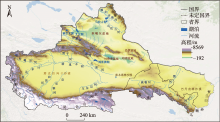
图1
研究区示意图 注:底图采用自然资源部标准地图制作,审图号为GS(2016)2923号,对底图边界无修改。下同。"

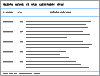
表1
数据详情"
| 数据集 | 空间分辨率 | 时间范围 | 数据来源 |
|---|---|---|---|
| Landsat 5 SR | 30 m | 1990—2011年 | 美国地质调查局( |
| Landsat 7 SR | 30 m | 1999—2012年 | 美国地质调查局( |
| Landsat 8 SR | 30 m | 2013—2022年 | 美国地质调查局( |
| 土地覆被数据 | 30 m | 1990—2022年 | 武汉大学30 m分辨率中国土地覆被数据集( |
| 气温数据 | 0.5° | 1990—2022年 | CRU TS( |
| 降水数据 | 0.5° | 1990—2022年 | CRU TS( |
| 蒸散发数据 | 0.0083333° | 1990—2022年 | 国家青藏高原科学数据中心( |
| 干燥度数据 | 0.0083333° | 1990—2022年 | 国家青藏高原科学数据中心( |
表2
FVC变化等级趋势"
| β | Z | 趋势特征 |
|---|---|---|
| β>0 | Z>1.96 | 显著增加 |
| Z<1.96 | 轻微增加 | |
| β=0 | Z=0 | 无变化 |
| β<0 | Z>-1.96 | 轻微减少 |
| Z<-1.96 | 显著减少 |
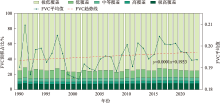
图2
FVC等级占比及平均值"

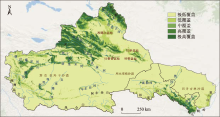
图3
1990—2022年平均生长季FVC空间分布"

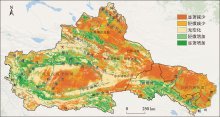
图4
西北干旱区FVC空间变化趋势分析"

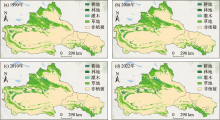
图5
不同植被分布和面积变化"

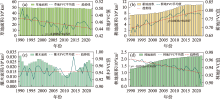
图6
不同植被类型FVC及面积变化"

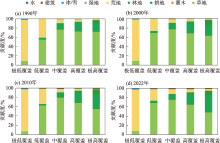
图7
不同土地类型对FVC各等级的贡献度"

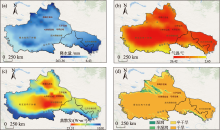
图8
西北干旱区生长季平均总降水量(a)、气温(b)、蒸散发(c)和年均干燥度(d)"

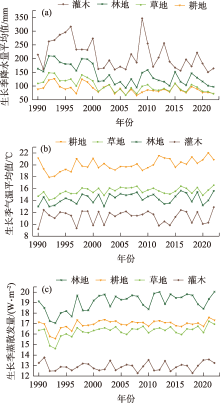
图9
1990—2022年不同植被区域生长季总降水量(a)、平均气温(b)和蒸散发(c)"

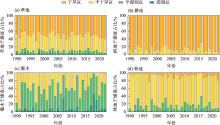
图10
1990—2022年不同植被区域年干燥度占比"

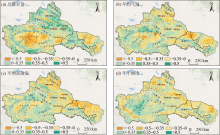
图11
FVC与生长季总降水量(a)、平均气温(b)、平均蒸散发(c)和年干燥度(d)相关性"

| [1] | Mao P, Zhang J, Li M, et al. Spatial and temporal variations in fractional vegetation cover and its driving factors in the Hulun Lake region[J]. Ecological Indicators, 2022, 135: 108490. |
| [2] | Xu W, Liu H, Zhang Q, et al. Response of vegetation ecosystem to climate change based on remote sensing and information entropy: A case study in the arid inland river basin of China[J]. Environmental Earth Sciences, 2021, 80: 132. |
| [3] | Zarandian A, Ramezani Mehrian M, Mohammadyari F. Impact assessment of vegetation loss on the ecosystem functions in a semiarid watershed in Iran[J]. Acta Geophysica, 2022, 70: 677-696. |
| [4] | Tang Z X, Zhou Z X, Wang D, et al. Impact of vegetation restoration on ecosystem services in the Loess Plateau, a case study in the Jinghe Watershed, China[J]. Ecological Indicators, 2022, 142: 109183. |
| [5] | Ma S, Wang L J, Jiang J, et al. Threshold effect of ecosystem services in response to climate change and vegetation coverage change in the Qinghai-Xizang Plateau ecological shelter[J]. Journal of Cleaner Production, 2021, 318: 128592. |
| [6] | Zhang Z Q, Zhai P M. Numerical simulation of the effects of global warming on vegetation in Asia[J]. Advances in Climate Change Research, 2022, 13(5): 688-699. |
| [7] | Li X, Shi Z, Yu J, et al. Study on the change in vegetation coverage in desert oasis and its driving factors from 1990 to 2020 based on Google Earth Engine[J]. Applied Sciences, 2023, 13: 5394. |
| [8] |
张倩, 曹广超, 张乐乐, 等. 祁连山南坡植被绿度时空变化及其对气候变化和人类活动的响应[J]. 干旱区研究, 2024, 41(12): 2143-2153.
doi: 10.13866/j.azr.2024.12.15 |
|
[Zhang Qian, Cao Guangchao, Zhang Lele, et al. Spatiotemporal changes in vegetation greenness on the southern slopes of the Qilian Mountains and their responses to climate change and human activities[J]. Arid Zone Research, 2024, 41(12): 2143-2153.]
doi: 10.13866/j.azr.2024.12.15 |
|
| [9] | 杨鹏辉, 田佳, 张楠, 等. 1990—2022年黄河流域植被时空变化特征及未来趋势预测[J]. 生态学报, 2024, 44(19): 8542-8553. |
| [Yang Penghui, Tian Jia, Zhang Nan, et al. Characteristics of spatio-temporal changes and future trends forecast of vegetation cover in the Yellow River basin from 1990-2022[J]. Acta Ecologica Sinica, 2024, 44(19): 8542-8553.] | |
| [10] | 李卓忆, 杨庆, 马柱国, 等. 中国北方干旱半干旱区植被对气候变化和人类活动的响应[J]. 大气科学, 2024, 48(3): 859-874. |
| [Li Zhuoyi, Yang Qing, Ma Zhuguo, et al. Responses of vegetation to climate change and human activities in the arid and semiarid regions of northern China[J]. Chinese Journal of Atmospheric Sciences, 2024, 48(3): 859-874.] | |
| [11] | Xu Z X, Li Y F, Li B, et al. A comparative study on the applicability and effectiveness of NSVI and NDVI for estimating fractional vegetation cover based on multi-source remote sensing image[J]. Geocarto International, 2023, 38(1): 2184501. |
| [12] | 赵晶, 周耀治, 邓兴耀. 西北干旱区植被覆盖时空动态特征[J]. 林业资源管理, 2017(1): 118-126. |
| [Zhao Jing, Zhou Yaozhi, Deng Xingyao. Temporal-spatial dynamic change characteristics of vegetation coverage in arid regions of Northwest China[J]. Forest and Grassland Resources Research, 2017(1): 118-126.] | |
| [13] | 王玮, 冯琦胜, 郭铌, 等. 基于长时间序列NDVI资料的我国西北干旱区植被覆盖动态监测[J]. 草业科学, 2012, 32(12): 1969-1979. |
| [Wang Wei, Feng Qisheng, Guo Ni, et al. Dynamic monitoring of vegetation coverage based on long time-series NDVI data sets in northwest arid region of China[J]. Pratacultural Science, 2012, 32(12): 1969-1979.] | |
| [14] | Wang S, Liu Q, Huang C. Vegetation change and its response to climate extremes in the arid region of Northwest China[J]. Remote Sensing, 2021, 13: 1230. |
| [15] | 阿多, 赵文吉, 宫兆宁, 等. 1981—2013华北平原气候时空变化及其对植被覆盖度的影响[J]. 生态学报, 2017, 37(2): 576-592. |
| [A Duo, Zhao Wenji, Gong Zhaoning, et al. Temporal analysis of climate change and its relationship with vegetation cover on the north China plain from 1981 to 2013[J]. Acta Ecologica Sinica, 2017, 37(2): 576-592.] | |
| [16] | Zhou Q, Chen W, Wang H, et al. Spatiotemporal evolution and driving factors analysis of fractional vegetation coverage in the arid region of Northwest China[J]. Science of the Total Environment, 2024, 954: 176271. |
| [17] |
李茂华, 都金康, 李皖彤, 等. 1982—2015年全球植被变化及其与温度和降水的关系[J]. 地理科学, 2020, 40(5): 823-832.
doi: 10.13249/j.cnki.sgs.2020.05.017 |
|
[Li Maohua, Du Jinkang, Li Wantong, et al. Global vegetation change and its relationship with precipitation and temperature based on GLASS-LAI in 1982-2015[J]. Scientia Geographica Sinica, 2020, 40(5): 823-832.]
doi: 10.13249/j.cnki.sgs.2020.05.017 |
|
| [18] | Wang Y, Kong X, Guo K, et al. Spatiotemporal change in vegetation cover in the Yellow River Basin between 2000 and 2022 and driving forces analysis[J]. Frontiers in Ecology and Evolution, 2023, 11: 1261210. |
| [19] | Li M, Yao J, Zheng J. Spatio-temporal change and drivers of the vegetation trends in central Asia[J]. Forests, 2024, 15: 8. |
| [20] |
Dong H, Liu Y, Cui J, et al. Spatial and temporal variations of vegetation cover and its influencing factors in Shandong Province based on GEE[J]. Environmental Monitoring and Assessment, 2023, 195: 1023.
doi: 10.1007/s10661-023-11650-7 pmid: 37548802 |
| [21] | Lin J, Bo W, Dong X, et al. Evolution of vegetation cover and impacts of climate change and human activities in arid regions of Northwest China: A Mu Us Sandy Land case[J]. Environment, Development and Sustainability, 2024. doi.org/10.1007/s10668-024-04704-4. |
| [22] | 张学渊, 魏伟, 周亮, 等. 西北干旱区生态脆弱性时空演变分析[J]. 生态学报, 2021, 41(12): 4707-4719. |
| [Zhang Xueyuan, Wei Wei, Zhou Liang, et al. Analysis on spatio-temporal evolution of ecological vulnerability in arid areas of Northwest China[J]. Acta Ecologica Sinica, 2021, 41(12): 4707-4719.] | |
| [23] | 陈亚宁, 李忠勤, 徐建华. 中国西北干旱区水资源与生态环境变化及保护建议[J]. 中国科学院院刊, 2023, 38(3): 385-393. |
| [Chen Yaning, Li Zhongqin, Xu Jianhua. Changes and protection suggestions in water resources and ecological environment in arid region of Northwest China[J]. Bulletin of Chinese Academy of Sciences, 2023, 38(3): 385-393.] | |
| [24] |
赵楠, 赵颖慧, 邹海凤. 1990—2020年黑龙江省植被覆盖度的时空变化趋势及驱动力[J]. 应用生态学报, 2023, 34(5): 1320-1330.
doi: 10.13287/j.1001-9332.202305.021 |
| [Zhao Nan, Zhao Yinghui, Zou Haifeng. Spatial and temporal trends and drivers of fractional vegetation cover in Heilongjiang Province China during 1990-2020[J]. Chinese Journal of Applied Ecology, 2023, 34(5): 1320-1330.] | |
| [25] |
陈以恒, 玉素甫江·如素力, 阿卜杜热合曼·吾斯曼. 2001—2020年天山新疆段草地植被覆盖度时空变化及驱动因素分析[J]. 植物生态学报, 2024, 48(5): 561-576.
doi: 10.17521/cjpe.2023.0155 |
|
[Chen Yiheng, Yusufujiang Rusuli, Abdureheman Wusiman. Analysis of spatial and temporal variation in grassland vegetation cover in Xinjiang section of Tianshan Mountains and the driving factors from 2001 to 2020[J]. Chinese Journal of Plant Ecology, 2024, 48(5): 561-576.]
doi: 10.17521/cjpe.2023.0155 |
|
| [26] | 刘坤, 袁新, 肖寒予, 等. 2000—2019年西藏草地植被覆盖度对气温和降水变化的响应[J]. 中国资源综合利用, 2022, 40(5): 95-100. |
| [Liu Kun, Yuan Xin, Xiao Hanyu, et al. Responses of grassland fractional vegetation coverage to temperature and precipitation changes in Xizang from 2000 to 2019[J]. China Resources Comprehensive Utilization, 2022, 40(5): 95-100.] | |
| [27] | 闫志远, 张圣微, 王怡璇. 基于GEE的1982—2021年内蒙古地区植被覆盖度时空动态及气候响应特征[J]. 农业工程学报, 2023, 39(15): 94-102. |
| [Yan Zhiyuan, Zhang Shengwei, Wang Yixuan. Spatiotemporal dynamics of fractional vegetation cover and climate response in Inner Mongolia during 1982-2021 based on GEE[J]. Transactions of the Chinese Society of Agricultural Engineering, 2023, 39(15): 94-102.] | |
| [28] |
杨靖, 戴君虎, 姚华荣, 等. 1992—2020年横断山区植被分布与植被活动变化[J]. 地理学报, 2022, 77(11): 2787-2802.
doi: 10.11821/dlxb202211007 |
|
[Yang Jing, Dai Junhu, Yao Huarong, et al. Vegetation distribution and vegetation activity changes in the Hengduan Mountains from 1992 to 2020[J]. Acta Geographica Sinica, 2022, 77(11): 2787-2802.]
doi: 10.11821/dlxb202211007 |
|
| [29] | 黄豪奔, 徐海量, 林涛, 等. 2001—2020年新疆阿勒泰地区归一化植被指数时空变化特征及其对气候变化的响应[J]. 生态学报, 2022, 42(7): 2798-2809. |
| [Huang Haoben, Xu Hailiang, Lin Tao, et al. Spatio-temporal variation characteristics of NDVI and its response to climate change in the Altay region of Xinjiang from 2001 to 2020[J]. Acta Ecologica Sinica, 2022, 42(7): 2798-2809.] | |
| [30] | de Jong R, de Bruin S, de Wit A, et al. Analysis of monotonic greening and browning trends from global NDVI time-series[J]. Remote Sensing of Environment, 2011, 115(2): 692-702. |
| [31] | 肖建勇, 王世杰, 白晓永, 等. 喀斯特关键带植被时空变化及其驱动因素[J]. 生态学报, 2018, 38(24): 8799-8812. |
| [Xiao Jianyong, Wang Shijie, Bai Xiaoyong, et al. Determinants and spatial-temporal evolution of vegetation coverage in the Karst critical zone of South China[J]. Acta Ecologica Sinica, 2018, 38(24): 8799-8812.] | |
| [32] | 沈贝贝, 魏一博, 马磊超, 等. 内蒙古草原植被覆盖度时空格局变化及驱动因素分析[J]. 农业工程学报, 2022, 38(12): 118-126. |
| [Shen Beibei, Wei Yibo, Ma Leichao, et al. Spatiotemporal changes and drivers of fractional vegetation cover in Inner Mongolia grassland of China[J]. Transactions of the Chinese Society of Agricultural Engineering, 2022, 38(12): 118-126.] | |
| [33] |
苏泽琛, 邵战林. 干旱区土地利用变化对耕地空间的影响及预测——以昌吉市为例[J]. 干旱区研究, 2024, 41(11): 1936-1945.
doi: 10.13866/j.azr.2024.11.13 |
|
[Su Zechen, Shao Zhanlin. Influence and prediction of land use change on the space of arable land in arid zones: Taking Changji City as an example[J]. Arid Zone Research, 2024, 41(11): 1936-1945.]
doi: 10.13866/j.azr.2024.11.13 |
|
| [34] | 潘竟虎, 李真. 2001—2012年西北干旱区植被净初级生产力时空变化[J]. 生态学杂志, 2015, 34(12): 3333-3340. |
| [Pan Jinghu, Li Zhen. Spatiotemporal changes in vegetation net primary productivity in the arid region of Northwest China, 2001 to 2012[J]. Chinese Journal of Ecology, 2015, 34(12): 3333-3340.] | |
| [35] |
马海云, 张林林, 魏学琼, 等. 2000—2015年西南地区土地利用与植被覆盖的时空变化[J]. 应用生态学报, 2021, 32(2): 618-628.
doi: 10.13287/j.1001-9332.202102.017 |
|
[Ma Haiyun, Zhang Linlin, Wei Xueqiong, et al. Spatial and temporal variations of land use and vegetation cover in Southwest China from 2000 to 2015[J]. Chinese Journal of Applied Ecology, 2021, 32(2): 618-628.]
doi: 10.13287/j.1001-9332.202102.017 |
|
| [36] | Shi L, Fan H, Yang L, et al. NDVI-based spatial and temporal vegetation trends and their response to precipitation and temperature changes in the Mu Us Desert from 2000 to 2019[J]. Water Science & Technology, 2023, 88(2): 430-442. |
| [37] | Liu Y, Huang T, Qiu Z, et al. Effects of precipitation changes on fractional vegetation cover in the Jinghe River basin from 1998 to 2019[J]. Ecological Informatics, 2024, 80: 102505. |
| [1] | 魏倩, 马全林, 赵锐锋. 古浪县八步沙区域生态环境质量变化[J]. 干旱区研究, 2025, 42(6): 1114-1125. |
| [2] | 李晓鹏, 李康, 雷双, 贾富贵, 徐静. 基于TVDI的新疆地区干旱时空变化特征[J]. 干旱区研究, 2025, 42(4): 589-599. |
| [3] | 张起鹏, 路红娥, 赵頔琛, 卓玛兰草. 甘南黄河上游植被覆盖度时空变化与地形因子的关系[J]. 干旱区研究, 2025, 42(3): 523-522. |
| [4] | 戚曌, 闫峰, 席磊, 曹晓明, 邹佳秀, 冯益明. 鄂尔多斯高原砒砂岩区植被恢复潜力[J]. 干旱区研究, 2024, 41(9): 1583-1592. |
| [5] | 吴思源, 郝利娜. 2001—2021年黄河流域植被覆盖变化及其驱动因素[J]. 干旱区研究, 2024, 41(8): 1373-1384. |
| [6] | 张宏伟, 别强, 石莹, 苏晓杰, 李欣璋. 黄河流域上游植被覆盖变化特征及其影响因素[J]. 干旱区研究, 2024, 41(8): 1385-1394. |
| [7] | 郑柳娜, 江红南, 孙梦婷. 基于遥感影像的新疆渭干河—库车河三角洲土壤水盐与植被覆盖度的关系[J]. 干旱区研究, 2024, 41(7): 1131-1139. |
| [8] | 雷菲亚, 李小双, 陶冶, 尹本丰, 荣晓莹, 张静, 陆永兴, 郭星, 周晓兵, 张元明. 西北干旱区藓类结皮覆盖下土壤多功能性特征及影响因子[J]. 干旱区研究, 2024, 41(5): 812-820. |
| [9] | 裴志林, 曹晓娟, 王冬, 李迪, 王鑫, 白艾原. 内蒙古植被覆盖时空变化特征及其对人类活动的响应[J]. 干旱区研究, 2024, 41(4): 629-638. |
| [10] | 赵东颖, 蒙仲举, 孟芮冰, 马泽. 乌兰布和沙漠风沙入黄段植被覆盖动态变化特征及驱动力[J]. 干旱区研究, 2024, 41(4): 639-649. |
| [11] | 齐容镰, 李庆波, 任佳, 邹苗, 杨昊鹏, 魏耀峰, 唐琼. “三北”工程地区植被覆盖变化特征及其驱动力分析——以宁夏为例[J]. 干旱区研究, 2024, 41(10): 1740-1752. |
| [12] | 赵雨琪, 魏天兴. 1990—2020年黄土高原典型县域植被覆盖变化及影响因素[J]. 干旱区研究, 2024, 41(1): 147-156. |
| [13] | 马瑶瑶, 史培军, 徐伟, 张钢锋. 干旱区水电站建设运营生态环境影响遥感监测[J]. 干旱区研究, 2023, 40(9): 1498-1508. |
| [14] | 文妙霞, 何学高, 刘欢, 张婧, 罗晨, 贾丰铭, 王义贵, 胡云云. 基于地理探测器的宁夏草地植被覆被时空分异及驱动因子[J]. 干旱区研究, 2023, 40(8): 1322-1332. |
| [15] | 李鑫磊, 李瑞平, 王秀青, 王思楠, 王成坤. 基于地理探测器的河套灌区林草植被覆盖度时空变化与驱动力分析[J]. 干旱区研究, 2023, 40(4): 623-635. |
|
||
