
Arid Zone Research ›› 2025, Vol. 42 ›› Issue (1): 97-107.doi: 10.13866/j.azr.2025.01.09
• Plant Ecology • Previous Articles Next Articles
QU Yuyang( ), WEN Tiantian, LIU Jiamin, YAN Ping()
Received:2024-08-14
Revised:2024-10-21
Online:2025-01-15
Published:2025-01-17
Contact:
YAN Ping
E-mail:1071408474@qq.com;1229016867@qq.com
QU Yuyang, WEN Tiantian, LIU Jiamin, YAN Ping. Potential geographic distribution of the three species of Cuscuta in China under climate scenarios[J].Arid Zone Research, 2025, 42(1): 97-107.
Add to citation manager EndNote|Reference Manager|ProCite|BibTeX|RefWorks
Tab. 1
Candidate environment variable factors"
| 环境变量代码 | 变量描述 | 单位 |
|---|---|---|
| Bio1 | 年平均温度 | ℃ |
| Bio2 | 昼夜温差月均值 | ℃ |
| Bio3 | 昼夜温差与年温差比值 | - |
| Bio4 | 温度季节性变化标准差 | - |
| Bio5 | 最热月最高温 | ℃ |
| Bio6 | 最冷月最低温 | ℃ |
| Bio7 | 气温年较差 | ℃ |
| Bio8 | 最湿季平均温度 | ℃ |
| Bio9 | 最干季平均温度 | ℃ |
| Bio10 | 最热季平均温度 | ℃ |
| Bio11 | 最冷季平均温度 | ℃ |
| Bio12 | 年降水量 | mm |
| Bio13 | 最湿月降水量 | mm |
| Bio14 | 最干月降水量 | mm |
| Bio15 | 降水量季节性变异系数 | - |
| Bio16 | 最湿季降水量 | mm |
| Bio17 | 最干季降水量 | mm |
| Bio18 | 最热季降水量 | mm |
| Bio19 | 最冷季降水量 | mm |
| DEM | 海拔 | m |
Tab. 2
The environment variable factors used to build the model"
| 物种 | 代码 |
|---|---|
| 杯花菟丝子 | Bio1、Bio2、Bio3、Bio4、Bio9、Bio11、Bio12、Bio13、 Bio14、Bio15、DEM |
| 原野菟丝子 | Bio1、Bio2、Bio3、Bio4、Bio6、Bio9、Bio14、Bio15、 Bio18、DEM |
| 单柱菟丝子 | Bio1、Bio2、Bio3、Bio4、Bio7、Bio10、Bio13、Bio15、 Bio19、DEM |
Tab. 3
MaxEnt parameter settings optimized based on the kuenm package"
| 类型 | 物种 | 特征组合 | 倍频 | 信息量准则 |
|---|---|---|---|---|
| 默认 | 杯花菟丝子 | LQPH | 1 | 32.93 |
| 原野菟丝子 | LQPH | 1 | 40.83 | |
| 单柱菟丝子 | LQPH | 1 | 82.31 | |
| 优化 | 杯花菟丝子 | QPT | 1.6 | 0 |
| 原野菟丝子 | QPT | 2.8 | 0 | |
| 单柱菟丝子 | QPT | 1.9 | 0 |
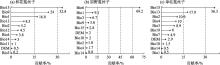
Fig. 1
Contribution rate of environmental factors involved in the modeling"

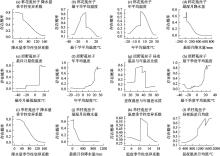
Fig. 2
Response curves for major environment variabl"

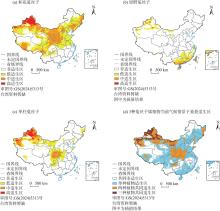
Fig. 3
Potential distribution areas of three species of Cuscuta under current climate conditions"


Fig. 4
Potential suitable area of three species of Cuscuta in different periods"

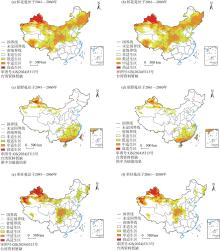
Fig. 5
Potential distribution areas of three species of Cuscuta under different climatic scenarios in the future"
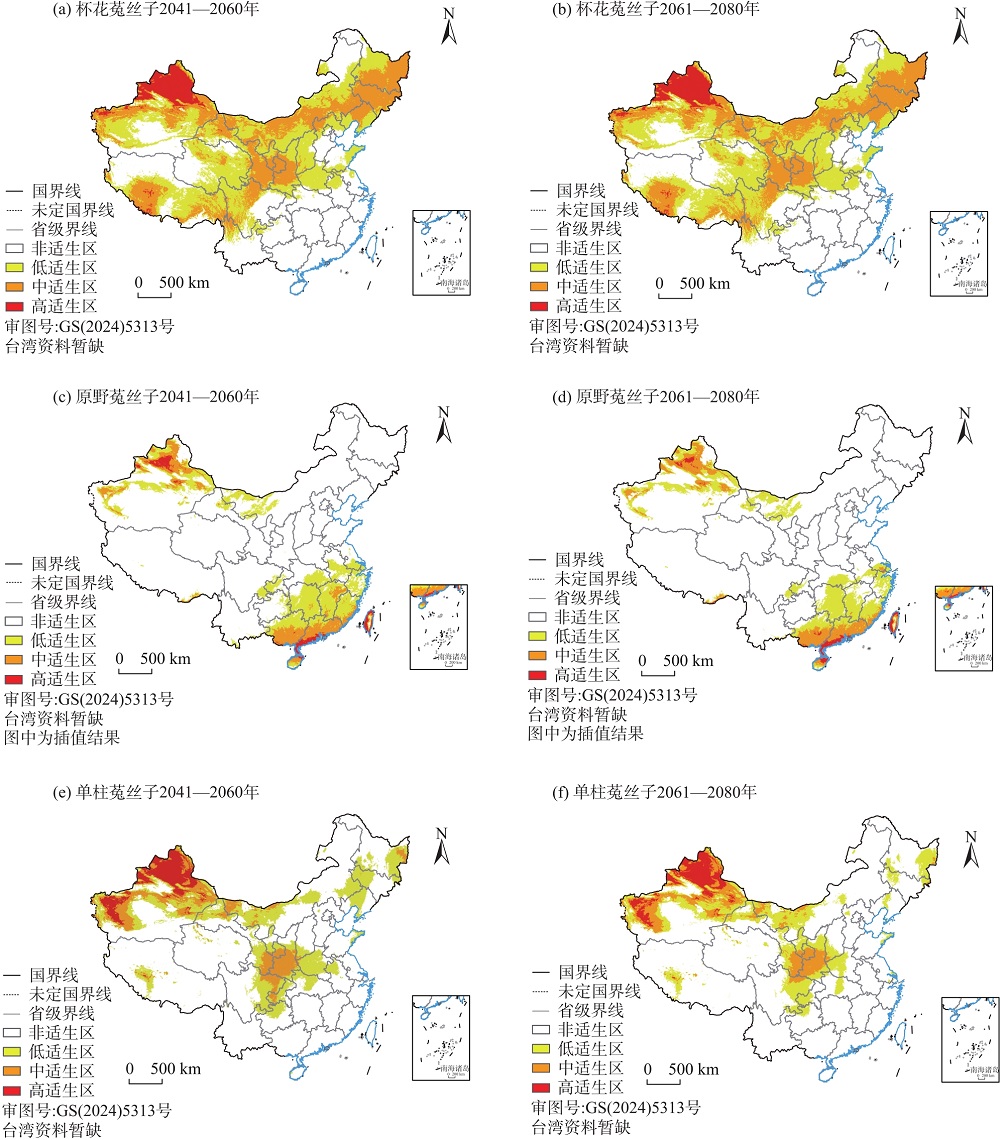
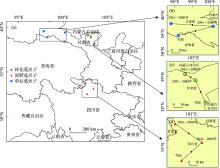
Fig. 6
The migration routes of centroid in three species of Cuscuta in different periods"


Fig. 7
Distribution of land types in three potential suitable areas of Cuscuta under current climate scenario"

Tab. 4
Distribution proportion of land use types in three potential suitable areas of Cuscuta species under current climate scenarios"
| 土地利用类型 | 耕地/% | 林地/% | 草地/% | 水域/% | 建设用地/% | 未利用土地/% | 总适生区面/104 km2 |
|---|---|---|---|---|---|---|---|
| 杯花菟丝子 | 20.69 | 16.80 | 30.53 | 2.44 | 3.24 | 26.30 | 588.54 |
| 原野菟丝子 | 21.62 | 37.13 | 13.71 | 2.82 | 4.50 | 20.22 | 117.45 |
| 单柱菟丝子 | 21.86 | 13.05 | 24.95 | 2.53 | 2.51 | 35.10 | 261.52 |
| [1] |
周杰, 王旭虎, 杜维波, 等. 气候变化背景下的天山云杉潜在分布区预测[J]. 干旱区研究, 2024, 41(7): 1167-1176.
doi: 10.13866/j.azr.2024.07.08 |
| [Zhou Jie, Wang Xuhu, Du Weibo, et al. Prediction of potential distribution area of Picea schrenkiana under the background of climate change[J]. Arid Zone Research, 2024, 41(7): 1167-1176. ] | |
| [2] |
王丽丽, 杨采青, 王瑛, 等. 全球入侵物种马铃薯块茎蛾生态位转移及适生区扩展[J]. 应用生态学报, 2024, 35(3): 797-805.
doi: 10.13287/j.1001-9332.202403.013 |
| [Wang Lili, Yang Caiqing, Wang Ying, et al. Ecological niche shift and suitable area expansion of a globally invasive species Phthorimaea operculella[J]. Chinese Journal of Applied Ecology, 2024, 35(3): 797-805. ] | |
| [3] | Amirmoradi S, Moghaddam P R, Noghabi M A. Effect of Cuscuta(dodder) on quality and quantity traits of Sugar Beet in Chenaran, Khorasan Razavi Province[J]. Iranian Journal of Field Crops Research, 2012, 8(6): 965-74. |
| [4] | 罗瑞萍, 赵志刚, 赵越, 等. 3个主栽大豆品种被菟丝子寄生危害的差异性研究[J]. 农业灾害研究, 2016, 6(1): 3-4. |
| [Luo Ruiping, Zhao Zhigang, Zhaoyue, et al. Study on the damage difference of three main soybean cultivars to dodder parasitizing[J]. Journal of Agricultural Catastrophology, 2016, 6(1): 3-4. ] | |
| [5] | 尚佰晓. 菟丝子属植物在园林绿化中的危害调查及防治[J]. 园艺与种苗, 2022, 42(8): 28-32. |
| [Shang Baixiao. Hazard investigation and control of Cuscuta plants in landscaping[J]. Horticulture & Seed, 2022, 42(8): 28-32. ] | |
| [6] | 周鑫, 瞿巧文, 吴夏华. 菟丝子对林木的危害及其防治[J]. 北方农业学报, 2013(6): 93. |
| [Zhou Xin, Qu Qiaowen, Wu Xiahua. Harm of Cuscuta chinensis to forest trees and its control[J]. Journal of Northern Agriculture, 2013(6): 93. ] | |
| [7] | 陈莹, 兰芳, 刘金平, 等. 日本菟丝子对园林植物危害度及适应性生长的研究[J]. 四川林业科技, 2023, 44(1): 32-39. |
| [Chen Ying, Lan Fang, Liu Jinping, et al. Effects of Cuscuta japonica on the harmfulness and adaptive growth of garden plants in Nanchong[J]. Journal of Sichuan Forestry Science and Technology, 2023, 44(1): 32-39. ] | |
| [8] | Qu X J, Fan S J. First report of the parasitic invasive weed field dodder (Cuscuta campestris) parasitizing the confamilial invasive weed common morning-glory (Ipomoea purpurea) in Shandong, China.[J]. Plant Disease, 2021, 105(4): 1230. |
| [9] | 余波, 瞿添添, 刘应蛟, 等. 菟丝子和大菟丝子形态组织研究与分类学意义[J]. 种子, 2023, 42(10): 57-64. |
| [Yu Bo, Qu Tiantian, Liu Yingjiao, et al. Morphlogical organization and taxonomic significance of Cuscutae semen and Cuscutae japonicae semen[J]. Seed, 2023, 42(10): 57-64. ] | |
| [10] | Yuan Y G, Oduor A M, Zhao Y Y, et al. Parasitism by Cuscuta gronovii mediated soil legacy effects and the competitive ability of invasive and native plant species by changing soil abiotic and biotic properties[J]. Applied Soil Ecology, 2024, 202: 105583. |
| [11] | 周冰颖, 刘霞, 谢伟, 等. 我国长江流域园林常见菟丝子及其防治方法[J]. 杂草学报, 2022, 40(3): 8-13. |
| [Zhou Bingying, Liu Xia, Xie Wei, et al. Common dodder in Chinese gardens of Yangtze River Basin and its control mehods[J]. Journal of Weed Science, 2022, 40(3): 8-13. ] | |
| [12] | 陈鲁宁, 胡扬, 辛国松, 等. 菟丝子化学成分、药理作用研究进展及其质量标志物(Q-Marker)预测[J]. 中草药, 2024, 55(15): 5298-5314. |
| [Chen Luning, Hu Yang, Xin Guosong, et al. Research progress on chemical constituents, pharmacological effects of Cuscutae Semen and its quality marker prediction[J]. Chinese Traditional and Herbal Drugs, 2024, 55(15): 5298-5314. ] | |
| [13] | Zhou Y C, Zhang Z X, Zhu B, et al. MaxEnt modeling based on CMIP6 models to project potential suitable zones for Cunninghamia lanceolata in China[J]. Forests, 2021, 12(6): 752. |
| [14] | 张晓玮, 蒋玉梅, 毕阳, 等. 基于MaxEnt模型的中国沙棘潜在适宜分布区分析[J]. 生态学报, 2022, 42(4): 1420-1428. |
| [Zhang Xiaowei, Jiang Yumei, Bi Yang, et al. Identification of potential distribution area for Hippophae rhamnoides subsp. sinensis by the MaxEnt model[J]. Acta Ecologica Sinica, 2022, 42(4): 1420-1428. ] | |
| [15] | 胡永云. 复杂气候系统和全球变暖[J]. 物理, 2022, 51(1): 10-15. |
| [Hu Yongyun. The complex climate system and global warming[J]. Physics, 2022, 51(1): 10-15. ] | |
| [16] |
田叙辰, 魏洪玲, 解胜男, 等. 基于MaxEnt模型的东北地区槭树潜在地理分布[J]. 生态环境学报, 2024, 33(4): 509-519.
doi: 10.16258/j.cnki.1674-5906.2024.04.002 |
| [Tian Xuchen, Wei Hongling, Xie Shengnan, et al. Potential geographical distribution of Acer in Northeast China based on the MaxEnt model[J]. Ecology and Environmental Sciences, 2024, 33(4): 509-519. ] | |
| [17] | 段义忠, 王佳豪, 王驰, 等. 未来气候变化下西北干旱区4种扁桃亚属植物潜在适生区分析[J]. 生态学杂志, 2020, 39(7): 2193-2204. |
| [Duan Yizhong, Wang Jiahao, Wang Chi, et al. Analysis on the potential suitable areas of four species of the subgen. Amygdalus in arid Northwest China under future climate change[J]. Chinese Journal of Ecology, 2020, 39(7): 2193-2204. ] | |
| [18] | Warren D L, Seifert S N. Ecological niche modeling in Maxent: The importance of model complexity and the performance of model selection criteria[J]. Ecological applications: A publication of the Ecological Society of America, 2011, 21(2): 335-342. |
| [19] | Muscarella R, Galante P J, Soley-Guardia M, et al. ENM eval: An R package for conducting spatially independent evaluations and estimating optimal model complexity for Maxent ecological niche models[J]. Methods in Ecology and Evolution, 2014, 5(11): 1198-1205. |
| [20] | 吴帆, 刘国豪, 谢鑫, 等. 未来气候变化对金花茶分布格局的影响[J]. 云南农业大学学报(自然科学), 2024, 39(3): 144-151. |
| [Wu Fan, Liu Guohao, Xie Xin, et al. Effects of future climate change on distribution pattern of Camellia petelotii[J]. Journal of Yunnan Agricultural University (Natural Science), 2024, 39(3): 144-151. ] | |
| [21] | Zhao Q, Mi Z Y, Chan L, et al. Predicting potential distribution of Ziziphus spinosa (Bunge) H. H. Hu ex F. H. Chen in China under climate change scenarios[J]. Ecology and Evolution, 2022, 12(2): e8629. |
| [22] | 艾尼古丽·依明. 石河子地区菟丝子种类鉴定、生物学特性研究及生防菌筛选[D]. 石河子: 石河子大学, 2017. |
| [ Ainiguli. Yiming. Species Identification, Biological Characteristics Study, and Screeningof Control Strain of Parasitic Weed Cuscuta in Shihezi[D]. Shihezi: Shihezi University, 2017. ] | |
| [23] | 任子春. 基于Maxent模型在全球变暖条件下菟丝子属全寄生植物及其寄主的潜在分布预测[D]. 太原: 山西师范大学, 2020. |
| [Ren Zichun. Potential Distribution Prediction of Holoparasitic Cuscuta Plantsand their Hosts under Global Warming Based on Maxent Model[D]. Taiyuan: Shanxi Normal University, 2020. ] | |
| [24] | 马金双. 中国入侵植物名录[M]. 北京: 高等教育出版社, 2013: 131-133. |
| [Ma Jinshuang. The Checklist of the Chinese Invasive Plants[M]. Beijing: Higher Education Press, 2013: 131-133. ] | |
| [25] | Goldwasser Y, Miryamchik H, Rubin B, et al. Field dodder (Cuscuta campestris) a new model describing temperature-dependent seed germination[J]. Weed Science, 2016, 64(1): 53-60. |
| [26] | 杨鑑初. 台湾温度初步分析[J]. 气象学报, 1950, 21(1): 47-52. |
| [Yang Jianchu. Preliminary analysis of temperature in Taiwan[J]. Acta Meteorologica Sinica, 1950, 21(1): 47-52. ] | |
| [27] | Piwowarczyk R, Góralski G, Denysenko-Bennett M, et al. First report of eastern dodder (Cuscuta monogyna) parasitizing Licorice (Glycyrrhiza glabra) in Armenia[J]. Plant Disease, 2018, 102(12): 2664. |
| [28] | Esmall E, Izadi D E, Rashed M M H, et al. Seed germination and seedling emergence in two populations of eastern dodder (Cuscuta monogyna Vahl. ): Evaluation of environmental factors and burial depth[J]. Acta Physiologiae Plantarum, 2022, 44(2): 26. |
| [29] | Yergin-Ozkan R, Tepe I. Emergence characteristics and germination physiology of smoothseed alfalfa dodder (Cuscuta approximata Bab.)[J]. Fresenius Environmental Bulletin, 2018, 27(1): 104-109. |
| [30] | Saric-Krsmanovic M, Bozic D, Pavlovic D, et al. Temperature effects on Cuscuta campestris Yunk. seed germination[J]. Pesticidi i Fitomedicina, 2013, 28(3): 187-193. |
| [31] | Roberts D R, Hamann A. Predicting potential climate change impacts with bioclimate envelope models: A palaeoecological perspective[J]. Global Ecology and Biogeography, 2012, 21(2): 121-133. |
| [32] | Ziska L H, Mcconnell L L. Climate change, carbon dioxide, and pest biology: Monitor, mitigate, manage[J]. Journal of Agricultural and Food Chemistry, 2016, 64(1): 6-12. |
| [33] | Guo F Y, Lenoir J, Bonebrake T C. Author Correction: Land-use change interacts with climate to determine elevational species redistribution[J]. Nature Communications, 2020, 11(1): 3485. |
| [34] | 新疆植物志编辑委员会. 新疆植物志·简本[M]. 乌鲁木齐: 新疆人民出版总社, 新疆科技卫生出版社, 2014: 343-344. |
| [ Commissione Redactorum Florae Xinjianggensis. Flora Xinjiangensis (the Brief Edition)[M]. Urumqi: Xinjiang People’s Publishing House, Xinjiang Science and Technology Press, 2014: 343-344. ] |
|
||
