
Arid Zone Research ›› 2025, Vol. 42 ›› Issue (7): 1211-1221.doi: 10.13866/j.azr.2025.07.05
• Land and Water Resources • Previous Articles Next Articles
YANG Chen1,2,3( ), MA Bin4,5,6, HE Xuemin1,2,3(), HAO Zhe4,5,6, MA Yu4,5,6
Received:2024-12-02
Revised:2025-03-26
Online:2025-07-15
Published:2025-07-07
Contact:
HE Xuemin
E-mail:yangchen1517@stu.xju.edu.cn;hxm@xju.edu.cn
YANG Chen, MA Bin, HE Xuemin, HAO Zhe, MA Yu. Patterns of spatial and temporal variation of evapotranspiration in Aksu River Basin and factors driving them[J].Arid Zone Research, 2025, 42(7): 1211-1221.
Add to citation manager EndNote|Reference Manager|ProCite|BibTeX|RefWorks
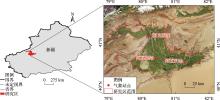
Fig. 1
Geographical overview and location map of the study area"

Tab. 1
Criteria for determining significant categories in Sen+MK trend analysis for the Aksu River Basin"
| β | Z | 趋势类型 |
|---|---|---|
| β>0 | |Z|>1.96 | 显著增长 |
| |Z|≤1.96 | 轻微增长 | |
| β<0 | |Z|≤1.96 | 轻微减少 |
| |Z|>1.96 | 显著减少 |
Tab. 2
Criteria for determining future trends of AET/PET in the Aksu River Basin"
| β | H | 趋势类型 |
|---|---|---|
| β>0 | H>0.5 | 持续增加 |
| H<0.5 | 可能由增加变为减少 | |
| β<0 | H>0.5 | 持续减少 |
| H<0.5 | 可能由减少变为增加 |
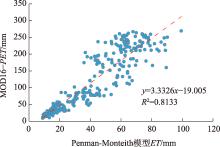
Fig. 2
Relationship between simulated ET values from the Penman-Monteith model and MOD16-PET"
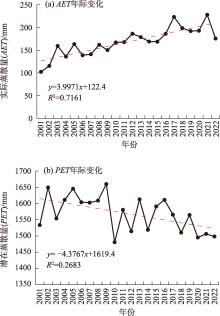
Fig. 3
Interannual variations of average AET and PET in the Aksu River Basin"

Fig. 4
Spatial variations of average AET and PET in the Aksu River Basin"
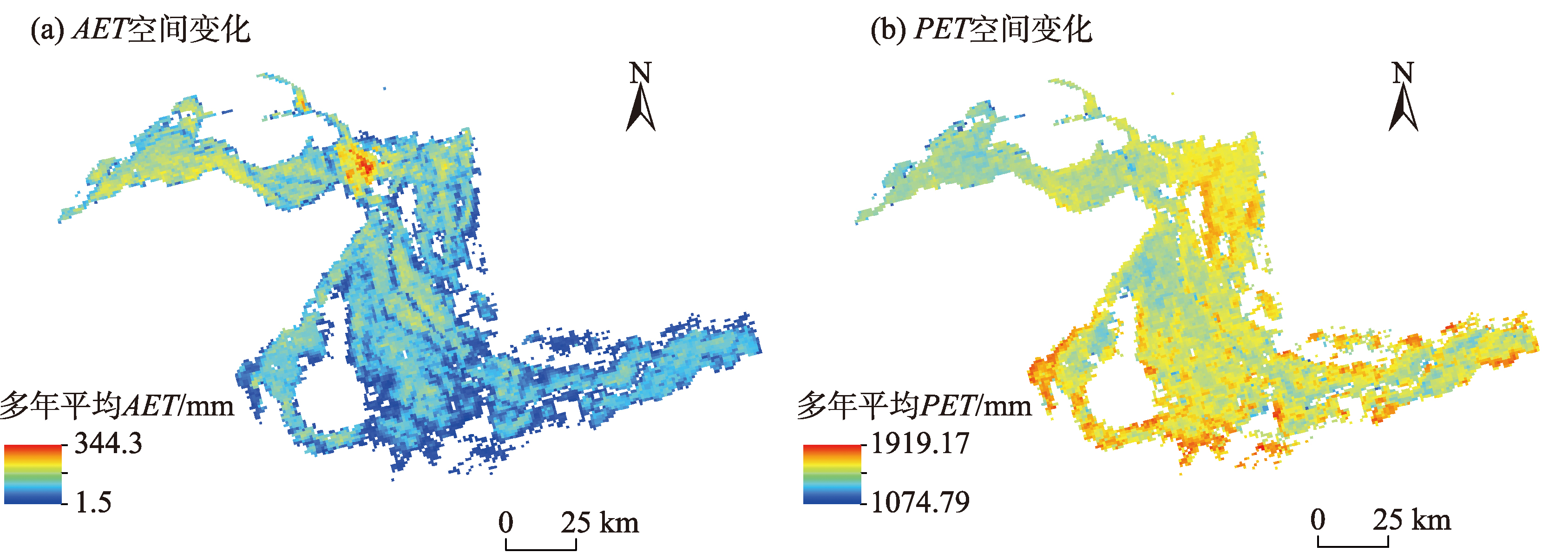
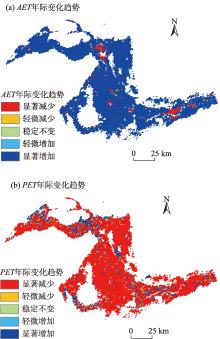
Fig. 5
Interannual trends of AET and PET in the Aksu River Basin"
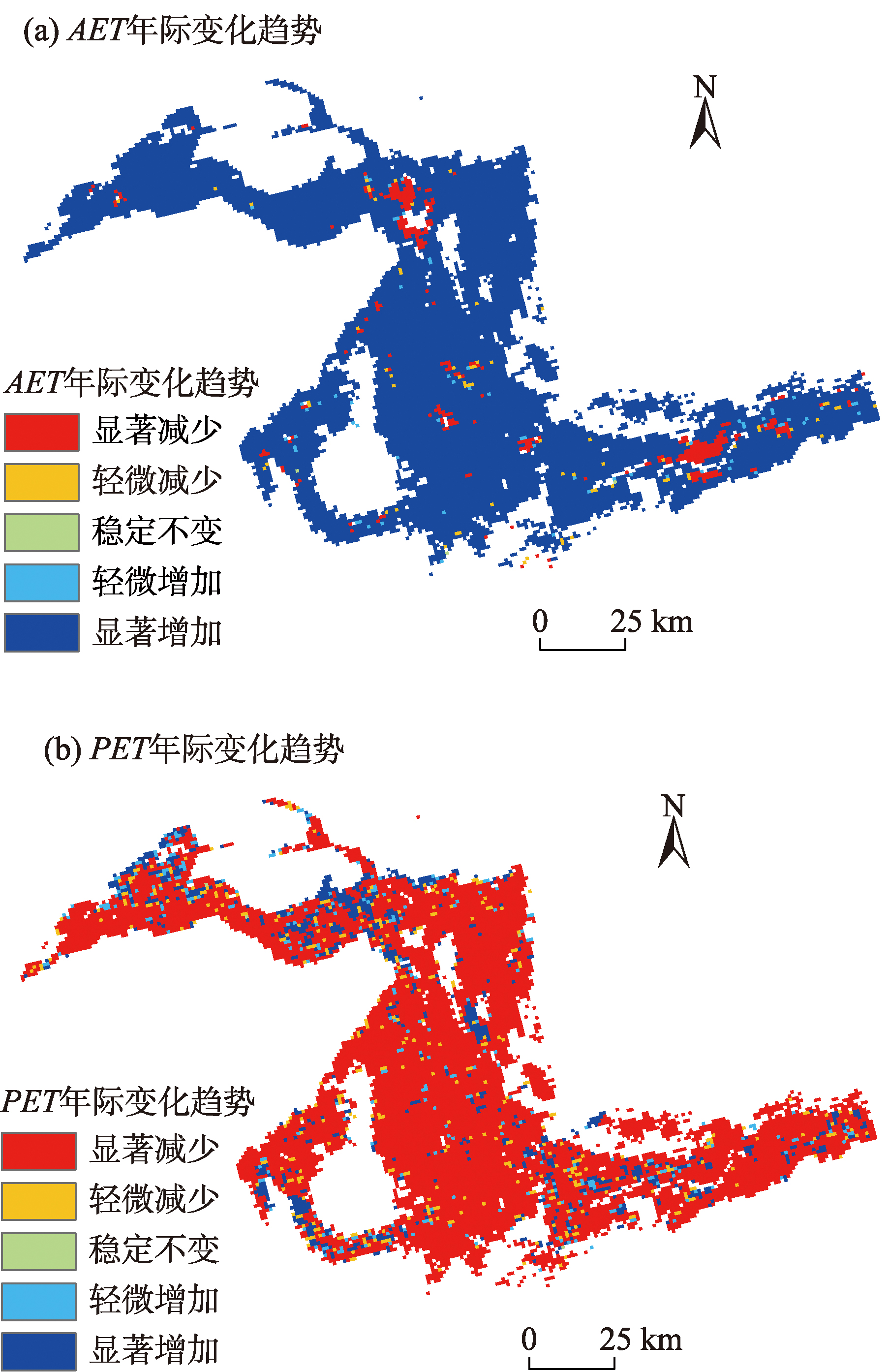
Tab. 3
Classification of interannual AET and PET variation trends in the Aksu River Basin"
| 蒸散类型 | 趋势类型 | 面积比例/% |
|---|---|---|
| AET | 显著增长 | 94.96 |
| 轻微增长 | 0.69 | |
| 稳定不变 | 0.03 | |
| 轻微减少 | 0.72 | |
| 显著减少 | 3.57 | |
| PET | 显著增长 | 9.39 |
| 轻微增长 | 3.18 | |
| 稳定不变 | 0.04 | |
| 轻微减少 | 4.14 | |
| 显著减少 | 83.25 |
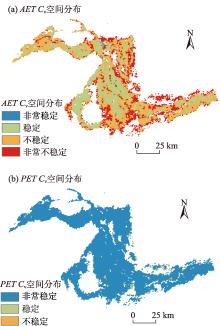
Fig. 6
Spatial distribution of fluctuation degrees of AET and PET in the Aksu River Basin"

Tab. 4
Classification of interannual fluctuation degrees of AET and PET in the Aksu River Basin"
| 蒸散类型 | 波动程度 | 面积比例/% |
|---|---|---|
| AET | 非常稳定 | 0.16 |
| 稳定 | 36.34 | |
| 不稳定 | 38.86 | |
| 非常不稳定 | 25.14 | |
| PET | 非常稳定 | 96.41 |
| 稳定 | 3.56 | |
| 不稳定 | 0.03 | |
| 非常不稳定 | 0 |
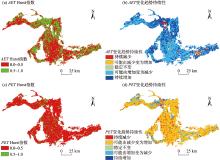
Fig. 7
Distribution map of Hurst indices and persistence of trends for AET and PET in the Aksu River Basin"

Tab. 5
Interannual correlation coefficients between AET, PET, and meteorological factors in the Aksu River Basin"
| 气温 | 风速 | 水汽压 | 相对湿度 | 日照时数 | |
|---|---|---|---|---|---|
| AET | 0.207 | 0.817** | 0.174 | -0.606** | 0.34 |
| PET | 0.089 | -0.446* | -0.057 | 0.372 | 0.321 |
| [1] | 张圆, 贾贞贞, 刘绍民, 等. 遥感估算地表蒸散量真实性检验研究进展[J]. 遥感学报, 2020, 24(8): 975-999. |
| [Zhang Yuan, Jia Zhenzhen, Liu Shaomin, et al. Advances in validation of remotely sensed land surface evapotranspiration[J]. Journal of Remote Sensing, 2020, 24(8): 975-999.] | |
| [2] | 李晓媛, 于德永. 蒸散量估算方法及其驱动力研究进展[J]. 干旱区研究, 2020, 37(1): 26-36. |
| [Li Xiaoyuan, Yu Deyong. Progress on evapotranspiration estimation methods and driving forces in arid and semiarid regions[J]. Arid Zone Research, 2020, 37(1): 26-36.] | |
| [3] | 刘洋, 于恩涛, 杨建军, 等. 西北干旱区1960—2019年实际蒸散量时空变化特征[J]. 水土保持研究, 2021, 28(6): 75-80, 89. |
| [Liu Yang, Yu Entao, Yang Jianjun, et al. Characteristics of spatial and temporal variation of actual evapotranspiration in the arid region of Northwest China from 1960 to 2019[J]. Research of Soil and Water Conservation, 2021, 28(6): 75-80, 89.] | |
| [4] |
周彦昭, 周剑, 李妍, 等. 利用SEBAL和改进的SEBAL模型估算黑河中游戈壁、绿洲的蒸散量[J]. 冰川冻土, 2014, 36(6): 1526-1537.
doi: 10.7522/j.issn.1000-0240.2014.0183 |
|
[Zhou Yanzhao, Zhou Jian, Li Yan, et al. Simulating the evapotranspiration with SEBAL and modified SEBAL (M-SEBAL) models over the desert and oasis of the middle reaches of the Heihe River[J]. Journal of Glaciology and Geocryology, 2014, 36(6): 1526-1537.]
doi: 10.7522/j.issn.1000-0240.2014.0183 |
|
| [5] | 郭晓彤, 孟丹, 蒋博武, 等. 基于MODIS蒸散量数据的淮河流域蒸散量时空变化及影响因素分析[J]. 水文地质工程地质, 2021, 48(3): 45-52. |
| [Guo Xiaotong, Meng Dan, Jiang Bowu, et al. Spatio-temporal change and influencing factors of evapotranspiration in the Huaihe River Basin based on MODIS evapotranspiration data[J]. Hydrogeology & Engineering Geology, 2021, 48(3): 45-52.] | |
| [6] | Chahine M T. The hydrological cycle and its influence on climate[J]. Nature, 1992, 359(6349): 373-380. |
| [7] |
阿迪来·乌甫, 玉素甫江·如素力, 热伊莱·卡得尔, 等. 基于MODIS数据的新疆地表蒸散量时空分布及变化趋势分析[J]. 地理研究, 2017, 36(7): 1245-1256.
doi: 10.11821/dlyj201707005 |
| [Adilai Wufu, Yusupujiang Rusuli, Reyila Kader, et al. Spatio-temporal distribution and evolution trend of evapotranspiration in Xinjiang based on MOD16 data[J]. Geographical Research, 2017, 36(7): 1245-1256.] | |
| [8] | 曹雪, 柯长青. 基于对象级的高分辨率遥感影像分类研究[J]. 遥感信息, 2006, 21(5): 27-30, 51, 73. |
| [Cao Xue, Ke Changqing. Classification of high-resolution remote sensing images using object-oriented method[J]. Remote Sensing Information, 2006, 21(5): 27-30, 51, 73.] | |
| [9] | 王冉冉, 吕光辉, 何学敏, 等. 克里雅河流域中游绿洲蒸散量的时空演变与驱动因素分析[J]. 测绘通报, 2024, 70(3): 31-36, 139. |
| [Wang Ranran, Lv Guanghui, He Xuemin, et al. Spatial-temporal evolution and driving factors analysis of oasis evapotranspiration in the middle reaches of the Keriya River Basin[J]. Bulletin of Surveying and Mapping, 2024, 70(3): 31-36, 139.] | |
| [10] | 邱新法, 曾燕, 刘昌明. 陆面实际蒸散研究[J]. 地理科学进展, 2003, 22(2): 118-124. |
|
[Qiu Xinfa, Zeng Yan, Liu Changming. A study on actual evaporation from non-saturated surfaces[J]. Progress in Geography, 2003, 22(2): 118-124.]
doi: 10.11820/dlkxjz.2003.02.002 |
|
| [11] | Moran M S, Rahman A F, Washburne J C, et al. Combining the Penman-Monteith equation with measurements of surface temperature and reflectance to estimate evaporation rates of semiarid grassland[J]. Agricultural and Forest Meteorology, 1996, 80(2-4): 87-109. |
| [12] | Bastiaanssen W, Pelgrum H, Wang J, et al. A remote sensing surface energy balance algorithm for land (SEBAL): Part 2: Validation[J]. Journal of Hydrology, 1998, 212-213(1-4): 198-212. |
| [13] | Jiang L, Islam S. A methodology for estimation of surface evapotranspiration over large areas using remote sensing observations[J]. Geophysical Research Letters, 1999, 26(17): 2773-2776. |
| [14] | Rodell M, Houser P R, Jambor U, et al. Land data assimilation systems[J]. Bulletin of the American Meteorological Society, 2004, 85(3): 381-394. |
| [15] | Martens B, Miralles D G, Lievens H, et al. GLEAM v3: Satellite-based land evaporation and root-zone soil moisture[J]. Geoscientific Model Development Discussions, 2016, 10(5): 1-36. |
| [16] | Mu Q Z, Zhao M, Steven W. Improvements to a MODIS global terrestrial evapotranspiration algorithm[J]. Remote Sensing of Environment, 2011, 115(8): 1781-1800. |
| [17] | 范建忠, 李登科, 高茂盛. 基于MOD16的陕西省蒸散量时空分布特征[J]. 生态环境学报, 2014, 23(9): 1536-1543. |
| [Fan Jianzhong, Li Dengke, Gao Maosheng. Spatio-temporal variations of evapotranspiration in Shaanxi Province using MOD16 products[J]. Ecology and Environmental Sciences, 2014, 23(9): 1536-1543.] | |
| [18] | 宋硕, 赵婉凝, 李少然, 等. 基于MOD16的银川地表蒸散量时空特征及影响因素分析[J]. 北京林业大学学报, 2024, 46(7): 18-26. |
| [Song Shuo, Zhao Wanning, Li Shaoran, et al. Spatio-temporal characteristics and influencing factors of evapotranspiration inYinchuan City of northwestern China Based on MOD16[J]. Journal of Beijing Forestry University, 2024, 46(7): 18-26.] | |
| [19] |
李晴, 杨鹏年, 彭亮, 等. 基于MOD16数据的焉耆盆地蒸散量变化研究[J]. 干旱区研究, 2021, 38(2): 351-358.
doi: 10.13866/j.azr.2021.02.06 |
|
[Li Qing, Yang Pengnian, Peng Liang, et al. Study of the variation trend of evapotranspiration in the Yanqi Basin based on MOD16 data[J]. Arid Zone Research, 2021, 38(2): 351-358.]
doi: 10.13866/j.azr.2021.02.06 |
|
| [20] | 刘静, 刘铁军, 杜晓峰, 等. 基于MOD16A2的毛乌素沙地实际蒸散量时空稳定性模拟[J]. 干旱地区农业研究, 2020, 38(2): 243-250. |
| [Liu Jing, Liu Tiejun, Du Xiaofeng, et al. Simulation on spatio-temporal stability of ET based on MOD16A2 in Mu Us Sandy Land[J]. Agricultural Research in the Arid Areas, 2020, 38(2): 243-250.] | |
| [21] | 艾力亚·艾尼瓦尔, 玉米提·哈力克, 买尔当·克依木, 等. 基于MOD16产品的塔里木河流域蒸散量时空分布特征[J]. 中国农村水利水电, 2018, 60(9): 79-84, 95. |
| [Ailiya Ainiwaer, Yumiti Halike, Maierdang Keyimu, et al. Spatio-temporal variation of evapotranspiration in the Tarim River Basin by using MOD16 products[J]. China Rural Water and Hydropower, 2018, 60(9): 79-84, 95.] | |
| [22] |
康利刚, 曹生奎, 曹广超, 等. 青海湖沙柳河流域蒸散量时空变化特征[J]. 干旱区研究, 2023, 40(3): 358-372.
doi: 10.13866/j.azr.2023.03.03 |
|
[Kang Ligang, Cao Shengkui, Cao Guangchao, et al. Temporal and spatial changes of evapotranspiration in the Shaliu River Basin of Qinghai Lake[J]. Arid Zone Research, 2023, 40(3): 358-372.]
doi: 10.13866/j.azr.2023.03.03 |
|
| [23] | 闫宇会, 薛宝林, 张路方, 等. 基于MOD16产品的黑河流域蒸散量时空分布特征[J]. 节水灌溉, 2019, 44(9): 85-92. |
| [Yan Yuhui, Xue Baolin, Zhang Lufang, et al. Temporal and spatial distribution characteristics of evapotranspiration in the Heihe River Basin based on MOD16 product[J]. Water Saving Irrigation, 2019, 44(9): 85-92.] | |
| [24] | 邓兴耀, 刘洋, 刘志辉, 等. 中国西北干旱区蒸散量时空动态特征[J]. 生态学报, 2017, 37(9): 2994-3008. |
| [Deng Xingyao, Liu Yang, Liu Zhihui, et al. Temporal-spatial dynamic change characteristics of evapotranspiration in arid region of Northwest China[J]. Acta Ecologica Sinica, 2017, 37(9): 2994-3008.] | |
| [25] |
姚小晨, 高凡, 韩方红, 等. 2000—2020年阿克苏河流域土地利用强度变化及其对蒸散量的影响[J]. 干旱区研究, 2024, 41(6): 951-963.
doi: 10.13866/j.azr.2024.06.05 |
|
[Yao Xiaochen, Gao Fan, Han Fanghong, et al. Land use intensity change and its influence on evapotranspiration in Aksu River Basin from 2000 to 2020[J]. Arid Zone Research, 2024, 41(6): 951-963.]
doi: 10.13866/j.azr.2024.06.05 |
|
| [26] | 陈亚宁, 郝兴明, 陈亚鹏, 等. 新疆塔里木河流域水系连通与生态保护对策研究[J]. 中国科学院院刊, 2019, 34(10): 1156-1164. |
| [Chen Yaning, Hao Xingming, Chen Yapeng, et al. Study on water system connectivity and ecological protection countermeasures of Tarim River Basin in Xinjiang[J]. Bulletin of the Chinese Academy of Sciences, 2019, 34(10): 1156-1164.] | |
| [27] | 韩路, 陈家力, 王家强, 等. 塔河源荒漠河岸林群落物种组成、结构与植物区系特征[J]. 植物科学学报, 2019, 37(3): 324-336. |
| [Han Lu, Chen Jiali, Wang Jiaqiang, et al. Species composition, community structure, and floristic characteristics of desert riparian forest community along the mainstream of Tarim River[J]. Plant Science Journal, 2019, 37(3): 324-336.] | |
| [28] | Wang L, Wang J J, Ding J L, et al. Estimation and spatiotemporal evolution analysis of actual evapotranspiration in Turpan and Hami Cities based on multi-source Data[J]. Remote Sensing, 2023, 15(10): 2565. |
| [29] |
张巧凤, 刘桂香, 于红博, 等. 基于MOD16A2的锡林郭勒草原近14年的蒸散量时空动态[J]. 草地学报, 2016, 24(2): 286-293.
doi: 10.11733/j.issn.1007-0435.2016.02.007 |
|
[Zhang Qiaofeng, Liu Guixiang, Yu Hongbo, et al. Temporal and spatial dynamic of ET based on MOD16A2 in recent fourteen years in Xilingol Steppe[J]. Acta Agrestia Sinica, 2016, 24(2): 286-293.]
doi: 10.11733/j.issn.1007-0435.2016.02.007 |
|
| [30] | 吴宏玥, 杜灵通, 乔成龙, 等. 基于蒸散演变驱动的宁夏绿洲平原生态系统耗水变化[J]. 水土保持学报, 2023, 37(3): 172-180, 189. |
| [Wu Hongyue, Du Lingtong, Qiao Chenglong, et al. Water consumption of ecosystem driven by evapotranspiration evolution in Ningxia oasis plain[J]. Journal of Soil and Water Conservation, 2023, 37(3): 172-180, 189.] | |
| [31] | Allen R, Pereira L, Raes D, et al. Crop Evapotranspiration-Guidelines for Computing Crop Water Requirements[M]. Irrigation and Drainage Paper, No.56, FAO, 1998. |
| [32] | 宋佳, 徐长春, 杨媛媛, 等. 基于MODIS16的新疆干湿气候时空变化及影响因素[J]. 水土保持研究, 2019, 26(5): 210-214, 221, 2. |
| [Song Jia, Xu Changchun, Yang Yuanyuan, et al. Temporal and spatial variation characteristics of evapotranspiration and dry-wet climate in Xinjiang based on MODIS16[J]. Research of Soil and Water Conservation, 2019, 26(5): 210-214, 221, 2.] | |
| [33] |
张守红, 刘苏峡, 莫兴国, 等. 阿克苏河流域气候变化对潜在蒸散量影响分析[J]. 地理学报, 2010, 65(11): 1363-1370.
doi: 10.11821/xb201011006 |
|
[Zhang Shouhong, Liu Suxia, Mo Xingguo, et al. Assessing the impact of climate change on reference evapotranspiration in Aksu River Basin[J]. Acta Geographica Sinica, 2010, 65(11): 1363-1370.]
doi: 10.11821/xb201011006 |
|
| [34] | 王志成, 方功焕, 张辉, 等. 阿克苏河灌区作物需水量对气候变化的敏感性分析[J]. 沙漠与绿洲气象, 2018, 12(3): 33-39. |
| [Wang Zhicheng, Fang Gonghuan, Zhang Hui, et al. Sensitivity analysis of crop water requirement to meteorological factors in Aksu Irrigation Area[J]. Desert and Oasis Meteorology, 2018, 12(3): 33-39.] | |
| [35] | 罗开盛, 陶福禄. 基于SWAT的西北干旱区县域水文模拟——以临泽县为例[J]. 生态学报, 2018, 38(23): 8593-8603. |
| [Luo Kaisheng, Tao Fulu. Hydrological modeling based on SWAT in arid Northwest China: A case study in Linze County[J]. Acta Ecologica Sinica, 2018, 38(23): 8593-8603.] | |
| [36] | 王怡宁, 杨秒, 王兵, 等. 五道沟地区“蒸发悖论”及成因探析[J]. 灌溉排水学报, 2020, 39(3): 126-133. |
| [Wang Yining, Yang Miao, Wang Bing, et al. The “Evaporation Paradox” in Wudaogou area and its underlying mechanisms[J]. Journal of Irrigation and Drainage, 2020, 39(3): 126-133.] | |
| [37] | Bouchet R J. Evapotranspiration réelle et potentielle,signification climatique[J]. International Association of Hydrological Sciences, 1963, 62: 134-142. |
| [38] | 余文君, 赵林, 李艳忠, 等. 基于互补相关理论的青藏高原蒸散量时空变化及其影响因素[J]. 生态学报, 2024, 44(12): 5024-5039. |
| [Yu Wenjun, Zhao Lin, Li Yanzhong, et al. Spatial-temporal variation of evapotranspiration based on the complementary relationship principle and its influencing factors on the Qinghai-Tibet Plateau[J]. Acta Ecologica Sinica, 2024, 44(12): 5024-5039.] | |
| [39] | 阴晓伟, 吴一平, 赵文智, 等. 西北旱区潜在蒸散量的气候敏感性及其干旱特征研究[J]. 水文地质工程地质, 2021, 48(3): 20-30. |
| [Yin Xiaowei, Wu Yiping, Zhao Wenzhi, et al. Drought characteristics and sensitivity of potential evapotranspiration to climatic factors in the arid and semi-arid areas of Northwest China[J]. Hydrogeology & Engineering Geology, 2021, 48(3): 20-30.] | |
| [40] |
马亚丽, 牛最荣, 孙栋元. 河西走廊潜在蒸散量时空格局变化与气象因素的关系[J]. 干旱区地理, 2024, 47(2): 192-202.
doi: 10.12118/j.issn.1000-6060.2023.108 |
|
[Ma Yali, Niu Zuirong, Sun Dongyuan. Relationship between changes in spatial and temporal patterns of potential evapotranspiration and meteorological factors in the Hexi Corridor[J]. Arid Land Geography, 2024, 47(2): 192-202.]
doi: 10.12118/j.issn.1000-6060.2023.108 |
|
||
