
Arid Zone Research ›› 2025, Vol. 42 ›› Issue (8): 1404-1414.doi: 10.13866/j.azr.2025.08.05
• Weather and Climate • Previous Articles Next Articles
LI Zimeng1,2( ), YANG Lianmei2(), Abuduwaili ABULIKEMU1
Received:2025-03-25
Revised:2025-06-05
Online:2025-08-15
Published:2025-11-24
LI Zimeng, YANG Lianmei, Abuduwaili ABULIKEMU. Macroscopic characterization of clouds in the Ili River Valley based on laser ceilometer observations[J].Arid Zone Research, 2025, 42(8): 1404-1414.
Add to citation manager EndNote|Reference Manager|ProCite|BibTeX|RefWorks
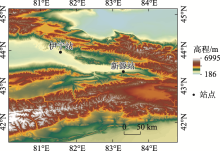
Fig. 1
Overview of the study area"

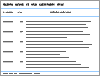
Tab. 1
Main parameters of laser ceilometer"
| 参数名称 | 参数值 |
|---|---|
| 工作频率 | 10 GHz |
| 脉冲宽度 | 100 ns |
| 光束半发散角 | 0.35 mrad |
| 波长 | 912±5 nm |
| 最大探测范围 | 10 km |
| 空间分辨率 | 5 m |
| 时间分辨率 | 1 min |
| 探测云层数 | 4层 |
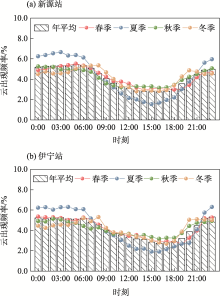
Fig. 2
Daily variation of cloud frequency at Xinyuan and Yining stations detected with laser ceilometer from 2022 to 2023"


Fig. 3
Monthly variation of cloud frequency at Xinyuan and Yining stations detected with laser ceilometer from 2022 to 2023"

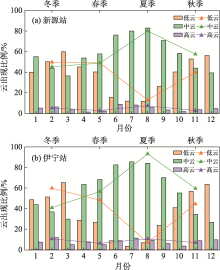
Fig. 4
Monthly and seasonal variations of low-level could, mid-level could, and high-level cloud occurrence frequencies at Xinyuan and Yining stations detected with laser ceilometer from 2022 to 2023"

Tab. 2
Proportion of single, double and multilayer cloud occurrences from 2022 to 2023 /%"
| 研究区 | 年份 | 2022年 | 2023年 | 平均值 |
|---|---|---|---|---|
| 新源站 | 单层云 | 79.10 | 80.45 | 79.78 |
| 双层云 | 15.01 | 13.62 | 14.32 | |
| 多层云 | 5.89 | 5.92 | 5.91 | |
| 伊宁站 | 单层云 | 84.65 | 84.38 | 84.52 |
| 双层云 | 13.28 | 13.65 | 13.47 | |
| 多层云 | 2.07 | 1.96 | 2.02 |
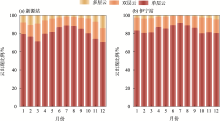
Fig. 5
Monthly variation of the frequency of single, double, and multiple clouds at Xinyuan and Yining stations as detected with laser ceilometer from 2022 to 2023"

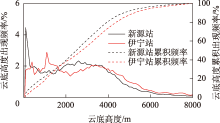
Fig. 6
Distribution of the cloud base height occurrence frequency at Xinyuan and Yining stations detected with laser ceilometer from 2022 to 2023"


Fig. 7
Seasonal distribution of the cloud base height occurrence frequency at Xinyuan and Yining stations observed with laser ceilometer from 2022 to 2023"

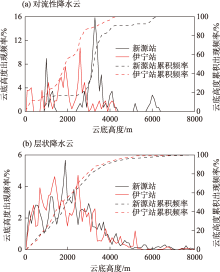
Fig. 8
Distribution of the cloud base height occurrence frequency of convective precipitation clouds and stratiform precipitation clouds at Xinyuan and Yining stations observed with laser ceilometer from 2022 to 2023"

| [1] |
Ramanathan V, Cess R D, Harrison E F, et al. Cloud-radiative forcing and climate: Results from the Earth Radiation Budget Experiment[J]. Science, 1989, 243(4887): 57-63.
pmid: 17780422 |
| [2] | 盛裴轩, 毛节泰, 李建国, 等. 大气物理学(第二版)[M]. 北京: 北京大学出版社, 2013 |
| [Sheng Peixuan, Mao Jietai, Li Jianguo, et al. Atmospheric Physics[M]. 2ndEd. Beijing: Peking University Press, 2013.] | |
| [3] |
Costa-Surós M, Calbó J, González J A, et al. Behavior of cloud base height from ceilometer measurements[J]. Atmospheric Research, 2013, 127: 64-76.
doi: 10.1016/j.atmosres.2013.02.005 |
| [4] | 郭婧晗, 薛惠文, 刘晓阳. 北京地区夏季云出现概率及云底高度分布的特征分析[J]. 北京大学学报(自然科学版), 2015, 51(4): 718-724. |
| [Guo Jinghan, Xue Huiwen, Liu Xiaoyang. Characteristics of cloud occurrence frequency and cloud base height in summer over Beijing[J]. Acta Scientiarum Naturalium Universitatis Pekinensis, 2015, 51(4): 718-724.] | |
| [5] | 汪天怡, 李德俊, 陈英英, 等. 基于云高仪探测数据的湖北省襄阳市云宏观特征分析[J]. 暴雨灾害, 2024, 43(2): 234-242. |
| [Wang Tianyi, Li Dejun, Chen Yingying, et al. Analysis of cloud macro-physical characteristics in Xiangyang of Hubei Province based on ceilometer data[J]. Torrential Rain and Disasters, 2024, 43(2): 234-242.] | |
| [6] | 李思腾, 马舒庆, 高玉春, 等. 毫米波云雷达与激光云高仪观测数据对比分析[J]. 气象, 2015, 41(2): 212-218. |
| [Li Siteng, Ma Shuqing, Gao Yuchun, et al. Comparative analysis of cloud base heights obsreved by cloud radar and ceilmeter[J]. Meteorological Monthly, 2015, 41(2): 212-218.] | |
| [7] | 顾桃峰, 岳海燕, 伍光胜, 等. 毫米波云雷达与激光云高仪气象探测性能对比分析[J]. 环境科学学报, 2023, 43(1): 275-283. |
| [Gu Taofeng, Yue Haiyan, Wu Guangsheng, et al. Comparative analysis of meteorological detection performance between millimeter-wave cloud radar and altimeter[J]. Acta Scientiae Circumstantiae, 2023, 43(1): 275-283.] | |
| [8] |
Chiao S, Lin Y L, Kaplan M L. Numerical study of the orographic forcing of heavy precipitation during MAP IOP-2B[J]. Monthly Weather Review, 2004, 132(9): 2184-2203.
doi: 10.1175/1520-0493(2004)132<2184:NSOTOF>2.0.CO;2 |
| [9] | 刘姝, 周煜, 王福侠, 等. 太行山地形与水汽特征对“23·7”河北中部极端降水形成的影响机制[J]. 气候与环境研究, 2025, 30(1): 24-38. |
| [Liu Shu, Zhou Yu, Wang Fuxia, et al. Influence mechanism of Taihang Mountain topography and water vapor characteristics on the formation of “23·7”extreme precipitation event in central Hebei[J]. Climatic and Environmental Research, 2025, 30(1): 24-38.] | |
| [10] |
付双喜, 张洪芬, 杨丽杰, 等. 地形影响下祁连山北麓不同类型降水特征对比分析[J]. 干旱区研究, 2021, 38(5): 1226-1234.
doi: 10.13866/j.azr.2021.05.04 |
|
[Fu Shuangxi, Zhang Hongfen, Yang Lijie, et al. Comparative analysis of different types of precipitation characteristics in the northern foot of Qilian Mountain under the influence of topography[J]. Arid Zone Research, 2021, 38(5): 1226-1234.]
doi: 10.13866/j.azr.2021.05.04 |
|
| [11] | 刘恩弘. 中天山北坡风切变层对地形云降水影响的观测和模拟研究[D]. 南京: 南京信息工程大学, 2022. |
| [Liu Enhong. Observation and Simulation Studies on the Influence of Wind Shear Layers on Topographic Cloud Precipitation on the Northern Slopes of the Central Tian Shan[D]. Nanjing: Nanjing University of Information Science & Technology, 2022.] | |
| [12] | 何颖. 基于Ka波段雷达的六盘山地形云和降水的动力和微物理特征研究[D]. 南京: 南京信息工程大学, 2023. |
| [He Ying. A Comparative Study on the Dynamic and Microphysical Properties of Topographic Cloud and Precipitation over Different Topographic Positions of the Liupan Mountains by Ka-band Cloud Radar[D]. Nanjing: Nanjing University of Information Science & Technology, 2023.] | |
| [13] |
杨涛, 杨莲梅, 李建刚, 等. 中国天山西部区域云降水物理野外观测科学试验研究若干进展[J]. 干旱区地理, 2023, 46(10): 1602-1611.
doi: 10.12118/j.issn.1000-6060.2023.056 |
|
[Yang Tao, Yang Lianmei, Li Jiangang, et al. Progress of the scientific experimental for cloud and precipitation physical observation in the western Tianshan Mountains of China[J]. Arid Land Geography, 2023, 46(10): 1602-1611.]
doi: 10.12118/j.issn.1000-6060.2023.056 |
|
| [14] |
Löffler-Mang M, Joss J. An optical disdrometer for measuring size and velocity of hydrometeors[J]. Journal of Atmospheric and Oceanic Technology, 2000, 17(2): 130-139.
doi: 10.1175/1520-0426(2000)017<0130:AODFMS>2.0.CO;2 |
| [15] |
Wang J, Rossow W B. Effects of cloud vertical structure on atmospheric circulation in the GISS GCM[J]. Journal of Climate, 1998, 11(11): 3010-3029.
doi: 10.1175/1520-0442(1998)011<3010:EOCVSO>2.0.CO;2 |
| [16] |
Bringi V N, Chandrasekar V, Hubbert J, et al. Raindrop size distribution in different climatic regimes from disdrometer and dual-polarized radar analysis[J]. Journal of the Atmospheric Sciences, 2003, 60(2): 354-365.
doi: 10.1175/1520-0469(2003)060<0354:RSDIDC>2.0.CO;2 |
| [17] |
李帅, 侯小刚, 崔宇, 等. 基于FY-2F资料的新疆区域云系特征研究[J]. 高原气象, 2019, 38(3): 617-624.
doi: 10.7522/j.issn.1000-0534.2018.00101 |
|
[Li Shuai, Hou Xiaogang, Cui Yu, et al. Research on cloud characteristics based on FY-2F satellite data in Xinjiang region[J]. Plateau Meteorology, 2019, 38(3): 617-624.]
doi: 10.7522/j.issn.1000-0534.2018.00101 |
|
| [18] | 李昀英, 宇如聪, 徐幼平, 等. 中国南方地区层状云的形成和日变化特征分析[J]. 气象学报, 2003, 61(6): 733-743. |
| [Li Yunying, Yu Rucong, Xu Youping, et al. The formation and digital changes of stratiform clouds in Southern China[J]. Acta Meteorologica Sinica, 2003, 61(6): 733-743.] | |
| [19] |
Ge J, Wang Z, Wang C, et al. Diurnal variations of global clouds observed from the CATS spaceborne lidar and their links to large-scale meteorological factors[J]. Climate Dynamics, 2021, 57(9-10): 2637-2651.
doi: 10.1007/s00382-021-05829-2 |
| [20] |
黄秋霞, 赵勇, 何清. 新疆伊犁河谷夏季降水日变化特征[J]. 冰川冻土, 2015, 37(2): 369-375.
doi: 10.7522/j.issn.1000-0240.2015.0040 |
|
[Huang Qiuxia, Zhao Yong, He Qing. The daily variation characteristics of summer precipitation over the Yili River Valley, Xinjiang[J]. Journal of Glaciology and Geocryology, 2015, 37(2): 369-375.]
doi: 10.7522/j.issn.1000-0240.2015.0040 |
|
| [21] |
郭玉琳, 赵勇, 周雅蔓, 等. 新疆天山山区夏季降水日变化特征及其与海拔高度关系[J]. 干旱区地理, 2022, 45(1): 57-65.
doi: 10.12118/j.issn.1000–6060.2021.057 |
|
[Guo Yulin, Zhao Yong, Zhou Yaman, et al. Diurnal variation of summer precipitation and its relationship with altitude in Tianshan Mountains of Xinjiang[J]. Arid Land Geography, 2022, 45(1): 57-65.]
doi: 10.12118/j.issn.1000–6060.2021.057 |
|
| [22] | 刘文惠. 西北暖湿化背景下云量变化及其对蒸散发的影响[D]. 南京: 南京信息工程大学, 2024. |
| [Liu Wenhui. Changes in Cloudiness and Their Effects on Evapotranspiration in the Context of Warming and Humidification in Northwest China[D]. Nanjing: Nanjing University of Information Science & Technology, 2024.] | |
| [23] |
曹越前, 张武, 药静宇, 等. 半干旱区云量变化特征及其与太阳辐射关系的研究[J]. 干旱气象, 2015, 33(4): 684-693.
doi: 10.11755/j.issn.1006-7639(2015)-04-0684 |
| [Cao Yueqian, Zhang Wu, Yao Jingyu, et al. Variation of cloud fraction and its relationship with solar radiation over semi-arid region[J]. Journal of Arid Meteorology, 2015, 33(4): 684-693.] | |
| [24] |
Yongsiriwith P, Khoonphunnarai P, Intarachumnum R, et al. The effects of clouds on solar radiation at Songkhla[J]. Journal of Physics: Conference Series, 2018, 1144(1): 012034.
doi: 10.1088/1742-6596/1144/1/012034 |
| [25] | 张华, 王菲, 汪方, 等. 全球气候变化中的云辐射反馈作用研究进展[J]. 中国科学: 地球科学, 2022, 52(3): 400-417. |
|
[Zhang Hua, Wang Fei, Wang Fang, et al. Advances in cloud radiative feedbacks in global climate change[J]. Scientia Sinica Terrae, 2022, 52(3): 400-417.]
doi: 10.1360/SSTe-2021-0052 |
|
| [26] |
阿迪来·乌甫, 玉素甫江·如素力, 热伊莱·卡得尔, 等. 伊犁河谷蒸散量时空分布特征及变化趋势[J]. 地球信息科学学报, 2018, 20(2): 217-227.
doi: 10.12082/dqxxkx.2018.170102 |
| [Adilai Wufu, Yusufujiang Rusuli, Reyilai Kadeer, et al. Spatiotemporal distribution and variation trend of evapotranspiration in Ili River valley[J]. Journal of Geo-information Science, 2018, 20(2): 217-227.] | |
| [27] |
Hang S, Abbas A, Imin B, et al. Trends and spatiotemporal patterns of the meteorological drought in the Ili River Valley from 1961 to 2023: An SPEI-Based study[J]. Atmosphere, 2025, 16(1): 43-63.
doi: 10.3390/atmos16010043 |
| [28] | 于碧馨, 张云惠, 宋雅婷. 2012年前冬伊犁河谷持续性大暴雪成因分析[J]. 沙漠与绿洲气象, 2016, 10(5): 44-51. |
| [Yu Bixin, Zhang Yunhui, Song Yating. Cause analysis of continuous heavy blizzard over Yili in the previous winter of 2012[J]. Desert and Oasis Meteorology, 2016, 10(5): 44-51.] | |
| [29] | 庄晓翠, 赵江伟, 李博渊, 等. 伊犁河谷暴雪过程水汽特征[J]. 沙漠与绿洲气象, 2023, 17(2): 15-25. |
| [Zhuang Xiaocui, Zhao Jiangwei, Li Boyuan, et al. Characteristics of water vapor during blizzard in Ili River Valley[J]. Desert and Oasis Meteorology, 2023, 17(2): 15-25.] | |
| [30] |
张俊兰, 崔彩霞, 陈春艳. 北疆典型暴雪天气的水汽特征研究[J]. 高原气象, 2013, 32(4): 1115-1125.
doi: 10.7522/j.issn.1000-0534.2012.00105 |
|
[Zhang Junlan, Cui Caixia, Chen Chunyan. Study on water vapor characteristic of typical heavy snowstorm case in northern Xinjiang[J]. Plateau Meteorology, 2013, 32(4): 1115-1125.]
doi: 10.7522/j.issn.1000-0534.2012.00105 |
|
| [31] | Xu H, Guo J P, Tong B, et al. Characterizing the near-global cloud vertical structures over land using high-resolution radiosonde measurements[J]. Atmospheric Chemistry and Physics, 2023, 23(23):15011-15038. |
| [32] |
Spaulding-Astudillo F E, Mitchell J L. Effects of varying saturation vapor pressure on climate, clouds, and convection[J]. Journal of the Atmospheric Sciences, 2023, 80(5): 1247-1266.
doi: 10.1175/JAS-D-22-0063.1 |
| [33] | Ma J, Yao X, Yuan C. Characteristics and formation mechanism of the cloud vertical structure over the southeastern Tibetan Plateau in summer[J]. Earth and Space Science, 2023, 10(5): e002811. |
| [34] |
Yin J, Porporato A. Diurnal cloud cycle biases in climate models[J]. Nature Communications, 2017, 8(1): 2269-2276.
doi: 10.1038/s41467-017-02369-4 pmid: 29273812 |
| [35] | 徐文静, 吕达仁. 基于静止卫星探测的夏季青藏高原云分布及其日变化分析[J]. 气候与环境研究, 2023, 28(3): 229-241. |
| [Xu Wenjing, Lü Daren. Analysis of cloud distribution and its diurnal variation over the Tibetan Plateau in summer based on geostationary satellite data[J]. Climatic and Environmental Research, 2023, 28(3): 229-241.] | |
| [36] | 田磊, 桑建人, 姚展予, 等. 基于Ka波段云雷达的六盘山顶云特征分析[J]. 气象与环境学报, 2021, 37(2): 84-90. |
| [Tian Lei, Sang Jianren, Yao Zhanyu, et al. Preliminary analysis of cloud macro characteristics over the Liupan Mountain based on Ka-band cloud radar[J]. Journal of Meteorology and Environment, 2021, 37(2): 84-90.] | |
| [37] | 王改利, 周任然, 扎西索郎, 等. 青藏高原墨脱地区云降水综合观测及初步统计特征分析[J]. 气象学报, 2021, 79(5): 841-852. |
| [Wang Gaili, Zhou Renran, Zhaxisuolang, et al. Comprehensive observations and preliminary statistical analysis of clouds and precipitation characteristics in Motuo of Xizang Plateau[J]. Acta Meteorologica Sinica, 2021, 79(5): 841-852.] | |
| [38] |
李慧, 郑旭程, 苏立娟, 等. 基于毫米波云雷达的黄河流域内蒙古段云宏观特征分析[J]. 干旱气象, 2023, 41(3): 434-441.
doi: 10.11755/j.issn.1006-7639(2023)-03-0434 |
| [Li Hui, Zheng Xucheng, Su Lijuan, et al. Statistical analysis of cloud macrophysical characteristics in the Inner Mongolia section of the Yellow River Basin based on millimeter-wave cloud radar[J]. Journal of Arid Meteorology, 2023, 41(3): 434-441.] | |
| [39] | 连钰. 北天山复杂地形作用下的局地强降水过程数值模拟研究[D]. 南京: 南京信息工程大学, 2014. |
| [Lian Yu. A Numerical Simulation Study of a Topographic-Induced Heavy Rain Case at Northern Tianshan[D]. Nanjing: Nanjing University of Information Science & Technology, 2014.] | |
| [40] | 谢梦瑗, 赵德龙, 成鹏. 基于WRF模式模拟研究天山山脉地形对降水过程的影响[J]. 黑龙江科学, 2024, 15(6): 16-19,24. |
| [Xie Mengyuan, Zhao Delong, Cheng Peng. Effect of topography on precipitation process in Tianshan Mountains based on WRF model simulation[J]. Heilongjiang Science, 2024, 15(6): 16-19,24.] |
| [1] | HU Jiran, YAO Juan, XIONG Changjiang. Ecological management zoning in the Ili River Valley based on supply and demand of water supply services [J]. Arid Zone Research, 2025, 42(7): 1313-1322. |
| [2] | LI Xiuming, JIA Wenru, LI Shengyu, WANG Cui, WANG Shijie. Characteristics of wind velocity pulsation of transverse ridge microtopography [J]. Arid Zone Research, 2025, 42(5): 933-943. |
| [3] | HAO Panpan, LIU Zhiyou. Coordination characteristics between land use implicit forms and land ecological security in Xinjiang oasis: The Ili River Valley as a case study [J]. Arid Zone Research, 2024, 41(9): 1605-1614. |
| [4] | LI Na, XIN Huinan, LAI Ning, LI Yongfu, LYU Caixia, GENG Qinglong, DUAN Jingjing, CHEN Shuhuang. Effects of different land-use methods on the organic carbon composition and soil microbial biomass carbon of farmland soil [J]. Arid Zone Research, 2024, 41(10): 1789-1796. |
| [5] | FAN Mingyan, TIAN Lihui, ZHOU Hai. Effects of micro-topography on water use characteristics of alpine sand-fixing plants [J]. Arid Zone Research, 2024, 41(1): 60-70. |
| [6] | KANG Ligang, CAO Shengkui, CAO Guangchao, YANG Yufan, YAN Li, WANG Youcai. Temporal and spatial changes of evapotranspiration in the Shaliu River Basin of Qinghai Lake [J]. Arid Zone Research, 2023, 40(3): 358-372. |
| [7] | WEN Guangchao,ZHAO Meijuan,XIE Hongbo,ZHANG Yi,ZHANG Juan. Analysis of land vegetation cover evolution and driving forces in the western part of the Ili River Valley [J]. Arid Zone Research, 2021, 38(3): 843-854. |
| [8] | Ailihamu Aikelamu,ZHOU Jinlong,ZHANG Jie,WEI Xing,YU Dong,CHEN Jinsong. Chemical characteristics and genesis analysis of groundwater in northwest Yili River Valley [J]. Arid Zone Research, 2021, 38(2): 504-512. |
| [9] | LIU Le, SUN Hong-yi, ZHANG Jian-xin, LI Dong-ze. Effect of Several Engineering Measures on Vegetation Coverage on Steep Slope in the Loess Region [J]. Arid Zone Research, 2019, 36(4): 1041-1048. |
| [10] | ZHANG Li-yang, YANG Kun, ZHANG Zhi-xian. Spatiotemporal Variation of Hail Weather in the Northeast Qinghai-Tibetan Plateau [J]. , 2014, 31(3): 446-451. |
| [11] | YANG Xiao-Ling, DING Wen-Kui, QIAN Pei-Quan, YIN Yu-Chun, YAO Yu-Bi. A Rainstorm Weather in Wuwei City on July 29, 2012 [J]. , 2013, 30(5): 789-795. |
|
||
