
Arid Zone Research ›› 2025, Vol. 42 ›› Issue (5): 866-874.doi: 10.13866/j.azr.2025.05.09
• Plant Ecology • Previous Articles Next Articles
ZHAO Yueyue( ), LI Zihan, WU Shuang, XING Shaohua()
Received:2025-02-27
Revised:2025-04-07
Online:2025-05-15
Published:2025-10-22
Contact:
XING Shaohua
E-mail:zhaoyueyue0823@163.com;xingshaohua@bifu.edu.cn
ZHAO Yueyue, LI Zihan, WU Shuang, XING Shaohua. Population structure and dynamic characteristics of Haloxylon in Ganjiahu Nature Reserve[J].Arid Zone Research, 2025, 42(5): 866-874.
Add to citation manager EndNote|Reference Manager|ProCite|BibTeX|RefWorks
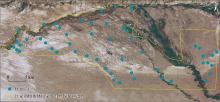
Fig. 1
Location map of the study area"

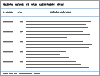
Tab. 1
Corresponding table of Haloxylon age class and base diameter"
| 龄级 | |||||||||||
|---|---|---|---|---|---|---|---|---|---|---|---|
| Ⅰ | Ⅱ | Ⅲ | Ⅳ | Ⅴ | Ⅵ | Ⅶ | Ⅷ | Ⅸ | Ⅹ | XI | |
| 基径/cm | 0~3 | 3~6 | 6~9 | 9~12 | 12~15 | 15~18 | 18~21 | 21~24 | 24~27 | 27~30 | >30 |
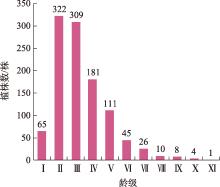
Fig. 2
Age class structure of Ganjiahu Haloxylon population"

Tab. 2
Investigated and smoothed date of Haloxylon population"
| 龄级 | |||||||||||
|---|---|---|---|---|---|---|---|---|---|---|---|
| Ⅰ | Ⅱ | Ⅲ | Ⅳ | Ⅴ | Ⅵ | Ⅶ | Ⅷ | Ⅸ | Ⅹ | Ⅺ | |
| 存活数ai0/株 | 65 | 322 | 309 | 181 | 111 | 45 | 26 | 10 | 8 | 4 | 1 |
| 匀滑修正后存活数ai/株 | 300 | 249 | 198 | 146 | 95 | 45 | 26 | 10 | 8 | 4 | 1 |
Tab. 3
Static life table of in Haloxylon population Ganjiahu"
| 龄级 | ai/株 | li/株 | di/株 | qi | Li/株 | Ti/株 | ei | ln li | Ki |
|---|---|---|---|---|---|---|---|---|---|
| Ⅰ | 300 | 1000.00 | 170.00 | 0.17 | 915.00 | 915.00 | 0.92 | 6.91 | 0.19 |
| Ⅱ | 249 | 830.00 | 170.00 | 0.20 | 745.00 | 1660.00 | 2.00 | 6.72 | 0.23 |
| Ⅲ | 198 | 660.00 | 173.33 | 0.26 | 573.33 | 2233.33 | 3.38 | 6.49 | 0.30 |
| Ⅳ | 146 | 486.67 | 170.00 | 0.35 | 401.67 | 2635.00 | 5.41 | 6.19 | 0.43 |
| Ⅴ | 95 | 316.67 | 166.67 | 0.53 | 233.33 | 2868.33 | 9.06 | 5.76 | 0.75 |
| Ⅵ | 45 | 150.00 | 63.33 | 0.42 | 118.33 | 2986.67 | 19.91 | 5.01 | 0.55 |
| Ⅶ | 26 | 86.67 | 53.33 | 0.62 | 60.00 | 3046.67 | 35.15 | 4.46 | 0.96 |
| Ⅷ | 10 | 33.33 | 6.67 | 0.20 | 30.00 | 3076.67 | 92.30 | 3.51 | 0.22 |
| Ⅸ | 8 | 26.67 | 13.33 | 0.50 | 20.00 | 3096.67 | 116.13 | 3.28 | 0.69 |
| Ⅹ | 4 | 13.33 | 10.00 | 0.75 | 8.33 | 3105.00 | 232.88 | 2.59 | 1.39 |
| Ⅺ | 1 | 3.33 | - | - | - | - | - | 1.20 | - |
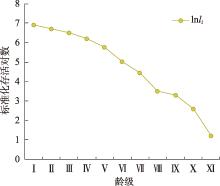
Fig. 3
Survivorship curve of Ganjiahu Haloxylon population"

Tab. 4
Test of survivorship curve equation of Ganjiahu Haloxylon population"
| 存活曲线方程 | R2 | Adjusted R2 | F | P | 类型 |
|---|---|---|---|---|---|
| y=8.1509e-0.036x | 0.9848 | 0.9833 | 650.0 | <0.01 | Deevey-Ⅱ |
| y=9.0320x-0.2644 | 0.9474 | 0.9421 | 179.9 | <0.01 |
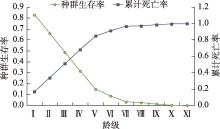
Fig. 4
Survivorship and cumulative death rate of Ganjiahu Haloxylon population"

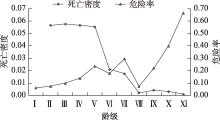
Fig. 5
Performance of death density and risk rate of Ganjiahu Haloxylon population"

Tab. 5
Dynamic index of Ganjiahu Haloxylon population"
| 种群动态指数 | 种群动态指数值 | 种群动态指数 | 种群动态指数值 |
|---|---|---|---|
| V1 | 0.17 | V8 | 0.20 |
| V2 | 0.20 | V9 | 0.50 |
| V3 | 0.26 | V10 | 0.75 |
| V4 | 0.35 | ||
| V5 | 0.53 | Vpi | 3.55 |
| V6 | 0.42 | V′pi | 0.32 |
| V7 | 0.62 | Pmax | 0.09 |
Tab. 6
Time series prediction of Ganjiahu Haloxylon population"
| 龄级 | 初始个体数/株 | Mt /株 | ||||
|---|---|---|---|---|---|---|
| M2 | M4 | M6 | M8 | M10 | ||
| Ⅰ | 65 | |||||
| Ⅱ | 322 | 194 | ||||
| Ⅲ | 309 | 316 | ||||
| Ⅳ | 181 | 245 | 219 | |||
| Ⅴ | 111 | 146 | 231 | |||
| Ⅵ | 45 | 78 | 162 | 172 | ||
| Ⅶ | 26 | 36 | 91 | 166 | ||
| Ⅷ | 10 | 18 | 48 | 114 | 134 | |
| Ⅸ | 8 | 9 | 22 | 64 | 127 | |
| Ⅹ | 4 | 6 | 12 | 34 | 87 | 108 |
| Ⅺ | 1 | 3 | 6 | 16 | 48 | 102 |
| 总计 | 1082 | 1051 | 791 | 566 | 396 | 210 |
| [1] | 李俊清. 森林生态学[M]. 第3版. 北京: 高等教育出版社, 2017: 119-133. |
| [Li Junqing. Forest Ecology[M]. 3rd ed. Beijing: Higher Education Press, 2017: 119-133.] | |
| [2] | 卢杰, 郭其强, 郑维列, 等. 藏东南高山松种群结构及动态特征[J]. 林业科学, 2013, 49(8): 154-160. |
| [Lu Jie, Guo Qiqiang, Zheng Weilie, et al. Population structure and dynamic characteristics of Pinus densata in southeast Xizang[J]. Scientia Silvae Sinicae, 2013, 49(8): 154-160.] | |
| [3] | 宋于洋. 古尔班通古特沙漠梭梭种群动态与持续发育[D]. 杨凌: 西北农林科技大学, 2011. |
| [Song Yuyang. Haloxylon ammodendron Population Dynamics and Sustainable Development in Gurbantunggut Desert[D]. Yangling: Northwest A & F University, 2011.] | |
| [4] | 张丹, 马松梅, 魏博, 等. 中国梭梭属植物历史分布格局及其驱动机制[J]. 生物多样性, 2022, 30(1): 42-51. |
| [Zhang Dan, Ma Songmei, Wei Bo, et al. Historical distribution pattern and driving mechanism of Haloxylon in China[J]. Biodiversity Science, 2022, 30(1): 42-51.] | |
| [5] | Yang L L, Liu J, Guo W J, et al. Insights into the multi-chromosomal mitochondrial genome structure of the xero-halophytic plant Haloxylon ammodendron (C. A. Mey.) Bunge ex Fenzl[J]. BMC Genomics, 2024, 25(1): 123-134. |
| [6] | 杨瑞红. 古尔班通古特沙漠梭梭种群及群落动态特征和稳定性评价[D]. 乌鲁木齐: 新疆农业大学, 2017. |
| [Yang Ruihong. The Research of Stability and Population & Community Dynamics of Haloxylon ammodendron in Gurbantunggut Desert[D]. Urumqi: Xinjiang Agriculture University, 2017.] | |
| [7] | 谭德远, 郭泉水, 王春玲, 等. 寄生植物肉苁蓉对寄主梭梭生长及生物量的影响研究[J]. 林业科学研究, 2004, 17(4): 472-478. |
| [Tan Deyuan, Guo Quanshui, Wang Chunling, et al. Effects of the parasite plant (Cistanche deserticola) on growth and biomass of the host plant (Haloxylon ammodendron)[J]. Forest Research, 2004, 17(4): 472-478.] | |
| [8] | 沈亮, 庞青云, 张明慧, 等. 肉苁蓉寄主梭梭和白梭梭主要生物学性状评价[J]. 植物遗传资源学报, 2024, 25(8): 1347-1355. |
| [Shen Liang, Pang Qingyun, Zhang Minghui, et al. Evaluation on main biological characters of host-plant Haloxylon ammodendron and Haloxylon persicum of Cistanche deserticola[J]. Journal of Plant Genetic Resources, 2024, 25(8): 1347-1355.] | |
| [9] | Yang F, Lv G H. Metabolomic analysis of the response of Haloxylon ammodendron and Haloxylon persicum to drought[J]. International Journal of Molecular Sciences, 2023, 24(10): 9099-9119. |
| [10] | Zhu M H, Jiang L M, Wu D Y, et al. Effects of water control and nitrogen addition on functional traits and rhizosphere microbial community diversity of Haloxylon ammodendron seedlings[J]. Forests, 2023, 14(9): 1879-1893. |
| [11] | 魏琪, 潘绒, 陈建茹, 等. 梭梭14-3-3蛋白基因HaFT-9转拟南芥过表达株系的耐旱性分析[J/OL]. 分子植物育种, [2025-03-07]. http://kns.cnki.net/kcms/detail/46.1068.S.20240524.1546.002.html. |
| [Wei Qi, Pan Rong, Chen Jianru, et al. Drought tolerance analysis of transgenic Arabidopsis thaliana lines overexpressing 14-3-3 protein gene HaFT-9 from Haloxylon ammodendron[J/OL]. Molecular Plant Breeding, [2025-03-07].http://kns.cnki.net/kcms/detail/46.1068.S.20240524.1546.002.html.] | |
| [12] |
李民青, 周乐, 王喜勇, 等. 7种荒漠木本植物枝干与叶片光合特征及其影响因素[J]. 应用生态学报, 2023, 34(10): 2637-2643.
doi: 10.13287/j.1001-9332.202310.007 |
|
[Li Minqing, Zhou Le, Wang Xiyong, et al. Stem and leaf photosynthesis of seven desert woody species and its influencing factors[J]. Chinese Journal of Applied Ecology, 2023, 34(10): 2637-2643.]
doi: 10.13287/j.1001-9332.202310.007 |
|
| [13] | Xiao F J, Liu Q F, Qin Y. Predicting the potential distribution of Haloxylon ammodendron under climate change scenarios using machine learning of a Maximum Entropy Model[J]. Biology, 2024, 13(1): 3-16. |
| [14] | Zhou D M, Si J H, He X H, et al. The process of soil desiccation under Haloxylon ammodendron plantations: A case study of the Alxa Legue Desert, China[J]. Plants, 2022, 11(3): 235-246. |
| [15] | 吉小敏, 朱雅娟, 雷春英. 新疆甘家湖自然保护区梭梭林碳储量[J]. 干旱区资源与环境, 2019, 33(5): 139-145. |
| [Ji Xiaomin, Zhu Yajuan, Lei Chunying. Carbon storage of Haloxylon ammodendron forests in Ganjiahu Natural Reserve, Xinjiang[J]. Journal of Arid Land Resources and Environment, 2019, 33(5): 139-145.] | |
| [16] | 闫涵, 孙芳芳, 马松梅, 等. 梭梭和白梭梭的种群结构与空间分布格局[J]. 西南农业学报, 2021, 34(8): 1781-1787. |
| [Yan Han, Sun Fangfang, Ma Songmei, et al. Population structure and spatial distribution pattern of Haloxylon ammodendron and H. persicum[J]. Southwest China Journal of Agricultural Sciences, 2021, 34(8): 1781-1787.] | |
| [17] | 李文霞, 康宝爽. 甘家湖荒漠梭梭林自然保护区管理问题的初探[J]. 干旱环境监测, 2000, 14(4): 236-240. |
| [Li Wenxia, Kang Baoshuang. Discussion on management of Nature Reserve of Ganjia Lake Desert Sacsaoul Forest[J]. Arid Environmental Monitoring, 2000, 14(4): 236-240.] | |
| [18] | 买买提江·吐尔逊, 黄俊华, 阿不力米提·阿不都热合曼, 等. 新疆甘家湖自然保护区种子植物组成及区系地理成分分析[J]. 林业科学研究, 2010, 23(3): 417-424. |
| [Tuerxun Maimaitijiang, Huang Junhua, Abudureheman Abulimiti, et al. Study on spermatophyte constituent and floristic element of Ganjiahu Nature Reserve in Xinjiang[J]. Forest Research, 2010, 23(3): 417-424.] | |
| [19] | 吴承祯, 洪伟, 谢金寿, 等. 珍稀濒危植物长苞铁杉种群生命表分析[J]. 应用生态学报, 2000, 11(3): 333-336. |
|
[Wu Chengzhen, Hong Wei, Xie Jinshou, et al. Life table analysis of Tsuga longibracteata population[J]. Chinese Journal of Applied Ecology, 2000, 11(3): 333-336.]
pmid: 11767626 |
|
| [20] | Frost I, Rydin H. Spatial pattern and size distribution of the animal-dispersed tree Quercus robur in two spruce-dominated forests[J]. Écoscience, 2000, 7(1): 38-44. |
| [21] | 江洪. 云杉种群生态学[M]. 北京: 中国林业出版社, 1992. |
| [Jiang Hong. Population Ecology of Picea asperata[M]. Beijing: China Forestry Publishing House, 1992.] | |
| [22] | Hett J M, Loucks O L. Age structure models of balsam fir and eastern hemlock[J]. The Journal of Ecology, 1976, 64(3): 1029-1044. |
| [23] | 杨凤翔, 王顺庆, 徐海根, 等. 生存分析理论及其在研究生命表中的应用[J]. 生态学报, 1991, 11(2): 153-158. |
| [Yang Fengxiang, Wang Shunqing, Xu Haigen, et al. The theory of survival analysis and its application to life table[J]. Acta Ecologica Sinica, 1991, 11(2): 153-158.] | |
| [24] | 陈晓德. 植物种群与群落结构动态量化分析方法研究[J]. 生态学报, 1998, 18(2): 104-107. |
| [Chen Xiaode. A study on the method of quantitative analysis for plant population and community structural dynamics[J]. Acta Ecologica Sinica, 1998, 18(2): 104-107.] | |
| [25] | 肖宜安, 何平, 李晓红, 等. 濒危植物长柄双花木自然种群数量动态[J]. 植物生态学报, 2004, 50(2): 252-257. |
| [Xiao Yi’an, He Ping, Li Xiaohong, et al. Study on numeric dynamics of natural populations of the endangered species Disanthus cercidifolius var. longipes[J]. Chinese Journal of Plant Ecology, 2004, 50(2): 252-257.] | |
| [26] |
毛毛, 蒙仲举, 党晓宏, 等. 巴丹吉林沙漠东缘天然梭梭种群结构与动态特征[J]. 干旱区研究, 2023, 40(6): 971-978.
doi: 10.13866/j.azr.2023.06.12 |
| [Mao Mao, Meng Zhongju, Dang Xiaohong, et al. Population dynamics of natural Haloxylon ammodendron in the eastern margin of Badain Jaran Desert[J]. Arid Zone Research, 2023, 40(6): 971-978.] | |
| [27] | 常晓敏, 余新晓, 贾国栋, 等. 基于随机森林的不同径级树木死亡影响因子研究[J]. 生态学报, 2019, 39(21): 8003-8009. |
| [Chang Xiaomin, Yu Xinxiao, Jia Guodong, et al. Influence factors of tree mortality in different size classes based on random forest[J]. Acta Ecologica Sinica, 2019, 39(21): 8003-8009.] | |
| [28] | 秦爱丽, 马凡强, 许格希, 等. 珍稀濒危树种峨眉含笑种群结构与动态特征[J]. 生态学报, 2020, 40(13): 4445-4454. |
| [Qin Aili, Ma Fanqiang, Xu Gexi, et al. Population structure and dynamic characteristics of a rare and endangered tree species Michelia wilsonii Finet et Gagn[J]. Acta Ecologica Sinica, 2020, 40(13): 4445-4454.] | |
| [29] | 蔡新斌, 吴俊侠. 甘家湖自然保护区白梭梭种群特征与动态分析[J]. 干旱区资源与环境, 2016, 30(7): 90-94. |
| [Cai Xinbin, Wu Junxia. Characteristics and dynamics analysis of Haloxylon persicum populations in the Nature Reserve of Gan Jia Lake[J]. Journal of Arid Land Resources and Environment, 2016, 30(7): 90-94.] | |
| [30] | 李建贵, 宁虎森, 刘斌. 梭梭种群性状结构与空间分布格局的初步研究[J]. 新疆农业大学学报, 2003, 39(3): 51-54. |
| [Li Jiangui, Ning Husen, Liu Bin. Study on character structure and distribution pattern of Haloxylon ammodron[J]. Journal of Xinjiang Agricultural University, 2003, 39(3): 51-54.] | |
| [31] |
李功麟, 张定海, 张志山, 等. 古尔班通古特沙漠沙丘主要灌木的种群数量动态[J]. 中国沙漠, 2021, 41(2): 129-137.
doi: 10.7522/j.issn.1000-694X.2020.00103 |
|
[Li Gonglin, Zhang Dinghai, Zhang Zhishan, et al. Population dynamics of main sand-fixing shrubs in the Gurbantunggut Desert[J]. Journal of Desert Research, 2021, 41(2): 129-137.]
doi: 10.7522/j.issn.1000-694X.2020.00103 |
|
| [32] | 郝需婷, 黄雅茹, 马迎宾, 等. 乌兰布和沙漠固沙梭梭林生长季土壤水分动态研究[J]. 中国农业科技导报, 2023, 25(7): 187-196. |
| [Hao Xuting, Huang Yaru, Ma Yingbin, et al. Study on soil moisture dynamics in growing season of sand-fixing Haloxylon ammodendron forest in Ulan Buhe Desert[J]. Journal of Agricultural Science and Technology, 2023, 25(7): 187-196.] | |
| [33] | 马松梅, 魏博, 李晓辰, 等. 气候变化对梭梭植物适宜分布的影响[J]. 生态学杂志, 2017, 36(5): 1243-1250. |
| [Ma Songmei, Wei Bo, Li Xiaochen, et al. The impacts of climate change on the potential distribution of Haloxylon ammodendron[J]. Chinese Journal of Ecology, 2017, 36(5): 1243-1250.] | |
| [34] | 赵鹏, 徐先英, 张裕年, 等. 民勤绿洲荒漠过渡带人工梭梭种群年龄结构及动态[J]. 生态学报, 2023, 43(14): 6069-6079. |
| [Zhao Peng, Xu Xianying, Zhang Yunian, et al. Age structure and its dynamics of artificial Haloxylon ammodendron population in Minqin oasis-desert ecotone[J]. Acta Ecologica Sinica, 2023, 43(14): 6069-6079.] | |
| [35] | Lloret F, Casanovas C, Peñuelas J. Seedling survival of Mediterranean shrubland species in relation to root: Shoot ratio, seed size and water and nitrogen use[J]. Functional Ecology, 1999, 13(2): 210-216. |
| [36] | 王泳腾, 黄治昊, 王俊, 等. 燕山山脉黄檗种群结构与动态特征[J]. 生态学报, 2021, 41(7): 2826-2834. |
| [Wang Yongteng, Huang Zhihao, Wang Jun, et al. The population structure and dynamic characteristics of Phellodendron amurense in Yanshan Mountains[J]. Acta Ecologica Sinica, 2021, 41(7): 2826-2834.] |
| [1] | FENG Kepeng, XU Dehao, ZHUANG Haoran. An estimation method of remote sensing evapotranspiration in farmland based on the three-temperature model with adjoint calibrated of WOFOST [J]. Arid Zone Research, 2025, 42(1): 166-178. |
| [2] | SONG Jiajia, LI Gangtie, GUO Jingjie, GU Zhonghou, LIU Kun, LI Zhilong, KANG Xia. Population structure and dynamic analysis of natural Juniperus rigida in a loess hilly area [J]. Arid Zone Research, 2023, 40(8): 1304-1311. |
| [3] | SONG Qi,SHI Zhou,FENG Chunhui,MA Ziqiang,JI Wenjun,PENG Jie,GAO Qi,JIANG Xuewei. Analysis of landscape pattern from 1990 to 2019 based on multi-temporal imagery in arid oasis [J]. Arid Zone Research, 2022, 39(2): 594-604. |
| [4] | LIU Xin,JIAO Jian,WANG Ting,ZHANG Lingyu,LI Chaozhou. Population ecological features of Phragmites australis in sandy habitats on the southern edge of Badain Jaran Desert [J]. Arid Zone Research, 2022, 39(1): 220-229. |
| [5] | FENG Zhuangzhuang,SHI Haibin,MIAO Qingfeng,LI Jiannan,SUN Wei,DAI Liping. Prediction of reference crop evapotranspiration in Xilinguole grassland based on multivariate time series model [J]. Arid Zone Research, 2021, 38(6): 1650-1658. |
| [6] | CAO Wenmei,LIU Tingxi,WANG Xixi,WANG Guanli,LI Dongfang,TONG Xing. Land use and land cover classifications of Horqin Sandy Land dune-meadow areas [J]. Arid Zone Research, 2021, 38(2): 526-535. |
| [7] | SU Zhi-hao, LI Wen-jun, CAO Qiu-mei, ZHOU Xiao-bing, ZHANG Yuan-ming. Age Composition and Quantitative Dynamic Status of Malus sieversii Population [J]. Arid Zone Research, 2019, 36(5): 1153-1160. |
| [8] | ZHANG Ping, LYU Zhao-zhi, ZHANG Xin, ZHAO Xiang-ping, ZHNAG Yong-guang, Gulzhanat Tanabekova, Maisupova Bagila, Adilbayeva Zhanera, CUI Zhi-jun. Age Structure of Malus sieversii Population in Ili of Xinjiang and Kazakhstan [J]. Arid Zone Research, 2019, 36(4): 844-862. |
| [9] | LIU Ya-qing, WANG Lei, ZHAO Xi-ni, QU Xiang-ning, XU Xing, WANG Rui. Extraction of Crops in Oasis Based on GF-1/WFV Time Series [J]. Arid Zone Research, 2019, 36(3): 781-789. |
| [10] | ZHAO Yu, LIU Ying, SHANG Tian-cui, LIU Bo. Root Sucker Propagation of Wild Prunus divaricata in Different Micro-habitats in Xinjiang,China [J]. Arid Zone Research, 2015, 32(5): 947-952. |
| [11] | WANG Zhi-jie ,WANG Xin-hui ,DAN Muren-jiafu ,GENG Shu-ping. Effect of Climate Change on Annual Runoff Volume of the Tailan River [J]. , 2014, 31(1): 125-130. |
|
||
