
Arid Zone Research ›› 2025, Vol. 42 ›› Issue (7): 1279-1290.doi: 10.13866/j.azr.2025.07.11
• Plant Ecology • Previous Articles Next Articles
TAO Xinran1,2,3( ), LI Haining3,4, GONG Yanming1,3, LIU Yanyan1,3, LIU Xuejun1,5, LI Kaihui1,3()
Received:2024-11-26
Revised:2025-04-25
Online:2025-07-15
Published:2025-07-07
Contact:
LI Kaihui
E-mail:taoxinran22@mails.ucas.ac.cn;likh@ms.xjb.ac.cn
TAO Xinran, LI Haining, GONG Yanming, LIU Yanyan, LIU Xuejun, LI Kaihui. Legacy effects of long-term nitrogen on plant community structure and function in the Tianshan grassland[J].Arid Zone Research, 2025, 42(7): 1279-1290.
Add to citation manager EndNote|Reference Manager|ProCite|BibTeX|RefWorks
Tab. 1
Linear mixed-effects model analysis of the effects of year (Y) and historical nitrogen addition (N) on the functional traits of dominant species"
| 处理 | 自由度 | 植株高度 | 叶干物质含量 | 叶面积 | 比叶面积 | |
|---|---|---|---|---|---|---|
| 天山赖草 | Y | 1 | 64.419*** | 50.846*** | 102.730*** | 100.601*** |
| N | 4 | 8.871*** | 1.142 | 10.559*** | 6.945*** | |
| Y×N | 4 | 0.424 | 0.187 | 0.692 | 0.937 | |
| 寒生羊茅 | Y | 1 | 8.562** | 49.000*** | 40.719*** | 43.978*** |
| N | 4 | 6.567** | 3.676* | 3.342* | 3.646* | |
| Y×N | 4 | 0.181 | 0.872 | 0.794 | 1.254 |
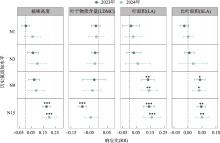
Fig. 1
Legacy effects of historical nitrogen addition on functional traits of Leymus tianschanicus"

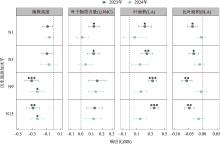
Fig. 2
Legacy effects of historical nitrogen addition on functional traits of Festuca kryloviana"

Tab. 2
Linear mixed-effects model analysis of the effects of year (Y) and historical nitrogen addition (N) on plant community cover and aboveground net primary productivity"
| 处理 | 自由度 | (相对)盖度 | (相对)地上净 初级生产力 | |
|---|---|---|---|---|
| 群落 | Y | 2 | 8.435*** | 17.265*** |
| N | 4 | 4.715*** | 6.632*** | |
| Y×N | 8 | 3.061** | 3.299** | |
| 根茎型禾草 | Y | 2 | 4.843* | 18.325*** |
| N | 4 | 34.438*** | 8.125*** | |
| Y×N | 8 | 3.454** | 1.113 | |
| 丛生型禾草 | Y | 2 | 5.307** | 60.247*** |
| N | 4 | 86.123*** | 30.221*** | |
| Y×N | 8 | 2.884** | 1.507 | |
| 杂类草 | Y | 2 | 19.019*** | 17.669*** |
| N | 4 | 18.578*** | 13.604*** | |
| Y×N | 8 | 1.455 | 8.379*** |
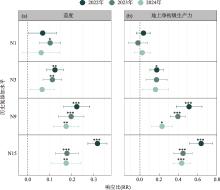
Fig. 3
Response ratios of community cover and aboveground net primary productivity under different historical nitrogen addition levels"

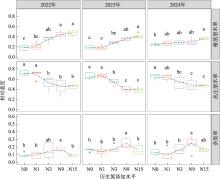
Fig. 4
Legacy effects of historical nitrogen addition on relative cover of plant functional groups"

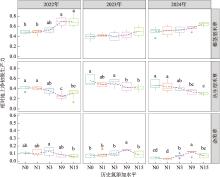
Fig. 5
Legacy effects of historical nitrogen addition on relative aboveground net primary productivity of plant functional groups"

Tab. 3
Linear mixed-effects model analysis of the effects of year (Y) and historical nitrogen addition (N) on soil chemical properties"
| 处理 | 自由度 | F值 | |
|---|---|---|---|
| 土壤pH | Y | 2 | 19.850*** |
| N | 4 | 2.885* | |
| Y×N | 8 | 1.059 | |
| 土壤全氮含量 | Y | 2 | 0.357 |
| N | 4 | 10.024*** | |
| Y×N | 8 | 5.303** | |
| 土壤全磷含量 | Y | 2 | 0.026 |
| N | 4 | 1.609 | |
| Y×N | 8 | 0.093 | |
| 土壤有机碳含量 | Y | 2 | 1.181 |
| N | 4 | 1.749 | |
| Y×N | 8 | 2.560* |
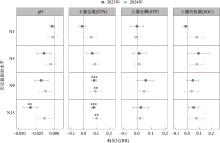
Fig. 6
Legacy effects of historical nitrogen addition on soil chemical properties"

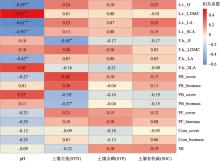
Fig. 7
Correlation analysis between soil chemical properties and vegetation characteristics"

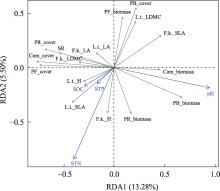
Fig. 8
Redundancy analysis (RDA) of soil chemical properties and vegetation characteristics"

| [1] |
Galloway J N, Townsend A R, Erisman J W, et al. Transformation of the nitrogen cycle: Recent trends, questions, and potential solutions[J]. Science, 2008, 320(5878): 889-892.
doi: 10.1126/science.1136674 pmid: 18487183 |
| [2] | 常运华, 刘学军, 李凯辉, 等. 大气氮沉降研究进展[J]. 干旱区研究, 2012, 29(6): 972-979. |
| [Chang Yunhua, Liu Xuejun, Li Kaihui, et al. Research progress in atmospheric nitrogen deposition[J]. Arid Zone Research, 2012, 29(6): 972-979.] | |
| [3] | Avolio M L, Koerner S E, La Pierre K J, et al. Changes in plant community composition, not diversity, during a decade of nitrogen and phosphorus additions drive above-ground productivity in a tall grass prairie[J]. Journal of Ecology, 2014, 102(6): 1649-1660. |
| [4] | Xu Z W, Ren H Y, Li M H, et al. Environmental changes drive the temporal stability of semi-arid natural grasslands through altering species asynchrony[J]. Journal of Ecology, 2015, 103(5): 1308-1316. |
| [5] | 张世虎, 张悦, 马晓玉, 等. 大气氮沉降影响草地植物物种多样性机制研究综述[J]. 生态学报, 2022, 42(4): 1252-1261. |
| [Zhang Shihu, Zhang Yue, Ma Xiaoyu, et al. Mechanisms underlying loss of plant biodiversity by atmospheric nitrogen deposition in grasslands[J]. Acta Ecologica Sinica, 2022, 42(4): 1252-1261.] | |
| [6] | Isbell F, Reich P B, Tilman D, et al. Nutrient enrichment, biodiversity loss, and consequent declines in ecosystem productivity[J]. Proceedings of the National Academy of Sciences, 2013, 110(29): 11911-11916. |
| [7] |
付伟, 武慧, 赵爱花, 等. 陆地生态系统氮沉降的生态效应:研究进展与展望[J]. 植物生态学报, 2020, 44(5): 475-493.
doi: 10.17521/cjpe.2019.0163 |
|
[Fu Wei, Wu Hui, Zhao Aihua, et al. Ecological impacts of nitrogen deposition on terrestrial ecosystems: Research progresses and prospects[J]. Chinese Journal of Plant Ecology, 2020, 44(5): 475-493.]
doi: 10.17521/cjpe.2019.0163 |
|
| [8] | Payne R J, Dise N B, Field C D, et al. Nitrogen deposition and plant biodiversity: Past, present, and future[J]. Frontiers in Ecology and the Environment, 2017, 15(8): 431-436. |
| [9] | Liu L, Wen Z, Liu S, et al. Decline in atmospheric nitrogen deposition in China between 2010 and 2020[J]. Nature Geoscience, 2024, 17(8): 733-736. |
| [10] | Yu G R, Jia Y L, He N P, et al. Stabilization of atmospheric nitrogen deposition in China over the past decade[J]. Nature Geoscience, 2019, 12(6): 424. |
| [11] |
周一平, 张玉革, 马望, 等. 氮添加和干旱对呼伦贝尔草原5种植物性状的影响[J]. 生态环境学报, 2020, 29(1): 41-48.
doi: 10.16258/j.cnki.1674-5906.2020.01.005 |
| [Zhou Yiping, Zhang Yuge, Ma Wang, et al. Effects of nitrogen addition and water reduction on the traits of five plants in Hulunbeir grassland[J]. Ecology and Environmental Sciences, 2020, 29(1): 41-48.] | |
| [12] | Gilliam F S, Billmyer J H, Walter C A, et al. Effects of excess nitrogen on biogeochemistry of a temperate hardwood forest: Evidence of nutrient redistribution by a forest understory species[J]. Atmospheric Environment, 2016, 146: 261-270. |
| [13] | Yang H J, Li Y, Wu M Y, et al. Plant community responses to nitrogen addition and increased precipitation: the importance of water availability and species traits[J]. Global Change Biology, 2011, 17(9): 2936-2944. |
| [14] | Bai Y F, Wu J G, Clark C M, et al. Tradeoffs and thresholds in the effects of nitrogen addition on biodiversity and ecosystem functioning: Evidence from Inner Mongolia grasslands[J]. Global Change Biology, 2010, 16(1): 358-372. |
| [15] |
潘庆民, 白永飞, 韩兴国, 等. 氮素对内蒙古典型草原羊草种群的影响[J]. 植物生态学报, 2005, 29(2): 311-317.
doi: 10.17521/cjpe.2005.0040 |
|
[Pan Qingmin, Bai Yongfei, Han Xingguo, et al. Effects of nitrogen additions on a Leymus chinensis population in typical steppe of Inner Mongolia[J]. Chinese Journal of Plant Ecology, 2005, 29(2): 311-317.]
doi: 10.17521/cjpe.2005.0040 |
|
| [16] | Tian D S, Niu S L. A global analysis of soil acidification caused by nitrogen addition[J]. Environmental Research Letters, 2015, 10(2): 1714-1721. |
| [17] | 邹亚丽. 氮沉降对典型草原土壤氮组分及氮矿化过程的影响及机制[D]. 兰州: 兰州大学, 2015. |
| [Zou Yali. Effects of Nitrogen Deposition on Soil Nitrogen Fractions, Nitrogen Mineralization Processes and the Underlying Mechanisms in the Typical Steppe[D]. Lanzhou: Lanzhou University, 2015.] | |
| [18] |
Isbell F, Tilman G D, Polasky S, et al. Low biodiversity state persists two decades after cessation of nutrient enrichment[J]. Ecology Letters, 2013, 16(4): 454-460.
doi: 10.1111/ele.12066 pmid: 23301631 |
| [19] | Clark C M, Hobbie S E, Venterea R, et al. Long-lasting effects on nitrogen cycling 12 years after treatments cease despite minimal long-term nitrogen retention[J]. Global Change Biology, 2009, 15(7): 1755-1766. |
| [20] | Wyngaard N, Franklin D H, Habteselassie M Y, et al. Legacy effect of fertilization and tillage systems on nitrogen mineralization and microbial communities[J]. Soil Science Society of America Journal, 2016, 80(5): 1262-1271. |
| [21] | 胡艳宇. 草地生态系统结构和功能对氮沉降的响应:氮沉降历史的重要性[D]. 北京: 中国科学院大学, 2018. |
| [Hu Yanyu. Responses of Ecosystem Structure and Functioning in Grasslands to Nitrogen Deposition: The Importance of Deposition History[D]. Beijing: University of Chinese Academy of Sciences, 2018.] | |
| [22] | 孟亚妮. 长期氮水添加对典型草原植物群落结构和功能的遗留效应[D]. 北京: 中国科学院大学, 2020. |
| [Meng Yani. Legacy Effects of Long-term Nitrogen and Water Addition on Plant Community Structure and Functioning in a Typical Steppe[D]. Beijing: University of Chinese Academy of Sciences, 2020.] | |
| [23] |
Hao T X, Song L, Goulding K, et al. Cumulative and partially recoverable impacts of nitrogen addition on a temperate steppe[J]. Ecological Applications, 2018, 28(1): 237-248.
doi: 10.1002/eap.1647 pmid: 29113017 |
| [24] | Shi S N, Yu Z Y, Zhao Q, et al. Responses of plant diversity and species composition to the cessation of fertilization in a sandy grassland[J]. Journal of Forestry Research, 2014, 25(2): 337-342. |
| [25] | Li L, He X Z, Sun Y, et al. Legacy effects of grazing and nitrogen fertilization on soil carbon, nitrogen and phosphorus in an alpine meadow on the Qinghai-Xizang Plateau[J]. European Journal of Soil Biology, 2025, 124: 103704. |
| [26] | 康念倩. 氮素输入对内蒙古典型草原土壤和植物矿质营养状况的遗留效应[D]. 沈阳: 辽宁大学, 2023. |
| [Kang Nianqian. Legacy Effects of Nitrogen Inputs on Mineral Nutrition of Soil and Plant in a Typical Steppe of Inner Mongolia[D]. Shenyang: Liaoning University, 2023.] | |
| [27] | 李慧. 草原群落结构与地上净初级生产力对停止氮添加的响应[D]. 北京: 中国科学院大学, 2019. |
| [Li Hui. Response of Community Structure and Aboveground Net Primary Productivity to the Cessation of Nitrogen Addition in a Steppe[D]. Beijing: University of Chinese Academy of Sciences, 2019.] | |
| [28] | Avlio M L, Pierre K J L, Houseman G R, et al. A framework for quantifying the magnitude and variability of community responses to global change drivers[J]. Ecosphere, 2015, 6(12): 280. |
| [29] | Hedges L V, Gurevitch J, Curtis P S. The meta-analysis of response ratios in experimental ecology[J]. Ecology, 1999, 80(4): 1150-1156. |
| [30] | Reich P B. The world-wide ‘fast-slow’ plant economics spectrum: A traits manifesto[J]. Journal of Ecology, 2014, 102(2): 275-301. |
| [31] | Westoby M. A leaf-height-seed (LHS) plant ecology strategy sche- me[J]. Plant and Soil, 1998, 199(2): 213-227. |
| [32] | Wilson P J, Thompson K, Hodgson J G. Specific leaf area and leaf dry matter content as alternative predictors of plant strategies[J]. New Phytologist, 2010, 143(1): 155-162. |
| [33] |
Liu M, Wang Z, Li S, et al. Changes in specific leaf area of dominant plants in temperate grasslands along a 2500-km transect in northern China[J]. Scientific Reports, 2017, 7(1): 10780.
doi: 10.1038/s41598-017-11133-z pmid: 28883421 |
| [34] | Wright I J, Reich P B, Westoby M, et al. The worldwide leaf economics spectrum[J]. Nature, 2004, 428(6985): 821. |
| [35] | 杨恬. 氮添加停止后典型草原植物多样性的恢复机制研究[D]. 北京: 中国农业科学院, 2022. |
| [Yang Tian. Recovery Mechanisms of Typical Grassland Plant Diversity After the Cessation of Nutrient Addition[D]. Beijing: Chinese Academy of Agricultural Sciences, 2022.] | |
| [36] |
梁元也, 范连连, 马学喜, 等. 新疆北部六种草地类型土壤碳氮磷生态化学计量特征[J]. 干旱区研究, 2024, 41(10): 1708-1718.
doi: 10.13866/j.azr.2024.10.09 |
|
[Liang Yuanye, Fan Lianlian, Ma Xuexi, et al. Ecological stoichiometry of soil carbon, nitrogen, and phosphorus in six grassland types in northern Xinjiang[J]. Arid Zone Research, 2024, 41(10): 1708-1718.]
doi: 10.13866/j.azr.2024.10.09 |
|
| [37] |
代泽成, 刘月秀, 党宁, 等. 长期氮水添加对温带草原土壤化学性质和微生物学特性的短期遗留效应[J]. 应用生态学报, 2023, 34(7): 1834-1844.
doi: 10.13287/j.1001-9332.202307.016 |
|
[Dai Zecheng, Liu Yuexiu, Dang Ning, et al. Short-term legacy effects of long-term nitrogen and water addition on soil chemical properties and microbial characteristics in a temperate grassland[J]. Chinese Journal of Applied Ecology, 2023, 34(7): 1834-1844.]
doi: 10.13287/j.1001-9332.202307.016 |
|
| [38] | Soussana J F, Loiseau P, Vuichard N, et al. Carbon cycling and sequestration opportunities in temperate grasslands[J]. Soil Use and Management, 2004, 20: 219-230. |
| [1] | CHAI Qiaodi, MA Rui, WANG Anlin, ZHANG Fu, LIU Teng, TIAN Yongsheng. Leaf functional traits of typical desert plants in the sand-blocking and sand-fixing belt of the Hexi Corridor [J]. Arid Zone Research, 2024, 41(11): 1898-1907. |
| [2] | SHA Tao, ZHANG Lingwei, LIU Huiliang, ZHANG Lan, LU Yuting, ZHOU Xinyu, WEN Xiaohu, ZHANG Yuanming. Effects of precipitation and nitrogen deposition on transgenerational plasticity in alternate generations of Erodium oxyrhinchum [J]. Arid Zone Research, 2024, 41(10): 1753-1766. |
| [3] | SHEN Zhibo,HAN Yaoguang,WANG Jiali,CHEN Kangyi,HU Yang,ZHU Xinping,JIA Hongtao. Nitrogen deposition increases N2O emission in an alpine wetland in the arid region of Northwest China [J]. Arid Zone Research, 2022, 39(5): 1655-1662. |
| [4] | YU Yang,ZHANG Zhihao,YANG Jianming,CHAI Xutian,ZENG Fanjiang. Stoichiometric characteristics of leaves and fine roots in Alhagi sparsifolia in response to the addition of nitrogen and water [J]. Arid Zone Research, 2022, 39(2): 551-559. |
| [5] | SU Yuan, LUO Yan, GENG Feng zhan, HAN Wen xuan, ZHU Yu mei, LI Kai hui, LIU Xue jun. Response of Stoichiometric Characteristics of Nitrogen and Phosphorus in Plant Leaves in an Alpine Grasslands to Nitrogen Deposition in the Tianshan Mountains [J]. Arid Zone Research, 2019, 36(2): 430-436. |
| [6] | CHANG Yun-Hua, LIU Xue-Jun, LI Kai-Hui, 吕Jin-Ling , SONG Wei-. Research Progress in Atmospheric Nitrogen Deposition [J]. , 2012, 29(6): 972-979. |
| [7] | ZHANG Wei, LIU Xue-jun, HU Yu-kun, LI Kai-hui, SHEN Jian-lin, LUO Xiao-sheng, SONG Wei. Analysis on Input of Atmospheric Nitrogen Dry Deposition in Urumqi [J]. , 2011, 28(4): 710-716. |
|
||
