
干旱区研究 ›› 2025, Vol. 42 ›› Issue (10): 1860-1875.doi: 10.13866/j.azr.2025.10.10 cstr: 32277.14.AZR.20251010
黄娩婷1,2( ), 穆振侠1,2(), 杨荣钦1,2, 赵世康1,2, 李子龙1,2
收稿日期:2025-02-08
修回日期:2025-04-30
出版日期:2025-10-15
发布日期:2025-10-22
通讯作者:
穆振侠. E-mail: xjmzx@xjau.edu.cn作者简介:黄娩婷(1995-),女,硕士研究生,主要从事水文水资源研究. E-mail: 320222324@xjau.edu.cn
基金资助:
HUANG Mianting1,2(), MU Zhenxia1,2(), YANG Rongqin1,2, ZHAO Shikang1,2, LI Zilong1,2
Received:2025-02-08
Revised:2025-04-30
Published:2025-10-15
Online:2025-10-22
摘要:
为适应或减缓气候变化对陆地生态系统的影响,探究气候变化下的植被生态需水(Ecological Water Requirement of Vegetation,EWR)规律对维持陆地生态系统的稳定至关重要。本文基于CMIP6气候模式数据,以塔里木河流域为研究区,综合运用随机森林(RF)、极端梯度提升(XGBoost)、人工神经网络(ANN)和长短期记忆网络(LSTM)四种机器学习模型,结合气象要素与遥感因素,设计多种输入组合,深入分析了各模型在不同输入组合下对EWR预测的性能。在此基础上,筛选最优模型对未来EWR进行预测,并采用SHAP法量化了气象与遥感因素对EWR变化的贡献。结果显示:(1) 四种机器学习模型均适用于研究区EWR的评估,其中,XGBoost模型的综合性能最优。温度和净辐射是影响模型预测性能的主要气象因素,引入遥感要素后,模型性能得到了进一步提升。(2) 历史情景(historical)、中排放强迫情景(SSP2-4.5)和高排放强迫情景(SSP5-8.5)下的研究区平均EWR分别为498.58×10⁸ m3,548.81×108 m3和570.28×10⁸ m3,未来EWR整体呈上升趋势,其中,4月和5月为水需求增幅最显著的时期。(3) 空间上,三种情景下研究区EWR均呈北高南低的分布特征;但相较而言,SSP5-8.5情景下EWR变化更为显著,南北差异明显缩小。(4) EWR变化的主要影响因素为叶面积指数、净辐射和最低气温,其中,平原区EWR变化主要受叶面积指数影响,而山区EWR的变化则受叶面积指数、净辐射和最低气温的共同影响。
黄娩婷, 穆振侠, 杨荣钦, 赵世康, 李子龙. 基于CMIP6气候变化下塔里木河流域天然植被生态需水预估[J]. 干旱区研究, 2025, 42(10): 1860-1875.
HUANG Mianting, MU Zhenxia, YANG Rongqin, ZHAO Shikang, LI Zilong. Estimation of ecological water requirements for natural vegetation in the Tarim River Basin under climate change using CMIP6[J]. Arid Zone Research, 2025, 42(10): 1860-1875.

图1
研究区示意图 注:底图采用自然资源部标准地图制作,审图号为GS(2023)2767号,对底图边界无修改。下同。"

表1
数据集及来源"
| 数据集 | 分辨率 | 数据来源 | |
|---|---|---|---|
| 空间 | 时间 | ||
| 实测气象数据 | - | 1 d | 中国气象数据网( |
| MOD13A2 | 1 km×1 km | 16 d | 美国国家航空航天局( |
| MOD15A2H | 500 m×500 m | 8 d | 美国国家航空航天局( |
| 中国多时期土地利用遥感监测数据集 | 30 m×30 m | 5 a | 中国科学院资源环境科学与数据中心( |
| 面向陆面过程模型的中国土壤水文数据集 | 1 km×1 km | - | 青藏高原科学数据中心( |
| 中国1 km土壤湿度日尺度数据集 | 1 km×1 km | 1 d | 青藏高原科学数据中心( |
| BCC-CSM2-MR模式数据 | 100 km×100 m | 月 | 世界气候研究计划( |

图2
未来EWR预估研究流程"

表2
不同输入组合汇总"
| 输入组合 | P | Rn | Tmin | Tmax | sfcWind | RH | Ps | mrso | LAI |
|---|---|---|---|---|---|---|---|---|---|
| S1 | √ | √ | |||||||
| S2 | √ | √ | √ | ||||||
| S3 | √ | √ | √ | √ | √ | √ | √ | ||
| S4 | √ | √ | √ | √ | √ | ||||
| S5 | √ | √ | √ | √ | √ | √ | √ | ||
| S6 | √ | √ | √ | √ | √ | √ | √ | ||
| S7 | √ | √ | √ | √ | √ | √ | √ | √ | |
| S8 | √ | √ | √ | √ | √ | √ | √ | √ | √ |
表3
2000—2014年BCC-CSM2-MR模式数据模拟偏差"
| 气象要素 | 单位 | 校正前 | 校正后 | |||
|---|---|---|---|---|---|---|
| 绝对偏差范围 | 偏差绝对值均值 | 绝对偏差范围 | 偏差绝对值均值 | |||
| P | mm·d-1 | -0.44~6.37 | 1.89 | -0.62~0.81 | 0.22 | |
| Rn | MJ·m-2·d-1 | -5.28~-1.23 | 3.01 | -0.89~1.03 | 0.38 | |
| Tmin | ℃ | -19.65~0.10 | 9.56 | -5.50~2.49 | 1.78 | |
| Tmax | ℃ | -25.84~1.30 | 12.06 | -8.73~3.14 | 2.83 | |
| sfcWind | m·s-1 | -1.79~0.39 | 0.62 | -0.58~0.34 | 0.21 | |
| Ps | kPa | -26.43~-0.07 | 12.11 | -8.94~2.18 | 2.68 | |
| RH | % | -17.55~49.87 | 29.35 | -13.02~20.94 | 7.51 | |
| mrso | % | -16.69~24.47 | 9.84 | -4.87~5.80 | 2.01 | |
| LAI | - | -0.22~0.16 | 0.07 | -0.03~0.04 | 0.01 | |
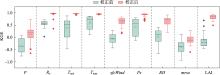
图3
模式数据修正前后的KGE箱型图"

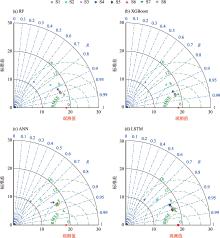
图4
四种模型各组合泰勒图"


图5
不同组合下各模型2000—2014年R、RMSE(a)和TSS评分(b)"
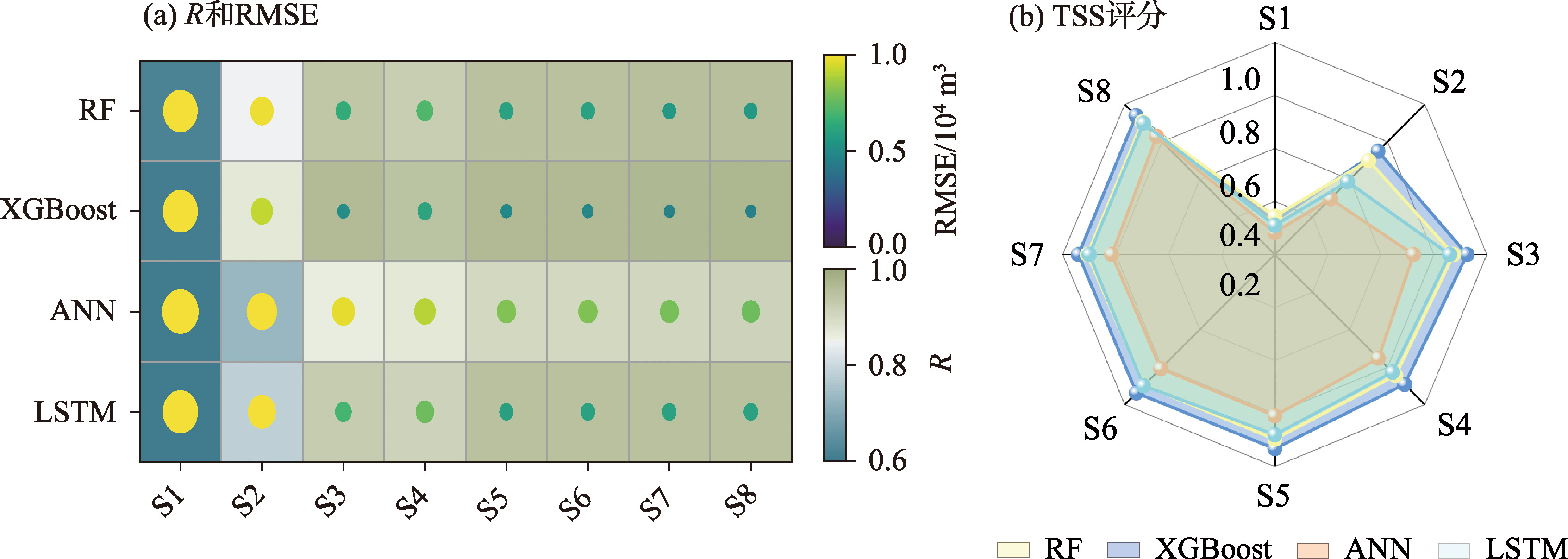

图6
不同情景下EWR的年际和年内变化"
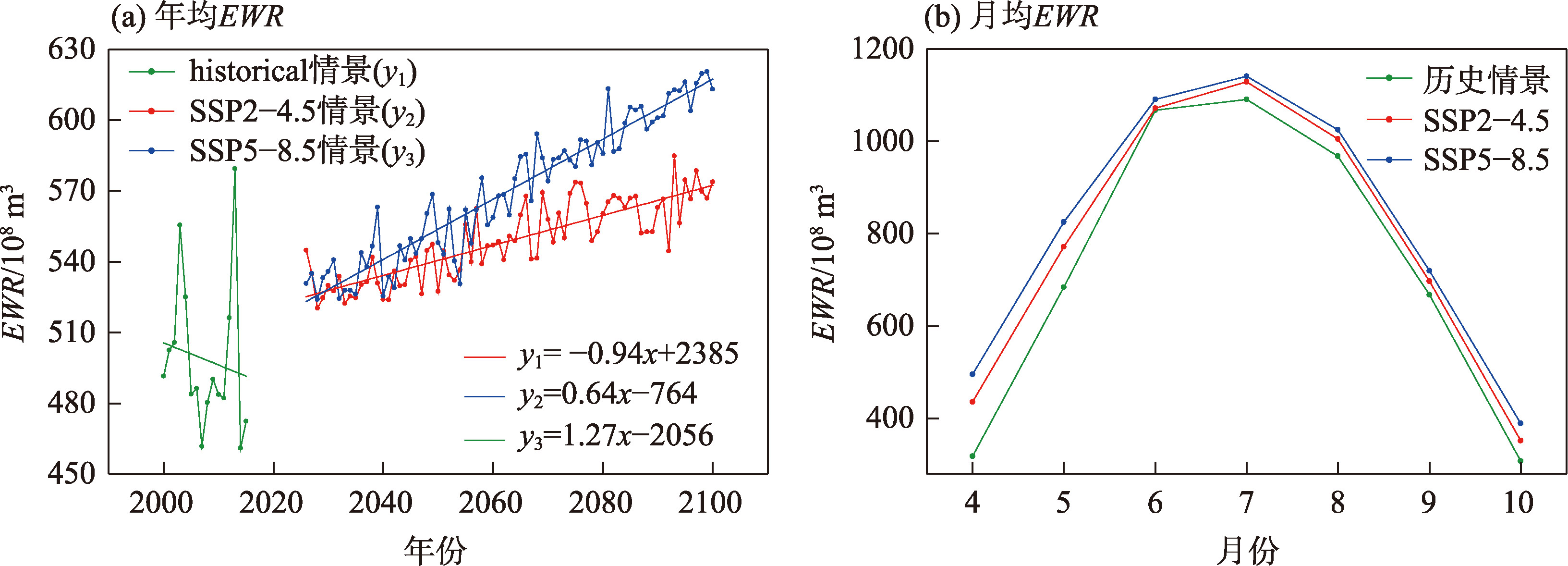
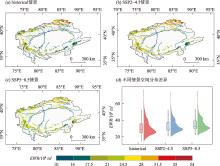
图7
不同情景下年均EWR的空间分布"

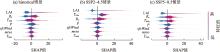
图8
不同情景下各环境因素SHAP摘要图 注:SHAP值代表各因素对植被生态需水变化的影响(正值为促进效应,负值为抑制效应),其解释性大小从上到下依次排序;颜色代表因素的数值范围(红色代表高值,蓝色代表低值)。"
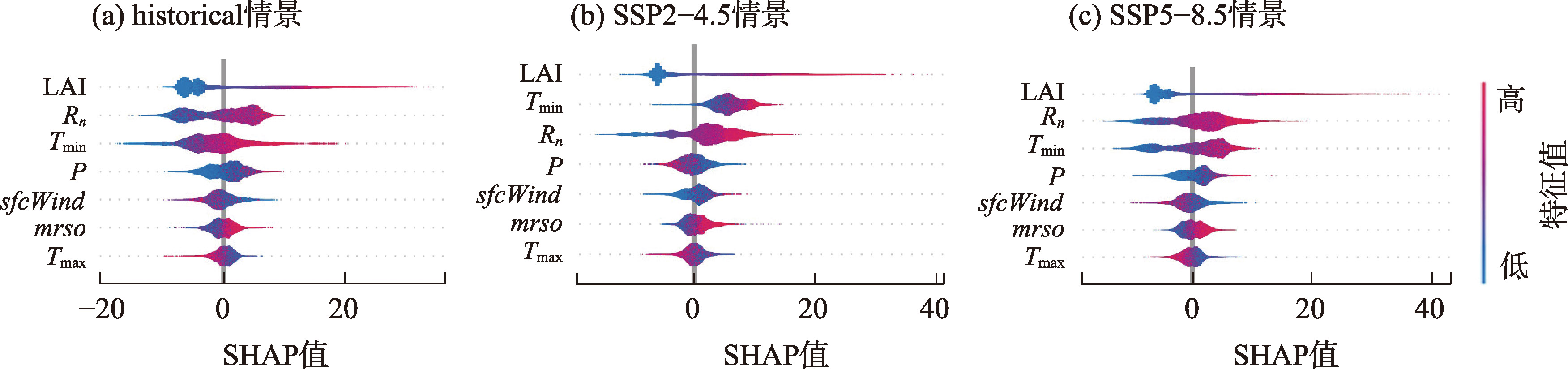
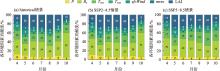
图9
不同情景下年内各环境因素对EWR变化的相对贡献"

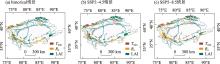
图10
不同情景下影响EWR变化的主要因素空间分布"
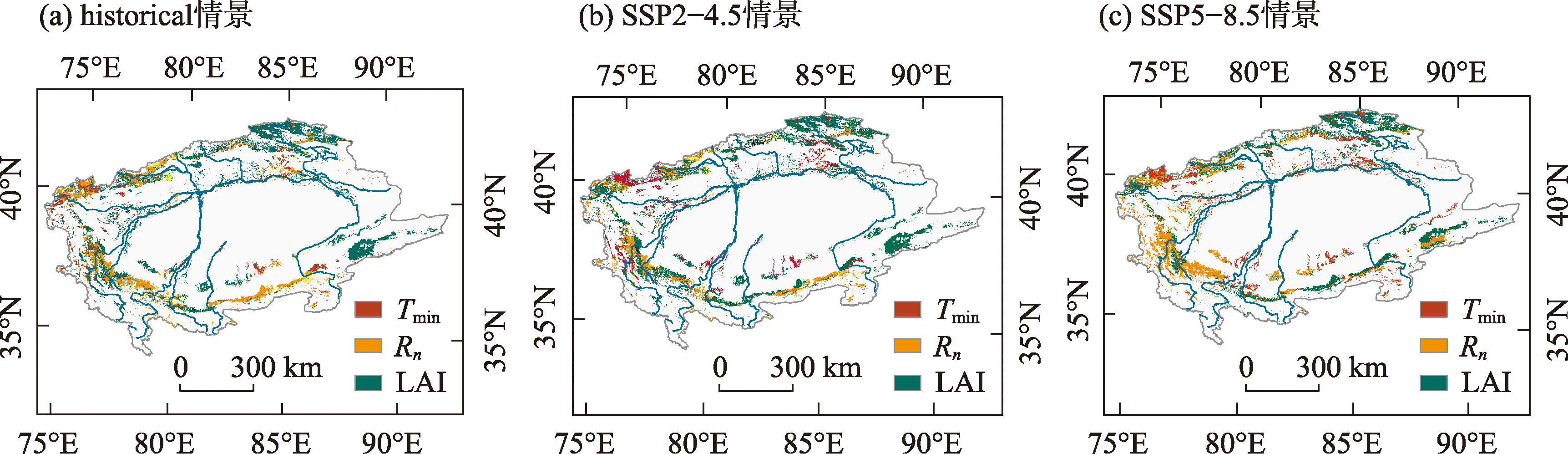
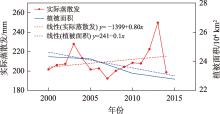
图11
塔里木河流域天然植被生长季实际蒸散发与天然植被面积年际变化"

图12
不同情景下Rn(a、b、c)和Tmin(d、e、f)年均空间分布"
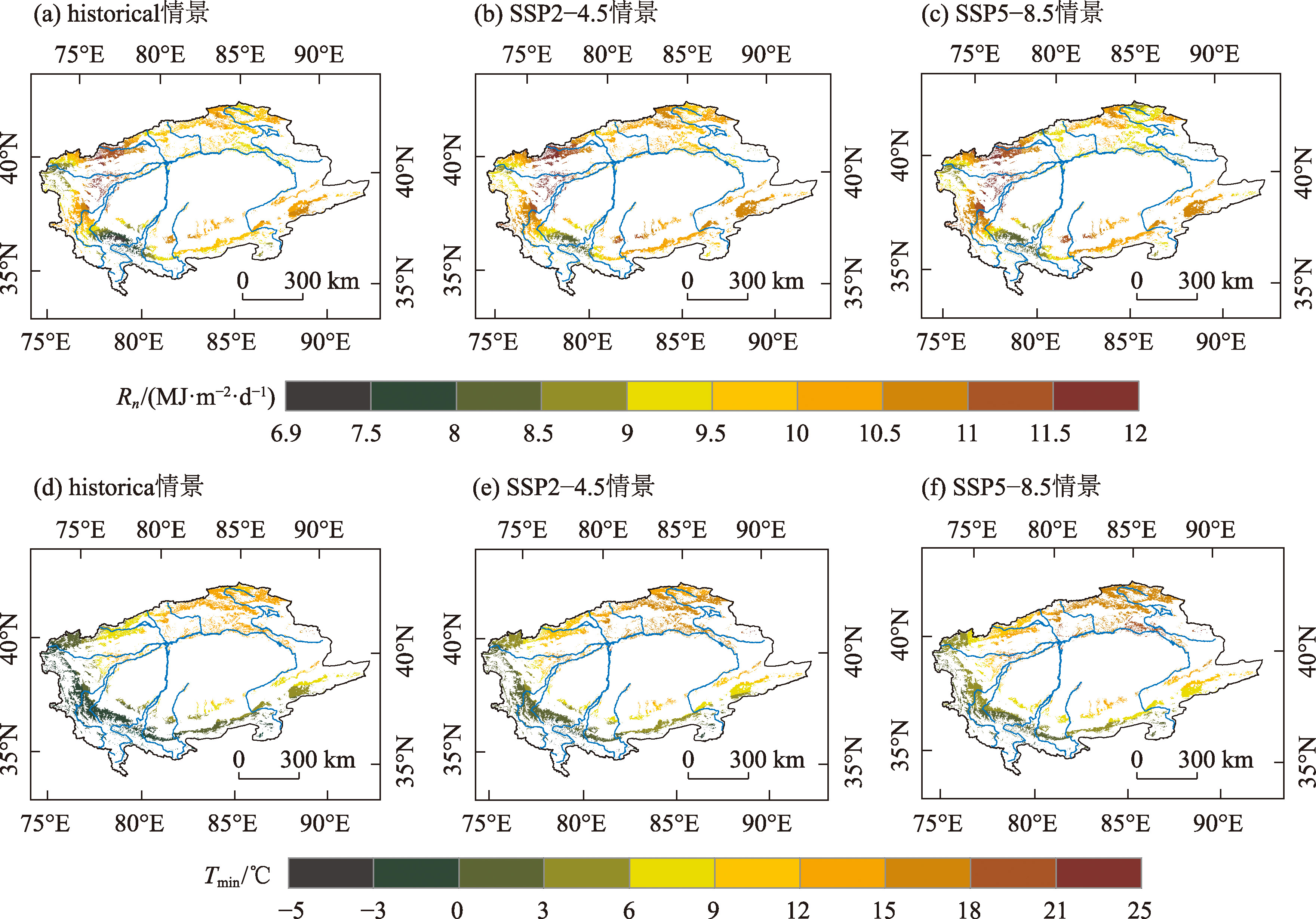
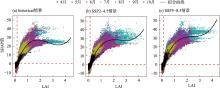
图13
LAI对植被生态需水的影响 注:图中的红色虚线分别表示y=0的水平线,以及y=0处与拟合曲线的交点所对应的垂直于x轴的线。"

| [1] | Ling H, Guo B, Xu H, et al. Configuration of water resources for a typical river basin in an arid region of China based on the ecological water requirements (EWRs) of desert riparian vegetation[J]. Global and Planetary Change, 2014, 122: 292-304. |
| [2] |
周洪华, 杨玉海, 朱成刚, 等. 供需平衡视角下昆仑山北坡县域单元地表水资源开发利用潜力初探[J]. 干旱区地理, 2024, 47(7): 1106-1115.
doi: 10.12118/j.issn.1000-6060.2024.093 |
|
[Zhou Honghua, Yang Yuhai, Zhu Chenggang, et al. Development and utilization potential of surface water resources of the counties on the northern slope of Kunlun Mountains from the perspective of supply and demand balance[J]. Arid Land Geography, 2024, 47(7): 1106-1115. ]
doi: 10.12118/j.issn.1000-6060.2024.093 |
|
| [3] |
Li F, Wang J, Li P, et al. Vegetation changes from 2014 to 2023 in the mongolian plateau permafrost region under climate change[J]. Journal of Resources and Ecology, 2024, 15(5): 1147-1159.
doi: 10.5814/j.issn.1674-764x.2024.05.004 |
| [4] |
马忠学, 崔惠娟, 葛全胜. 基于植被动态模式预估中国植被净初级生产力变化格局[J]. 地理学报, 2022, 77(7): 1821-1836.
doi: 10.11821/dlxb202207017 |
|
[Ma Zhongxue, Cui Huijuan, Ge Quansheng. Prediction of net primary productivity change pattern in China based on vegetation dynamic models[J]. Acta Geographica Sinica, 2022, 77(7): 1821-1836. ]
doi: 10.11821/dlxb202207017 |
|
| [5] | Han Y, Xia F, Hang H, et al. Impact of the Grain for Green Project on water resources and ecological water stress in the Yanhe River Basin[J]. PloS One, 2022, 17(6): e0259611. |
| [6] | 钱正英. 中国可持续发展水资源战略研究综合报告[J]. 中国水利, 2000(8): 5-17. |
| [Qian Zhengying. Comprehensive report on China’s water resources strategy for sustainable development[J]. China Water Resources, 2000(8): 5-17. ] | |
| [7] | 贾宝全, 张志强, 张红旗, 等. 生态环境用水研究现状、问题分析与基本构架探索[J]. 生态学报, 2002, 22(10): 1734-1740. |
| [Jia Baoquan, Zhang Zhiqiang, Zhang Hongqi, et al. On the current research status, problems and future framework of ecological and environmental water use[J]. Acta Ecologica Sinica, 2002, 22(10): 1734-1740. ] | |
| [8] | 贾宝全, 慈龙骏. 新疆生态用水量的初步估算[J]. 生态学报, 2000, 20(2): 243-250. |
| [Jia Baoquan, Ci Longjun. The primary estimation of water demand by the eco-environment in Xinjiang[J]. Acta Ecologica Sinica, 2000, 20(2): 243-250. ] | |
| [9] | 吴佳星. 土壤水分胁迫对生态系统碳水耦合的影响研究[D]. 长沙: 中南林业科技大学, 2022. |
| [Wu Jiaxing. Effect of Soil Water Stress on Carbon-water Coupling in Ecosystems[D]. Changsha: Central South University of Forestry and Technology, 2022. ] | |
| [10] | 孙栋元, 胡想全, 金彦兆, 等. 疏勒河中游绿洲天然植被生态需水量估算与预测研究[J]. 干旱区地理, 2016, 39(1): 154-161. |
| [Sun Dongyuan, Hu Xiangquan, Jin Yanzhao, et al. Prediction and evaluation of ecological water requirement of natural vegetation in the middle reaches oasis of Shulehe River Basin[J]. Arid Land Geography, 2016, 39(1): 154-161. ] | |
| [11] | 粟晓玲, 刘雨翰, 姜田亮, 等. 西北地区陆地生态系统未来生态需水量预估[J]. 水资源保护, 2023, 39(4): 9-18, 78. |
| [Su Xiaoling, Liu Yuhan, Jiang Tianliang, et al. Prediction of future ecological water demand of terrestrial ecosystem in Northwest China[J]. Water Resources Protection, 2023, 39(4): 9-18, 78. ] | |
| [12] | 朱婉怡, 张振克, 郭新亚, 等. 马拉河流域植被生态需水特征及估算[J]. 生态学报, 2023, 43(18): 7523-7535. |
| [Zhu Wanyi, Zhang Zhenke, Guo Xinya, et al. Characteristics and estimation of vegetation ecological water demand in the Mara River Basin[J]. Acta Ecologica Sinica, 2023, 43(18): 7523-7535. ] | |
| [13] | Hu X, Shi L, Lin G. The data-driven solution of energy imbalance-induced structural error in evapotranspiration models[J]. Journal of Hydrology, 2021, 597: 126205. |
| [14] | Hu X, Shi L, Lin L, et al. Improving surface roughness lengths estimation using machine learning algorithms[J]. Agricultural and Forest Meteorology, 2020, 287: 107956. |
| [15] | Hu X, Shi L, Lin G, et al. Comparison of physical-based, data-driven and hybrid modeling approaches for evapotranspiration estimation[J]. Journal of Hydrology, 2021, 601(2): 126592. |
| [16] | Breiman L. Random forests[J]. Machine Learning, 2001, 45(1): 5-32. |
| [17] | Chen T, Guestrin C. XGboost: A scalable tree boosting system[C]// Proceedings of the 22nd Acm Sigkdd International Conference on Knowledge Discovery and Data Mining, 2016: 785-794. |
| [18] | 毛健, 赵红东, 姚婧婧. 人工神经网络的发展及应用[J]. 电子设计工程, 2011, 19(24): 62-65. |
| [Mao Jian, Zhao Hongdong, Yao Jingjing. Application and prospect of Artificial Neural Network[J]. Electronic Design Engineering, 2011, 19(24): 62-65. ] | |
| [19] |
Klaus G, K R S, Jan K, et al. LSTM: A search space odyssey[J]. IEEE transactions on neural networks and learning systems, 2017, 28(10): 2222-2232.
doi: 10.1109/TNNLS.2016.2582924 pmid: 27411231 |
| [20] |
Fu A, Li W, Chen Y, et al. The effects of ecological rehabilitation projects on the resilience of an extremely drought-prone desert riparian forest ecosystem in the Tarim River Basin, Xinjiang, China[J]. Scientific Reports, 2021, 11(1): 18485.
doi: 10.1038/s41598-021-96742-5 pmid: 34531419 |
| [21] | Yu Y, Yu R, Chen X, et al. Agricultural water allocation strategies along the oasis of Tarim River in Northwest China[J]. Agricultural Water Management, 2017, 187: 24-36. |
| [22] |
郭泽呈, 魏伟, 石培基, 等. 中国西北干旱区土地沙漠化敏感性时空格局[J]. 地理学报, 2020, 75(9): 1948-1965.
doi: 10.11821/dlxb202009010 |
|
[Guo Zecheng, Wei Wei, Shi Peiji, et al. Spatiotemporal changes of land desertification sensitivity in the arid region of Northwest China[J]. Acta Geographica Sinica, 2020, 75(9): 1948-1965. ]
doi: 10.11821/dlxb202009010 |
|
| [23] | 彭飞, 何新林, 刘兵, 等. 干旱区荒漠植被生态需水量计算方法研究[J]. 节水灌溉, 2017(12): 90-93. |
| [Peng Fei, He Xinlin, Liu Bing, et al. A Study on estimation method for ecological water requirement of desert vegetation in arid area[J]. Water Saving Irrigation, 2017(12): 90-93. ] | |
| [24] | Lu S, Shang Y, Li W. Assessment of the Tarim River Basin water resources sustainable utilization based on entropy weight set pair theory[J]. Water Supply, 2019, 19(3): 908-917. |
| [25] | 周天军, 陈梓明, 邹立维, 等. 中国地球气候系统模式的发展及其模拟和预估[J]. 气象学报, 2020, 78(3): 332-350. |
| [Zhou Tianjun, Chen Ziming, Zou Liwei, et al. Development of climate and earth system models in China: Past achievements and new CMIP6 fesults[J]. Acta Meteorologica Sinica, 2020, 78(3): 332-350. ] | |
| [26] | Hay L E, Wilby R L, Leavesley G H. A comparison of delta change and downscaled GCM scenarios for three mountainous basins in the United States[J]. Journal of the American Water Resources Association, 2000, 36(2): 387-397. |
| [27] |
郭大辛, 李傲翔, 刘恩科, 等. 气候变化背景下汾渭平原参考作物蒸散量的时空变化与归因分析[J]. 应用生态学报, 2024, 35(6): 1625-1634.
doi: 10.13287/j.1001-9332.202406.022 |
|
[Guo Daxin, Li Aoxiang, Liu Enke, et al. Spatiotemporal variations and attribution analysis of reference evapotranspiration in the Fenwei Plain under climate change[J]. Chinese Journal of Applied Ecology, 2024, 35(6): 1625-1634. ]
doi: 10.13287/j.1001-9332.202406.022 |
|
| [28] | 郝振纯, 李丽, 徐毅, 等. 区域气候情景Delta-DCSI降尺度方法[J]. 工程科学与技术, 2009, 41(5): 1-7. |
| [Hao Zhenchun, Li Li, Xu Yi, et al. Study on Delta-DCSI downscaling method of GCM output[J]. Advanced Engineering Sciences, 2009, 41(5): 1-7. ] | |
| [29] | Pechlivanidis I G, Jackson B, McMillan H, et al. Use of an entropy-based metric in multiobjective calibration to improve model performance[J]. Water Resources Research, 2014, 50(10): 8066-8083. |
| [30] | Yin Z, Feng Q, Yang L, et al. Future projection with an extreme-learning machine and support vector regression of reference evapotranspiration in a mountainous inland watershed in North-West China[J]. Water, 2017, 9(11): 880. |
| [31] | Allen R G, Pereira L S, Raes D, et al. Crop evapotranspiration-guidelines for computing crop water requirements-FAO Irrigation and drainage paper 56[J]. FAO, 1998, 300(9): D05109. |
| [32] | Jensen M E. Consumptive Use of Water and Irrigation Water Requirements[M]. New York: American Society of Civil Engineers, 1973: 215. |
| [33] | Huang M, Mu Z, Zhao S, et al. Ecological water requirement of natural vegetation in the Tarim River Basin based on multi-source data[J]. Sustainability, 2024, 16(16): 7034. |
| [34] | 傅迎豪. 基于机器学习的CMIP6优选模式集对区域作物需水量的预测分析研究[D]. 银川: 宁夏大学, 2023. |
| [Fu Yinghao. Prediction and Analysis of Regional Crop Water Demand Based on CMIP6 Optimal Pattern Set by Machine Learning[D]. Yinchuan: Ningxia University, 2023. ] | |
| [35] | Štrumbelj E, Kononenko I. Explaining prediction models and individual predictions with feature contributions[J]. Knowledge and information systems, 2014, 41: 647-665. |
| [36] | 罗妍, 王枞, 叶文玲. 基于XGBoost和SHAP的急性肾损伤可解释预测模型[J]. 电子与信息学报, 2022, 44(1): 27-38. |
| [Luo Yan, Wang Zong, Ye Wenling. An interpretable prediction model for acute kidney injury based on XGBoost and SHAP[J]. Journal of Electronics & Information Technology, 2022, 44(1): 27-38. ] | |
| [37] | Granata F, Di Nunno F. Forecasting evapotranspiration in different climates using ensembles of recurrent neural networks[J]. Agricultural Water Management, 2021, 255: 107040. |
| [38] |
Chen Z, Li Z, Huang J, et al. An effective method for anomaly detection in industrial Internet of Things using XGBoost and LSTM[J]. Scientific Reports, 2024, 14(1): 23969.
doi: 10.1038/s41598-024-74822-6 pmid: 39397055 |
| [39] | Grinsztajn L, Oyallon E, Varoquaux G. Why do tree-based models still outperform deep learning on typical tabular data?[J]. Advances in Neural Information Processing Systems, 2022, 35: 507-520. |
| [40] | 徐海量, 陈亚宁, 杨戈. 塔里木河下游生态输水对植被和地下水位的影响[J]. 环境科学, 2003, 24(4): 18-22. |
| [Xu Hailiang, Chen Yaning, Yang Ge. Effect of translating water on vegetation at the lower reaches of Tarim River[J]. Environmental Science, 2003, 24(4): 18-22. ] | |
| [41] | 陈亚宁, 郝兴明, 陈亚鹏, 等. 新疆塔里木河流域水系连通与生态保护对策研究[J]. 中国科学院院刊, 2019, 34(10): 1156-1164. |
| [Chen Yaning, Hao Xingming, Chen Yapeng, et al. Study on water system connectivity and ecological protection countermeasures of Tarim River Basin in Xinjiang[J]. Bulletin of Chinese Academy of Sciences, 2109, 34(10): 1156-1164. ] | |
| [42] | 王恒. 2000—2023年全球气温变化特征与环流机制分析[J]. 地理科学研究, 2024, 13(2): 330-336. |
| [Wang Heng. Characteristics of global air temperature change and analysis on circulation mechanism from 2000 to 2023[J]. Geographical Science Research, 2024, 13(2): 330-336. ] | |
| [43] | Zhang W, Furtado K, Wu P, et al. Increasing precipitation variability on daily-to-multiyear time scales in a warmer world[J]. Science Advances, 2021, 7(31): eabf8021. |
| [44] | Reyer C P O, Otto I M, Adams S, et al. Climate change impacts in Central Asia and their implications for development[J]. Regional Environmental Change, 2017, 17: 1639-1650. |
| [45] | Xue T, Ding Y, Lu C. Interdecadal variability of summer precipitation in Northwest China and associated atmospheric circulation changes[J]. Journal of Meteorological Research, 2022, 36(6): 824-840. |
| [46] | Wu X, Hao Z, Tang Q, et al. Projected increase in compound dry and hot events over global land areas[J]. International Journal of Climatology, 2021, 41(1): 393-403. |
| [47] |
Atkin O K, Tjoelker M G. Thermal acclimation and the dynamic response of plant respiration to temperature[J]. Trends in Plant Science, 2003, 8(7): 343-351.
doi: 10.1016/S1360-1385(03)00136-5 pmid: 12878019 |
| [48] | Seneviratne S I, Lüthi D, Litschi M, et al. Land-atmosphere coupling and climate change in Europe[J]. Nature, 2006, 443(7108): 205-209. |
| [49] | Schwartz M D, Ahas R, Aasa A. Onset of spring starting earlier across the Northern Hemisphere[J]. Global Change Biology, 2006, 12(2): 343-351. |
| [50] | 马瀚青, 张琨, 马春锋, 等. 参数敏感性分析在遥感及生态水文模型中的研究进展[J]. 遥感学报, 2022, 26(2): 286-298. |
| [Ma Hanqing, Zhang Kun, Ma Chunfeng, et al. Research progress on parameter sensitivity analysis in ecological and hydrologicalmodels of remote sensing[J]. National Remote Sensing Bulletin, 2022, 26(2): 286-298. ] |
| [1] | 段宝玲, 冯强, 王晶, 张薇. 汾河流域生态系统服务供需风险量化评估及其影响阈值[J]. 干旱区研究, 2025, 42(9): 1726-1741. |
| [2] | 王艺璇, 邓晓红, 范慧文青, 韩江哲, 李宗省. 水资源承载力评价耦合模型的研究进展与干旱区应用[J]. 干旱区研究, 2025, 42(6): 1004-1020. |
| [3] | 林洲艳, 王霞迎, 夏元平. 基于多特征融合的面向对象冰川边界提取[J]. 干旱区研究, 2025, 42(6): 1032-1042. |
| [4] | 岳胜如, 胡雪菲, 侯晓华, 孟福军. 基于CMIP6模式的塔里木河流域棉花生产评估[J]. 干旱区研究, 2025, 42(10): 1925-1938. |
| [5] | 谢刚, 王甜甜, 于涛, 董靖玮, 陈世强, 王梦晓, 张圣杰, 张浩铭. 青海湖入湖口水温演变初步研究[J]. 干旱区研究, 2024, 41(9): 1503-1513. |
| [6] | 龙威夷, 施建飞, 李双媛, 孙金金, 王玉刚. 流域绿洲土壤盐分多模型反演效果评估[J]. 干旱区研究, 2024, 41(7): 1120-1130. |
| [7] | 杨荣钦, 肖玉磊, 池苗苗, 穆振侠. 近20 a塔里木河流域人类活动及景观生态风险时空变化[J]. 干旱区研究, 2024, 41(6): 1010-1020. |
| [8] | 洪国军, 谢俊博, 张灵, 范振岐, 喻彩丽, 付仙兵, 李旭. 基于多光谱影像的阿拉尔垦区棉田土壤盐分反演[J]. 干旱区研究, 2024, 41(5): 894-904. |
| [9] | 程晓瑜, 吕洁华. 塔里木河流域碳储量的气候影响机制及地形分异下的归因[J]. 干旱区研究, 2024, 41(5): 865-875. |
| [10] | 山建安, 朱睿, 尹振良, 杨华庆, 张薇, 方春爽. 基于CMIP6模式的中国西北地区干旱时空变化[J]. 干旱区研究, 2024, 41(5): 717-729. |
| [11] | 张嘉琪, 刘招, 韩忠青, 王丽霞, 张晋霞, 岳甲寅, 管子隆. 气候变化下泾河流域蓝绿水变化趋势及预测[J]. 干旱区研究, 2024, 41(12): 2045-2055. |
| [12] | 王洋, 冯卓亚, 许丽, 高文信. 塔里木河流域生境质量与土地利用变化响应及驱动力[J]. 干旱区研究, 2024, 41(12): 2132-2142. |
| [13] | 张音, 孙从建, 刘庚, 钞锦龙, 耿甜伟. 近20 a塔里木河流域山区NDSI对气候变化的响应[J]. 干旱区研究, 2024, 41(10): 1639-1648. |
| [14] | 杜慧娟, 王光耀, 冉光妍, 吕密. 面向SDGs的塔里木河流域农业灰水足迹分析[J]. 干旱区研究, 2023, 40(7): 1184-1193. |
| [15] | 戴君, 胡海珠, 毛晓敏, 张霁. 基于CMIP6多模式预估数据的石羊河流域未来气候变化趋势分析[J]. 干旱区研究, 2023, 40(10): 1547-1562. |
|
||
