
干旱区研究 ›› 2025, Vol. 42 ›› Issue (5): 907-921.doi: 10.13866/j.azr.2025.05.13 cstr: 32277.14.AZR.20250513
刘拉军1,2( ), 袁秀亮1,3(), 井长青4, 潘昌祥1,3
收稿日期:2025-03-17
修回日期:2025-04-23
出版日期:2025-05-15
发布日期:2025-10-22
通讯作者:
袁秀亮. E-mail: yuanxiuliang@ms.xjb.ac.cn作者简介:刘拉军(1999-),男,硕士研究生,主要从事干旱区水资源研究. E-mail: liulajun@126.com
基金资助:
LIU Lajun1,2(), YUAN Xiuliang1,3(), JING Changqing4, PAN Changxiang1,3
Received:2025-03-17
Revised:2025-04-23
Published:2025-05-15
Online:2025-10-22
摘要:
本研究基于水资源、社会、经济和生态4个维度构建水资源承载力评价体系,并采用改进的逼近理想解排序模型(Technique for Order Preference by Similarity to an Ideal Solution,TOPSIS)对中国西北省会城市及典型城市2010—2022年的水资源承载力进行评价。研究首次引入贝叶斯优化算法进行水资源优化配置,并据此计算各产业的水资源可支撑发展阈值。研究结果表明:(1) 中国西北省会城市及典型城市2010—2022年的水资源承载力平均值在0.3~0.5之间,处于中等水平,除石嘴山市、西安市和银川市外,其余城市的水资源承载力均呈现显著提升趋势(P<0.05)。(2) 水资源维度对水资源承载力的影响最大,其次为社会和生态维度,经济维度影响最小。(3) 基于2022年数据的优化配置结果显示,农业用水量与生态用水量有所减少,而工业用水量与生活用水量显著增加。各城市在最优用水配置下的预估综合效益与总GDP均优于现状,其中石嘴山市的优化效果最为显著,综合效益得分提升41.49%。本研究可为中国西北省会城市及典型城市的水资源可持续开发利用与合理优化配置提供科学依据。
刘拉军, 袁秀亮, 井长青, 潘昌祥. 中国西北省会及典型城市2010—2022年水资源承载力评价与发展阈值评估[J]. 干旱区研究, 2025, 42(5): 907-921.
LIU Lajun, YUAN Xiuliang, JING Changqing, PAN Changxiang. Evaluation of water resources carrying capacity and development threshold in provincial capitals and typical cities of Northwest China from 2010 to 2022[J]. Arid Zone Research, 2025, 42(5): 907-921.

图1
研究区示意图 注:底图采用自然资源部标准地图制作,审图号为GS(2023)2767,对底图边界无修改。"

表1
数据来源与时间范围"
| 类别 | 主要指标 | 数据来源 | 时间范围 |
|---|---|---|---|
| 水资源 | 单位面积降水量、水资源总量、单位面积地表水资源量、单位面积地下水资源量、人均水资源量、综合生产能力、产水模数 | 水资源公报、统计年鉴 | 2010—2022年 |
| 社会 | 总用水量、人均生活用水、农业用水强度、工业用水强度、人口密度、自然增长率、常住人口、供水管密度 | 水资源公报、统计年鉴 | 2010—2022年 |
| 经济 | GDP、农业GDP、工业GDP、人均GDP、GDP增长率、第一产业GDP占比、第三产业GDP占比、单位GDP水耗 | 统计年鉴、国民经济和社会发展统计公报 | 2010—2022年 |
| 生态 | 绿地面积、人均公园绿地面积、建成区绿化覆盖率、城市环境用水强度、污水处理率、生活垃圾处理率、SO2排放强度、工业氮氧化物排放强度、工业烟尘排放强度 | 统计年鉴、中国城市建设统计年鉴 | 2010—2022年 |
| 过程指标 | 农业用水量、行政区面积、工业用水量、生活用水量、生态用水量、第三产业GDP、SO2排放量、工业氮氧化物排放量、工业烟尘排放量 | 统计年鉴、水资源公报、中国城市建设统计年鉴 | 2010—2022年 |
| 其他指标 | 生活用水排污系数、工业用水排污系数、再生水利用率、工业用水重复利用率 | 政府网站公告 | 2022年 |
表2
水资源承载力评价指标体系"
| 子系统 | 序号 | 指标 | 单位 | 方向 |
|---|---|---|---|---|
| 水资源子系统 | X1 | 单位面积降水量 | mm | 正向 |
| X2 | 水资源总量 | 104 m3 | 正向 | |
| X3 | 单位面积地表水资源量 | m3·km-2 | 正向 | |
| X4 | 单位面积地下水资源量 | m3·km-2 | 正向 | |
| X5 | 人均水资源量 | m3·人-1 | 正向 | |
| X6 | 综合生产能力 | 104 m3·d-1 | 正向 | |
| X7 | 产水模数 | 104 m3·km-2 | 正向 | |
| 社会子系统 | X8 | 总用水量 | 104 m3 | 负向 |
| X9 | 人均生活用水 | L·d-1 | 负向 | |
| X10 | 农业用水强度 | m3·元-1 | 负向 | |
| X11 | 工业用水强度 | m3·元-1 | 负向 | |
| X12 | 人口密度 | 人·km2 | 负向 | |
| X13 | 自然增长率 | ‰ | 负向 | |
| X14 | 常住人口 | 104人 | 负向 | |
| X15 | 供水管密度 | km·km-2 | 正向 | |
| 经济子系统 | X16 | GDP | 108元 | 正向 |
| X17 | 农业GDP | 108元 | 正向 | |
| X18 | 工业GDP | 108元 | 正向 | |
| X19 | 人均GDP | 元·人-1 | 正向 | |
| X20 | GDP增长率 | % | 负向 | |
| X21 | 第一产业GDP占比 | % | 负向 | |
| X22 | 第三产业GDP占比 | % | 负向 | |
| X23 | 单位GDP水耗 | m3·(104元)-1 | 负向 | |
| 生态子系统 | X24 | 绿地面积 | hm2 | 正向 |
| X25 | 人均公园绿地面积 | m2 | 正向 | |
| X26 | 建成区绿化覆盖率 | % | 正向 | |
| X27 | 城市环境用水强度 | m3·元-1 | 负向 | |
| X28 | 污水处理率 | % | 正向 | |
| X29 | 生活垃圾处理率 | % | 正向 | |
| X30 | SO2排放强度 | t·(108元)-1 | 负向 | |
| X31 | 工业氮氧化物排放强度 | t·(108元)-1 | 负向 | |
| X32 | 工业烟尘排放强度 | t·(108元)-1 | 负向 |
表3
水资源承载力等级划分"
| 等级 | 接近度 | 评价等级 |
|---|---|---|
| Ⅰ | [0.7~1.0] | 优秀 |
| Ⅱ | [0.5~0.7) | 良好 |
| Ⅲ | [0.3~0.5) | 中等 |
| Ⅳ | [0.2~0.3) | 较差 |
| Ⅴ | [0.0~0.2) | 很差 |
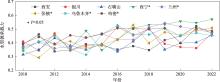
图2
水资源承载力变化 注:*表示在P<0.05水平显著相关。下同。"

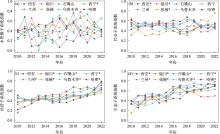
图3
水资源承载力子系统指数变化"

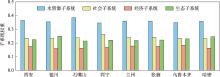
图4
水资源承载力子系统权重"

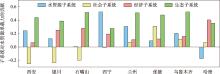
图5
子系统对水资源承载力的贡献"

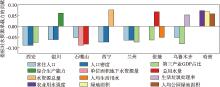
图6
指标对水资源承载力的贡献"

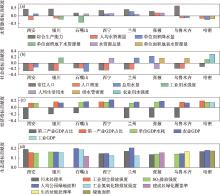
图7
指标对水资源承载力子系统的贡献"

表4
优化结果"
| 城市 | 农业用水/104 m3 | 工业用水/104 m3 | 生活用水/104 m3 | 生态用水/104 m3 | 人口/104人 | 综合得分 |
|---|---|---|---|---|---|---|
| 西安 | 65471.62 | 20763.97 | 91341.63 | 33766.70 | 1307.47 | 126018164.92 |
| 银川 | 146771.28 | 8024.69 | 21802.89 | 19470.00 | 311.05 | 31528906.09 |
| 石嘴山 | 90436.70 | 8882.70 | 7205.19 | 9363.33 | 75.30 | 10100873.02 |
| 西宁 | 24527.00 | 5852.52 | 16871.20 | 5676.23 | 247.56 | 19714216.58 |
| 兰州 | 47533.15 | 14209.66 | 27262.34 | 19656.33 | 438.50 | 35126256.78 |
| 张掖 | 181005.02 | 1843.04 | 8018.83 | 3093.33 | 112.42 | 7277489.45 |
| 乌鲁木齐 | 40682.93 | 21688.18 | 30930.01 | 15083.33 | 456.80 | 40071565.61 |
| 哈密 | 66230.58 | 8247.49 | 6651.65 | 8333.33 | 67.00 | 9336897.85 |
表5
优化前后增减比例"
| 城市 | 农业用水/% | 工业用水/% | 生活用水/% | 生态用水/% | 人口/% | 综合得分/% |
|---|---|---|---|---|---|---|
| 西安 | -3.29 | 3.30 | 10.32 | -17.84 | 0.61 | 7.51 |
| 银川 | -1.03 | 18.01 | 21.87 | -18.54 | 7.38 | 19.25 |
| 石嘴山 | -6.19 | 13.88 | 84.75 | -21.97 | 0.16 | 41.49 |
| 西宁 | -6.09 | 3.71 | 23.29 | -27.53 | -0.18 | 15.15 |
| 兰州 | -3.97 | -3.34 | 10.05 | -3.34 | -0.69 | 5.17 |
| 张掖 | -1.12 | 7.65 | 44.90 | -21.87 | 0.36 | 24.03 |
| 乌鲁木齐 | -5.17 | -8.10 | 6.29 | -3.93 | 11.89 | 2.05 |
| 哈密 | -0.55 | 3.09 | 6.77 | -7.41 | 0.00 | 4.04 |

图8
各产业优化前后GDP对比"

| [1] | 张建港, 赖苹, 王江婷. 贵州省水资源生态足迹时空演变与可持续利用研究[J]. 环境污染与防治, 2024, 46(10): 1521-1528, 1537. |
| [Zhang Jiangang, Lai Ping, Wang Jiangting. Research on the spatio-temporal evolution of water resources ecological footprint and sustainable utilization in Guizhou Province[J]. Environmental pollution and Control, 2024, 46(10): 1521-1528, 1537.] | |
| [2] | 李洋. 沈阳市水资源承载力适度水平研究[J]. 水利技术监督, 2024(11): 203-207. |
| [Li Yang. Study on the moderate level of water resources carrying capacity in Shenyang City[J]. Techenical Supervision in Water Resources, 2024(11): 203-207.] | |
| [3] | Wu C, Zhou L, Jin J, et al. Regional water resource carrying capacity evaluation based on multi-dimensional precondition cloud and risk matrix coupling model[J]. Science of the Total Environment, 2020, 710: 136324. |
| [4] | Chen Q, Zhu M, Zhang C, et al. The driving effect of spatial-temporal difference of water resources carrying capacity in the Yellow River Basin[J]. Journal of Cleaner Production, 2023, 388: 135709. |
| [5] | 伍巧, 贺秀斌, 鲍玉海, 等. 四川省水资源承载力时空变化格局及驱动因素[J]. 水文, 2024, 44(6): 85-92. |
| [Wu Qiao, He Xiubin, Bao Yuhai, et al. Spatiotemporal variation and driving factors of water resources carrying capacity in Sichuan Province[J]. Journal of China Hydrology, 2024, 44(6): 85-92.] | |
| [6] | 王昆漩, 陈威. 基于改进模糊综合评价的十堰市水资源承载力评价[J]. 水电能源科学, 2024, 42(2): 14-17. |
| [Wang Kunxuan, Chen Wei. Evaluation of water resources carrying capacity in Shiyan City based on improved fuzzy comprehensive evaluation[J]. Water Resources and Power, 2024, 42(2): 14-17.] | |
| [7] | Song X M, Kong F Z, Zhan C S, et al. Assessment of water resources carrying capacity in Tianjin City of China[J]. Water Resources Management, 2011, 25(3): 857-873. |
| [8] | 俞阳, 牟琴, 闵雪峰, 等. 基于熵权TOPSIS-SD的超大城市水资源承载力研究[J]. 人民长江, 2024, 55(12): 148-156, 175. |
| [Yu Yang, Mou Qin, Min Xuefeng, et al. Study on water resource carrying capacity simulation in megacities based on entropy-weighted TOPSIS-SD model[J]. Yangtze River, 2024, 55(12): 148-156, 175.] | |
| [9] | 魏建涛, 李治军, 王海庆, 等. 河南省水资源空间匹配及承载力现状分析[J]. 人民黄河, 2024, 46(12): 78-84. |
| [Wei Jiantao, Li Zhijun, Wang Haiqing, et al. Analysis of spatial matching and carrying capacity of water resources in Henan Province[J]. Yellow River, 2024, 46(12): 78-84.] | |
| [10] | Feng J. Optimal allocation of regional water resources based on multi-objective dynamic equilibrium strategy[J]. Applied Mathematical Modelling, 2021, 90: 1183-1203. |
| [11] | Zhou M, Sun D, Wang X, et al. Multi-objective optimal allocation of water resources in Shule River Basin of Northwest China based on climate change scenarios[J]. Agricultural Water Management, 2024, 302: 109015. |
| [12] | Li S, Yan Z, Sha J, et al. Application of AMOGWO in multi-objective optimal allocation of water resources in Handan, China[J]. Water, 2022, 14: 63. |
| [13] | 董远恒, 徐斌, 张雨薇, 等. 跨流域调水多水源多目标水量调度模拟-优化双层耦合算法[J]. 南水北调与水利科技, 2025, 23(1): 36-46. |
| [Dong Yuanheng, Xu Bin, Zhang Yuwei, et al. Inter-basin water transfer multi-source multi-objective water allocation simulation-optimization twin-level coupling algorithm[J]. South-to-North Water Transfers and Water Science & Technology, 2025, 23(1): 36-46.] | |
| [14] | 卢娜, 张佳明, 苏承国, 等. 考虑水土互馈关系的区域水土资源联合优化配置[J]. 水科学进展, 2024, 35(2): 208-219. |
| [Lu Na, Zhang Jiaming, Su Chengguo, et al. Joint optimal allocation of regional water and land resources considering mutual feedback relationship[J]. Advance in Water Science, 2024, 35(2): 208-219.] | |
| [15] | 邓毛颖, 邓策方. 动态规划法在水资源分配中的实践[J]. 给水排水, 2021, 57(S2): 253-256, 271. |
| [Deng Maoying, Deng Cefang. Optimal allocation of water resource based on dynamic programming[J]. Water and Wastewater Engineering, 2021, 57(S2): 253-256, 271.] | |
| [16] | 唐晓宇, 刘铁, 黄粤, 等. 开都河流域水-能源-生态综合收益下的水资源优化配置[J]. 南水北调与水利科技, 2025, 23(1): 90-98. |
| [Tang Xiaoyu, Liu Tie, Huang Yue, et al. Optimal allocation of water resources under integrated water-energy-ecological benefits in Kaidu River Basin[J]. South-to-North Water Transfers and Water Science & Technology, 2025, 23(1): 90-98.] | |
| [17] | Kucukmehmetoglu M. An integrative case study approach between game theory and Pareto frontier concepts for the transboundary water resources allocations[J]. Journal of Hydrology, 2012, 450-451: 308-319. |
| [18] | Li M, Fu Q, Singh V P, et al. An intuitionistic fuzzy multi-objective non-linear programming model for sustainable irrigation water allocation under the combination of dry and wet conditions[J]. Journal of Hydrology, 2017, 555: 80-94. |
| [19] | 王晓宇, 袁汝华, 王维. 新形势下黄河流域水资源配置SD模型构建与仿真[J]. 生态经济, 2024, 40(2): 181-190. |
| [Wang Xiaoyu, Yuan Ruhua, Wang Wei. Construction and simulation of water resources allocation SD model in the Yellow River Basin under the new situation[J]. Ecological Economy, 2024, 40(2): 181-190. | |
| [20] | 刘欣, 赵雪花, 武雯昱, 等. 基于NSGA-Ⅱ+ARSBX算法的太原市水资源优化配置[J]. 水利水电科技进展, 2025, 45(1): 79-86, 103. |
| [Liu Xin, Zhao Xuehua, Wu Wenyu, et al. Optimal allocation of water resources based in Taiyuan City on NSGA-Ⅱ+ARSBX algorithm[J]. Advances in Science and Technology of Water Resources, 2025, 45(1): 79-86, 103.] | |
| [21] | 史利杰, 苏律文, 杨侃. 基于改进多目标蝙蝠算法的洛河流域水库优化调度[J]. 水电能源科学, 2020, 38(8): 55-58, 82. |
| [Shi Lijie, Su Lüwen, Yang Kan. An improved multi-objective bat algorithm for reservoir operation in Luohe River[J]. Water Resources and Power, 2020, 38(8): 55-58, 82.] | |
| [22] | 赵燕, 武鹏林, 祝雪萍. 基于改进萤火虫算法的水资源优化配置[J]. 人民黄河, 2019, 41(5): 62-66. |
| [Zhao Yan, Wu Penglin, Zhu Xueping. Optimal allocation of water resources based on modified firefly algorithm[J]. Yellow River, 2019, 41(5): 62-66.] | |
| [23] | Pérez C J, Vega-Rodríguez M A, Reder K, et al. A multi-objective artificial bee colony-based optimization approach to design water quality monitoring networks in river basins[J]. Journal of Cleaner Production, 2017, 166: 579-589. |
| [24] | Fang G, Guo Y, Wen X, et al. Multi-objective differential evolution-chaos shuffled frog leaping algorithm for water resources system optimization[J]. Water Resources Management, 2018, 32(12): 3835-3852. |
| [25] | 杜佰林, 张建丰, 高泽海, 等. 基于模拟退火粒子群算法的水资源优化配置[J]. 排灌机械工程学报, 2021, 39(3): 292-299. |
| [Du Bailin, Zhang Jianfeng, Gao Zehai, et al. Optimal allocation of water resources based on simulated annealing particle swarm optimization algorithm[J]. Journal of Drainage and Irrigation Machinery Engineering, 2021, 39(3): 292-299.] | |
| [26] | Wu X, Wang Z. Multi-objective optimal allocation of regional water resources based on slime mould algorithm[J]. The Journal of Supercomputing, 2022, 78(16): 18288-18317. |
| [27] | Long X, Wu S, Wang J, et al. Urban water environment carrying capacity based on VPOSR-coefficient of variation-grey correlation model: A case of Beijing, China[J]. Ecological Indicators, 2022, 138: 108863. |
| [28] | Li Y, Chen Y. Variable precondition S-type cloud algorithm: Theory and application on water resources carrying capacity assessment[J]. Ecological Indicators, 2021, 121: 107209. |
| [29] | Wang G, Xiao C, Qi Z, et al. Development tendency analysis for the water resource carrying capacity based on system dynamics model and the improved fuzzy comprehensive evaluation method in the Changchun City, China[J]. Ecological Indicators, 2021, 122: 107232. |
| [30] | Shao Y, Yuan X, Jing C, et al. A better simulation of water and carbon fluxes in a typical desert grassland ecosystem through the common land model[J]. Journal of Hydrology, 2024, 644: 132111. |
| [31] | Liu H, Liu Y, Li L, et al. Study of an evaluation method for water resources carrying capacity based on the projection pursuit technique[J]. Water Supply, 2017, 17(5): 1306-1315. |
| [32] | 刘欢, 宋孝玉, 李磊, 等. 中国31省(市、自治区)水资源承载力评价及预测研究[J]. 干旱地区农业研究, 2023, 41(4): 226-237. |
| [Liu Huan, Song Xiaoyu, Li Lei, et al. Evaluation and prediction of water resources carrying capacity in 31 provinces, municipalities and autonomous regions of China[J]. Agricultural Research in the Arid Areas, 2023, 41(4): 226-237.] | |
| [33] |
姜德娟, 余灏哲, 李丽娟. 基于综合赋权和TOPSIS模型的山东省水资源承载力动态评价[J]. 资源科学, 2024, 46(3): 538-548.
doi: 10.18402/resci.2024.03.08 |
|
[Jiang Dejuan, Yu Haozhe, Li Lijuan. Dynamic evaluation of water resources carrying capacity in Shandong Province based on the comprehensive weight and TOPSIS model[J]. Resources Science, 2024, 46(3): 538-548.]
doi: 10.18402/resci.2024.03.08 |
|
| [34] | 吴明艳, 曾晓春, 刘兴德, 等. 基于熵权TOPSIS模型的西北五省区水资源承载力评价研究[J]. 中国农村水利水电, 2022, 64(12): 78-85, 92. |
| [Wu Mingyan, Zeng Xiaochun, Liu Xingde, et al. Research on the evaluation of water resources carrying capacity in five northwest provinces based on entropy TOPSIS model[J]. China Rural Water and Hydropower, 2022, 64(12): 78-85, 92.] | |
| [35] | 莫崇勋, 刘奇忠, 唐玲玲, 等. 基于模糊-博弈-障碍综合评价模型的玉林市水资源承载力评价[J]. 水电能源科学, 2024, 42(12): 50-53, 161. |
| [Mo Chongxun, Liu Qizhong, Tang Lingling, et al. Evaluation of water resources carrying capacity in Yulin City based on fuzzy-game-obstacle comprehensive evaluation model[J]. Water Resources and Power, 2024, 42(12): 50-53, 161.] | |
| [36] | Lü B, Liu C, Li T, et al. Evaluation of the water resource carrying capacity in Heilongjiang, eastern China, based on the improved TOPSIS model[J]. Ecological Indicators, 2023, 150: 110208. |
| [37] | 向扬, 李治军. 基于改进TOPSIS模型的山西省水资源承载力与协调发展分析[J]. 水利水电技术, 2024, 55(4): 48-58. |
| [Xiang Yang, Li Zhijun. Evaluation and coordinated development of water resources carrying capacity in Shanxi Province based on the improved TOPSIS model[J]. Water Resource and Hydropower Engineering, 2024, 55(4): 48-58.] | |
| [38] | 李洪波, 王成文, 吴瑞, 等. 基于博弈论法的银川市地下水资源承载力评价[J]. 人民黄河, 2023, 45(S1): 42-43. |
| [Li Hongbo, Wang Chengwen, Wu Rui, et al. Evaluation of groundwater resources carrying capacity in Yinchuan City based on game theory method[J]. Yellow River, 2023, 45(S1): 42-43.] | |
| [39] |
Haozhe Y U, Lijuan L I, Jiuyi L I. Evaluation of water resources carrying capacity in the Beijing-Tianjin-Hebei Region based on quantity-quality-water bodies-flow[J]. Resources Science, 2020, 42(2): 358-371.
doi: 10.18402/resci.2020.02.14 |
| [40] | Ge Y, Wu J, Zhang D, et al. Uncertain analysis of fuzzy evaluation model for water resources carrying capacity: A case study in Zanhuang County, North China Plain[J]. Water, 2021, 13: 2804. |
| [41] | 王西琴, 刘昌明, 张远. 基于二元水循环的河流生态需水水量与水质综合评价方法——以辽河流域为例[J]. 地理学报, 2006, 61(11): 1132-1140. |
| [Wang Xiqin, Liu Changming, Zhang Yuan. Water quantity/quality combined evaluation method for rivers’ water requirements of the instream environmental flow in dualistic water cycle: A case study of Liaohe River Basin[J]. Acta Geographica Sinica 2006, 61(11): 1132-1140.] | |
| [42] | Rodemann J, Augustin T. Imprecise Bayesian optimization[J]. Knowledge-Based Systems, 2024, 300: 112186. |
| [1] | 王艺璇, 邓晓红, 范慧文青, 韩江哲, 李宗省. 水资源承载力评价耦合模型的研究进展与干旱区应用[J]. 干旱区研究, 2025, 42(6): 1004-1020. |
| [2] | 窦家晅, 徐利岗, 苑蒙飞, 汤英. 不同供氮水平下宁夏枸杞养分吸收利用特征研究[J]. 干旱区研究, 2025, 42(4): 754-765. |
| [3] | 文迪, 吕爱锋, 李涛辉, 张文翔. 塔里木盆地农业光热资源特征及开发潜力分析[J]. 干旱区研究, 2025, 42(2): 384-396. |
| [4] | 李常亮, 雒天峰, 康燕霞. 甘肃省内陆河流域水资源承载能力[J]. 干旱区研究, 2025, 42(1): 63-71. |
| [5] | 戴文渊, 玛久草, 陈亦晨, 郑志祥, 张芮, 张江科. 黄河流域甘肃段水生态安全驱动力分析及动态演变[J]. 干旱区研究, 2024, 41(10): 1662-1671. |
| [6] | 姚玉璧, 郑绍忠, 董宏昌, 石界, 张民, 夏权. 中国西北地区太阳辐射时空分异特征[J]. 干旱区研究, 2023, 40(6): 863-873. |
| [7] | 赵豫芝, 杨建军. 南疆地区水资源承载力及子系统耦合协调性时空格局[J]. 干旱区研究, 2023, 40(2): 213-223. |
| [8] | 贾琼, 宋孝玉, 宋淑红, 刘晓迪, 覃琳, 刘辉. 基于LMDI-SD耦合模型的关中地区水资源承载力动态预测与调控[J]. 干旱区研究, 2023, 40(12): 1918-1930. |
| [9] | 卢方园,贾德彬,高瑞忠,苏文旭,赵航,杨丽娜. 库布齐沙漠社会经济系统动态仿真及其应用[J]. 干旱区研究, 2022, 39(4): 1102-1111. |
| [10] | 缑倩倩, 屈建军, 王国华, 肖建华, 庞营军. 中国干旱半干旱地区湿地研究进展[J]. 干旱区研究, 2015, 32(2): 213-220. |
| [11] | 程肖侠, 方建刚. 中国西北东部电线积冰气候特征及分区[J]. 干旱区研究, 2013, 30(2): 341-346. |
|
||
