
Arid Zone Research ›› 2025, Vol. 42 ›› Issue (7): 1257-1268.doi: 10.13866/j.azr.2025.07.09
• Plant Ecology • Previous Articles Next Articles
YAN Yingcun1,2( ), SUN Shujiao1,2, YU Di3, GAO Guisheng4
Received:2024-07-24
Revised:2025-04-08
Online:2025-07-15
Published:2025-07-07
YAN Yingcun, SUN Shujiao, YU Di, GAO Guisheng. Impact and trend estimation of climate change on vegetation greenness in the Qaidam Basin[J].Arid Zone Research, 2025, 42(7): 1257-1268.
Add to citation manager EndNote|Reference Manager|ProCite|BibTeX|RefWorks
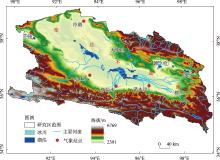
Fig. 1
Research area of Qaidam Basin"

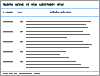
Tab. 1
Classification of vegetation greenness in the Qaidam Basin"
| 等级 | 植被绿度 | 植被NDVI | 面积/km2 | R | G | B | 颜色 |
|---|---|---|---|---|---|---|---|
| Ⅰ级 | 褐 | <0.08 | SⅠ | 115 | 0 | 0 | |
| Ⅱ级 | 橙 | 0.08~0.12 | SⅡ | 230 | 152 | 0 | |
| Ⅲ级 | 黄 | 0.13~0.3 | SⅢ | 255 | 255 | 115 | |
| Ⅳ级 | 绿 | >0.3 | 152 | 230 | 0 |
Tab. 2
Climate tendency rates of temperature and precipitation changes in the Qaidam Basin from 2000 to 2023"
| 站点 | 平均降水/mm | 降水倾向率 /[mm·(10a)-1] | 相关系数 | 站点 | 平均气温/℃ | 气温倾向率 /[℃·(10a)-1] | 相关系数 |
|---|---|---|---|---|---|---|---|
| 茫崖 | 48.1 | 1.31 | 0.04 | 茫崖 | 4.4 | 0.08 | 0.13 |
| 冷湖 | 19.1 | 1.45 | 0.12 | 冷湖 | 3.6 | 0.14 | 0.2 |
| 小灶火 | 31.6 | 5.07 | 0.19 | 小灶火 | 5.1 | 0.06 | 0.11 |
| 大柴旦 | 101.7 | -1.48 | -0.03 | 大柴旦 | 3.2 | 0.22 | 0.34 |
| 格尔木 | 47.6 | 5.81 | 0.22 | 格尔木 | 6.5 | 0.11 | 0.21 |
| 诺木洪 | 53 | 0.79 | 0.02 | 诺木洪 | 6 | 0.23 | 0.41* |
| 德令哈 | 238.4 | 17.09 | 0.18 | 德令哈 | 4.9 | 0.01 | 0.01 |
| 乌兰 | 222.9 | 28.12 | 0.36* | 乌兰 | 4.3 | 0.17 | 0.32 |
| 都兰 | 246.3 | 13.41 | 0.16 | 都兰 | 3.9 | 0.08 | 0.14 |
| 平均 | 112.1 | 7.95 | 0.21 | 平均 | 4.7 | 0.12 | 0.23 |
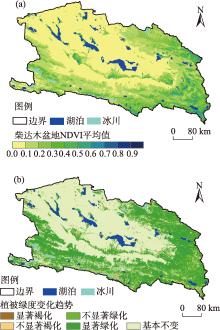
Fig. 2
Average NDVI value of vegetation in the Qaidam Basin from 2000 to 2023 (a) and the trend of vegetation greenness change (b)"

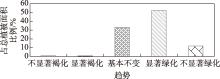
Fig. 3
Proportion of vegetation area with greening trends in the Qaidam Basin from 2000 to 2023"

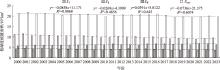
Fig. 4
Interannual variations of vegetation greenness at different levels in the Qaidam Basin from 2000 to 2023"

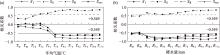
Fig. 5
Correlation coefficient between low green vegetation, average temperature (a),and precipitation (b) in the Qaidam Basin from 2000 to 2020"

Tab. 3
Climate simulation model for low green vegetation area in the Qaidam Basin"
| 序号 | 模拟模型 | R | F | Sig |
|---|---|---|---|---|
| 1 | 0.829 | 41.730 | 0.0000 | |
| 2 | 0.775 | 13.544 | 0.0003 | |
| 3 | 0.924 | 110.846 | 0.0000 | |
| 4 | 0.760 | 25.988 | 0.0000 |
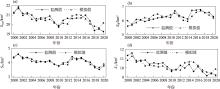
Fig. 6
Validation of climate simulation model hindcast for different NDVI vegetation in the Qaidam Basin from 2000 to 2020"

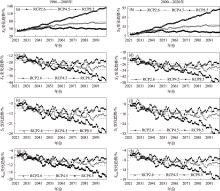
Fig. 7
Changes in low green vegetation from baseline values under different emission scenarios from 2021 to 2100"

Tab. 4
Climate simulation trends of different NDVI vegetation in the Qaidam Basin /[%·(10a)-1]"
| 时段 | SⅢ植被面积与1986—2005年基准值比 | SⅢ植被面积与2000—2020年实测值比 | ||||
|---|---|---|---|---|---|---|
| RCP2.6 | RCP4.5 | RCP8.5 | RCP2.6 | RCP4.5 | RCP8.5 | |
| 2021—2040年 | 5.119 | 9.723 | 11.224 | 4.501 | 8.549 | 9.870 |
| 2041—2070年 | 0.681 | 5.138 | 11.701 | 0.599 | 4.518 | 10.289 |
| 2071—2100年 | -1.288 | 0.842 | 13.703 | -1.133 | 0.740 | 12.049 |
| 时段 | SⅠ植被面积与1986—2005年基准值比 | SⅠ植被面积与2000—2020年实测值比 | ||||
| RCP2.6 | RCP4.5 | RCP8.5 | RCP2.6 | RCP4.5 | RCP8.5 | |
| 2021—2040年 | -0.664 | -3.891 | -3.289 | -0.696 | -4.040 | -3.448 |
| 2041—2070年 | -1.723 | -1.241 | -1.817 | -1.805 | -1.289 | -1.904 |
| 2071—2100年 | 0.699 | -0.052 | -3.387 | 0.733 | -0.054 | -3.550 |
| 时段 | SⅡ植被面积与1986—2005年基准值比 | SⅡ植被面积与2000—2020年实测值比 | ||||
| RCP2.6 | RCP4.5 | RCP8.5 | RCP2.6 | RCP4.5 | RCP8.5 | |
| 2021—2040年 | -0.826 | -4.852 | -4.092 | -0.876 | -5.087 | -4.341 |
| 2041—2070年 | -2.143 | -1.548 | -2.261 | -2.273 | -1.623 | -2.398 |
| 2071—2100年 | 0.870 | -0.065 | -4.214 | 0.923 | -0.068 | -4.469 |
| 时段 | Ssum植被面积与1986—2005年基准值比 | Ssum植被面积与2000—2020年实测值比 | ||||
| RCP2.6 | RCP4.5 | RCP8.5 | RCP2.6 | RCP4.5 | RCP8.5 | |
| 2021—2040年 | -0.368 | -2.149 | -1.824 | -0.378 | -2.193 | -1.872 |
| 2041—2070年 | -0.955 | -0.686 | -1.008 | -0.980 | -0.700 | -1.034 |
| 2071—2100年 | 0.388 | -0.029 | -1.878 | 0.398 | -0.029 | -1.927 |
| [1] | 陈燕丽, 龙步菊, 潘学标, 等. 基于MODIS NDVI和气候信息的草原植被变化监测[J]. 应用气象学报, 2010, 21(2): 229-236. |
| [Chen Yanli, Long Buju, Pan Xuebiao, et al. Grassland vegetation change based on MODIS NDVI data and climate information[J]. Journal of Applied Meteorological Science, 2010, 21(2): 229-236.] | |
| [2] | 谢佩君, 宋小燕, 孙文义, 等. 基于GEE的黄土高原植被绿度线推移变化研究[J]. 中国环境科学, 2023, 43(12): 6518-6529. |
| [Xie Peijun, Song Xiaoyan, Sun Wenyi, et al. Research on the shift change of vegetation greenness line in the Loess Plateau based on GEE[J]. China Environmental Science, 2023, 43(12): 6518-6529.] | |
| [3] | 刘爽, 宫鹏. 2000—2010年中国地表植被绿度变化[J]. 科学通报, 2012, 57(16): 1423-1434. |
| [Liu Shuang, Gong Peng. Change of surface cover greenness in China between 2000 and 2010[J]. Science Bulletin, 2012, 57(16): 1423-1434.] | |
| [4] | 包岩, 田野, 柳彩霞, 等. 中国东部草原植被绿度时空变化分析及其对煤电基地建设的响应[J]. 生态学报, 2018, 38(15): 5423-5433. |
| [Bao Yan, Tian Ye, Liu Caixia, et al. Spatial and temporal variation analysis of vegetation greenness in grassland of eastern China and its response on the construction of coal and electricity base[J]. Acta Ecologica Sinica, 2018, 38(15): 5423-5433.] | |
| [5] | 张宇, 余振, 栾军伟, 等. 1982—2020年东北森林带植被绿度时空变化特征[J]. 生态学报, 2023, 43(16): 6670-6681. |
| [Zhang Yu, Yu Zhen, Luan Junwei, et al. Spatiotemporal variations of vegetation greenness in the forest belt of Northeast China during 1982-2020[J]. Acta Ecologica Sinica, 2023, 43(16): 6670-6681.] | |
| [6] | 徐至真, 王建萍, 韩积斌. 基于SRP模型的柴达木盆地生态脆弱性评价[J]. 盐湖研究, 2024, 32(3): 53-60. |
| [Xu Zhizhen, Wang Jianping, Han Jibin. Ecological vulnerability assessment of the Qaidam Basin based on SRP model[J]. Journal of Salt Lake Research, 2024, 32(3): 53-60.] | |
| [7] |
杨海娇, 魏加华, 任倩慧. 柴达木盆地典型流域地表水-地下水转化关系及水化学特征[J]. 干旱区研究, 2022, 39(5): 1543-1554.
doi: 10.13866/j.azr.2022.05.19 |
|
[Yang Haijiao, Wei Jiahua, Ren Qianhui. Interaction between surface water and groundwater and hydr-ochemical characteristics in the typical watersheds of the Qaidam Basin[J]. Arid Zone Research, 2022, 39(5): 1543-1554.]
doi: 10.13866/j.azr.2022.05.19 |
|
| [8] |
文广超, 李兴, 吴冰洁, 等. 基于Landsat影像的柴达木盆地湖泊提取方法[J]. 干旱区研究, 2022, 39(3): 774-786.
doi: 10.13866/j.azr.2022.03.11 |
|
[Wen Guangchao, Li Xing, Wu Bingjie, et al. An automatic method for delineating lake surfaces in Qaidam Basin usingLandsat images[J]. Arid Zone Research, 2022, 39(3): 774-786.]
doi: 10.13866/j.azr.2022.03.11 |
|
| [9] | 唐文家, 张紫萍, 张志军, 等. 2000—2020年青海省生态环境质量时空变化[J]. 环境科学与技术, 2023, 46(5): 229-237. |
| [Tang Wenjia, Zhang Ziping, Zhang Zhijun, et al. Spatial-temporal changes of ecological environment quality in Qinghai Province from 2000 to 2020[J]. Environmental Science & Technology, 2023, 46(5): 229-237.] | |
| [10] |
王远征, 马启民, 贾晓鹏. 柴达木盆地灌木林地和高寒草甸蒸散发特征研究[J]. 高原气象, 2023, 42(3): 785-794.
doi: 10.7522/j.issn.1000-0534.2022.00055 |
|
[Wang Yuanzheng, Ma Qimin, Jia Xiaopeng. Evapotranspiration characteristics of shrub land and alpine meadow in Qaidam Basin[J]. Plateau Meteorology, 2023, 42(3): 785-794.]
doi: 10.7522/j.issn.1000-0534.2022.00055 |
|
| [11] |
金晓媚, 夏薇, 郭任宏. 柴达木河都兰区植被覆盖率变化特征[J]. 中国沙漠, 2014, 34(2): 603-609.
doi: 10.7522/j.issn.1000-694X.2013.00354 |
|
[Jin Xiaomei, Xia Wei, Guo Renhong. Variation of vegetation coverage in the Dulan area of Qaidam River Basin[J]. Journal of Desert Research, 2014, 34(2): 603-609.]
doi: 10.7522/j.issn.1000-694X.2013.00354 |
|
| [12] | 李艳丽, 杨太保, 曾彪. 基于MODIS数据的柴达木盆地南缘绿洲土地覆盖动态变化研究[J]. 中国沙漠, 2011, 31(1): 34-42. |
| [Li Yanli, Yang Taibao, Zeng Biao. Land cover change of southern fringe oasis in the Qaidam Basin from 2000 to 2009 based on MODIS data[J]. Journal of Desert Research, 2011, 31(1): 34-42.] | |
| [13] | 李学敏, 周定文, 范广洲, 等. 青藏高原冬季NDVI与西南地区夏季气温的滞后关系[J]. 应用气象学报, 2008, 19(2): 161-170. |
| [Li Xuemin, Zhou Dingwen, Fan Guangzhou, et al. The lag relationship between winter NDVI over Tibetan Plateauand temperature of the Southwest China[J]. Journal of Applied Meteorological Science, 2008, 19(2): 161-170.] | |
| [14] | 范广洲, 周定文, 黄荣辉, 等. 我国夏季降水与青藏高原春季NDVI的关系[J]. 应用气象学报, 2009, 20(4): 492-496. |
| [Fan Guangzhou, Zhou Dingwen, Huang Ronghui, et al. The relationship between summer precipitation in China and spring NDVI over the Qinghai-Xizang Plateau[J]. Journal of Applied Meteorology Science, 2009, 20(4): 492-496.] | |
| [15] | 王永立, 范广洲, 周定文, 等. 我国东部地区NDVI与气温、降水的关系研究[J]. 热带气象学报, 2009, 25(6): 725-732. |
| [Wang Yongli, Fan Guangzhou, Zhou Dingwen, et al. Study on the relationship between NDVI, temperature, and precipitation in Eastern China[J]. Journal of Tropical Meteorology, 2009, 25(6): 725-732.] | |
| [16] | 侯光雷, 刘德赢, 张正祥, 等. 松嫩平原不同气候区植被NDVI对气候变化的响应[J]. 中国农业气象, 2012, 33(2): 271-277. |
| [Hou Guanglei, Liu Deying, Zhang Zhengxiang, et al. Response of NDVI in different climatic zone to climate change in Songnen Plain[J]. Chinese Journal of Agrometeorology, 2012, 33(2): 271-277.] | |
| [17] | 吴运力, 张钰, 田佳榕. 气候变化和人类活动对内蒙古高原不同植被类型NDVI的影响[J]. 中国农业气象, 2023, 44(12): 1155-1168. |
|
[Wu Yunli, Zhang Yu, Tian Jiarong. Impacts by climate change and human activities on NDVI in different vegetation types across the Inner Mongolia Plateau[J]. Chinese Journal of Agrometeorology, 2023, 44(12): 1155-1168.]
doi: 10.3969/j.issn.1000-6362.2023.12.008 |
|
| [18] |
赵美亮, 曹广超, 曹生奎, 等. 1980—2017年青海省地表温度时空变化特征[J]. 干旱区研究, 2021, 38(1): 178-187.
doi: 10.13866/j.azr.2021.01.19 |
|
[Zhao Meiliang, Cao Guangchao, Cao Shengkui, et al. Spatial-temporal variation characteristics of land surface temperature in Qinghai Province from 1980 to 2017[J]. Arid Zone Research, 2021, 38(1): 178-187.]
doi: 10.13866/j.azr.2021.01.19 |
|
| [19] |
郝爱华, 薛娴, 尤全刚, 等. 青藏高原近60年降水变化研究进展[J]. 中国沙漠, 2023, 43(2): 43-52.
doi: 10.7522/j.issn.1000-694X.2022.00113 |
|
[Hao Aihua, Xue Xian, You Quangang, et al. Review on precipitation change over the Qinghai-Xizang Plateau in recent 60 years[J]. Journal of Desert Research, 2023, 43(2): 43-52.]
doi: 10.7522/j.issn.1000-694X.2022.00113 |
|
| [20] | 许婉彤, 曾彪, 李博, 等. 柴达木盆地气候变化区域性特征及其影响因素[J]. 兰州大学学报(自然科学版), 2019, 55(3): 357-372. |
| [Xu Wantong, Zeng Biao, Li Bo, et al. Regional differentiation of climate changes in Qaidam Basin and its influencing factors[J]. Journal of Lanzhou University (Natural Science Edition), 2019, 55(3): 357-372.] | |
| [21] | 张旺雄, 刘普幸. 1961—2017年柴达木盆地干湿状况及其影响因子[J]. 干旱区研究, 2019, 36(6): 1391-1400. |
| [Zhang Wangxiong, Liu Puxing. Surface humid situation and its affecting factors in the Qaidam Basin from 1961 to 2017[J]. Arid Zone Research, 2019, 36(6): 1391-1400.] | |
| [22] | 曾方明, 董博, 张西营. 青藏高原东北部60多年来的气候暖湿化: 来自德令哈水文气候的记录[J]. 盐湖研究, 2024, 32(4): 32-39. |
| [Zeng Fangming, Dong Bo, Zhang Xiying. Warming and humidification of climate on the northeastern Qinghai-Xizang plateau over the past 60 years: Evidence from hydroclimatic records of Delingha[J]. Journal of Salt Lake Research, 2024, 32(4): 32-39.] | |
| [23] | 霍佳璇, 任梁, 潘莹萍, 等. 柴达木盆地荒漠植物功能性状及其对环境因子的响应[J]. 生态学报, 2022, 42(11): 4494-4503. |
| [Huo Jiaxuan, Ren Liang, Pan Yingpeng, et al. Functional traits of desert plants and their responses to environmental factors in Qaidam Basin, China[J]. Acta Ecologica Sinica, 2022, 42(11): 4494-4503.] | |
| [24] | 陈犇. 青藏高原高寒草地对气候变化的敏感性及其调控机制[D]. 石家庄: 河北师范大学, 2023. |
| [Chen Ben. Regulatory Mechanisms under Alpine Grasslands Sensitivity to Climate Change on the Qinghai-Xizang Plateau[D]. Shijiazhuang: Hebei Normal University, 2023.] | |
| [25] | 曹旭娟, 干珠扎布, 胡国铮, 等. 基于NDVI3g数据反演的青藏高原草地退化特征[J]. 中国农业气象, 2019, 40(2): 86-95. |
| [Cao Xujuan, Ganzhuzhabu, Hu Guozheng, et al. Characteristics of gr-assland degradation in the Qinghai-Xizang Plateau, based on NDVI3g data[J]. Chinese Journal of Agrometeorology, 2019, 40(2): 86-95.] | |
| [26] |
李庆, 周娜, 王盛, 等. 气候变化和人类活动对土壤风蚀影响的定量评估——以内蒙古自治区为例[J]. 中国沙漠, 2024, 44(1): 178-188.
doi: 10.7522/j.issn.1000-694X.2023.00077 |
|
[Li Qing, Zhou Na, Wang Sheng, et al. Quantitative assessment the impacts of climate change and human actives on wind erosion: A case study of Inner Mongolia Autonomous Region[J]. Journal of Desert Research, 2024, 44(1): 178-188.]
doi: 10.7522/j.issn.1000-694X.2023.00077 |
|
| [27] |
黄梦真, 鲁瑞洁, 赵瑾, 等. 柴达木盆地典型风蚀区土壤质量评价[J]. 中国沙漠, 2023, 43(3): 199-209.
doi: 10.7522/j.issn.1000-694X.2022.00125 |
|
[Huang Mengzhen, Lu Ruijie, Zhao Jin, et al. Assessment of soil quality in typical wind erosion area of Qaidam Basin[J] Journal of Desert Research, 2023, 43(3): 199-209.]
doi: 10.7522/j.issn.1000-694X.2022.00125 |
|
| [28] |
张哲乐, 陈奕云, 郑敏, 等. 基于智能分区的草原资源资产清查价格体系优化[J]. 资源科学, 2023, 45(6): 1107-1122.
doi: 10.18402/resci.2023.06.02 |
|
[Zhang Zheyue, Chen Yiyun, Zheng Min, et al. Optimization of pricing system for the inventory of grassland resource assets based on intelligent zoning[J]. Resources Science, 2023, 45(6): 1107-1122.]
doi: 10.18402/resci.2023.06.02 |
|
| [29] | 胡海伟, 格桑卓玛, 王存, 等. 青海省天然草地区简述[J]. 青海草业, 2022, 31(3): 50-54. |
| [Hu Haiwei, Gesangzhuoma, Wang Cun, et al. A brief description of the grass zong in Qinghai Province[J]. Qinghai Grassland Industry, 2022, 31(3): 50-54.] | |
| [30] |
曹晓云, 祝存兄, 陈国茜, 等. 2000—2021年柴达木盆地地表绿度变化及地形分异研究[J]. 生态环境学报, 2022, 31(6): 1080-1090.
doi: 10.16258/j.cnki.1674-5906.2022.06.002 |
| [Cao Xiaoyun, Zhu Cunxiong, Chen Guoqian, et al. Surface greenness change and topographic differentiation over Qaidam Basin from 2000 to 2021[J]. Ecology and Environmental Science, 2022, 31(6): 1080-1090.] | |
| [31] | 王江山, 殷青军, 杨英莲. 利用NOAA/AVHRR监测青海省草地生产力变化的研究[J]. 高原气象, 2005, 24(1): 117-123. |
| [Wang Jiangshan, Yin Qingjun, Yang Yinglian. A study of Qinghai grassland productivity using NOAA/AVHRR[J]. Plateau Meteorology, 2005, 24(1): 117-123.] | |
| [32] | 魏凤英. 现代气候统计诊断与预测技术[M]. 北京: 气象出版社, 2013. |
| [Wei Fengying. Modern Climate Statistical Diagnosis and Prediction Technology[M]. Beijing: China Meteorological Press, 2013.] | |
| [33] | 唐启义, 唐睿. DPS数据处理系统[M]. 北京: 科学出版社, 2020. |
| [Tang Qiyi, Tang Rui. DPS Data Processing System[M]. Beijing: China Science Publishing, 2020.] | |
| [34] |
孙树娇, 曹晓云, 肖建设, 等. 基于NDVI-Albedo特征空间的柴达木盆地荒漠化监测研究[J]. 干旱气象, 2023, 41(4): 560-569.
doi: 10.11755/j.issn.1006-7639(2023)-04-0560 |
| [Sun Shujiao, Cao Xiaoyun, Xiao Jianshe, et al. Desertification monitoring in the Qaidam Basin based on NDVI-Albedo feature space[J]. Journal of Arid Meteorology, 2023, 41(4): 560-569.] | |
| [35] | 杨航, 马彩虹, 滑雨琪, 等. 宁夏草地绿度时空变化图谱及驱动因素分析[J]. 水土保持研究, 2024, 31(2): 1-12. |
| [Yang Hang, Ma Caihong, Hua Yuqi, et al. Temporal and spatial variation map of grassland greenness in Ningxia and analysis of driving factors[J]. Research of Soil and Water Conservation, 2024, 31(2): 228-239.] | |
| [36] | 陈林, 曹萌豪, 宋乃平, 等. 中国荒漠草原的研究态势与热点分析——基于文献计量研究[J]. 生态学报, 2021, 41(24): 9990-10000. |
| [Chen Lin, Cao Menghao, Song Naiping, et al. Research trends and hotspots analysis of desert grasslands in China: Based on bibliometric research[J]. Acta Ecologica Sinica, 2021, 41(24): 9990-10000.] | |
| [37] | 李文雄, 靳瑰丽, 刘文昊, 等. 基于无人机遥感的荒漠草地地上生物量反演研究[J/OL]. 草地学报, 1-14[2025-04-24]. http://kns.cnki.net/kcms/detail/11.3362.S.20241223.0912.002.html. |
| [Li Wenxiong, Jin Guili, Liu Wenhao, et al. Research on aboveground biomass inversion of desert grassland based on unmanned aerial vehicle remote sensing[J/OL]. Journal of Grassland Science, 1-14[2025-04-24]. http://kns.cnki.net/kcms/detail/11.3362.S.20241223.0912.002.html.] | |
| [38] |
张春雨, 刘爱利, 吕嫣冉, 等. 基于CMIP6青藏高原腹地气候模拟评估及时空分析[J]. 高原气象, 2023, 42(5): 1144-1159.
doi: 10.7522/j.issn.1000-0534.2022.00104 |
|
[Zhang Chunyu, Li Aili, Lü Yanran, et al. Spatial-temporal analysis and assessment of CMIP6 based climate simulation over the Tibet Plateau’s Hinterland[J]. Plateau Meteorology, 2023, 42(5): 1144-1159.]
doi: 10.7522/j.issn.1000-0534.2022.00104 |
|
| [39] | 秦艳红, 金鑫, 金彦香, 等. 气候变化对高寒山区流域径流量的影响模拟及预测[J]. 盐湖研究, 2024, 32(1): 29-38. |
| [Qin Yanhong, Jin Xin, Jin Yanxiang, et al. Simulation and prediction of runoff in cold alpine basins under climate change conditions[J]. Journal of Salt Lake Research, 2024, 32(1): 29-38.] | |
| [40] | 何生录, 严应存, 张亚珍, 等. 祁连山南麓汛期降水时空分布特征研究[J]. 沙漠与绿洲气象, 2022, 16(2): 116-121. |
| [He Shenglu, Yan Yingcun, Zhang Yazhen, et al. Study on the spatiotemporal distribution characteristics of precipitation during flood season in the southern foot of Qilian Mountains[J]. Desert and Oasis Meteorology, 2022, 16(2): 116-121.] |
| [1] | ZOU Bin, ZOU Shan, YANG Yuhui. Dynamic changes and driving factors of surface water body in Xinjiang from 1990 to 2023 [J]. Arid Zone Research, 2025, 42(1): 40-50. |
| [2] | ZHANG Qunhui, CHANG Liang, GU Xiaofan, WANG Qian, MA Maonan, LI Xiaodeng, DUAN Rui, YOU Xiangzhi. Spatial-temporal variations and trends in the human body comfort index in the Qaidam Basin, China, during 1979-2020 [J]. Arid Zone Research, 2024, 41(8): 1300-1308. |
| [3] | LYU Zhuangzhuang, QIAO Qingqing, DONG Sunyi, WANG Dong. Paleoclimatic evolution and driving mechanisms in arid areas of inland Asia during the Middle Miocene Climatic Optimum in the context of global climate warming [J]. Arid Zone Research, 2024, 41(8): 1309-1322. |
| [4] | ZHOU Jie, WANG Xuhu, DU Weibo, ZHOU Xiaolei, YANG Jie, ZAHNG Xiaowei. Prediction of potential distribution area of Picea schrenkiana under the background of climate change [J]. Arid Zone Research, 2024, 41(7): 1167-1176. |
| [5] | LIANG Shuanghe, NIU Zuirong, JIA Ling. Analysis of runoff changes and attribution in the main stream of Zuli River in the past 65 years [J]. Arid Zone Research, 2024, 41(6): 928-939. |
| [6] | TANG Kexin, GUO Jianbin, HE Liang, CHEN Lin, WAN Long. Characteristics of the spatial and temporal evolution of Gross Primary Productivity and its influencing factors in China’s drylands [J]. Arid Zone Research, 2024, 41(6): 964-973. |
| [7] | ZHANG Jiaqi, LIU Zhao, HAN Zhongqing, WANG Lixia, ZHANG Jinxia, YUE Jiayin, GUAN Zilong. Trend change and prediction of blue-green water in the Jinghe River Basin under climate change [J]. Arid Zone Research, 2024, 41(12): 2045-2055. |
| [8] | ZHANG Qian, CAO Guangchao, ZHANG Lele, ZHAO Meiliang. Spatiotemporal changes in vegetation greenness on the southern slopes of the Qilian Mountains and their responses to climate change and human activities [J]. Arid Zone Research, 2024, 41(12): 2143-2153. |
| [9] | YANG Fei, ZHANG Wentao, ZHANG Feimin, WANG Chenghai. Climate characteristics and variation in the Qilian Mountains from 1961 to 2022 [J]. Arid Zone Research, 2024, 41(10): 1627-1638. |
| [10] | ZHANG Yin, SUN Congjian, LIU Geng, CHAO Jinlong, GENG Tianwei. Response of NDSI in the Tarim River Basin mountainous areas to climate change over the past 20 years [J]. Arid Zone Research, 2024, 41(10): 1639-1648. |
| [11] | CHENG Qian, QI Yue, LIU Mingchun, ZHANG Peng, DING Wenkui, LI Xingyu, REN Liwen, YANG Hua. Characteristics of ecology and water resource changes in the Shiyang River Basin under the background of climate change and human activities [J]. Arid Zone Research, 2024, 41(10): 1672-1684. |
| [12] | FAN Yuke, REN Ju, WANG Runlong, ZHOU Dongdong, PAN Zikai, ZHANG Xiaowei, ZHOU Xiaolei. Prediction of potential suitable distribution area of Pinus bungeana in China under the background of climate change [J]. Arid Zone Research, 2024, 41(10): 1719-1730. |
| [13] | ZHAO Yuqi, WEI Tianxing. Changes in vegetation cover and influencing factors in typical counties of the Loess Plateau from 1990 to 2020 [J]. Arid Zone Research, 2024, 41(1): 147-156. |
| [14] | HU Guanglu,TAO Hu,JIAO Jiao,BAI Yuanru,CHEN Haizhi,MA Jin. Runoff trend and attribution analysis of the Zhengyi Gorge in the middle reaches of the Heihe River [J]. Arid Zone Research, 2023, 40(9): 1414-1424. |
| [15] | ZHOU Xiaodong, CHANG Shunli, WANG Guanzheng, ZHANG Yutao, YU Shulong, ZHANG Tongwen. Radial growth response of Picea schrenkiana to climate change in the middle section of the northern slope of the Tianshan Mountains [J]. Arid Zone Research, 2023, 40(8): 1215-1228. |
|
||
