
Arid Zone Research ›› 2025, Vol. 42 ›› Issue (11): 2117-2126.doi: 10.13866/j.azr.2025.11.14
• Ecology and Environment • Previous Articles Next Articles
ZHANG Yuxin1( ), ZHANG Boyue2(), HOU Yonghui2, KANG Xiaoyan1
Received:2025-04-07
Revised:2025-05-31
Online:2025-11-15
Published:2025-12-13
Contact:
ZHANG Boyue
E-mail:nuistzyx@126.com;rybzhk@163.com
ZHANG Yuxin, ZHANG Boyue, HOU Yonghui, KANG Xiaoyan. Airborne observation of the vertical distribution of atmospheric aerosols over the Qinghai-Xizang Plateau[J].Arid Zone Research, 2025, 42(11): 2117-2126.
Add to citation manager EndNote|Reference Manager|ProCite|BibTeX|RefWorks
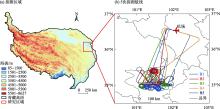
Fig. 1
Observation area and 5 flight detection tracks"

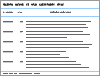
Tab. 1
Overview of the airborne detections on May 18-22, 2020"
| 编号 | 日期/年-月-日 | 飞机起降时间 (北京时) | 天气状况 | 高度 /m | 样本数 /个 | T/°C | RH/% |
|---|---|---|---|---|---|---|---|
| B1 | 2020-05-18 | 13:41—15:26 | 晴 | 2129~7792 | 5554 | -27.84~21.29 | 20~99 |
| B2 | 2020-05-19 | 16:27—18:22 | 多云 | 2126~7772 | 6945 | -22.30~10.67 | 32~94 |
| B3 | 2020-05-20 | 12:20—15:40 | 晴 | 2928~7808 | 11961 | -24.10~19.16 | 1~100 |
| B4 | 2020-05-21 | 08:43—10:35 | 多云 | 2116~7823 | 4727 | -21.74~13.09 | 30~80 |
| B5 | 2020-05-22 | 08:22—10:50 | 晴 | 2116~7834 | 7957 | -30.82~12.31 | 34~87 |
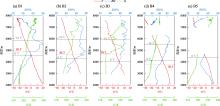
Fig. 2
Average the vertical distribution of T, RH and θv of five aircraft detections"

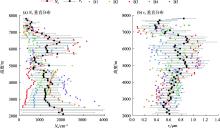
Fig. 3
Vertical distribution of Na and re"

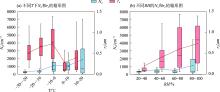
Fig. 4
Box-chart relationship of Na and re for different T and RH"
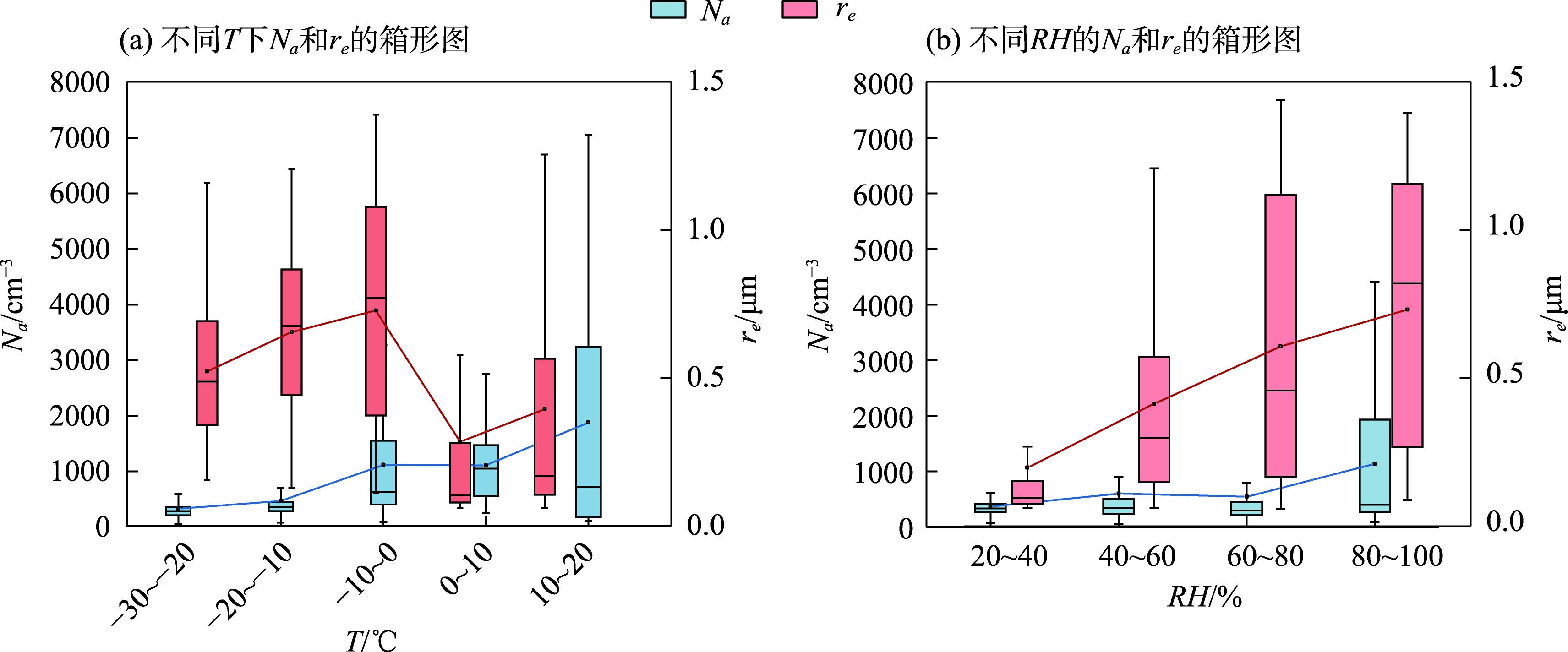
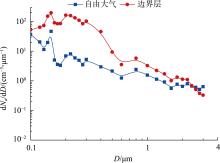
Fig. 5
Spectral distribution of free atmosphere and boundary layer aerosols"
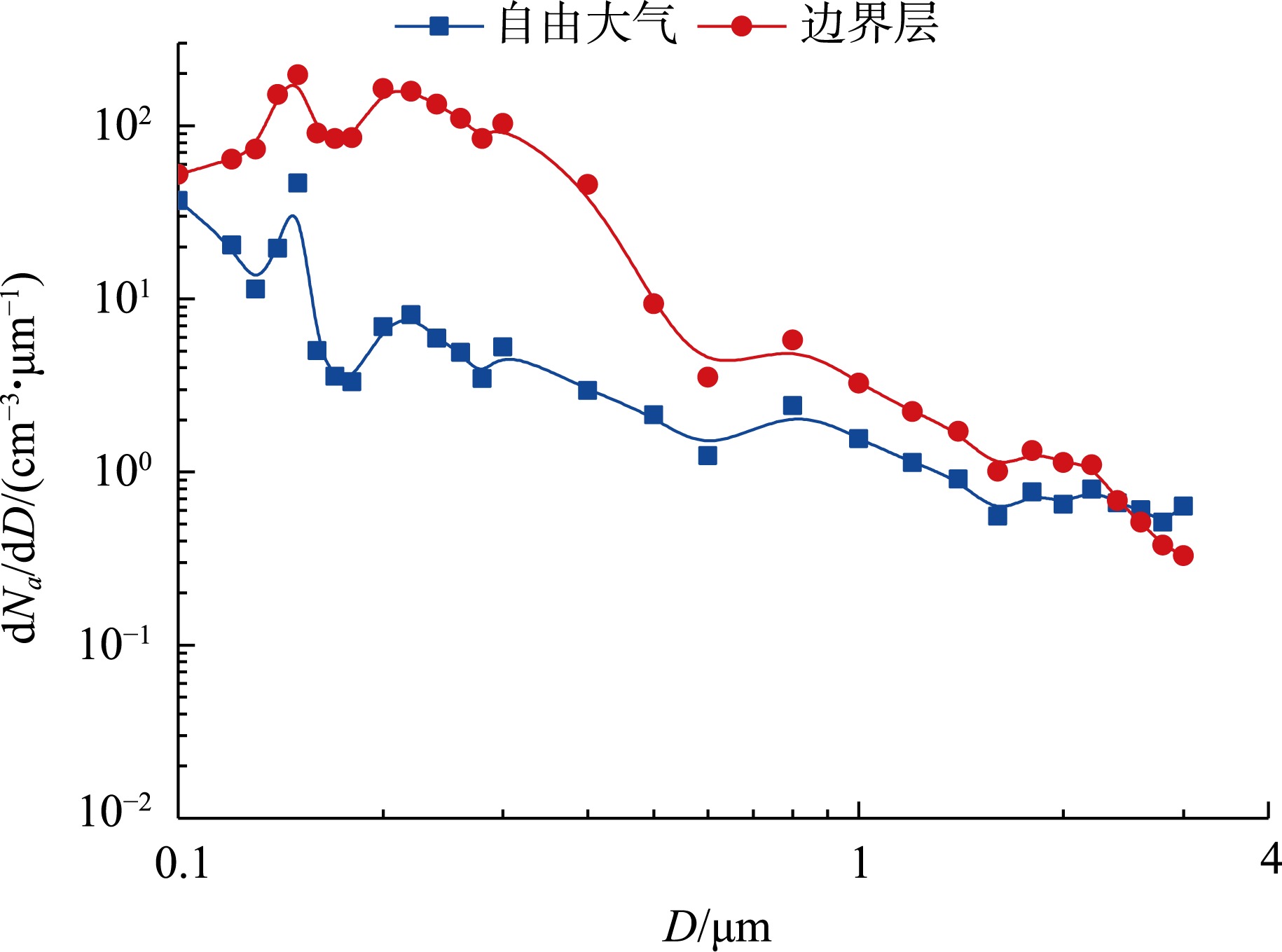
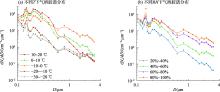
Fig. 6
Spectral distribution of different T and RH aerosols"

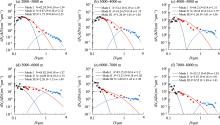
Fig. 7
Logarithmic plus distribution of aerosol spectra of the three modes at different altitudes"

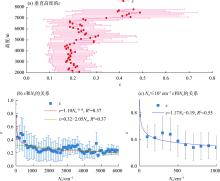
Fig. 8
ε of vertical height and different Na"

| [1] |
Campbell J R, Reid J S, Westphal D, et al. Characterizing the vertical profile of aerosol particle extinction and linear depolarization over southeast asia and the maritime continent: The 2007-2009 view from caliop[J]. Atmospheric Research, 2013, 122(5): 520-543.
doi: 10.1016/j.atmosres.2012.05.007 |
| [2] |
Ma X Y, Yu F Q. Seasonal variability of aerosol vertical profiles over East US and West Europe: GEOS-Chem/APM simulation and comparison with CALIPSO observations[J]. Atmospheric Research, 2014, 140-141: 28-37.
doi: 10.1016/j.atmosres.2014.01.001 |
| [3] | 辛金元, 吴肖燕, 张文煜, 等. 中美大陆区域气溶胶成分消光贡献研究综述[J]. 大气科学, 2024, 48(1): 273-286. |
| [ Xin Jinyuan, Wu Xiaoyan, Zhang Wenyu, et al. A review on the extinction contribution of aerosol components in the United States[J]. Chinese Journal of Atmospheric Sciences, 2024, 48(1): 273-286. ] | |
| [4] |
Hudson J G, Noble S. CCN and vertical velocity influences on droplet concentrations and super saturations in clean and polluted stratus clouds[J]. Journal of the Atmospheric Sciences, 2014, 71(1): 312-331
doi: 10.1175/JAS-D-13-086.1 |
| [5] |
Aberson S D, Black M L, Black R A, et al. Thirty years of tropical cyclone research with the NOAA P-3 aircraft[J]. Bulletin of the American Meteorological Society, 2006, 87(8): 1039-1056.
doi: 10.1175/BAMS-87-8-1039 |
| [6] | Kulmala M, Maso M D, Mäkelä J M, et al. On the formation, growth and composition of nucleation mode particles[J]. Tellus B: Chemical and Physical Meteorology, 2001, 53(B): 479-490. |
| [7] |
Andreae M O, Rosenfeld D. Aerosol-cloud-precipitation interactions. Part 1. The nature and sources of cloud-active aerosols[J]. Earth-Science Reviews, 2008, 89(1-2): 13-41.
doi: 10.1016/j.earscirev.2008.03.001 |
| [8] | Mcfiggans G, Artaxo P, Baltensperger U, et al. The effect of physical and chemical aerosol properties on warm cloud droplet activation[J]. Atmospheric Chemistry and Physics, 2006, 6(9): 2593-2649. |
| [9] | 郭学良, 付丹红, 郭欣, 等. 我国云降水物理飞机观测研究进展[J]. 应用气象学报, 2021, 32(6): 641-652. |
| [ Guo Xueliang, Fu Danhong, Guo Xin, et al. Advances in aircraft measurements of clouds and precipitation in China[J]. Journal of Applied Meteorology and Climatology, 2021, 32(6): 641-652. ] | |
| [10] | Maring H, Savioe D L, Izaguirre M A, et al. Vertical distributions of dust and sea-salt aerosols over Puerto Rico during PRIDE measured from a light aircraft[J]. Geophysical Research Letters, 2003, 108(D19): 8587. |
| [11] |
Fuelberg H E, VanAusdall J D, Browell E V, et al. Meteorological conditions associated with vertical distributions of aerosols off the west coast of Africa[J]. Journal of Geophysical Research: Atmospheres, 1996, 101(D19): 24105-24115.
doi: 10.1029/95JD02889 |
| [12] |
Zhang Q, Ma X C, Tie X X, et al. Vertical distributions of aerosols under different weather conditions: Analysis of in-situ aircraft measurements in Beijing, China[J]. Atmospheric Environment, 2009, 43(34): 5526-5535.
doi: 10.1016/j.atmosenv.2009.05.037 |
| [13] |
Birmili W, Wiedensohler A, Heintzenberg J, et al. Atmospheric particle number size distribution in central Europe: Statistical relations to air masses and meteorology[J]. Journal of Geophysical Research: Atmospheres, 2001, 106(D23): 32005-32018.
doi: 10.1029/2000JD000220 |
| [14] | Wang F, Li Z Q, Ren X R, et al. Vertical distributions of aerosol optical properties during the spring 2016 ARIAs airborne campaign in the North China Plain[J]. Atmospheric Chemistry and Physics Discussions, 2018, 18(12): 1-22. |
| [15] |
付双喜, 亓鹏, 常祎, 等. 祁连山中部一次层状云降水云微物理特征的飞机观测研究[J]. 干旱区研究, 2025, 42(2): 212-222.
doi: 10.13866/j.azr.2025.02.03 |
|
[ Fu Shuangxi, Qi Peng, Chang Yi, et al. Aircraft observation of the cloud microphysical characteristics of stratocumulus precipitation in the Qilian Mountains[J]. Arid Zone Research, 2025, 42(2): 212-222. ]
doi: 10.13866/j.azr.2025.02.03 |
|
| [16] |
Chang Y, Guo X L, Tang J, et al. Aircraft measurement campaign on summer cloud microphysical properties over the Tibetan Plateau[J]. Scientific Reports, 2019, 9(1): 4921.
doi: 10.1038/s41598-019-41381-0 |
| [17] |
Li Y N, Zhang F, Li Z Q, et al. Influences of aerosol physio-chemical properties and new particle formation on CCN activity from observation at a suburban site of China[J]. Atmospheric Research, 2017, 188: 80-89.
doi: 10.1016/j.atmosres.2017.01.009 |
| [18] | 马新成, 毕凯, 王飞, 等. 沙尘暴天气下云的飞机观测研究[J]. 应用气象学报, 2024, 35(3): 323-336. |
| [ Ma Xincheng, Bi Kai, Wang Fei, et al. Cloud observation by aircraft during dust storms[J]. Journal of Applied Meteorological Science, 2024, 35(3): 323-336. ] | |
| [19] |
刘庆芳, 谢佳亮, 张先甜, 等. 青藏高原县域尺度PM2.5浓度时空动态演进特征[J]. 地理学报, 2024, 79(3): 654-671.
doi: 10.11821/dlxb202403007 |
|
[ Liu Qingfang, Xie Jialiang, Zhang Xiantian, et al. Spatio-temporal dynamic evolution of PM2.5 concentrations in the Qinghai-Xizang Plateau ba- sed on county scale[J]. Acta Geographica Sinica, 2024, 79(3): 654-671. ]
doi: 10.11821/dlxb202403007 |
|
| [20] | Feng S, Fu Y F, Xiao Q N. Is the tropopause higher over the Tibetan Plateau? Observational evidence from Constellation Observing System for Meteorology, Ionosphere, and Climate (COSMIC) data[J]. Journal of Geophysical Research Atmospheres, 2011, 116(1): D21121. |
| [21] | Sugimoto S, Ueno K. Formation of mesoscale convective systems over the eastern Tibetan Plateau affected by plateau-scale heating contrasts[J]. Journal of Geophysical Research Atmospheres, 20010, 115: D16105. |
| [22] | 马学谦, 郭学良, 刘娜, 等. 青藏高原中东部气溶胶特征的飞机观测[J]. 应用气象学报, 2021, 32(6): 706-719. |
| [ Ma Xueqian, Guo Xueliang, Liu Na, et al. Aircraft measurements on properties of aerosols over the central and eastern Qinghai-Xizang Plateau[J]. Journal of Applied Meteorological Science, 2021, 32(6): 706-719. ] | |
| [23] | 王启花, 张鹏亮, 王丽霞, 等. 青海格尔木地区大气气溶胶分布的飞机观测[J]. 干旱气象, 2021, 39(4): 603-609. |
| [ Wang Qihua, Zhang Pengliang, Wang Lixia, et al. Aircraft measurements of distribution of aerosol over Golmud in Qinghai Province[J]. Journal of Arid Meteorology, 2021, 39(4): 603-609. ] | |
| [24] |
Yan Y F, Liu Y M, Lu J H. Cloud vertical structure, precipitation, and cloud radiative effects over Tibetan Plateau and its neighboring regions[J]. Journal of Geophysical Research: Atmospheres, 2016, 121(10): 5864-5877.
doi: 10.1002/jgrd.v121.10 |
| [25] |
Huang J, Wang Y, Wang T, et al. Dusty cloud radiative forcing derived from satellite data for middle latitude regions of East Asia[J]. Progress in Natural Science, 2006, 16(10): 1084-1089.
doi: 10.1080/10020070612330114 |
| [26] | 张屹, 陆春松, 张胜龙, 等. 层积云与积云中的微物理特征及其影响因子[J]. 暴雨灾害, 2021, 40(3): 297-305. |
| [ Zhang Yi, Lu Chunsong, Zhang Shenglong, et al. Stratocumulus and cumulus microphysics and the influencing factors[J]. Torrential Rain and Disasters, 2021, 40(3): 297-305. ] | |
| [27] |
Willeke K, Whitby K T. Atmospheric aerosol: Size distribution interpetration[J]. Journal of the Air Pollution Control Association, 1975, 25(5): 529-534.
doi: 10.1080/00022470.1975.10470110 |
| [28] |
Matthias-Maser S, Jaenicke R. The size distribution of primary biological aerosol particles with radii > 0.2 μm in an urban/rural influenced region-science direct[J]. Atmospheric Research, 1995, 39(4): 279-286.
doi: 10.1016/0169-8095(95)00017-8 |
| [29] |
Bessho K, Date K, Hayashi M, et al. An introduction to Himawari-8/9-Japan’s new-generation geostationary meteorological satellites[J]. Journal of the Meteorological Society of Japan, 2016, 94(2): 151-183.
doi: 10.2151/jmsj.2016-009 |
| [30] |
Nakajima T Y, Nakajma T. Wide-area determination of cloud microphysical properties from NOAA AVHRR measurements for FIRE and ASTEX regions[J]. Journal of the Atmospheric Sciences, 1995, 52(23): 4043-4059.
doi: 10.1175/1520-0469(1995)052<4043:WADOCM>2.0.CO;2 |
| [31] |
Kawamoto K, Nakajima T, Nakajima T Y. A global determination of cloud microphysics with AVHRR remote sensing[J]. Journal of Climate, 2001, 14(9): 2054-2068.
doi: 10.1175/1520-0442(2001)014<2054:AGDOCM>2.0.CO;2 |
| [32] | Letu H, Nagao T M, Nakajima T Y, et al. Ice cloud properties from Himawari-8/AHI next-generation geostationary satellite: Capability of the AHI to monitor the DC cloud generation process[J]. Geoscience and Remote Sensing Magazine, 2019, 57(6): 3229-3239. |
| [33] | Draxler R R, Hess G D. An overview of the HYSPLIT 4 modeling system for trajectories, dispersion, and deposition[J]. Australian Meteorological Magazine, 1998, 47(4): 295-308. |
| [34] | Chen J, Wu Z J, Wu G M, et al. Ice-nucleating particle concentration sand sources in rainwater over the third pole, Tibetan Plateau[J]. Journal of Geophysical Research: Atmospheres, 2021, 126(9): e2020JD033864. |
| [35] | 程楠, 黄鹤, 张文煜, 等. 边界层高度的不同诊断方法在京津冀及周边地区的适用性分析[J]. 气候与环境研究, 2024, 29(1): 1-12. |
| [ Cheng Nan, Huang He, Zhang Wenyu, et al. Applicability analysis of different diagnostic methods for boundary layer height in Beijing-Tianjing-Hebei region and its surrounding areas[J]. Climatic and Environmental Research, 2024, 29(1): 1-12. ] | |
| [36] |
Duan J, Chen Y, Guo X L. Characteristics of aerosol activation eficiency and aerosol and CCN vertical distributions in North China[J]. Acta Meteorologica Sinica, 2012, 26(5): 579-596.
doi: 10.1007/s13351-012-0504-6 |
| [37] |
Liu P F, Zhao C S, Liu P F, et al. Aircraft study of aerosol vertical distributions over Beijing and their optical properies[J]. Tellus B: Chemical and Physical Meteorology, 2009, 61(5): 756-767.
doi: 10.1111/j.1600-0889.2009.00440.x |
| [38] |
Yang J F, Lei H C, Li Y H. Airborne observations of cloud condensation nuclei spectra and aerosols over East Inner Mongolia[J]. Advances in Atmospheric Sciences, 2017, 34(8): 1003-1016.
doi: 10.1007/s00376-017-6219-y |
| [39] |
Sun X, Yan Y, Sun Y W, et al. Seasonal and vertical variations in aerosol distribution over Shijiazhuang, China[J]. Atmospheric Environment, 2013, 81: 245-252.
doi: 10.1016/j.atmosenv.2013.08.009 |
| [40] | Shen X J, Sun J Y, Zhang, Y M, et al. First long-term study of particle number size distributions and new particle formation events of regional aerosol in the North China Plain[J]. Atmospheric Chemistry Physics, 2011, 10: 1565-1580. |
| [41] |
Li J X, Yin Y, Li P R, et al. Aircraft measurements of the vertical distribution and activation property of aerosol particles over the Loess Plateau in China[J]. Atmospheric Research, 2015, 155(3): 73-86.
doi: 10.1016/j.atmosres.2014.12.004 |
| [42] |
Zhang Q, Quan J N, Tie X X, et al. Impact of aerosol particles on cloud formation: Aircraft measurements in China[J]. Atmospheric Environment, 2011, 45(3): 665-672.
doi: 10.1016/j.atmosenv.2010.10.025 |
| [43] |
王飞, 陆春松. 云滴谱离散度的理论、观测和数值模拟研究进展[J]. 高原气象, 2023, 42(4): 809-820.
doi: 10.7522/j.issn.1000-0534.2022.00067 |
| [ Wang Fei, Lu Chunsong. Advances of theoretical, observational, and numerical studies on relative dispersion of cloud droplet spectraf[J]. Plateau Meteorology, 2023, 42(4): 809-820. ] | |
| [44] | Zhao C S, Tie X X, Brasseur G, et al. Aircraft measurements of cloud droplet spectral dispersion and implications for indirect aerosol radiative forcing[J]. Geophysical Research Letters, 2006, 33: L16809. |
| [45] |
Wang X F, Xue H W, Fang W, et al. A study of shallow cumulus cloud droplet dispersion by large eddy simulations[J]. Acta Meteorologica Sinica, 2011, 25(2): 166-175.
doi: 10.1007/s13351-011-0024-9 |
| [1] | LI Moyu, DONG Shaorui, GUO Yingxiang. Applicability evaluation of three kinds of precipitation products in eastern Qinghai-Xizang Plateau [J]. Arid Zone Research, 2025, 42(7): 1173-1183. |
| [2] | TIAN Wenjun, XUE Yibo, ZHANG Xiaoxiao, LEI Jiaqiang, LI Shengyu, FAN Jinglong, ZHANG Heng. Study on the vertical distribution and transport of dust aerosols during typical dust weather events in the Tarim Basin, Northwest China in spring, 2021 [J]. Arid Zone Research, 2025, 42(1): 14-26. |
| [3] | GUO Shiyu, ZHANG Yuxin, HAN Huibang, ZHOU Wanfu, KANG Xiaoyan, ZHANG Liyan. Vertical characteristics of raindrop size distribution in a precipitation process in a Three-River Source Region [J]. Arid Zone Research, 2024, 41(3): 353-362. |
| [4] | QIMEI Lamu, ZHENG Cheng, YUAN Liuhuan, WU Peitong, TAN Kai, SHEN Qiaotian, SHI Haijing. Spatial-temporal dynamics of vegetation light use efficiency and its driving factors on the Qinghai-Xizang Plateau [J]. Arid Zone Research, 2024, 41(10): 1731-1739. |
| [5] | PENG Yan-mei, HE Qing, LIU Xin-chun, XIAO Gao-xiang, WEI Zi-jie. Variation Characteristics of Aerosol Scattering Coefficient in Taklimakan Desert [J]. Arid Zone Research, 2015, 32(5): 977-982. |
| [6] | GAO Li-juan,LV Guang-hui,WANG Yun,SU Qian,ZHANG Xue-mei. [J]. , 2014, 31(1): 51-56. |
| [7] | WANG Yuan-Gang, LUO Ge-Ping, FENG Yi-Xing, LI Chao-Fan, HAN Qi-Fei, FAN Bin-Bin. Vertical Distribution of Soil Organic Carbon in Different Land Cover Types in Northern Piedmont of the Tianshan Mountains [J]. , 2013, 30(5): 913-918. |
| [8] | WANG Yong-hui, MA Bei, HAMID Yimit. Soil Salinity in the Riparian Zone in Lower Reaches of the Main Feeding Rivers of the Ebinur Lake [J]. Arid Zone Research, 2013, 30(2): 196-202. |
| [9] | LI Run-chun, ZHANG Xiu-zhi, WANG Li-hua, LV Xin-yan, GAO Yuan. Analysis on Soil Moisture Content in the Middle Reaches of the Yellow River [J]. , 2011, 28(1): 85-91. |
|
||
