
Arid Zone Research ›› 2025, Vol. 42 ›› Issue (7): 1301-1312.doi: 10.13866/j.azr.2025.07.13
• Plant Ecology • Previous Articles Next Articles
ZHANG Jiarong1,2,3( ), ZHAO Jin1,4, LI Haining3,5, GONG Yanming1,3, LIU Yanyan1,3, LIN Jun6, LI Kaihui1,3()
Received:2024-11-27
Revised:2025-04-08
Online:2025-07-15
Published:2025-07-07
Contact:
LI Kaihui
E-mail:zhangjiarong21@mails.ucas.ac.cn;likh@ms.xjb.ac.cn
ZHANG Jiarong, ZHAO Jin, LI Haining, GONG Yanming, LIU Yanyan, LIN Jun, LI Kaihui. Multitemporal extraction of Pedicularis kansuensis in the Bayinbuluk grassland based on UAV images[J].Arid Zone Research, 2025, 42(7): 1301-1312.
Add to citation manager EndNote|Reference Manager|ProCite|BibTeX|RefWorks
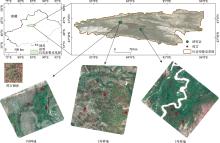
Fig. 1
Location of ground sampling plots and UAV RGB imagery in the Pedicularis kansuensis study area"

Tab. 1
Information of study sites"
| 样地编号 | 样地位置 | 主要物种 | 杂类草 | 其他地物 |
|---|---|---|---|---|
| 1号样地 | 83°44′19.8″E, 42°54′26.7″N, 2470 m | 紫花针茅(Stipa purpurea)、寒生羊茅(Festuca kryloviana)、溚草(Koeleria cristata)、天山赖草(Leymus tianschanicus)、垂穗披碱草(Elymus nutans)、多裂委陵菜(Potentilla multifida)等 | 甘肃马先蒿 (Pedicularis kansuensis) | 裸地 |
| 2号样地 | 83°43′0.5″E, 42°54′2.3″N, 2466 m | 紫花针茅、垂穗披碱草、多裂委陵菜等 | 甘肃马先蒿、新疆假龙胆 (Gentianella turkestanorum) | 裸地河道 |
| 3号样地 | 83°17′2.6″E, 42°42′29.8″N, 2410 m | 垂穗披碱草、多裂委陵菜等 | 甘肃马先蒿、新疆假龙胆 | 裸地河道 |
Tab. 2
Sampling dates of UAV data"
| 1号样地 | 2号样地 | 3号样地 | |
|---|---|---|---|
| 2023年6月中旬 | 6月16日 | 6月16日 | 6月19日 |
| 2023年6月下旬 | 6月30日 | - | 7月3日 |
| 2023年7月中旬 | 7月13日 | 7月13日 | 7月14日 |
| 2023年7月下旬 | 7月23日 | 7月23日 | 7月24日 |
| 2023年8月上旬 | 8月2日 | 8月02日 | 8月6日 |
| 2023年8月中旬 | 8月19日 | 8月19日 | 8月20日 |
| 2023年8月下旬 | 8月30日 | 8月31日 | 8月30日 |
| 2023年9月中旬 | 9月12日 | 9月12日 | 9月8日 |
| 2024年8月 | 8月12日 | 8月21日 | 8月1日 |
Tab. 3
Sample selection in the study area"
| 地物 | 1号样地 | 2号样地 | 3号样地 |
|---|---|---|---|
| 甘肃马先蒿 | 10295 | 3444 | 7284 |
| 其他地物(裸地、多年生草本绿草、枯草、其他) | 60536 | - | - |
| 其他地物(裸地、多年生草本绿草、枯草、河道、其他) | - | 15547 | 22759 |
Tab. 4
Classification accuracy of site 1"
| 分类器 | 时间 | OA/% | PA/% | UA/% | F1-score | Kappa系数 | |||
|---|---|---|---|---|---|---|---|---|---|
| 甘肃马先蒿 | 其他地物 | 甘肃马先蒿 | 其他地物 | ||||||
| SVM | 2023年6月中旬 | 97.19 | 83.34 | 99.52 | 96.70 | 97.26 | 0.9131 | 0.8792 | |
| 2023年6月下旬 | 98.02 | 88.31 | 99.66 | 97.76 | 98.06 | 0.9393 | 0.9165 | ||
| 2023年7月中旬 | 98.23 | 89.71 | 99.66 | 97.79 | 98.29 | 0.9457 | 0.9255 | ||
| 2023年7月下旬 | 99.16 | 95.59 | 99.76 | 98.52 | 99.26 | 0.9744 | 0.9654 | ||
| 2023年8月上旬 | 99.49 | 97.29 | 99.86 | 99.13 | 99.55 | 0.9844 | 0.9790 | ||
| 2023年8月中旬 | 99.58 | 98.24 | 99.80 | 98.82 | 99.70 | 0.9872 | 0.9828 | ||
| 2023年8月下旬 | 99.36 | 96.41 | 99.86 | 99.13 | 99.40 | 0.9806 | 0.9738 | ||
| 2023年9月中旬 | 98.56 | 93.21 | 99.46 | 96.68 | 98.86 | 0.9564 | 0.9407 | ||
| RF | 2023年6月中旬 | 97.36 | 85.04 | 99.43 | 96.20 | 97.53 | 0.9188 | 0.8875 | |
| 2023年6月下旬 | 97.91 | 86.90 | 99.76 | 98.41 | 97.84 | 0.9355 | 0.9110 | ||
| 2023年7月中旬 | 98.14 | 88.63 | 99.74 | 98.30 | 98.12 | 0.9428 | 0.9214 | ||
| 2023年7月下旬 | 99.01 | 93.86 | 99.87 | 99.21 | 98.98 | 0.9697 | 0.9588 | ||
| 2023年8月上旬 | 99.39 | 96.83 | 99.82 | 98.90 | 99.47 | 0.9814 | 0.9750 | ||
| 2023年8月中旬 | 99.43 | 97.13 | 99.81 | 98.87 | 99.52 | 0.9826 | 0.9766 | ||
| 2023年8月下旬 | 99.16 | 95.10 | 99.85 | 99.05 | 99.18 | 0.9745 | 0.9655 | ||
| 2023年9月中旬 | 98.45 | 92.98 | 99.37 | 96.12 | 98.82 | 0.9531 | 0.9362 | ||
Tab. 5
Classification accuracy of site 2"
| 分类器 | 时间 | OA/% | PA/% | UA/% | F1-score | Kappa系数 | |||
|---|---|---|---|---|---|---|---|---|---|
| 甘肃马先蒿 | 其他地物 | 甘肃马先蒿 | 其他地物 | ||||||
| SVM | 2023年6月中旬 | 99.18 | 96.22 | 99.65 | 97.78 | 99.40 | 0.9745 | 0.9652 | |
| 2023年7月中旬 | 99.09 | 96.71 | 99.56 | 97.78 | 99.35 | 0.9746 | 0.9670 | ||
| 2023年7月下旬 | 99.02 | 96.58 | 99.51 | 97.51 | 99.32 | 0.9727 | 0.9646 | ||
| 2023年8月上旬 | 99.48 | 97.67 | 99.84 | 99.17 | 99.54 | 0.9853 | 0.9810 | ||
| 2023年8月中旬 | 99.16 | 97.26 | 99.54 | 97.66 | 99.46 | 0.9765 | 0.9696 | ||
| 2023年8月下旬 | 98.64 | 95.21 | 99.32 | 96.53 | 99.05 | 0.9619 | 0.9505 | ||
| 2023年9月中旬 | 97.77 | 90.00 | 99.32 | 96.33 | 98.04 | 0.9373 | 0.9173 | ||
| RF | 2023年6月中旬 | 99.22 | 97.47 | 99.55 | 97.57 | 99.53 | 0.9776 | 0.9706 | |
| 2023年7月中旬 | 99.21 | 97.57 | 99.57 | 98.05 | 99.47 | 0.9789 | 0.9733 | ||
| 2023年7月下旬 | 99.09 | 96.99 | 99.55 | 97.94 | 99.34 | 0.9756 | 0.9691 | ||
| 2023年8月上旬 | 99.37 | 97.57 | 99.76 | 98.92 | 99.47 | 0.9830 | 0.9786 | ||
| 2023年8月中旬 | 99.19 | 96.80 | 99.72 | 98.71 | 99.30 | 0.9783 | 0.9725 | ||
| 2023年8月下旬 | 98.95 | 95.44 | 99.72 | 98.69 | 99.00 | 0.9717 | 0.9640 | ||
| 2023年9月中旬 | 98.26 | 93.50 | 99.31 | 96.78 | 98.58 | 0.9534 | 0.9406 | ||
Tab. 6
Classification accuracy of site 3"
| 分类器 | 时间 | OA/% | PA/% | UA/% | F1-score | Kappa系数 | |||
|---|---|---|---|---|---|---|---|---|---|
| 甘肃马先蒿 | 其他地物 | 甘肃马先蒿 | 其他地物 | ||||||
| SVM | 2023年6月中旬 | 95.13 | 85.92 | 97.83 | 92.06 | 95.95 | 0.8836 | 0.8577 | |
| 2023年6月下旬 | 97.49 | 93.77 | 98.58 | 95.10 | 98.18 | 0.9399 | 0.9281 | ||
| 2023年7月中旬 | 98.54 | 96.88 | 99.02 | 96.68 | 99.09 | 0.9649 | 0.9583 | ||
| 2023年7月下旬 | 99.25 | 98.07 | 99.60 | 98.65 | 99.43 | 0.9819 | 0.9787 | ||
| 2023年8月上旬 | 99.10 | 97.64 | 99.54 | 98.43 | 99.30 | 0.9784 | 0.9745 | ||
| 2023年8月中旬 | 98.67 | 96.67 | 99.26 | 97.51 | 99.01 | 0.9681 | 0.9622 | ||
| 2023年8月下旬 | 97.41 | 94.52 | 98.25 | 94.06 | 98.39 | 0.9381 | 0.9261 | ||
| 2023年9月中旬 | 93.47 | 84.26 | 96.17 | 86.58 | 95.42 | 0.8469 | 0.8120 | ||
| RF | 2023年6月中旬 | 95.75 | 88.52 | 98.03 | 93.41 | 96.44 | 0.9007 | 0.8813 | |
| 2023年6月下旬 | 97.65 | 94.26 | 98.72 | 95.86 | 98.20 | 0.9448 | 0.9351 | ||
| 2023年7月中旬 | 98.38 | 96.21 | 99.07 | 97.01 | 98.81 | 0.9619 | 0.9554 | ||
| 2023年7月下旬 | 99.32 | 98.20 | 99.68 | 98.97 | 99.43 | 0.9840 | 0.9814 | ||
| 2023年8月上旬 | 99.08 | 97.64 | 99.53 | 98.51 | 99.26 | 0.9782 | 0.9747 | ||
| 2023年8月中旬 | 98.48 | 96.48 | 99.11 | 97.16 | 98.89 | 0.9642 | 0.9582 | ||
| 2023年8月下旬 | 97.35 | 94.86 | 98.13 | 94.12 | 98.38 | 0.9382 | 0.9275 | ||
| 2023年9月中旬 | 94.01 | 85.84 | 96.58 | 88.80 | 95.58 | 0.8619 | 0.8338 | ||
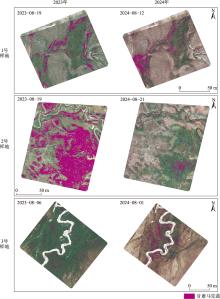
Fig. 2
Spatial distribution of P. kansuensis in the study area in 2023 and 2024"

Tab. 7
Spatial transition matrix of P. kansuensis during 2023-2024"
| 面积/m2 | 1号样地 | 合计 | 2号样地 | 合计 | 3号样地 | 合计 | ||||
|---|---|---|---|---|---|---|---|---|---|---|
| 2024年 | 2024年 | 2024年 | ||||||||
| 甘肃马先蒿 | 其他地物 | 甘肃马先蒿 | 其他地物 | 甘肃马先蒿 | 其他地物 | |||||
| 2023年 | 甘肃马先蒿 | 79.10 | 571.59 | 650.69 | 524.44 | 7732.42 | 8256.87 | 5.37 | 266.21 | 271.58 |
| 其他地物 | 557.78 | 10586.27 | 11144.05 | 253.32 | 13931.63 | 14184.94 | 776.83 | 23522.22 | 24299.05 | |
| 合计 | 636.88 | 11157.86 | 11794.74 | 777.76 | 21664.05 | 22441.81 | 782.20 | 23788.43 | 24570.63 | |
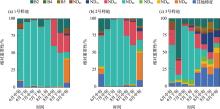
Fig. 3
Temporal changes in relative importance of features"

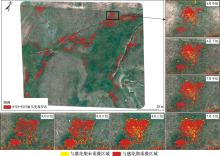
Fig. 4
Spatial overlap of P. kansuensis between different stages and peak flowering stage (mid-August 2023) in site 1"

| [1] |
Vetter V M S, Kreyling J, Dengler J, et al. Invader presence disrupts the stabilizing effect of species richness in plant community recovery after drought[J]. Global Change Biology, 2020, 26(6): 3539-3551.
doi: 10.1111/gcb.15025 pmid: 32011046 |
| [2] | Wang C, Jiang K, Liu J, et al. Moderate and heavy Solidago canadensis L. invasion are associated with decreased taxonomic diversity but increased functional diversity of plant communities in East China[J]. Ecological Engineering, 2018, 112: 55-64. |
| [3] | 阿德力·麦地, 柳妍妍, 古丽努尔, 等. 乌鲁木齐县天然草地毒害植物初步调查及防治对策[J]. 干旱区研究, 2013, 30(6): 1044-1048. |
| [Adeli Maidi, Liu Yanyan, Guli Nuer, et al. Poisonous plants in natural grasslands in Urumqi County and their control measures[J]. Arid Zone Research, 2013, 30(6): 1044-1048.] | |
| [4] |
鞠瑞亭, 李慧, 石正人, 等. 近十年中国生物入侵研究进展[J]. 生物多样性, 2012, 20(5): 581-611.
doi: 10.3724/SP.J.1003.2012.31148 |
|
[Ju Ruiting, Li Hui, Shih Chengjen, et al. Progress of biological invasions research in China over the last decade[J]. Biodiversity Science, 2012, 20(5): 581-611.]
doi: 10.3724/SP.J.1003.2012.31148 |
|
| [5] | Weisberg P J, Dilts T E, Greenberg J A, et al. Phenology-based classification of invasive annual grasses to the species level[J]. Remote Sensing of Environment, 2021, 263: 112568. |
| [6] | Liu X, Liu H, Datta P, et al. Mapping an invasive plant Spartina alterniflora by combining an ensemble one-class classification algorithm with a phenological NDVI time-series analysis approach in middle coast of Jiangsu, China[J]. Remote Sensing, 2020, 12(24): 4010. |
| [7] | Sun C, Li J, Liu Y, et al. Plant species classification in salt marshes using phenological parameters derived from Sentinel-2 pixel-differential time-series[J]. Remote Sensing of Environment, 2021, 256: 112320. |
| [8] | Graenzig T, Fassnacht F E, Kleinschmit B, et al. Mapping the fractional coverage of the invasive shrub Ulex europaeus with multi-temporal Sentinel-2 imagery utilizing UAV orthoimages and a new spatial optimization approach[J]. International Journal of Applied Earth Observation and Geoinformation, 2021, 96: 102281. |
| [9] | Valero-Jorge A, Zayas R G D, Matos-Pupo F, et al. Mapping and monitoring of the invasive species Dichrostachys cinerea (Marabú) in central Cuba using Landsat imagery and machine learning (1994-2022)[J]. Remote Sensing, 2024, 16(5): 798. |
| [10] | Xing F, An R, Guo X, et al. Mapping invasive noxious weed species in the alpine grassland ecosystems using very high spatial resolution UAV hyperspectral imagery and a novel deep learning model[J]. GIScience & Remote Sensing, 2024, 61(1): 2327146. |
| [11] | Innangi M, Marzialetti F, Di Febbraro M, et al. Coastal dune invaders: Integrative mapping of Carpobrotus sp. pl. (Aizoaceae) using UAVs[J]. Remote Sensing, 2023, 15(2): 503. |
| [12] | Zhao J, Li K, Zhang J, et al. Mapping invasive species Pedicularis and background grassland using UAV and machine learning algorithms[J]. Drones, 2024, 8(11): 639. |
| [13] | Yang X, Smith A M, Bourchier R S, et al. Mapping flowering leafy spurge infestations in a heterogeneous landscape using unmanned aerial vehicle Red-Green-Blue images and a hybrid classification method[J]. International Journal of Remote Sensing, 2021, 42(23): 8930-8951. |
| [14] | Valente J, Hiremath S, Ariza-Sentis M, et al. Mapping of Rumex obtusifolius in nature conservation areas using very high resolution UAV imagery and deep learning[J]. International Journal of Applied Earth Observation and Geoinformation, 2022, 112: 102864. |
| [15] | Wijesingha J, Astor T, Schulze-Brueninghoff D, et al. Mapping invasive Lupinus polyphyllus Lindl. in semi-natural grasslands using object-based image analysis of UAV-borne images[J]. PFG-Journal of Photogrammetry, Remote Sensing and Geoinformation Science, 2020, 88(5): 391-406. |
| [16] | Kupková L, Červená L, Potůčková M, et al. Towards reliable monitoring of grass species in nature conservation: Evaluation of the potential of UAV and PlanetScope multi-temporal data in the Central European tundra[J]. Remote Sensing of Environment, 2023, 294: 113645. |
| [17] |
孙法福, 赖宁, 耿庆龙, 等. 基于无人机高光谱影像的冬小麦叶片氮浓度遥感估测[J]. 干旱区研究, 2024, 41(6): 1069-1078.
doi: 10.13866/j.azr.2024.06.15 |
|
[Sun Fafu, Lai Ning, Geng Qinglong, et al. Estimation of nitrogen contentration in winter wheat leaves based on hyperspectral images of UAV[J]. Arid Zone Research, 2024, 41(6): 1069-1078.]
doi: 10.13866/j.azr.2024.06.15 |
|
| [18] | Knapp L S P, Coyle D R, Dey D C, et al. Invasive plant management in eastern North American forests: A systematic review[J]. Forest Ecology and Management, 2023, 550: 121517. |
| [19] | Wang D, Cui B, Duan S, et al. Moving north in China: The habitat of Pedicularis kansuensis in the context of climate change[J]. Science of the Total Environment, 2019, 697: 133979. |
| [20] | 鲍根生, 王宏生. 甘肃马先蒿对高寒地区几种优良牧草的化感作用[J]. 中国草地学报, 2011, 33(2): 88-94. |
| [Bao Gensheng, Wang Hongsheng. Allelopathic effects of Pedicularis kansuensis Maxim. on several graminaceous grass species on alpine meadow[J]. Chinese Journal of Grassland, 2011, 33(2): 88-94.] | |
| [21] | Li H, Gong Y, Fang F, et al. Effects of nutrient addition on Pedicularis kansuensis invasion of alpine grassland[J]. Atmosphere, 2023, 14(2): 367. |
| [22] | Sui X, Kuss P, Li W, et al. Identity and distribution of weedy Pedicularis kansuensis Maxim. (Orobanchaceae) in Tianshan Mountains of Xinjiang: Morphological, anatomical and molecular evidence[J]. Journal of Arid Land, 2016, 8(3): 453-461. |
| [23] | Li W, Huang L, Yang L, et al. Phenotypic plasticity drives the successful expansion of the invasive plant Pedicularis kansuensis in Bayanbulak, China[J]. Diversity, 2023, 15(3): 313. |
| [24] | Wang W, Tang J, Zhang N, et al. Spatiotemporal pattern of invasive Pedicularis in the Bayinbuluke Land, China, during 2019-2021: An analysis based on PlanetScope and Sentinel-2 data[J]. Remote Sensing, 2023, 15(18): 4383. |
| [25] | Wang W, Tang J, Zhang N, et al. Automated detection method to extract Pedicularis based on UAV images[J]. Drones, 2022, 6(12): 399. |
| [26] | Liu Y, Li W, Sui X, et al. An exotic plant successfully invaded as a passenger driven by light availability[J]. Frontiers in Plant Science, 2022, 13: 1047670. |
| [27] | 柳妍妍. 巴音布鲁克草原甘肃马先蒿种群扩张的生态因子研究[D]. 乌鲁木齐: 新疆大学, 2018. |
| [Liu Yanyan. Ecological Factors of Pedicularis kansuensis Maxim. Expansion in Bayanbulak Grassland[D]. Urumqi: Xinjiang University, 2018.] | |
| [28] | Cortes C, Vapnik V. Support-vector networks[J]. Machine Learning, 1995, 20(3): 273-297. |
| [29] | Breiman L. Random forests[J]. Machine Learning, 2001, 45(1): 5-32. |
| [30] |
詹国旗, 杨国东, 王凤艳, 等. 基于特征空间优化的随机森林算法在GF-2影像湿地分类中的研究[J]. 地球信息科学学报, 2018, 20(10): 1520-1528.
doi: 10.12082/dqxxkx.2018.180119 |
| [Zhan Guoqi, Yang Guodong, Wang Fengyan, et al. The random forest classification of wetland from GF-2 imagery based on the optimized feature space[J]. Journal of Geo-information Science, 2018, 20(10): 1520-1528.] | |
| [31] |
Chen X, Ishwaran H. Random forests for genomic data analysis[J]. Genomics, 2012, 99(6): 323-329.
doi: 10.1016/j.ygeno.2012.04.003 pmid: 22546560 |
| [32] |
Strobl C, Boulesteix A L, Zeileis A, et al. Bias in random forest variable importance measures: illustrations, sources and a solution[J]. BMC Bioinformatics, 2007, 8: 25.
pmid: 17254353 |
| [33] | Boulesteix A L, Bender A, Lorenzo Bermejo J, et al. Random forest Gini importance favours SNPs with large minor allele frequency: Impact, sources and recommendations[J]. Briefings in Bioinformatics, 2012, 13(3): 292-304. |
| [34] |
Dronova I, Spotswood E N, Suding K N. Opportunities and constraints in characterizing landscape distribution of an invasive grass from very high resolution multi-spectral imagery[J]. Frontiers in Plant Science, 2017, 8: 890.
doi: 10.3389/fpls.2017.00890 pmid: 28611806 |
| [35] |
高莎, 林峻, 马涛, 等. 新疆巴音布鲁克草原马先蒿光谱特征提取与分析[J]. 遥感技术与应用, 2018, 33(5): 908-914.
doi: 10.11873/j.issn.1004-0323.2018.5.0908 |
| [Gao Sha, Lin Jun, Ma Tao, et al. Extraction and analysis of hyperspectral data and characteristics from Pedicularis on Bayanbulak grassland in Xinjiang[J]. Remote Sensing Technology and Application, 2018, 33(5): 908-914.] | |
| [36] | 李海宁, 柳妍妍, 公延明, 等. 甘肃马先蒿入侵对巴音布鲁克高寒草原凋落物分解的影响[J]. 草原与草坪, 2023, 43(1): 1-11. |
| [Li Haining, Liu Yanyan, Gong Yanming, et al. Effects of Pedicularis kansuensis invasion on litter decomposition in Bayanbulak alpine steppe[J]. Grassland and Turf, 2023, 43(1): 1-11.] | |
| [37] | Hu J, Li K, Deng C, et al. Seed germination ecology of semiparasitic weed Pedicularis kansuensis in alpine grasslands[J]. Plants, 2022, 11(13): 1777. |
| [1] | ZHANG Bin, ZHENG Xinjun, WANG Yugang, TANG Lisong, LI Yan, DU Lan, TIAN Shengchuan. Changes in the salt content of the plow layer soil during cultivation from 1990 to 2022 on the northern slope of the Tianshan Mountains [J]. Arid Zone Research, 2024, 41(9): 1435-1445. |
| [2] | LI Xiaoyu, JIA Keli, WEI Huimin, CHEN Ruihua, WANG Yijing. Prediction of soil salt content based on the random forest algorithm [J]. Arid Zone Research, 2023, 40(8): 1258-1267. |
| [3] | XUE Zhixuan, ZHANG Li, WANG Xinjun, LI Yongkang, ZHANG Guanhong, LI Peiyao. Downscaling analysis of SMAP soil moisture products in Gurbantunggut Desert [J]. Arid Zone Research, 2023, 40(4): 583-593. |
| [4] | XIAO Sentian, Ilyas NURMEMET, Nuerbiye MUHETAER, Zhao Jing, Adilai ABULAITI. Spatial and temporal analysis of soil salinity in Yutian Oasis by combined optical and radar multi-source remote sensing [J]. Arid Zone Research, 2023, 40(1): 59-68. |
| [5] | LIU Huanhuan, CHEN Yin, LIU Yue, GANG Chengcheng. Simulation of spatial pattern and future trends of grassland net primary productivity in the Loess Plateau based on random forest model [J]. Arid Zone Research, 2023, 40(1): 123-131. |
| [6] | ZHU Cunxiong,SHI Feifei,QIAO Bin,ZHANG Juan,CHEN Guoqian. Analysis of Qinghai Lake expansion and lakeside sandy land change characteristics based on GF-1 satellite [J]. Arid Zone Research, 2022, 39(4): 1076-1089. |
| [7] | LIU Chang,ZHANG Hong,ZHANG Xiaoyu,YANG Guoting,LIU Yong. Spatio-temporal evolution and prediction of land use in semi-arid mining areas [J]. Arid Zone Research, 2022, 39(1): 292-300. |
|
||
