
Arid Zone Research ›› 2025, Vol. 42 ›› Issue (11): 2005-2017.doi: 10.13866/j.azr.2025.11.05
• Weather and Climate • Previous Articles Next Articles
WANG Fan1,2,3( ), ZHU Xiaowei1,2,3(), GAO Ruina1,2,3, SUN Yinchuan1,2,3, HUANG Ying1,2,3, JIANG Guoyong1,2,4, LI Jiayao1,2,3, XU Haoyang1,2,3, Liu Yao1,2
Received:2025-03-27
Revised:2025-09-15
Online:2025-11-15
Published:2025-12-13
Contact:
ZHU Xiaowei
E-mail:wangfan922@126.com;zhxw1029@163.com
WANG Fan, ZHU Xiaowei, GAO Ruina, SUN Yinchuan, HUANG Ying, JIANG Guoyong, LI Jiayao, XU Haoyang, Liu Yao. Numerical simulation study on the impact of typical trban lakes in arid regions on local climate effects[J].Arid Zone Research, 2025, 42(11): 2005-2017.
Add to citation manager EndNote|Reference Manager|ProCite|BibTeX|RefWorks
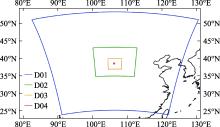
Fig. 1
Four-level nested grid domain constructed in the WRF_CLM model"
Tab. 1
Parameter configuration of the WRF_CLM model"
| 参数 | D01 | D02 | D03 | D04 |
|---|---|---|---|---|
| 水平分辨率 | 9 km | 3 km | 1 km | 333 m |
| 微物理方案 | WRF Double-moment 6-class scheme | |||
| 长波辐射 | RRTM scheme | |||
| 短波辐射 | Dudhia scheme | |||
| 陆面过程 | CLM 4.0 | |||
| 边界层 | YSU scheme | |||
| 近地面方案 | Revised MM5 surface layer scheme | |||
| 积云方案 | 无 | |||
| 湖泊方案 | CLM 4.5 lake model | |||
| 地形 | 24-category USGS-based land use data | |||
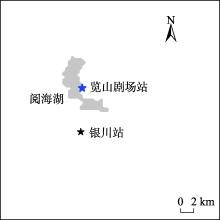
Fig. 2
Distribution range of Yuehai Lake"

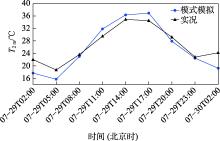
Fig. 3
Comparison of observed and model-simulated temperature evolution at Yinchuan Station from 02:00 on July 29 to 02:00 on July 30, 2021"

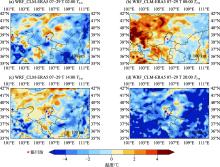
Fig. 4
Difference distribution of the 2 m temperature field in the simulated nested domain of the second layer in the model and ERA5 reanalysis data on July 29, 2021"

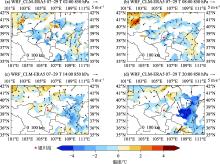
Fig. 5
Difference distribution of the 850 hPa temperature field (unit: ℃) and wind field (unit: m·s-1) in the simulated nested domain of the second layer in the model and ERA5 reanalysis data on July 29, 2021"

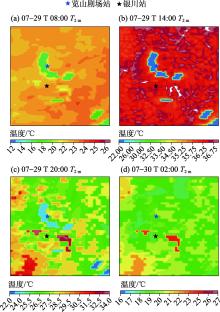
Fig. 6
Spatial distribution of 2 m temperature in the simulated nested domain of the fourth layer in the model from July 29 to 30, 2021"

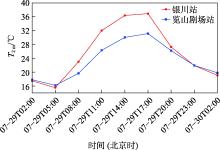
Fig. 7
Temporal variation sequence of 2 m temperature in the simulated nested domain of the fourth layer in the model from July 29 to 30, 2021"
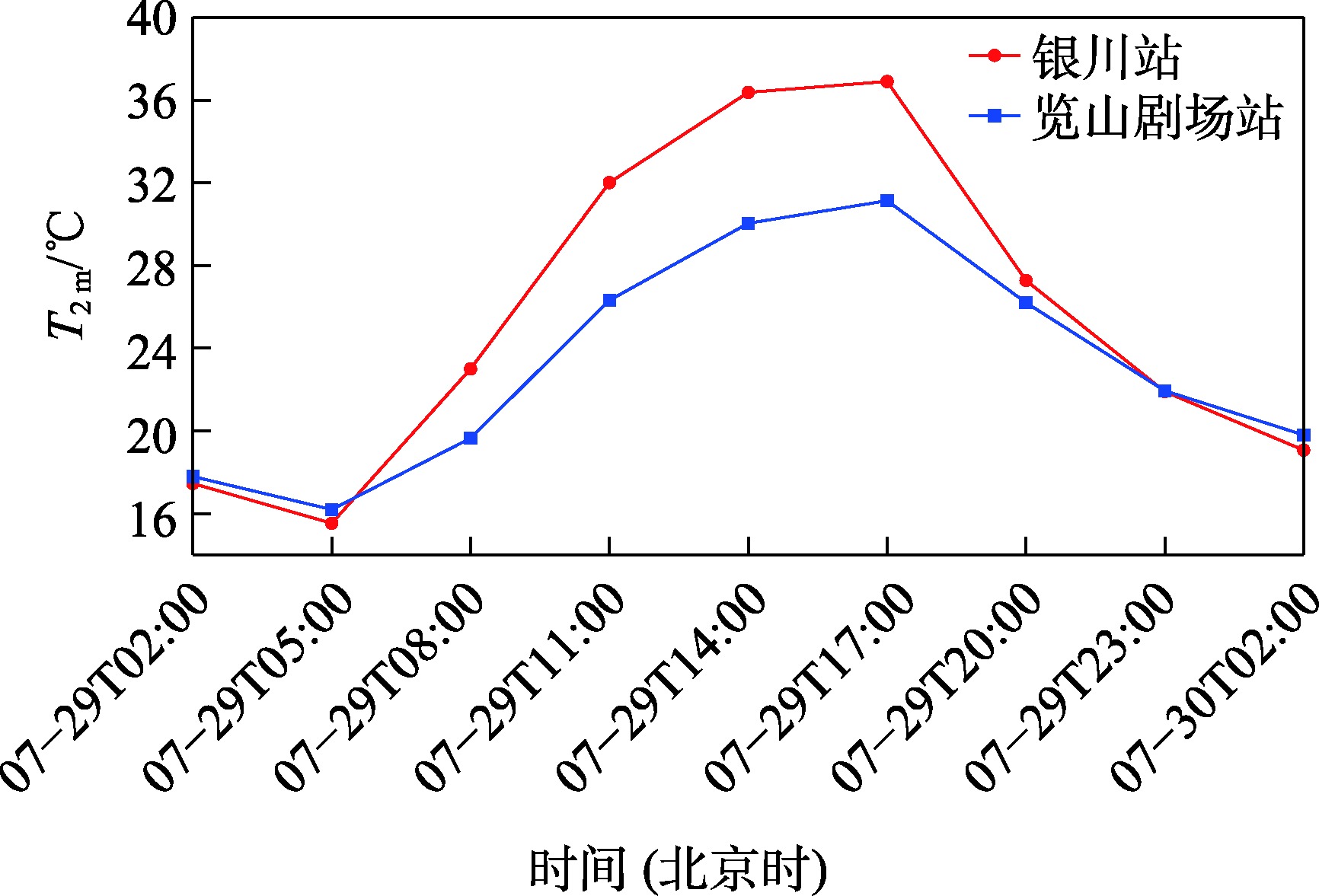
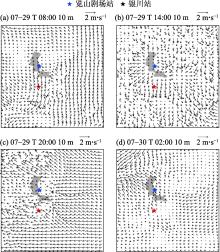
Fig. 8
Spatial distribution of 10 m wind speed in the simulated nested domain of the fourth layer in the model on July 29, 2021"

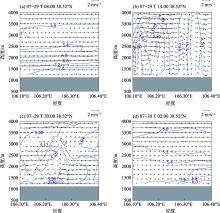
Fig. 9
Meridional cross-sectional distribution of wind speed (vector arrows, unit: m·s-1)and specific humidity (blue lines, unit: g·kg-1) along 38.52°N in the simulated nested domain of the fourth layer in the model"

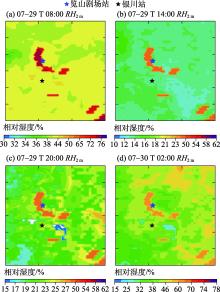
Fig. 10
Spatial distribution of relative humidity in the fourth-layer simulated nested domain on July 29, 2021"

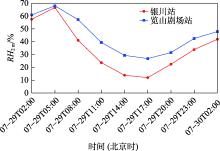
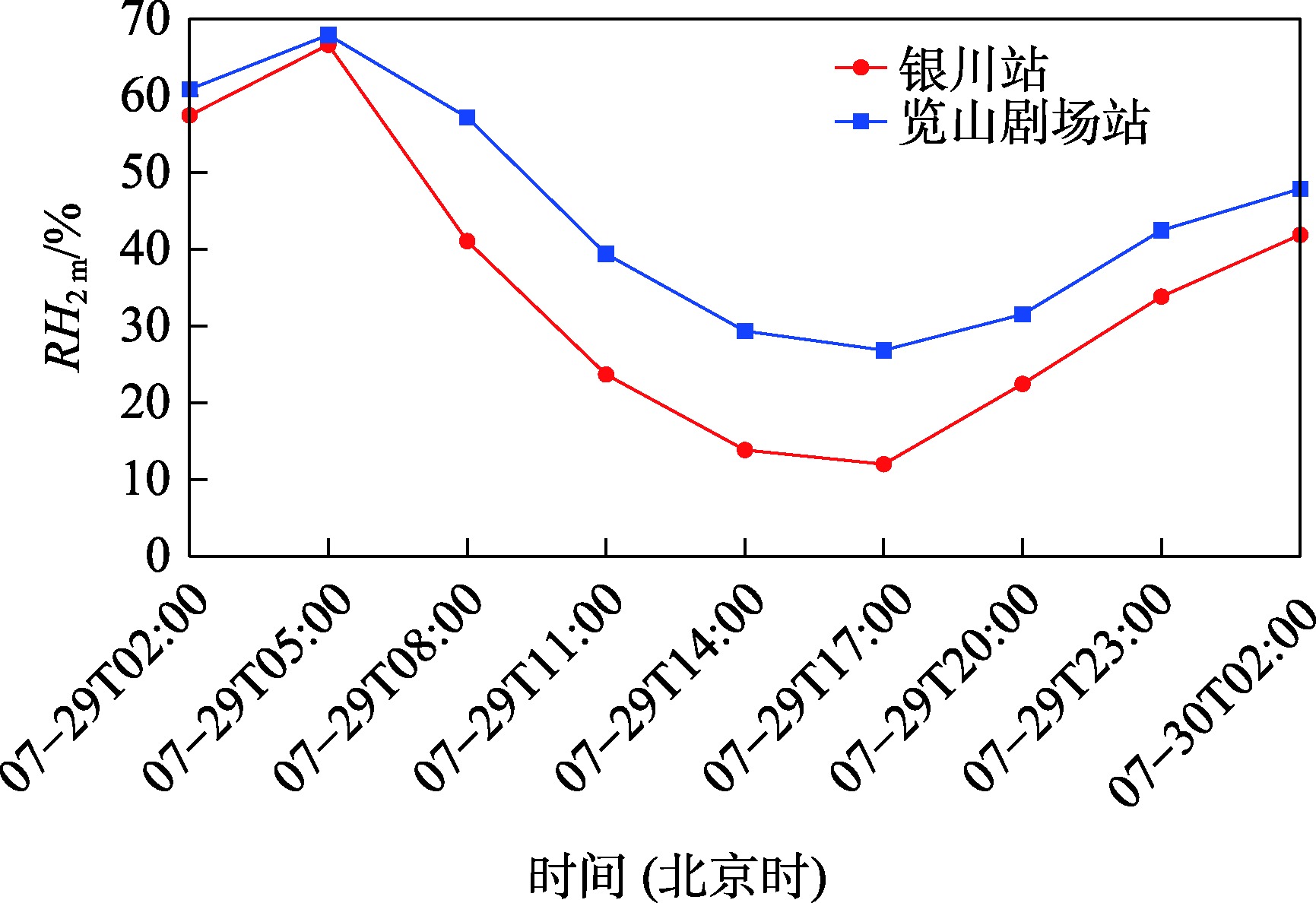
Fig. 11
Time series of 2 m relative humidity and temperature in the simulated nested domain of the fourth layer from July 29 to 30, 2021"
| [1] | Ke C Q. A review of monitoring lake environment change by means of remote sensing[J]. Transactions of Oceanology and Limnology, 2004, 23(4): 81-86. |
| [2] |
Changnon S A, Jones D. Review of the influences of the Great Lakes on weather[J]. Water Resources Research, 1972, 8(2): 360-371.
doi: 10.1029/WR008i002p00360 |
| [3] | Eerola K, Rontu L, Kourzeneva E, et al. A study on lake temperature and ice cover in HIRLAM[J]. Boreal Environment Research, 2010, 15: 130-142. |
| [4] |
MacKay M D, Neale P J, Arpe K D. Modeling lakes and reservoirs in the climate system[J]. Limnology and Oceanography, 2009, 54(6): 2315-2329.
doi: 10.4319/lo.2009.54.6_part_2.2315 |
| [5] | Samuelsson P, Kourzeneva E, Mironov D. The impact of lakes on the European climate as simulated by a regional climate model[J]. Boreal Environment Research, 2010, 15: 113-129. |
| [6] | Subin Z M, Riley W J, Mironov D. An improved lake model for climate simulations: Model structure, evaluation, and sensitivity analyses in CESM1[J]. Journal of Advances in Modeling Earth Systems, 2012, 4(2): M02001. |
| [7] |
Ballentine R J. Numerical simulation of landbreezeinduced snow bands along the western shore of Lake Michigan[J]. Monthly Weather Review, 1982, 110(10): 1544-1553.
doi: 10.1175/1520-0493(1982)110<1544:NSOLBI>2.0.CO;2 |
| [8] |
Theeuwes N E, Solcerova A, Steeneveld G J. Modeling the influence of open water surfaces on the summertime temperature and thermal comfort in the city[J]. Journal of Geophysical Research: Atmospheres, 2013, 118(16): 8881-8896.
doi: 10.1002/jgrd.v118.16 |
| [9] | 李维亮, 秦瑜. 长江三角洲城市热岛与太湖对局地环流影响的分析研究[J]. 中国科学(D辑), 2003, 33(2): 97-104. |
| [ Li Weiliang, Qin Yu. Analysis of the impact of urban heat island and Taihu Lake on local circulation in the Yangtze River Delta[J]. Science in China Series D: Earth Sciences, 2003, 33(2): 97-104. ] | |
| [10] | Keeler J M, Kristovich D A R. Observations of urban heat island influence on lakebreeze frontal movement[J]. Journal of Applied Meteorology and Climatology, 2015, 54(4): 702-710. |
| [11] | 唐滢. 夏季太湖局地气候效应的数值模拟研究[J]. 气象科学, 2016, 36(5): 610-617. |
| [ Tang Ying. Numerical simulation study on the local climate effect of Taihu Lake in summer[J]. Journal of the Meteorological Sciences, 2016, 36(5): 610-617. ] | |
| [12] | 任侠. 太湖对局地气象环境影响的模拟研究[D]. 南京: 南京信息工程大学, 2017. |
| [ Ren Xia. Simulation Study on the Impact of Taihu Lake on Local Meteorological Environment[D]. Nanjing: Nanjing University of Information Science and Technology, 2017. ] | |
| [13] |
王澄海, 孙超. 一个基于WRF+CLM区域气候模式(WRFC)的建立及初步试验[J]. 高原气象, 2013, 32(6): 1626-1637.
doi: 10.7522/j.issn.1000-0534.2013.00021 |
| [ Wang Chenghai, Sun Chao. Development and preliminary test of a regional climate model based on WRF+CLM (WRFC)[J]. Plateau Meteorology, 2013, 32(6): 1626-1637. ] | |
| [14] |
Wang Y, Leung L R, McGregor J L, et al. Regional climate modeling: Progress, challenges, and prospects[J]. Journal of the Meteorological Society of Japan, 2004, 82(6): 1599-1628.
doi: 10.2151/jmsj.82.1599 |
| [15] | Huang A N, Zhang Y C. The impact of BATS land surface scheme on the performance of a ninelayer regional climate model[J]. Advances in Atmospheric Sciences, 2007, 24(1): 155-166. |
| [16] | Chen B L, Lyu S H, Luo S Q. Numerical simulation study of land surface processes at Maqu station on the Tibetan Plateau using CLM 3.5 model[J]. Plateau Meteorology, 2012, 31(6): 1511-1522. |
| [17] | 邢雯雯, 孙绩华, 刘辉志, 等. 高黎贡山复杂地形下局地环流的数值模拟研究[J]. 大气科学, 2021, 45(4): 746-758. |
| [ Xing Wenwen, Sun Jihua, Liu Huizhi, et al. Numerical simulation of local circulation under complex terrain of Gaoligong Mountain[J]. Chinese Journal of Atmospheric Sciences, 2021, 45(4): 746-758. ] | |
| [18] | 许鲁君, 刘辉志, 曹杰. 大理苍山-洱海局地环流的数值模拟[J]. 大气科学, 2014, 38(6): 1198-1210. |
| [ Xu Lujun, Liu Huizhi, Cao Jie. Numerical simulation of local circulation over Cangshan Mountain and Erhai Lake in Dali[J]. Chinese Journal of Atmospheric Sciences, 2014, 38(6): 1198-1210. ] | |
| [19] |
苏东生, 文莉娟, 赵林, 等. 青海湖夏秋季局地气候效应数值模拟研究[J]. 高原气象, 2019, 38(5): 944-958.
doi: 10.7522/j.issn.1000-0534.2018.00125 |
|
[ Su Dongsheng, Wen Lijuan, Zhao Lin, et al. Numerical simulation of local climate effects over Qinghai Lake in summer and autumn[J]. Plateau Meteorology, 2019, 38(5): 944-958. ]
doi: 10.7522/j.issn.1000-0534.2018.00125 |
|
| [20] |
宋兴宇, 文莉娟, 李茂善, 等. 不同湖泊模式对青藏高原典型湖泊适用性对比研究[J]. 高原气象, 2020, 39(2): 213-225.
doi: 10.7522/j.issn.1000-0534.2019.00102 |
|
[ Song Xingyu, Wen Lijuan, Li Maoshan, et al. Comparative study on the applicability of different lake models to typical lakes over the Tibetan Plateau[J]. Plateau Meteorology, 2020, 39(2): 213-225. ]
doi: 10.7522/j.issn.1000-0534.2019.00102 |
|
| [21] | 许鲁君, 刘辉志. 云贵高原洱海湖泊效应的数值模拟[J]. 气象学报, 2015, 73(4): 789-802. |
| [ Xu Lujun, Liu Huizhi. Numerical simulation of the lake effect of Erhai Lake on the YunnanGuizhou Plateau[J]. Acta Meteorologica Sinica, 2015, 73(4): 789-802. ] | |
| [22] | 张达, 冯顺新, 郭红民, 等. 云南高原异龙湖冬季典型日湖面风场特征及其形成机制[J/OL]. 中国水利水电科学研究学报(中英文), 1-18. [2024-12-02]. https://doi.org/10.13244/j.cnki.jiwhr.20240-215. |
| [ Zhang Da, Feng Shunxin, Guo Hongmin, et al. Characteristics and formation mechanisms of typical winter daily surface wind fields over Yilong Lake on the Yunnan Plateau[J/OL]. Journal of China Institute of Water Resources and Hydropower Research (Chinese and English), 1-18. [2024-12-02]. https://doi.org/10.13244/j.cnki.jiwhr.20240-215. ] | |
| [23] | 田宇. 夏季静稳天气下大型城中湖气候调节服务功能模拟研究——以武汉东湖为例[D]. 武汉: 华中农业大学, 2023. |
| [ Tian Yu. Simulation of Climate Regulation Services of Large Urban Lakes under Summer Stagnant Weather: A Case Study of Wuhan East Lake[D]. Wuhan: Huazhong Agricultural University, 2023. ] | |
| [24] |
杨显玉, 吕雅琼, 文军, 等. 扎陵湖和鄂陵湖夏季典型地表水热交换特征的数值模拟[J]. 高原气象, 2022, 41(1): 143-152.
doi: 10.7522/j.issn.1000-0534.2020.00090 |
|
[ Yang Xianyu, Lyu Yaqiong, Wen Jun, et al. Numerical simulation of typical surface water and heat exchange characteristics over the Gyaring Lake and Ngoring Lake in summer[J]. Plateau Meteorology, 2022, 41(1): 143-152. ]
doi: 10.7522/j.issn.1000-0534.2020.00090 |
|
| [25] | 吴昌广, 谢婧, 成雅田, 等. 武汉市局地次级湖风环流特征模拟及其降温效应分析[J]. 西部人居环境学刊, 2022, 37(6): 126-134. |
| [ Wu Changguang, Xie Jing, Cheng Yatian, et al. Simulation of local secondary lake breeze circulation characteristics and cooling effect analysis in Wuhan[J]. Journal of Human Settlements in West China, 2022, 37(6): 126-134. ] | |
| [26] | 傅敏宁. 鄱阳湖对典型天气过程的影响及近地面边界层特征研究[D]. 南京: 南京信息工程大学, 2013. |
| [ Fu Minning. Study on the Impact of Poyang Lake on Typical Weather Processes and Characteristics of Nearsurface Boundary Layer[D]. Nanjing: Nanjing University of Information Science and Technology, 2013. ] | |
| [27] | 覃海润. 太湖湖风环流时空分布特征及与城市热岛的相互影响[D]. 南京: 南京信息工程大学, 2015. |
| [ Qin Hairun. Spatial and Temporal Characteristics of Lake Breeze Circulation over Taihu Lake and Its Interaction with Urban Heat Island[D]. Nanjing: Nanjing University of Information Science and Technology, 2015. ] | |
| [28] |
高睿娜, 朱晓炜, 王璠, 等. 银川城市热岛效应演变及湖泊湿地降温效果评估[J]. 干旱气象, 2025, 43(1): 97-103.
doi: 10.11755/j.issn.1006-7639-2025-01-0097 |
| [ Gao Ruina, Zhu Xiaowei, Wang Fan, et al. Evolution of urban heat island effects and cooling efficiency assessment of lake wetlands in Yinchuan[J]. Arid Meteorology, 2025, 43(1): 97-103. ] | |
| [29] | 庄晓林, 段玉侠, 金荷仙. 城市风景园林小气候研究进展[J]. 中国园林, 2017(33): 23-28. |
| [ Zhuang Xiaolin, Duan Yuxia, Jin Hexian. Advances in microclimate research of urban landscape architecture[J]. Chinese Landscape Architecture, 2017(33): 23-28. ] | |
| [30] |
Hersbach H, Bell B, Berrisford P, et al. The ERA5 global reanalysis[J]. Quarterly Journal of the Royal Meteorological Society, 2020, 146(730): 1999-2049.
doi: 10.1002/qj.v146.730 |
| [31] | Subin Z M, Riley W J, Jin J, et al. Ecosystem feedbacks to climate change in California: Development, testing, and analysis using a coupled regional atmosphere and land surface model (WRF3-CLM3.5)[J]. Earth Interactions, 2011, 15: 1-38. |
| [32] | Hostetler S W, Bartlein P J. Simulation of lake evaporation with application to modeling lake level variations of HarneyMalheur Lake, Oregon[J]. Water Resources Research, 1990, 26(10): 2603-2612. |
| [33] | Oleson K, Dai Y, Bonan G B, et al. Technical Description of the Community Land Model (CLM)[R]. NCAR Technical Note NCAR/TN-461+STR, 2004. |
| [34] | Skamarock W, Klemp J B, Dudhia J, et al. A Description of the Advanced Research WRF Version 3[R]. NCAR Technical Note NCAR/TN-475+STR, 2008. |
| [35] |
王腾蛟, 张镭, 胡向军, 等. WRF模式对黄土高原丘陵地形条件下夏季边界层结构的数值模拟[J]. 高原气象, 2013, 32(5): 1261-1271.
doi: 10.7522/j.issn.1000\|0534.2012.00121 |
| [ Wang Tengjiao, Zhang Lei, Hu Xiangjun, et al. Numerical simulation of summer boundary layer structure over hilly terrain conditions on the Loess Plateau using the WRF model[J]. Plateau Meteorology, 2013, 32(5): 1261-1271. ] | |
| [36] |
Peterson T C, Owen T W. Urban heat island assessment: Metadata are important[J]. Journal of Climate, 2005, 18(14): 2637-2646.
doi: 10.1175/JCLI3431.1 |
| [37] | 赵英时. 遥感应用分析原理与方法[M]. 北京: 科学出版社, 2003: 194-199. |
| [ Zhao Yingshi. Principles and Methods of Remote Sensing Application Analysis[M]. Beijing: Science Press, 2003: 194-199. ] | |
| [38] | 李婷婷, 赵聆言, 关艺蕾, 等. 城市湖泊湿地周边建成环境温湿效应的时空分布特征——以武汉16个湖泊湿地为例[J]. 中国园林, 2021, 37(3): 106-111. |
| [ Li Tingting, Zhao Lingyan, Guan Yilei, et al. Spatiotemporal distribution characteristics of temperature and humidity effects of built environment around urban lake wetlands: A case study of 16 lake wetlands in Wuhan[J]. Chinese Landscape Architecture, 2021, 37(3): 106-111. ] | |
| [39] | 张伟, 陈存友, 胡希军, 等. 基于计算机流体力学的城市近郊湖泊“湿岛效应”情景模拟研究: 以长沙市同升湖为例[J]. 生态与农村环境学报, 2022, 38(5): 670-680. |
| [ Zhang Wei, Chen Cunyou, Hu Xijun, et al. Simulation of “wet island effect” of urban suburban lakes based on computational fluid dynamics: A case study of Tongsheng Lake in Changsha[J]. Journal of Ecology and Rural Environment, 2022, 38(5): 670-680. ] | |
| [40] | Zhou X, Li Y, Guo W D, et al. On the Role of Soil Moisture in the Persistence of Cold Anomalies over Arid Regions[J]. Journal of Geophysical Research: Atmospheres, 2013, 118(12): 5928-5941. |
| [41] | Li Y, Lu H, Yang K, et al. Improving NoahMP for simulating surface heat fluxes and soil temperature in arid regions[J]. Journal of Advances in Modeling Earth Systems, 2019, 11(7): 2139-2160. |
| [42] | Li Z, Leng P, Zhou C, et al. Enhanced representation of land surface emissivity improves nocturnal warming simulation in deserts[J]. Geoscientific Model Development, 2021, 14(3): 1497-1514. |
| [43] | Li X, Barlage M, Chen F, et al. Diagnosing nocturnal boundary layer overestimation over deserts in WRF using GOESR LST[J]. Journal of Geophysical Research: Atmospheres, 2023, 128(5): e2022JD038102. |
| [44] |
张嘉荣, 程雪玲. 基于CFD降尺度的复杂地形风场数值模拟研究[J]. 高原气象, 2020, 39(1): 172-184.
doi: 10.7522/j.issn.1000-0534.2019.00005 |
|
[ Zhang Jiarong, Cheng Xueling. Numerical simulation of wind field in complex terrain based on CFD downscaling[J]. Plateau Meteorology, 2020, 39(1): 172-184. ]
doi: 10.7522/j.issn.1000-0534.2019.00005 |
| [1] | HUO Wenting, GU Tianqi, GAO Mengyu, SONG Yanfang, LI Hongbin, ZHUO Lu. Analysis of the expression patterns of the heat-resistant gene of Syntrichia caninervis under different abiotic stresses based on RT-qPCR technology [J]. Arid Zone Research, 2025, 42(5): 885-894. |
| [2] | WANG Dai,WANG Suyan,WANG Fan,LI Xin,YANG Jianling. Characteristics of summer extremely high temperature in Ningxia in connection with Arctic sea ice [J]. Arid Zone Research, 2021, 38(5): 1285-1294. |
| [3] | LI Bo, CHEN Ting, WANG Nan, HUA Deng-xin, WANG Qian. Extremely High Temperature and Circulation Features in Xi'an in 2017 and 2014 [J]. Arid Zone Research, 2019, 36(3): 645-656. |
| [4] | ZHAO Shu-man, ZUO Hong-chao, WEI Xiang-qian, YANG Bin, WU Li-yang, WANG Shi-xin. Numerical Simulation of Climate Effect in East Asia by Plastic Film Mulching Farmland in Arid Area [J]. Arid Zone Research, 2018, 35(6): 1363-1372. |
| [5] | MA Ji-Hong, 吕Zhao-Zhi , GAO Gui-Zhen, XIA De-Ping. Impacts of Different Temperature Conditions on Population Crash of Aphis gossypii in Midsummer [J]. , 2012, 29(2): 369-374. |
|
||
