
Arid Zone Research ›› 2025, Vol. 42 ›› Issue (7): 1184-1195.doi: 10.13866/j.azr.2025.07.03
• Weather and Climate • Previous Articles Next Articles
NIU Jin1( ), LIU Yahong2, Bao Gang1(), YUAN Zhihui3, TONG Siqin1, Chao buga1
Received:2025-03-17
Revised:2025-05-09
Online:2025-07-15
Published:2025-07-07
Contact:
Bao Gang
E-mail:18547419961@163.com;baogang@imnu.edu.cn
NIU Jin, LIU Yahong, Bao Gang, YUAN Zhihui, TONG Siqin, Chao buga. Response of snowmelt over the Mongolian Plateau to air temperature[J].Arid Zone Research, 2025, 42(7): 1184-1195.
Add to citation manager EndNote|Reference Manager|ProCite|BibTeX|RefWorks
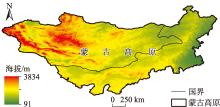
Fig. 1
Map of research area"

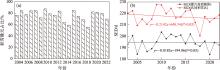
Fig. 2
Proportion of snow on the Mongolian Plateau to the total area of the plateau from 2003 to 2022 (a) and interannual variation of SED on the Mongolian Plateau (b)"
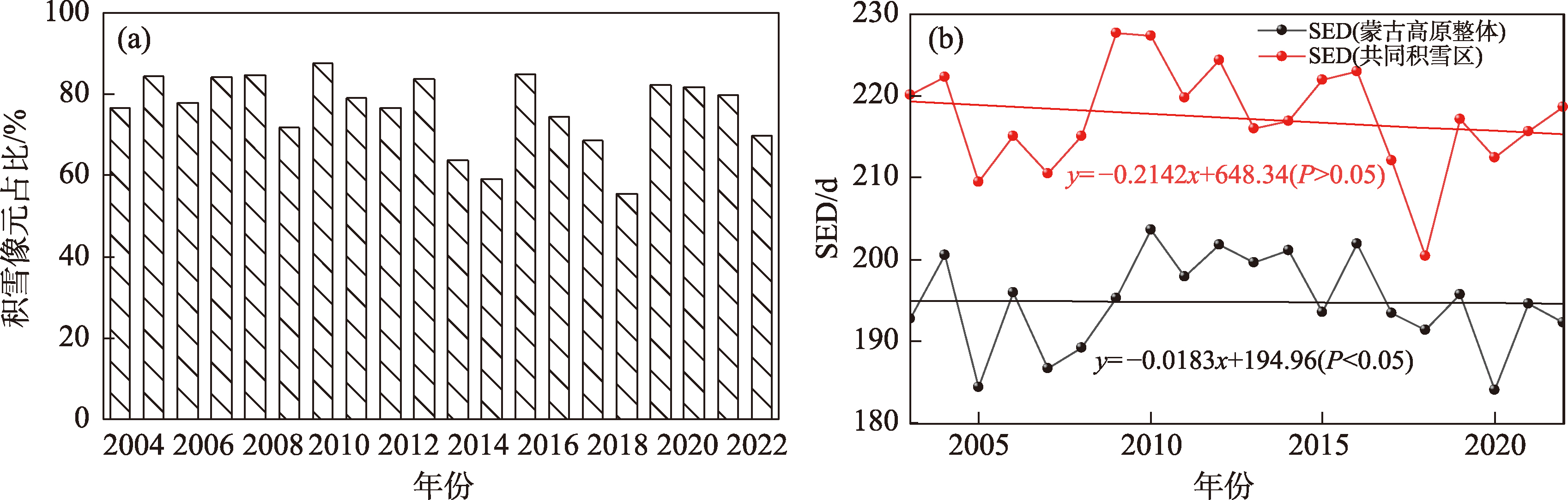
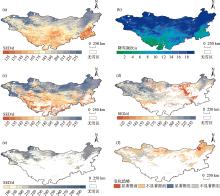
Fig. 3
Spatial distribution of multi-year average SED and corresponding snowfall frequency (a-b) over the Mongolian Plateau from 2003 to 2022, spatial distributions of SED in 2009 and 2018 (c-d), and multi-year average SED and its variation trend in the stable snow-covered area (e-f)"

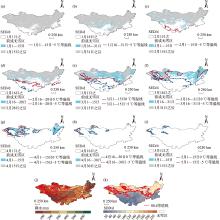
Fig. 4
Spatial distribution characteristics of SED in the Mongolian Plateau over the past 20 years at 15-day intervals, along with the -5 ℃ and 0 ℃ isotherms (a-i), as well as the annual cumulative precipitation (j) and SDD spatial distribution (k)"

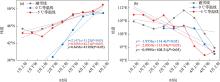
Fig. 5
Movement of the snow-melt line, as well as the 0 ℃ and -5 ℃ isotherms, in latitude (a) and longitude (b) every half-month"

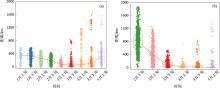
Fig. 6
Geographical distance between the snow-melt line and the adjacent -5 ℃ (a) and 0 ℃ (b) isotherms every half-month"

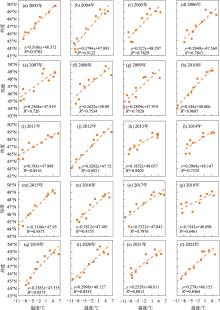
Fig. 7
Correlation between the semi-monthly mean air temperature and the latitude of the snow-melt line in the Mongolian Plateau from 2003 to 2022"

| [1] | Barnett T P, Adam J C, Lettenmaier D P. Potential impacts of a warming climate on water availability in snow-dominated regions[J]. Nature, 2005, 438(7066): 303-309. |
| [2] | Samset B H, Zhou C, Fuglestvedt J S, et al. Steady global surface warming from 1973 to 2022 but increased warming rate after 1990[J]. Communications Earth & Environment, 2023, 4(1): 400. |
| [3] | Lee H, Calvin K, Dasgupta D, et al. IPCC, 2023: Climate Change 2023: Synthesis Report, Summary for Policymakers[R]. Contribution of Working Groups I, II and III to the Sixth Assessment Report of the Intergovernmental Panel on Climate Change. IPCC, Geneva, Switzerland, 2023: 1-34. |
| [4] | Hayhoe K, Wake C P, Huntington T G, et al. Past and future changes in climate and hydrological indicators in the US Northeast[J]. Climate Dynamics, 2007, 28: 381-407. |
| [5] | Choi G, Robinson D A, Kang S. Changing northern hemisphere snow seasons[J]. Journal of Climate, 2010, 23(19): 5305-5310. |
| [6] | Notaro M, Lorenz D, Hoving C, et al. Twenty-first-century projections of snowfall and winter severity across central-eastern North America[J]. Journal of Climate, 2014, 27(17): 6526-6550. |
| [7] | Berghuijs W R, Woods R A, Hrachowitz M. A precipitation shift from snow towards rain leads to a decrease in streamflow[J]. Nature Climate Change, 2014, 4(7): 583-586. |
| [8] |
Niittynen P, Heikkinen R K, Luoto M. Snow cover is a neglected driver of Arctic biodiversity loss[J]. Nature Climate Change, 2018, 8(11): 997-1001.
doi: 10.1038/s41558-018-0311-x |
| [9] | Dye D G. Variability and trends in the annual snow-cover cycle in Northern Hemisphere land areas, 1972-2000[J]. Hydrological processes, 2002, 16(15): 3065-3077. |
| [10] | Peng S, Piao S, Ciais P, et al. Change in snow phenology and its potential feedback to temperature in the Northern Hemisphere over the last three decades[J]. Environmental Research Letters, 2013, 8(1): 014008. |
| [11] | Chen X, An S, Inouye D W, et al. Temperature and snowfall trigger alpine vegetation green-up on the world’s roof[J]. Global Change Biology, 2015, 21(10): 3635-3646. |
| [12] | Allchin M I, Déry S J. A spatio-temporal analysis of trends in Northern Hemisphere snow-dominated area and duration, 1971-2014[J]. Annals of Glaciology, 2017, 58(75pt1): 21-35. |
| [13] | Chen X, Liang S, Cao Y, et al. Observed contrast changes in snow cover phenology in northern middle and high latitudes from 2001-2014[J]. Scientific Reports, 2015, 5(1): 16820. |
| [14] | Qin Y, Hong C, Zhao H, et al. Snowmelt risk telecouplings for irrigated agriculture[J]. Nature Climate Change, 2022, 12(11): 1007-1015. |
| [15] | Dai L, Che T. Spatiotemporal variability in snow cover from 1987 to 2011 in northern China[J]. Journal of Applied Remote Sensing, 2014, 8(1): 084693. |
| [16] |
黄坤琳, 吴国周, 徐维新, 等. 呼伦贝尔东部农田区动态融雪过程及其影响因子[J]. 干旱区研究, 2024, 41(9): 1514-1526.
doi: 10.13866/j.azr.2024.09.08 |
|
[Huang Kunlin, Wu Guozhou, Xu Weixin, et al. Dynamic snowmelt process and its influencing factors in the eastern farmland region of Hulun Buir[J]. Arid Zone Research, 2024, 41(9): 1514-1526.]
doi: 10.13866/j.azr.2024.09.08 |
|
| [17] |
肖雄新, 张廷军. 基于被动微波遥感的积雪深度和雪水当量反演研究进展[J]. 地球科学进展, 2018, 33(6): 590-605.
doi: 10.11867/j.issn.1001-8166.2018.06.0590 |
|
[Xiao Xiongxin, Zhang Tingjun. Passive microwave remote sensing of snow depth and snow water equivalent: Overview[J]. Advances in Earth Science, 2018, 33(6): 590-605.]
doi: 10.11867/j.issn.1001-8166.2018.06.0590 |
|
| [18] |
张音, 孙从建, 刘庚, 等. 近20 a塔里木河流域山区NDSI对气候变化的响应[J]. 干旱区研究, 2024, 41(10): 1639-1648.
doi: 10.13866/j.azr.2024.10.03 |
|
[Zhang Yin, Sun Congjian, Liu Geng, et al. Response of NDSI in the Tarim River Basin mountainous areas to climate change over the past 20 years[J]. Arid Zone Research, 2024, 41(10): 1639-1648.]
doi: 10.13866/j.azr.2024.10.03 |
|
| [19] |
李虹, 李忠勤, 陈普晨, 等. 近20 a新疆阿尔泰山积雪时空变化及其影响因素[J]. 干旱区研究, 2023, 40(7): 1040-1051.
doi: 10.13866/j.azr.2023.07.02 |
|
[Li Hong, Li Zhongqin, Chen Puchen, et al. Spatio-temporal variation of snow cover in Altai Mountains of Xinjiang in recent 20 years and its influencing factors[J]. Arid Zone Research, 2023, 40(7): 1040-1051.]
doi: 10.13866/j.azr.2023.07.02 |
|
| [20] | Xiao X, Zhang T, Zhong X, et al. Support vector regression snow-depth retrieval algorithm using passive microwave remote sensing data[J]. Remote Sensing of Environment, 2018, 210: 48-64. |
| [21] | Ma Q, Keyimu M, Li X, et al. Climate and elevation control snow depth and snow phenology on the Tibetan Plateau[J]. Journal of Hydrology, 2023, 617: 128938. |
| [22] |
赵琴, 郝晓华, 和栋材, 等. 1980—2019 年北疆积雪时空变化与气候和植被的关系[J]. 遥感技术与应用, 2021, 36(6): 1247-1258.
doi: 10.11873/j.issn.1004-0323.2021.6.1247 |
| [Zhao Qin, Hao Xiaohua, He Dongcai, et al. The relationship between the temporal and spatial changes of snow cover and climate and vegetation in Northern Xinjiang from 1980 to 2019[J]. Remote Sensing Technology and Application, 2021, 36(6): 1247-1258.] | |
| [23] | Wei Y, Li X, Gu L, et al. Significant decreasing trends in snow cover and duration in Northeast China during the past 40 years from 1980 to 2020[J]. Journal of Hydrology, 2023, 626: 130318. |
| [24] |
颜伟, 刘景时, 罗光明, 等. 基于 MODIS 数据的 2000—2013 年西昆仑山玉龙喀什河流域积雪面积变化[J]. 地理科学进展, 2014, 33(3): 315-325.
doi: 10.11820/dlkxjz.2014.03.003 |
|
[Yan Wei, Liu Jingshi, Luo Guangming, et al. Snow cover area changes in the Yurungkax River Basin of West Kunlun Mountains during 2000-2013 using MODIS data[J]. Progress in Geography, 2014, 33(3): 315-325.]
doi: 10.11820/dlkxjz.2014.03.003 |
|
| [25] | 姜康, 包刚, 乌兰图雅, 等. 基于MODIS数据的蒙古高原积雪时空变化研究[J]. 干旱区地理, 2019, 42(4): 782-789. |
| [Jiang Kang, Bao Gang, Wulantuya, et al. Spatiotemporal changes of snow cover in Mongolian Plateau based on MODIS data[J]. Arid Land Geography, 2019, 42(4): 782-789.] | |
| [26] | 刘钟龄. 蒙古高原景观生态区域的分析[J]. 干旱区资源与环境, 1993, 7(Z1): 256-261. |
| [Liu Zhonglin. Analysis of landscape ecological regions of the Mongolian Plateau[J]. Journal of Arid Land Resources and Environment, 1993, 7(Z1): 256-261.] | |
| [27] | 薛浩, 于瑞宏, 张艳霞, 等. 内蒙古典型草原区流域在不同时间尺度下的径流深动态变化——以锡林河流域为例[J]. 中国水土保持科学, 2019, 17(2): 27-36. |
| [Xue Hao, Yu Ruihong, Zhang Yanxia, et al. Temporal variation of runoff depth in the drainage basin of typical grassland area in Inner Mongolia: A case study of Xilin River Basin[J]. Science of Soil and Water Conservation, 2019, 17(2): 27-36.] | |
| [28] | 高彦哲. 2000—2020 年蒙古高原湖泊面积变化分析[D]. 呼和浩特: 内蒙古师范大学, 2023. |
| [Gao Yanzhe. Analysis of Lake Area Changes in the Mongolian Plateau from 2000 to 2020[D]. Hohhot: Inner Mongolia Normal University, 2023.] | |
| [29] | Hall D K, Riggs G A, Salomonson V V, et al. MODIS snow-cover products[J]. Remote Sensing of Environment, 2002, 83(1-2): 181-194. |
| [30] | Wang X, Xie H. New methods for studying the spatiotemporal variation of snow cover based on combination products of MODIS Terra and Aqua[J]. Journal of Hydrology, 2009, 371(1-4): 192-200. |
| [31] | Hall D K, Kelly R E J, Riggs G A, et al. Assessment of the relative accuracy of hemispheric-scale snow-cover maps[J]. Annals of Glaciology, 2002, 34: 24-30. |
| [32] | Chen X, Yang Y, Ma Y, et al. Distribution and attribution of terrestrial snow cover phenology changes over the Northern Hemisphere during 2001-2020[J]. Remote Sensing, 2021, 13(9): 1843. |
| [33] |
Harris I, Osborn T J, Jones P, et al. Version 4 of the CRU TS monthly high-resolution gridded multivariate climate dataset[J]. Scientific Data, 2020, 7(1): 109.
doi: 10.1038/s41597-020-0453-3 pmid: 32246091 |
| [34] | Wipfler E L, Metselaar K, Van Dam J C, et al. Seasonal evaluation of the land surface scheme HTESSEL against remote sensing derived energy fluxes of the Transdanubian region in Hungary[J]. Hydrology and Earth System Sciences, 2011, 15(4): 1257-1271. |
| [35] | Balsamo G, A Beljaars, K Scipal, et al. A revised hydrology for the ECMWF model: Verification from field site to terrestrial water storage and impact in the integrated forecast system[J]. Hydrometeor, 2009, 10: 623-643. |
| [36] | 张港栋. 蒙古高原积雪区植被物候和积雪物候时空差异及其对气温响应[D]. 呼和浩特: 内蒙古师范大学, 2024. |
| [Zhang Gangdong. Spatio-temporal Differences of Vegetation Phenology and Snow Phenology in Snow Cover Area of Mongolian Plateau and Their Responses to Temperature[D]. Hohhot: Inner Mongolia Normal University, 2024.] | |
| [37] | 元志辉. 欧亚草原积雪动态及其对春季物候的影响研究[D]. 呼和浩特: 内蒙古师范大学, 2024. |
| [Yuan Zhihui. Analysis of Snow Dynamics and Their Influence on Spring Phenology in the Eurasian Steppe[D]. Hohhot: Inner Mongolia Normal University, 2024.] | |
| [38] | Kaur R, Kulkarni A V, Chaudhary B S. Using RESOURCESAT-1 data for determination of snow cover and snowline altitude, Baspa Basin, India[J]. Annals of Glaciology, 2010, 51(54): 9-13. |
| [39] |
张廷军, 钟歆玥. 欧亚大陆积雪分布及其类型划分[J]. 冰川冻土, 2014, 36(3): 481-490.
doi: 10.7522/j.issn.1000-0240.2014.0058 |
|
[Zhang Tingjun, Zhong Xinyue. Classification and regionalization of the seasonal snow cover across the Eurasian Coninent[J]. Journal of Glaciology and Geocryology, 2014, 36(3): 481-490.]
doi: 10.7522/j.issn.1000-0240.2014.0058 |
|
| [40] | 孙慧, 萨楚拉, 孟凡浩, 等. 2000—2020年蒙古高原积雪覆盖率时空变化及其影响因素分析[J]. 赤峰学院学报(自然科学版) 2022, 38(11): 1-6. |
| [Sun Hui, Sa Chula, Meng Fanhao, et al. The spatiotemporal changes in snow cover of the Mongolian Plateau from 2000 to 2020 and analysis of its influencing factors[J]. Journal of Chifeng University (Natural Science Edition), 2022, 38(11): 1-6.] | |
| [41] | 李晨昊, 萨楚拉, 刘桂香, 等. 2000—2017年蒙古高原积雪时空变化及其对气候响应研究[J]. 中国草地学报, 2020, 42(2): 95-104. |
| [Li Chenhao, Sa Chula, Liu Guixiang, et al. Spatiotemporal changes of snow cover and its response to climate changes in the Mongolian Plateau from 2000 to 2017[J]. Chinese Journal of Grassland, 2020, 42(2): 95-104.] | |
| [42] | 赵晓萌, 李栋梁, 陈光宇. 基于GIS的东北及邻近地区积雪深度空间化方法[J]. 干旱区研究, 2012, 29(6): 927-933. |
| [Zhao Xiaomeng, Li Dongliang, Chen Guangyu. GIS-based spatializing method for estimating snow cover depth in Northeast China and its nabes[J]. Arid Zone Research, 2012, 29(6): 927-933.] | |
| [43] | 李培基. 新疆积雪对气候变暖的响应[J]. 气象学报, 2001, 59(4): 491-501. |
| [Li Peiji. Response of Xinjiang snow cover to climate change[J]. Acta Meteorologica Sinica, 2001, 59(4): 491-501.] | |
| [44] | 张人禾, 张若楠, 左志燕. 中国冬季积雪特征及欧亚大陆积雪对中国气候影响[J]. 应用气象学报, 2016, 27(5): 513-526. |
| [Zhang Renhe, Zhang Ruonan, Zuo Zhiyan. An overview of wintertime snow cover characteristics over China and the impact of Eurasian snow cover on Chinese climate[J]. Journal of Applied Meteorogical Science, 2016, 27(5): 513-526.] |
| [1] | SHA Beining, YANG Yuhui, HUANG Fojun, YE Mao. Spatial and temporal distribution characteristics of the temperature inversion in Northwest China [J]. Arid Zone Research, 2025, 42(3): 397-408. |
| [2] | ZHANG Qiaofeng, YU Hongbo, HUANG Fang. The spatiotemporal dynamics of drought and the cumulative impact on vegetation phenology in the Mongolian Plateau [J]. Arid Zone Research, 2024, 41(9): 1548-1559. |
| [3] | LU Wenjing, QU Deye, YANG Mingyue, HUANG Hanlin, YANG Shanquan. GCM-based stable isotope modelling of precipitation in the Mongolian Plateau [J]. Arid Zone Research, 2024, 41(9): 1491-1502. |
| [4] | LI Shengyu,FAN Jinglong,WANG Haifeng,CUI Kejun,LEI Jiaqiang. Ecological restoration and control technology schemes for hazards of windblown sand and snow along primary communication lines in the Mongolian Plateau [J]. Arid Zone Research, 2021, 38(6): 1760-1770. |
|
||
