
干旱区研究 ›› 2025, Vol. 42 ›› Issue (5): 800-809.doi: 10.13866/j.azr.2025.05.03 cstr: 32277.14.AZR.20250503
季亚新1,2( ), 李璐1,2, 杨学东1,2, 厚富来1,2, 张萌1,2, 董少刚1,2()
收稿日期:2024-11-22
修回日期:2025-02-05
出版日期:2025-05-15
发布日期:2025-10-22
通讯作者:
董少刚. E-mail: groundwater@163.com作者简介:季亚新(2000-),女,在读硕士研究生,主要研究方向为水文地质学. E-mail: jiyaxin0217@163.com
基金资助:
JI Yaxin1,2(), LI Lu1,2, YANG Xuedong1,2, HOU Fulai1,2, ZHANG Meng1,2, DONG Shaogang1,2()
Received:2024-11-22
Revised:2025-02-05
Published:2025-05-15
Online:2025-10-22
摘要: 沙漠地下水赋存量大且溶解无机碳(Dissolved Inorganic Carbon,DIC)含量高,揭示沙漠区地下水中碳的迁移转化机制对深入理解全球碳循环具有重要意义。本文基于地下水流动系统理论,在乌兰布和沙漠东部区采集地下水样50个,利用统计分析、Piper三线图、Gibbs图和水文地球化学模拟等方法,对研究区地下水化学特征及其径流过程中碳的迁移转化机制进行研究。结果表明:研究区整体水环境呈弱碱性,潜水为微咸水,承压水为淡水和微咸水;水化学类型以Cl-Ca∙Mg型水和Cl-Na型水为主,地下水水化学组分主要受蒸发浓缩作用和水-岩相互作用影响。乌兰布和沙漠东部区潜水总固碳量为4.26~5.39 g·m-2·a-1,其中水-岩相互作用过程中吸收的碳量为1.14 g·m-2·a-1,由降水经包气带补给地下水的碳量为3.12~4.25 g·m-2·a-1。上述结果表明乌兰布和沙漠东部区地下水具有显著的“碳汇”效应,为全球碳循环中沙漠地下水的作用提供了实证。
季亚新, 李璐, 杨学东, 厚富来, 张萌, 董少刚. 沙漠区地下水化学特征及碳循环——以乌兰布和沙漠东部区为例[J]. 干旱区研究, 2025, 42(5): 800-809.
JI Yaxin, LI Lu, YANG Xuedong, HOU Fulai, ZHANG Meng, DONG Shaogang. Chemical characteristics of groundwater and carbon cycle in desert areas: A case study of the eastern region of Ulan Buh Desert[J]. Arid Zone Research, 2025, 42(5): 800-809.
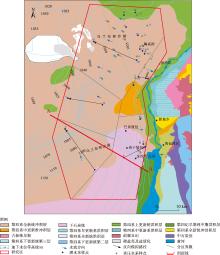
图1
研究区水文地质图及采样点分布"

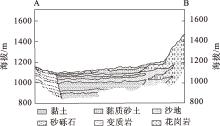
图2
剖面A-B示意图"
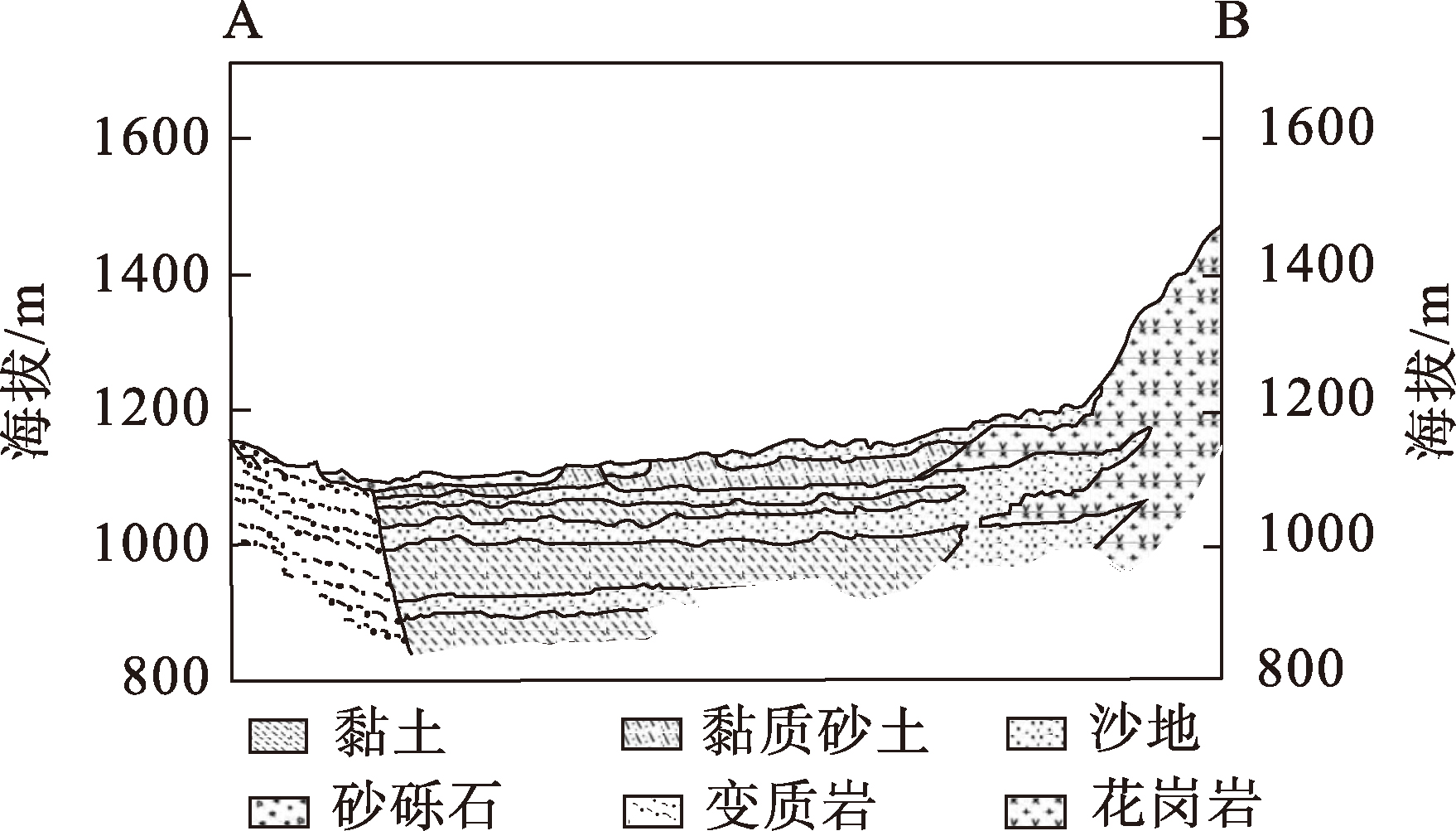
表1
研究区水化学指标统计"
| K+ | Na+ | Ca2+ | Mg2+ | Cl- | SO42- | HCO3- | NO3- | F- | TDS | pH | ||
|---|---|---|---|---|---|---|---|---|---|---|---|---|
| 潜水 | 均值 | 12.66 | 131.84 | 57.90 | 47.20 | 135.45 | 199.33 | 242.89 | 43.53 | 0.75 | 764.84 | 8.30 |
| 标准差 | 35.18 | 69.19 | 38.79 | 35.31 | 88.76 | 153.61 | 101.40 | 58.03 | 0.36 | 437.89 | 0.72 | |
| 极小值 | 1.20 | 34.90 | 8.00 | 8.50 | 39.00 | 38.40 | 103.70 | 0.00 | 0.18 | 252.40 | 7.66 | |
| 极大值 | 156.40 | 283.90 | 140.30 | 170.10 | 340.30 | 744.00 | 433.20 | 241.40 | 1.44 | 2299.45 | 10.67 | |
| 变异系数 | 2.78 | 0.52 | 0.67 | 0.75 | 0.66 | 0.77 | 0.42 | 1.33 | 0.49 | 0.57 | 0.09 | |
| 承压水 | 均值 | 3.86 | 144.60 | 48.51 | 41.23 | 162.97 | 177.77 | 227.62 | 12.41 | 0.72 | 716.56 | 8.25 |
| 标准差 | 1.81 | 101.00 | 30.49 | 25.23 | 121.29 | 103.88 | 110.04 | 16.37 | 0.58 | 372.92 | 0.40 | |
| 极小值 | 0.80 | 29.70 | 12.00 | 7.30 | 42.50 | 28.80 | 67.10 | 0.00 | 0.18 | 246.50 | 7.66 | |
| 极大值 | 7.80 | 383.90 | 140.30 | 111.80 | 549.50 | 422.40 | 494.20 | 64.49 | 3.20 | 1562.30 | 9.18 | |
| 变异系数 | 0.47 | 0.70 | 0.63 | 0.61 | 0.74 | 0.58 | 0.48 | 1.32 | 0.80 | 0.52 | 0.05 |
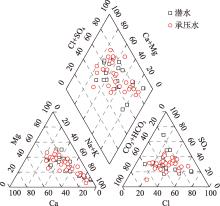
图3
地下水化学Piper三线图"

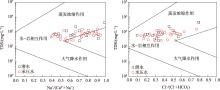
图4
研究区潜水和承压水 Gibbs 图"
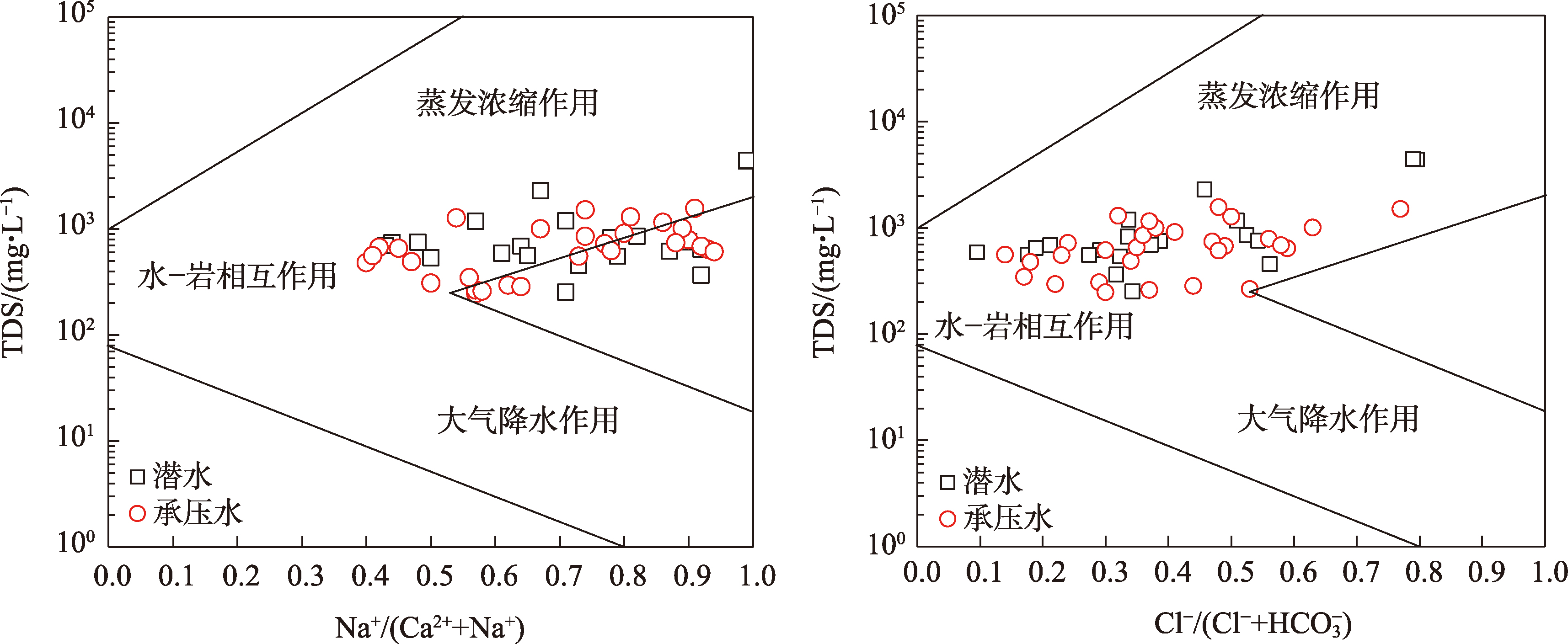
表2
矿物饱和指数范围及溶解方程"
| 矿物名称 | 饱和指数范围 | 平均值 | 矿物溶解方程 |
|---|---|---|---|
| 白云石 | 2.37~5.01 | 3.901 | CaMg(CO3)2=Ca2++Mg2++2CO32- |
| 方解石 | 1.12~2.43 | 1.894 | CaCO3=Ca2++CO32- |
| 石膏 | -0.23~1.30 | 0.534 | CaSO4·2H2O=Ca2++SO42-+2H2O |
| 岩盐 | -4.56~-1.54 | -3.643 | NaCl=Na++Cl- |
| 石英 | 1.07~2.55 | 1.958 | SiO2+2H2O=H4SiO4 |
表3
模拟路径上的矿物溶解-沉淀量"
| 矿物名称及化学式 | 路径 | ||||
|---|---|---|---|---|---|
| 1-5 | 6-7 | 10-11 | 15-14 | 21-23 | |
| 钠长石NaAlSi3O8 | -1.35E-04 | 1.04E-03 | -2.61E-05 | 1.01E-03 | -1.40E-03 |
| 钙长石CaAl2Si2O8 | -5.27E-08 | 1.01E-03 | -1.13E-05 | 1.38E-03 | -1.79E-03 |
| 方解石CaCO3 | 1.63E-03 | -7.52E-04 | -9.63E-04 | 1.78E-03 | 9.82E-04 |
| 二氧化碳CO2 | -2.04E-04 | 1.30E-03 | 1.73E-03 | 7.95E-04 | -1.36E-03 |
| 白云石CaMg(CO3)2 | -8.28E-04 | -2.58E-04 | 7.25E-04 | -1.41E-03 | 1.01E-03 |
| 钾长石KAlSi3O8 | 2.05E-05 | -1.79E-04 | 4.86E-05 | -3.84E-05 | 1.02E-05 |
| 蒙脱石Al2O9Si3 | 4.90E-05 | -1.24E-03 | 1.58E-04 | -1.60E-03 | 2.13E-03 |
| 石膏CaSO4·2H2O | -1.62E-03 | -1.50E-04 | -1.50E-04 | 2.10E-03 | 2.50E-04 |
表4
各路径上矿物溶解沉淀及CO2的吸收或释放总量"
| 路径 | 水量/(105 m3) | 方解石/(t·a-1) | 白云石/(t·a-1) | CO2/(t·a-1) | 钠长石/(t·a-1) | 钙长石/(t·a-1) | 钾长石/(t·a-1) | 蒙脱石/(t·a-1) | 石膏/(t·a-1) |
|---|---|---|---|---|---|---|---|---|---|
| 1-5 | 61.75 | 1007.10 | -940.50 | -55.370 | -217.75 | -0.09 | 35.12 | 85.38 | -1403.02 |
| 6-7 | 196.20 | -1475.63 | -929.96 | 1119.680 | 5320.39 | 5519.85 | -977.43 | -6838.63 | -412.85 |
| 10-11 | 36.45 | -351.09 | 486.26 | 277.109 | -24.89 | -11.43 | 49.26 | 161.98 | -76.59 |
| 15-14 | 31.50 | 561.38 | -818.47 | 110.128 | 836.93 | 1209.45 | -33.62 | -1424.96 | 926.18 |
| 21-23 | 26.06 | 255.81 | 483.73 | -156.260 | -955.03 | -1298.01 | 7.42 | 1567.98 | 91.27 |
| 合计 | -2.43 | -1718.94 | 1295.290 | 4959.66 | 5419.77 | -919.25 | -6448.26 | -875.00 |
表5
研究区各矿物相反应排放或吸收的碳量"
| 矿物相 | 消耗或排放CO2/(t·a-1) | 净碳量/(t·a-1) |
|---|---|---|
| 方解石 | (4149.300) | 1131.627 |
| 白云石 | (-1182.041) | -298.509 |
| CO2 | (3488.516) | 951.413 |
| 钠长石 | (757.789) | 1230.624 |
| 钙长石 | (1826.310) | 249.042 |
| 钾长石 | (-142.749) | -58.397 |
| [1] | 杜新强, 方永军, 郭辉, 等. 面向地下水资源可持续开发利用的地下水适宜埋深研究进展[J]. 中国环境科学, 2024, 44(9): 4987-4998. |
| [Du Xinqiang, Fang Yongjun, Guo Hui, et al. Research progress on suitable groundwater depth towards sustainable development and utilization of groundwater resources[J]. China Environmental Science, 2024, 44(9): 4987-4998.] | |
| [2] |
王思佳, 刘鹄, 赵文智, 等. 干旱-半干旱区地下水可持续性研究评述[J]. 地球科学进展, 2019, 34(2): 210-223.
doi: 10.11867/j.issn.1001-8166.2019.02.0210 |
|
[Wang Sijia, Liu Hu, Zhao Wenzhi, et al. Groundwater sustainability in arid and semi-arid environments: A review[J]. Advances in Earth Science, 2019, 34(2): 210-223.]
doi: 10.11867/j.issn.1001-8166.2019.02.0210 |
|
| [3] | Hao A, Zhang Y, Zhang E, et al. Review: Groundwater resources and related environmental issues in China[J]. Hydrogeol Journal, 2018, 26(5): 1325-1337. |
| [4] | 王锟. 土默川平原地下水数值模拟及应用[D]. 呼和浩特: 内蒙古大学, 2023. |
| [Wang Kun. Numerical Simulation and Application of Groundwater in Tumochuan Plain[D]. Hohhot: Inner Mongolia University, 2023.] | |
| [5] | 刘晓波, 董少刚, 刘白薇, 等. 内蒙古土默川平原地下水水文地球化学特征及其成因[J]. 地球学报, 2017, 38(6): 919-929. |
| [Liu Xiaobo, Dong Shaogang, Liu Baiwei, et al. Hydrogeochemical characteristics and genesis of groundwater in the Tumochuan Plain of Inner Mongolia[J]. Acta Geoscientica Sinica, 2017, 38(6): 919-929.] | |
| [6] | 李浩乾, 孟姝蓉, 董生旺, 等. 内蒙古土默特左旗地下水化学特征及成因[J]. 地球与环境, 2024, 52(4): 429-437. |
| [Li Haoqian, Meng Shurong, Dong Shenwang, et al. Origin and chemical characteristics of groundwater in Tumed Left Banner, Inner Mongolia[J]. Earth and Environment, 2024, 52(4): 429-437.] | |
| [7] | 刘海燕, 马玉学, 赵志鹏, 等. 银川平原地下水水化学特征及演变研究[J]. 宁夏工程技术, 2023, 22(4): 377-384. |
| [Liu Haiyan, Ma Yuxue, Zhao Zhipeng, et al. Study on the hydrochemical characteristics and evolution of groundwater in Yinchuan Plain[J]. Ningxia Engineering Technology, 2023, 22(4): 377-384.] | |
| [8] | 吴玺, 安永会, 魏世博, 等. 黑河下游鼎新谷地浅层地下水水化学特征及演化规律[J]. 干旱区资源与环境, 2021, 35(9): 103-109. |
| [Wu Xi, An Yonghui, Wei Shibo, et al. Hydrochemical characteristics and evolution of shallow groundwater in Dingxin Valley, lower reaches of Heihe River[J]. Journal of Arid Land Resources and Environment, 2021, 35(9): 103-109.] | |
| [9] | 张文强. 巴丹吉林沙漠湖泊与地下水主要特征及成因机理分析[D]. 北京: 中国地质大学(北京), 2018. |
| [Zhang Wenqiang. Main Characteristics and Genetic Mechanism of Lakes and Groundwater in Badain Jaran Desert[D]. Beijing: China University of Geosciences (Beijing), 2018.] | |
| [10] | Jin T, Zhao W, Zhou L, et al. Gilgai microtopography enhances groundwater recharge in the Gobi Desert[J]. Water Resources, 2024, 51(3): 221-228. |
| [11] | Wang Z, Wang L J, Shen J M, et al. Groundwater recharge via precipitation in the Badain Jaran Desert, China[J]. Journal of Groundwater Science and Engineering, 2024, 12(1): 109-118. |
| [12] | Dong S G, Liu B W, Ma M Y, et al. Influence mechanism of groundwater on the carbon cycle in alkaline lakes[J]. Journal of Hydrology, 2023, 617: 129104. |
| [13] | 雷君豪. 土默川平原地下水碳平衡[D]. 呼和浩特: 内蒙古大学, 2023. |
| [Lei Junhao. Carbon Balance of Groundwater in Tumochuan Plain[D]. Hohhot: Inner Mongolia University, 2023.] | |
| [14] |
Li Y, Zhang C, Wang N, et al. Substantial inorganic carbon sink in closed drainage basins globally[J]. Nature Geoscience, 2017, 10(7): 501-506.
doi: 10.1038/NGEO2972 |
| [15] | Ma J, Liu R, Tang L S, et al. A downward CO2 flux seems to have nowhere to go[J]. Biogeosciences, 2014, 11(22): 6251-6262. |
| [16] | 李畅, 杨忠芳, 余涛, 等. 干旱区土壤无机碳碳汇作用及其对固碳减排贡献研究进展[J]. 中国地质, 2024, 51(4): 1210-1242. |
| [Li Chang, Yang Zhongfang, Yu Tao, et al. Carbon sink of soil inorganic carbon in arid regions and its contribution to carbon sequestration and emission reduction: A review[J]. Geology in China, 2024, 51(4): 1210-1242.] | |
| [17] | Granados V, Gutiérrez-Cánovas C, Arias-Real R, et al. The interruption of longitudinal hydrological connectivity causes delayed responses in dissolved organic matter[J]. Science of the Total Environment, 2020, 713: 136619. |
| [18] |
陈发家, 肖琼, 胡祥云, 等. 典型岩溶小流域碳酸盐岩风化过程及其碳汇效应[J]. 地学前缘, 2024, 31(5): 449-459.
doi: 10.13745/j.esf.sf.2024.2.13 |
|
[Chen Fajia, Xiao Qiong, Hu Xiangyun, et al. Weathering process and carbon sink effect of carbonates in typical karst small basin[J]. Earth Science Frontiers, 2024, 31(5): 449-459.]
doi: 10.13745/j.esf.sf.2024.2.13 |
|
| [19] | 李璐, 燕亚平, 史晓珑, 等. 地下水蒸发排泄区无机碳迁移——以呼和浩特盆地为例[J]. 地球与环境, 2024, 52(5): 567-575. |
| [Li Lu, Yan Yaping, Shi Xiaolong, et al. Migration of inorganic carbon in groundwater evaporation discharge areas: A case study of Hohhot Basin[J]. Earth and Environment, 2024, 52(5): 567-575.] | |
| [20] | Tariq A, Graciano C, Sardans J, et al. Plant root mechanisms and their effects on carbon and nutrient accumulation in desert ecosystems under changes in land use and climate[J]. New Phytologist, 2024, 242(3): 916-934. |
| [21] |
Richard S. Have desert researchers discovered a hidden loop in the carbon cycle?[J]. Science, 2008, 320(5882): 1409-1410.
doi: 10.1126/science.320.5882.1409 pmid: 18556524 |
| [22] | Wang W, Chen X, Zheng H, et al. Soil CO2 uptake in deserts and its implications to the groundwater environment[J]. Water, 2016, 8(9): 379. |
| [23] | Jia X, Ling H B, Zhang G P, et al. Variations in the dissolved carbon concentrations of the shallow groundwater in a desert inland river basin[J]. Journal of Hydrology, 2021, 602: 0022-1694. |
| [24] | Dong S G, Liu B W, Lei J H, et al. Carbon balance model of groundwater system: A field application[J]. Journal of Hydrology, 2022, 610(7): 127845. |
| [25] | Li Y, Wang Y, Houghton R A, et al. Hidden carbon sink beneath desert[J]. Geophysical Research Letters, 2015, 42(14): 5880-5887. |
| [26] | 党慧慧. 乌兰布和沙漠地下水水化学特征和水文地球化学过程[D]. 兰州: 兰州大学, 2016. |
| [Dang Huihui. Groundwater Hydrochemical Characters and Hydrogeochemical Processes of Ulan Buh[D]. Lanzhou: Lanzhou University, 2016.] | |
| [27] | 赵杰, 李德文, 孙昌斌, 等. 末次冰期以来乌兰布和沙漠北缘的环境变迁[J]. 第四纪研究, 2017, 37(2): 380-392. |
| [Zhao Jie, Li Dewen, Sun Changbin, et al. Environmental evolution of the northern boundary of the Ulan Buh Desert since the last glacial period[J]. Quaternary Sciences, 2017, 37(2): 380-392.] | |
| [28] | 朱锡芬. 乌兰布和沙漠地下水补给来源及演化规律[D]. 兰州: 兰州大学, 2015. |
| [Zhu Xifen. Study on Recharge and Evolution of Groundwater of Ulan Buh Desert[D]. Lanzhou: Lanzhou University, 2015.] | |
| [29] | 兰梦. 乌兰布和沙漠全新世环境演化研究[D]. 太原: 山西大学, 2024. |
| [Lan Meng. Environment Evolution of Ulan Buh Desert During the Holocene[D]. Taiyuan: Shanxi University, 2024.] | |
| [30] |
党慧慧, 董军, 岳宁, 等. 贺兰山以北乌兰布和沙漠地下水水化学特征演化规律研究[J]. 冰川冻土, 2015, 37(3): 793-802.
doi: 10.7522/j.issn.1000-0240.2015.0088 |
|
[Dang Huihui, Dong Jun, Yue Ning, et al. Study of the evolution of hydrochemical properties of groundwater in Ulan Buh Desert in the north of the Helan Mountains[J]. Journal of Glaciology and Geocryology, 2015, 37(3): 793-802.]
doi: 10.7522/j.issn.1000-0240.2015.0088 |
|
| [31] |
Wouter Z, Mustafa R E. Flow systems of the Earth’s viscous subsurface: A complement to groundwater flow systems[J]. Ain Shams Engineering Journal, 2021, 12(1): 775-778.
doi: 10.1016/j.asej.2020.08.017 |
| [32] | 焦峥瑞. 青海省东部乐都盆地地下水化学演化特征[D]. 石家庄: 河北地质大学, 2019. |
| [Jiao Zhengrui. Research on Evolution of Groundwater Chemical Characteristics of Ledu Basin in the Eastern Qinghai Province[D]. Shijiazhuang: Hebei GEO University, 2019.] | |
| [33] | 王文龙. 乌兰布和沙漠东部地区地下水资源评价[D]. 呼和浩特: 内蒙古大学, 2020. |
| [Wang Wenlong. Evaluation of Groundwater Resources in Ulan Buh and the Eastern Desert Region[D]. Hohhot: Inner Mongolia University, 2020.] | |
| [34] | Higashino M, Erickson A J, Toledo-Cossu F L, et al. Rinsing of saline water from road salt in a sandy soil by infiltrating rainfall: Experiments, simulations, and implications[J]. Water and Soil Pollut, 2017, 228(80): 1573-2932. |
| [35] | 李燕. 乌兰布和沙漠水汽热耦合运移规律及植被生态学意义[D]. 西安: 长安大学, 2013. |
| [Li Yan. The Law of Coupled Water-Vapor-Heat Migration and the Vegetation Ecological Significance of Ulan Buh Desert[D]. Xi’an: Chang’an University, 2013.] | |
| [36] | 肖彩虹, 郝玉光, 辛智鸣, 等. 乌兰布和沙漠东北部人工绿洲地下水位动态变化研究[J]. 防护林科技, 2013(12): 1-3. |
| [Xiao Caihong, Hao Yuguang, Xin Zhiming, et al. Dynamic changes of groundwater level at artificial oasis in northeastern Ulan Buh Desert protection[J]. Forest Science and Technology, 2013(12): 1-3.] | |
| [37] | 叶冬梅, 秦佳琪, 韩胜利, 等. 乌兰布和沙漠流动沙丘不同部位水分动态研究[J]. 干旱区研究, 2005, 22(3): 367-370. |
| [Ye Dongmei, Qin Jiaqi, Han Shengli, et al. Study on the dynamic change of soil moisture content at the different sites of mobile dunes in Ulan buh Desert, Inner Mongolia[J]. Arid Zone Research, 2005, 22(3): 367-370.] | |
| [38] |
岳宁, 魏国孝, 孙朋, 等. 乌兰布和沙漠降水入渗补给对气候变化的响应[J]. 中国沙漠, 2017, 37(5): 1016-1025.
doi: 10.7522/j.issn.1000-694X.2016.00079 |
|
[Yue Ning, Wei Guoxiao, Sun Peng, et al. Rainfall infiltration recharge and its responses to climate change in the Ulan Buh Desert[J]. Journal of Desert Research, 2017, 37(5): 1016-1025.]
doi: 10.7522/j.issn.1000-694X.2016.00079 |
| [1] | 鲁力, 郭建华, 王友年. 干旱区地下水埋深对土壤水盐运移影响的模拟与调控——以阿克苏河下游河岸带典型田块为例[J]. 干旱区研究, 2025, 42(7): 1196-1210. |
| [2] | 刘亮, 董江伟, 周金龙, 李江. 且末县绿洲区地表水与地下水中硼的分布特征及其影响因素[J]. 干旱区研究, 2025, 42(7): 1222-1235. |
| [3] | 鲁力, 葛燕燕, 李升, 张云. 新疆阿克苏河流域高砷地下水化学特征及富集成因[J]. 干旱区研究, 2025, 42(2): 258-273. |
| [4] | 李小等, 常亮, 段瑞, 王倩, 张群慧, 杨炳超. 和田河流域水化学特征与地下水补给来源分析[J]. 干旱区研究, 2024, 41(6): 917-927. |
| [5] | 王平顺, 苗新岳, 燕亚平, 董生旺, 董少刚. 内蒙古伊敏盆地地下水水化学特征及其成因[J]. 干旱区研究, 2024, 41(3): 411-420. |
| [6] | 李平平, 盖楠, 王晓丹, 杨俊仓. 敦煌月牙泉域地下水系统水文地球化学特征分析[J]. 干旱区研究, 2024, 41(2): 240-249. |
| [7] | 郑钰, 孙英, 周金龙, 李如跃. 新疆额尔齐斯河流域平原区地下水水化学特征及高氟水成因机制[J]. 干旱区研究, 2024, 41(12): 2056-2070. |
| [8] | 侯聪, 史海滨, 苗庆丰, 胡智远, 赵毅, 于翠翠, 闫妍, 范理权, 张涛. 河套灌区农田地下水化学特征与不同地类水盐迁移[J]. 干旱区研究, 2024, 41(11): 1956-1968. |
| [9] | 薛栋元, 胡海珠, 张锦宁, 任嘉伟. 牧区河岸潜流带硝酸盐氮和氨氮浓度对水文过程的响应机制[J]. 干旱区研究, 2023, 40(6): 937-948. |
| [10] | 高福翔, 徐东升, 周金龙, 周龙. 新疆博尔塔拉河中游地表水与地下水转化关系及原因[J]. 干旱区研究, 2023, 40(11): 1754-1764. |
| [11] | 杨海娇,魏加华,任倩慧. 柴达木盆地典型流域地表水-地下水转化关系及水化学特征[J]. 干旱区研究, 2022, 39(5): 1543-1554. |
| [12] | 阮永健,吴秀芹. 基于GRACE和GLDAS的西北干旱区地下水资源量可持续性评价[J]. 干旱区研究, 2022, 39(3): 787-800. |
| [13] | 崔佳琪,李仙岳,史海滨,孙亚楠,马红雨,菅文浩. 节水改造前后永济灌域地下水环境时空变化特征[J]. 干旱区研究, 2022, 39(3): 841-852. |
| [14] | 苏春利,纪倩楠,陶彦臻,谢先军,潘洪捷. 河套灌区西部土壤盐渍化分异特征及其主控因素[J]. 干旱区研究, 2022, 39(3): 916-923. |
| [15] | 丁启振,雷米,周金龙,张杰,徐东升. 博尔塔拉河上游河谷地区水化学特征及水质评价[J]. 干旱区研究, 2022, 39(3): 829-840. |
|
||
