
干旱区研究 ›› 2025, Vol. 42 ›› Issue (6): 1021-1031.doi: 10.13866/j.azr.2025.06.06 cstr: 32277.14.AZR.20250606
张雅静( ), 郝蕊芳()
收稿日期:2024-10-31
修回日期:2024-11-27
出版日期:2025-06-15
发布日期:2025-06-11
通讯作者:
郝蕊芳. E-mail: hrf@mail.bnu.edu.cn作者简介:张雅静(2000-),女,硕士研究生,主要从事生态系统服务研究. E-mail: zhangyajing_7067@163.com
基金资助:
ZHANG Yajing(), HAO Ruifang()
Received:2024-10-31
Revised:2024-11-27
Published:2025-06-15
Online:2025-06-11
摘要:
水资源是维持生态系统平衡,保障人类生活和经济发展的基础,模拟干旱半干旱区生态系统水文过程能够促进当地水资源的有效利用。本文分析分布式水文-植被-土壤模型(DHSVM)和土壤与水评估工具(SWAT)两种模型在半干旱区不同类型流域的适用性。对两种模型参数进行敏感性分析与参数率定。采用两种模型分别模拟了2011—2012年和2017—2019年生长季北方农牧交错带东段西拉木伦河上游和老哈河上游流域的月径流量,其中,西拉木伦河上游流域以草地为主,老哈河上游流域以林地和农田为主。 结果表明:DHSVM模型在西拉木伦河上游水文过程模拟中有7个主要敏感参数,在老哈河上游流域中有6个主要敏感参数。SWAT模型分别选取11个和12个敏感参数。通过敏感参数率定,在西拉木伦河上游流域,DHSVM模型在率定期Nash系数为0.70,验证期Nash系数为0.11;SWAT模型Nash系数分别为0.43和0.04。在老哈河上游流域,DHSVM模型在率定期和验证期Nash系数分别为0.56和0.70;SWAT模型分别为0.86和0.54。两种模型在北方农牧交错带西拉木伦河和老哈河上游流域的水文过程模拟中都具有较好的适用性。DHSVM模型对总体径流量的模拟更准确,SWAT模型对月径流量峰值的模拟更准确。
张雅静, 郝蕊芳. 中国北方农牧交错带东段不同类型流域水文模型适用性[J]. 干旱区研究, 2025, 42(6): 1021-1031.
ZHANG Yajing, HAO Ruifang. Applicability analysis of hydrological models for different types of watersheds in the eastern section of the agro-pastoral transitional zone in northern China[J]. Arid Zone Research, 2025, 42(6): 1021-1031.
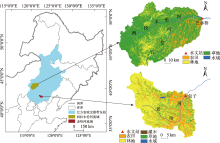
图1
研究区地理位置及概况 注:底图采用自然资源部标准地图制作,审图号为GS(2020)4619号,对底图边界无修改。"

表1
数据来源"
| 数据类型 | 数据名称 | 数据来源 | 空间分辨率 | 时间分辨率 |
|---|---|---|---|---|
| 遥感数据 | DEM | 地理空间数据云( | 90 m | - |
| 土地利用数据 | 中国土地覆盖数据集(CLCD)( | 30 m | - | |
| LAI | 全球地表卫星(GLASS)( | 500 m | 8 d | |
| Alb | 全球地表卫星(GLASS)( | 500 m | 8 d | |
| 土壤数据 | 土壤类型数据 | 国家青藏高原科学数据中心( | 1 km | - |
| 气象数据 | 气温 | 中国地面气候资料日值数据集(V3.0)( | - | 2010—2012年 2017—2019年 日数据 |
| 最高气温 | ||||
| 最低气温 | ||||
| 降水 | ||||
| 风速 | ||||
| 相对湿度 | ||||
| 日照时数 | ||||
| 水文站数据 | 巴林桥 | 水文年鉴 | - | 2010—2012年 2017—2019年 月径流量 |
| 甸子 |
表2
DHSVM模型不同类型流域敏感参数值"
| 壤土 | 砂壤土 | 沙土 | 粉壤土 | ||||||||||||
|---|---|---|---|---|---|---|---|---|---|---|---|---|---|---|---|
| 西拉木伦河 | 老哈河 | 西拉木伦河 | 老哈河 | 西拉木伦河 | 西拉木伦河 | ||||||||||
| 土壤参数 | 横向饱和导水率 | 1.05×10⁻⁵ | 1.0×10⁻⁵ | 1.1×10⁻⁴ | 1.1×10⁻⁴ | 3.4×10⁻⁴ | 1.0×10⁻⁵ | ||||||||
| 衰减系数 | 0.1 | 0.1 | 1.0 | 1.0 | 0.1 | 1.0 | |||||||||
| 田间持水量 | 0.261 | 0.261 | 0.172 | 0.172 | 0.77 | 0.299 | |||||||||
| 土壤泡压 | 0.112 | - | 0.147 | - | 0.073 | 0.208 | |||||||||
| 体积密度 | 1471.4 | - | 1491.5 | - | 1429.9 | 1426.2 | |||||||||
| 土壤导热率 | - | 7.1 | - | 7.1 | - | - | |||||||||
| 森林 | 草地 | 农田 | |||||||||||||
| 冠层 | 林下层 | ||||||||||||||
| 西拉木伦河 | 老哈河 | 西拉木伦河 | 老哈河 | 西拉木伦河 | 老哈河 | 西拉木伦河 | 老哈河 | ||||||||
| 植被参数 | 最小气孔阻力 | 110 | 110 | 60 | 60 | 60 | 60 | 60 | 60 | ||||||
| 叶面积指数 | GLASS LAI数据 | ||||||||||||||
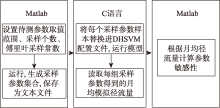
图2
EFAST参数敏感性分析流程图"

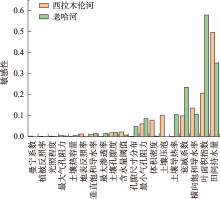
图3
DHSVM模型主要参数敏感性分析"

表3
SWAT模型不同类型流域主要敏感参数值"
| 类别 | 参数代码 | 参数取值 | |
|---|---|---|---|
| 西拉木伦河 | 老哈河 | ||
| 径流 | 径流曲线数(CN2) | -0.17 | 0.12 |
| 地表径流滞后时间(SURLAG) | 17.65 | 3.43 | |
| 蒸发 | 土壤蒸发补偿系数(ESCO) | 0.12 | 0.22 |
| 地下水蒸发系数(GW_REVAP) | 0.18 | 0.09 | |
| 基流 | 浅层地下水径流系数(GWQMN) | 1.71 | 1.99 |
| 基流分割系数(ALPHA_BF) | 0.65 | 0.29 | |
| 地下水延迟时间(GW_DELAY) | 443.70 | 102.59 | |
| 主河道 | 主河道曼宁值(CH_N2) | 0.21 | -0.01 |
| 主河道有效水力传导系数(CH_K2) | 117.49 | 344.61 | |
| 土壤 | 饱和导水率(SOL_K) | -0.17 | -0.43 |
| 土壤有效含水量(SOL_AWC) | -0.11 | 0.30 | |
| 土壤容重(SOL_BD) | - | 0.04 | |
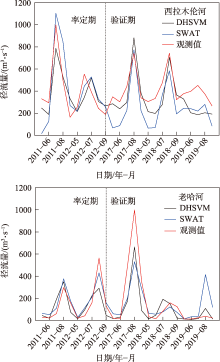
图4
DHSVM模型和SWAT模型模拟与观测月径流量"
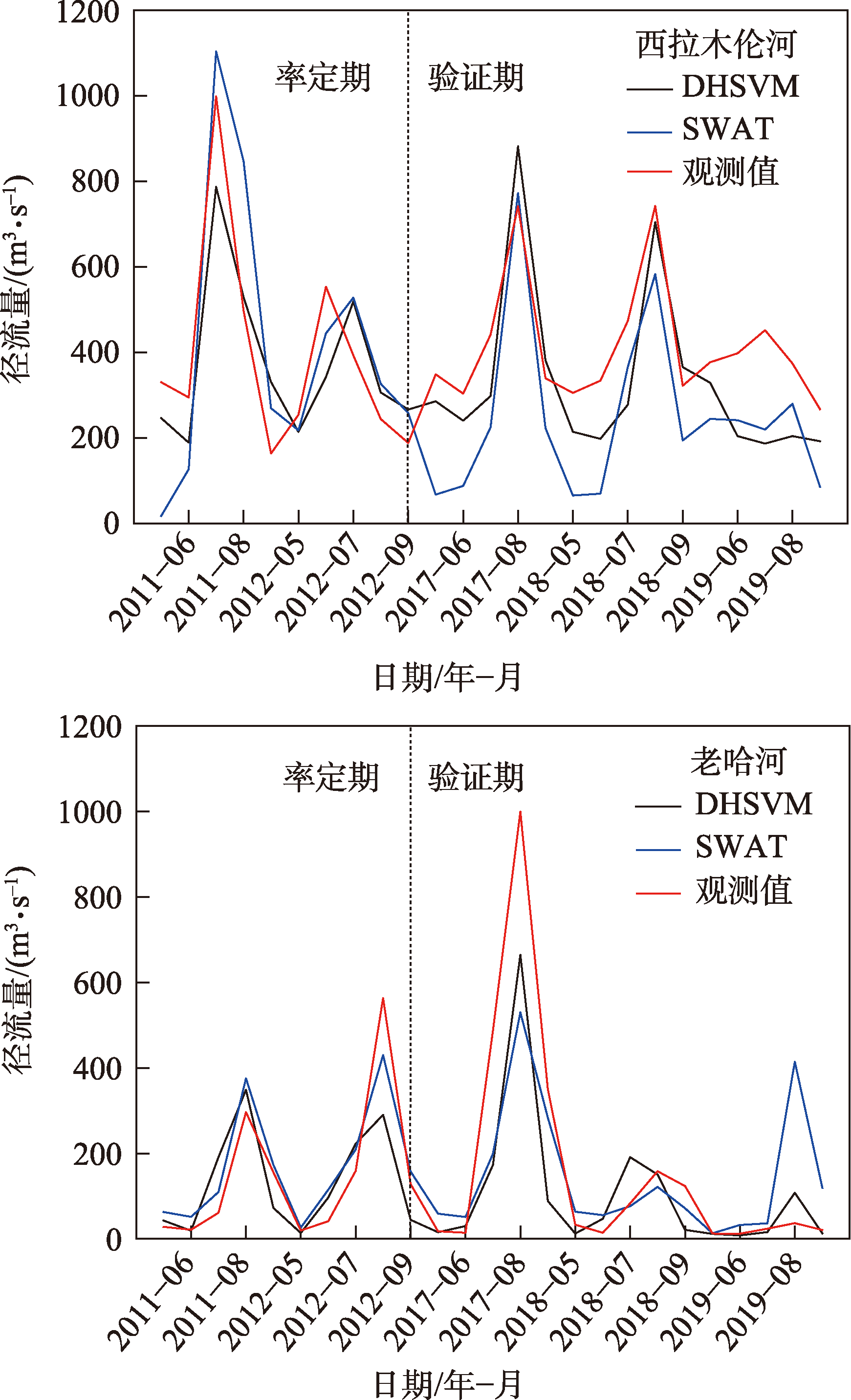
表4
DHSVM模型和SWAT模型模拟与观测月径流量之间的NSE、R2值"
| DHSVM | SWAT | |||||
|---|---|---|---|---|---|---|
| NSE | R2 | NSE | R2 | |||
| 西拉木伦河 | 率定期 | 0.70 | 0.85 | 0.43 | 0.84 | |
| 验证期 | 0.11 | 0.83 | 0.04 | 0.94 | ||
| 老哈河 | 率定期 | 0.56 | 0.75 | 0.86 | 0.95 | |
| 验证期 | 0.70 | 0.91 | 0.54 | 0.77 | ||
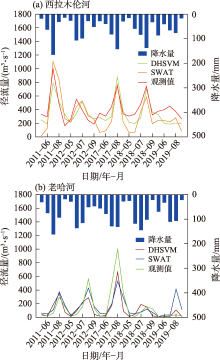
图5
不同类型流域降水-径流过程"

| [1] | Li M S, Yang X H, Wang K W, et al. Exploring China’s water scarcity incorporating surface water quality and multiple existing solutions[J]. Environmental Research, 2024, 246: 118191. |
| [2] | Scanlon B R, Fakhreddine S, Rateb A, et al. Global water resources and the role of groundwater in a resilient water future[J]. Nature Reviews Earth & Environment, 2023, 4(2): 87-101. |
| [3] | He C Y, Liu Z F, Wu J G, et al. Future global urban water scarcity and potential solutions[J]. Nature Communications, 2021, 12(1): 1-11. |
| [4] | Zhang Y J, Hao R F, Qin Y. Temporal and spatial variation of agricultural and pastoral production in the eastern section of the agro-pastoral transitional zone in northern China[J]. Agriculture-Basel, 2024, 14(6): 829. |
| [5] | 李秋月, 潘学标. 气候变化对我国北方农牧交错带空间位移的影响[J]. 干旱区资源与环境, 2012, 26(10): 1-6. |
| [Li Qiuyue, Pan Xuebiao. The impact of climate change on boundary shift of farming pasture ecotone in northern China[J]. Journal of Arid Land Resources and Environment, 2012, 26(10): 1-6.] | |
| [6] | Xie P, Wu Z Y, Sang Y F, et al. Evaluation of the significance of abrupt changes in precipitation and runoff process in China[J]. Journal of Hydrology, 2018, 560: 451-460. |
| [7] | Jayathilake D I, Smith T. Understanding the role of hydrologic model structures on evapotranspiration-driven sensitivity[J]. Hydrological Sciences Journal-journal Des Sciences Hydrologiques, 2020, 65(9): 1474-1489. |
| [8] | Beven K J, Warren R, Zaoui J. SHE: Towards a methodology for physically-based distributed forecasting in hydrology[J]. IAHS, 1980, 129: 133-137. |
| [9] | Feyen L, Vázquez R, Christiaens K, et al. Application of a distributed physically based hydrological model to a medium size catchment[J]. Hydrology and Earth System Sciences, 2000, 4(1): 47-63. |
| [10] | Zhang Z P, Wang Q Z, Guan Q Y, et al. Research on the optimal allocation of agricultural water and soil resources in the Heihe River Basin based on SWAT and intelligent optimization[J]. Agricultural Water Management, 2023, 279: 108177. |
| [11] | Soufiane T, Lamia E, Youssef A, et al. The application of SWAT model and remotely sensed products to characterize the dynamic of streamflow and snow in a mountainous watershed in the High Atlas[J]. Sensors, 2023, 23(3): 1246. |
| [12] | dos Santos F M, Pelinson N D, de Oliveira R P, et al. Using the SWAT model to identify erosion prone areas and to estimate soil loss and sediment transport in Mogi Guaçu River basin in Sao Paulo State, Brazil[J]. Catena, 2023, 222: 106872. |
| [13] | Anteneh Y, Alamirew T, Zeleke G, et al. Modeling runoff-sediment influx responses to alternative BMP interventions in the Gojeb watershed, Ethiopia, using the SWAT hydrological model[J]. Environmental Science and Pollution Research, 2023, 30(9): 22816-22834. |
| [14] | Mabood F, Hadi F, Jan A U, et al. Assessment of Pb and Ni and potential health risks associated with the consumption of vegetables grown on the roadside soils in District Swat, Khyber Pakhtunkhwa, Pakistan[J]. Environmental Monitoring and Assessment, 2022, 194(12): 906. |
| [15] | Zhang X Q, Chen P, Dai S N, et al. Analysis of non-point source nitrogen pollution in watersheds based on SWAT model[J]. Ecological Indicators, 2022, 138: 108881. |
| [16] | Gu P F, Wu Y X, Liu G D, et al. Application of meteorological element combination-driven SWAT model based on meteorological datasets in alpine basin[J]. Water Supply, 2022, 22(3): 3307-3324. |
| [17] | Yang S, Tan M L, Song Q X, et al. Coupling SWAT and Bi-LSTM for improving daily-scale hydro-climatic simulation and climate change impact assessment in a tropical river basin[J]. Journal of Environmental Management, 2023, 330: 117244. |
| [18] | Tian P P, Lu H W, Feng W, et al. Large decrease in streamflow and sediment load of Qinghai-Tibetan Plateau driven by future climate change: A case study in Lhasa River Basin[J]. Catena, 2020, 187: 104340. |
| [19] | Zhang X C, Yuan X, Liu H R, et al. Soil moisture estimation for winter-wheat waterlogging monitoring by assimilating remote sensing inversion data into the Distributed Hydrology Soil Vegetation Model[J]. Remote Sensing, 2022, 14(3): 792. |
| [20] | Ma Y, Xiong Q X, Zhu J Q, et al. Early warning indexes determination of the crop injuries caused by waterlogging based on DHSVM model[J]. The Journal of Supercomputing, 2020, 76(4): 2435-2448. |
| [21] | Ridgeway J B, Surfleet C G. Effects of streamside buffers on stream temperatures associated with forest management and harvesting using DHSVM-RBM; South Fork Caspar Creek, California[J]. Frontiers in Forests and Global Change, 2021, 4: 611380. |
| [22] | Sun N, Yearsley J, Voisin N, et al. A spatially distributed model for the assessment of land use impacts on stream temperature in small urban watersheds[J]. Hydrological Processes, 2015, 29(10): 2331-2345. |
| [23] | Xu Y P, Gao X C, Zhu Q, et al. Coupling a regional climate model and a distributed hydrological model to assess future water resources in Jinhua River Basin, East China[J]. Journal of Hydrologic Engineering, 2015, 20(4): 04014054. |
| [24] | 杨明智, 许继军, 桑连海, 等. 基于水循环的分布式水资源调配模型开发与应用[J]. 水利学报, 2022, 53(4): 456-470. |
| [Yang Mingzhi, Xu Jijun, Sang Lianhai, et al. Development and application of the distributed water resources allocation and regulation model based on hydrological cycle[J]. Journal of Hydraulic Engineering, 2022, 53(4): 456-470.] | |
| [25] | 张力仁, 郭振民, 曾宏伟, 等. 应用多目标遗传演算法于DHSVM之参数最佳化——以石门水库集水区为例[J]. 农业工程学报, 2019, 65(1): 18-35. |
| [Zhang Liren, Guo Zhenmin, Zeng Hongwei, et al. Application of multi-objective genetic algorithm on parameter optimization of DHSVM: A case study in Shihmen reservoir catchment[J]. Journal of Taiwan Agricultural Engineering, 2019, 65(1): 18-35.] | |
| [26] | 王静爱, 史培军. 论内蒙古农牧交错地带土地资源利用及区域发展战略[J]. 地域研究与开发, 1988, 7(1): 24-28. |
| [Wang Jingai, Shi Peijun. On the utilization of land resources and regional development strategies in the ecotone of agriculture and animal husbandry in Inner Mongolia[J]. Areal Research and Development, 1988, 7(1): 24-28.] | |
| [27] | 张建春, 储少林, 陈全功. 中国农牧交错带界定的现状及进展[J]. 草业科学, 2008, 25(3): 78-84. |
| [Zhang Jianchun, Chu Shaolin, Chen Quangong. Advances in defining the boundary of farming-grazing transition zone in China[J]. Pratacultural Science, 2008, 25(3): 78-84.] | |
| [28] | 靳英华, 周道玮, 姜世成, 等. 北方农牧交错带东段生长季气候变化与温水组合规律研究[J]. 东北师大学报(自然科学版), 2007, 39(4): 137-142. |
| [Jin Yinghua, Zhou Daowei, Jiang Shicheng, et al. Research on climate changes and combinational law of temperature and precipitation during growing season in the eastern ecotone between agriculture and animal husbandry in Northern China[J]. Journal of Northeast Normal University (Natural Science Edition), 2007, 39(4): 137-142.] | |
| [29] |
Yang J, Huang X. The 30 m annual land cover dataset and its dynamics in China from 1990 to 2019[J]. Earth System Science Data, 2021, 13(8): 3907-3925.
doi: 10.5194/essd-13-3907-2021 |
| [30] |
赵奕, 南卓铜, 李祥飞, 等. 分布式水文模型DHSVM在西北高寒山区流域的适用性研究[J]. 冰川冻土, 2019, 41(1): 147-157.
doi: 10.7522/j.issn.1000-0240.2019.0003 |
|
[Zhao Yi, Nan Zhuotong, Li Xiangfei, et al. On applicability of a fully distributed hydrological model in the cold and alpine watershed of Northwest China[J]. Journal of Glaciology and Geocryology, 2019, 41(1): 147-157.]
doi: 10.7522/j.issn.1000-0240.2019.0003 |
|
| [31] | Angstrom A. Solar and terrestrial radiation. Report to the international commission for solar research on actinometric investigations of solar and atmospheric radiation[J]. Quarterly Journal of the Royal Meteorological Society, 1924, 50(210): 121-126. |
| [32] | Prescott J A. Evaporation from a water surface in relation to solar radiation[J]. Transactions of the Royal Society of South Australia, 1940, 64: 114-118. |
| [33] | 徐宗学. 水文模型[M]. 北京: 科学出版社, 2009. |
| [Xu Zongxue. Hydrological Models[M]. Beijing: Science Press, 2009.] | |
| [34] | Tan M L, Gassman P W, Yang X Y, et al. A review of SWAT applications, performance and future needs for simulation of hydro-climatic extremes[J]. Advances In Water Resources, 2020, 143: 103662. |
| [35] | Lan C, Giambelluca T W, Ziegler A D. Lumped parameter sensitivity analysis of a distributed hydrological model within tropical and temperate catchments[J]. Hydrological Processes, 2011, 25(15): 2405-2421. |
| [36] | 赵奕. 高寒山区流域水文时空特征的分布式模型模拟研究[D]. 南京: 南京师范大学, 2019. |
| [Zhao Yi. Research on the Distributed Model Simulation of the Spatial/Temporal Hydrological Characteristics in a Cold Alpine Basin[D]. Nanjing: Nanjing Normal University, 2019.] | |
| [37] | 王建栋, 郭维栋, 李红祺. 拓展傅里叶幅度敏感性检验(EFAST)在陆面过程模式中参数敏感性分析的应用探索[J]. 物理学报, 2013, 62(5): 35-41. |
| [Wang Jiandong, Guo Weidong, Li Hongqi. Application of extended Fourier amplitude sensitivity test (EFAST) method in land surface parameter sensitivity analysis[J]. Acta Physica Sinica, 2013, 62(5): 35-41.] | |
| [38] | 左德鹏, 徐宗学. 基于SWAT模型和SUFI-2算法的渭河流域月径流分布式模拟[J]. 北京师范大学学报(自然科学版), 2012, 48(5): 490-496. |
| [Zuo Depeng, Xu Zongxue. Distributed hydrological simulation using SWAT and SUFI-2 in the Wei River Basin[J]. Journal of Beijing Normal University (Natural Science), 2012, 48(5): 490-496.] | |
| [39] | 刘宁, 张霞, 祝雪萍, 等. 基于SWAT模型和SUFI-2算法的碧流河流域径流模拟[J]. 水力发电, 2019, 45(3): 18-22, 89. |
| [Liu Ning, Zhang Xia, Zhu Xueping, et al. Runoff simulation using SWAT model and SUFI-2 algorithm in Biliu River Basin[J]. Water Power, 2019, 45(3): 18-22, 89.] | |
| [40] | Pan S L, Liu L, Bai Z X, et al. Integration of remote sensing evapotranspiration into multi-objective calibration of Distributed Hydrology-Soil-Vegetation Model (DHSVM) in a Humid Region of China[J]. Water, 2018, 10(12): 1841. |
| [41] | Stieglitz M, Rind D, Famiglietti J, et al. An efficient approach to modeling the topographic control of surface hydrology for regional and global climate modeling[J]. Journal of Climate, 1997, 10(1): 118-137. |
| [42] | Meyer P D, Rockhold M L, Gee G W. Uncertainty analyses of infiltration and subsurface flow and transport for SDMP sites[J]. Office of Scientific and Technical Information, 1997, 51: 541818. |
| [43] | Spellman P, Webster V, Watkins D. Bias correcting instantaneous peak flows generated using a continuous, semi-distributed hydrologic model[J]. Journal of Flood Risk Management, 2018, 11(4): e12342. |
| [44] | Javaheri A, Babbar-Sebens M. On comparison of peak flow reductions, flood inundation maps, and velocity maps in evaluating effects of restored wetlands on channel flooding[J]. Ecological Engineering, 2014, 73: 132-145. |
| [45] | Liu Q, Liang L Q, Cai Y P, et al. Assessing climate and land-use change impacts on streamflow in a mountainous catchment[J]. Journal of Water and Climate Change, 2020, 11(2): 503-513. |
| [46] | Safeeq M, Fares A. Hydrologic effect of groundwater development in a small mountainous tropical watershed[J]. Journal of Hydrology, 2012, 428: 51-67. |
| [47] | Lan C, Lettenmaier D P, Mattheussen B V, et al. Hydrologic prediction for urban watersheds with the Distributed Hydrology-Soil-Vegetation Model[J]. Hydrological Processes, 2008, 22(21): 4205-4213. |
| [48] | Nguyen T V, Dietrich J, Dang T D, et al. An interactive graphical interface tool for parameter calibration, sensitivity analysis, uncertainty analysis, and visualization for the Soil and Water Assessment Tool[J]. Environmental Modelling & Software, 2022, 156: 105497. |
| [49] | Voisin N, Liu L, Hejazi M, et al. One-way coupling of an integrated assessment model and a water resources model: Evaluation and implications of future changes over the US Midwest[J]. Hydrology and Earth System Sciences, 2013, 17(11): 4555-4575. |
| [50] | Zhao G, Gao H L, Naz B S, et al. Integrating a reservoir regulation scheme into a spatially distributed hydrological model[J]. Advances in Water Resources, 2016, 98: 16-31. |
| [51] |
刘哲, 兰措. 青海北川河流域径流变化的机理研究——基于模型和统计两种方法[J]. 地理科学进展, 2022, 41(2): 304-315.
doi: 10.18306/dlkxjz.2022.02.010 |
|
[Liu Zhe, Lancuo. Investigating the mechanisms of streamflow change in the Beichuan River Basin, Qinghai Province: Based on modeling and statistic analyses[J]. Progress in Geography, 2022, 41(2): 304-315.]
doi: 10.18306/dlkxjz.2022.02.010 |
|
| [52] | Liu Z J, Liu Y S, Li Y R. Anthropogenic contributions dominate trends of vegetation cover change over the farming-pastoral ecotone of northern China[J]. Ecological Indicators, 2018, 95: 370-378. |
| [53] | Chawanda C J, Nkwasa A, Thiery W, et al. Combined impacts of climate and land-use change on future water resources in Africa[J]. Hydrology and Earth System Sciences, 2024, 28(1): 117-138. |
| [54] | Mahdian M, Hosseinzadeh M, Siadatmousavi S M, et al. Modelling impacts of climate change and anthropogenic activities on inflows and sediment loads of wetlands: Case study of the Anzali wetland[J]. Scientific Reports, 2023, 13(1): 5399. |
| [55] | Van Wie J B, Adam J C, Ullman J L. Conservation tillage in dryland agriculture impacts watershed hydrology[J]. Journal of Hydrology, 2013, 483: 26-38. |
| [56] | 任菲莹, 熊勤学. 基于分布式水文模型的小麦渍害对气候变化响应研究[J]. 麦类作物学报, 2020, 40(10): 1265-1274. |
| [Ren Feiying, Xiong Qinxue. Response of wheat sub-surface waterlogging to climate changing using DHSVM model Simulations[J]. Journal of Triticeae Crops, 2020, 40(10): 1265-1274.] |
| [1] | 张嘉琪, 刘招, 韩忠青, 王丽霞, 张晋霞, 岳甲寅, 管子隆. 气候变化下泾河流域蓝绿水变化趋势及预测[J]. 干旱区研究, 2024, 41(12): 2045-2055. |
| [2] | 赵文龙, 吕海深, 朱永华, 刘涵, 吴卓珺. 额尔齐斯河库威站日尺度的降雨融雪径流模拟[J]. 干旱区研究, 2024, 41(10): 1685-1698. |
| [3] | 赵美亮, 曹广超, 赵青林, 曹生奎. 气候及土地利用变化对大通河源区水文要素空间分布的影响[J]. 干旱区研究, 2023, 40(3): 381-391. |
| [4] | 邵建,张肃诏,陈敏,李强,郑友炯,程瑶,马宁. FY-4A卫星在宁夏短时强降水中的适用性研究[J]. 干旱区研究, 2023, 40(2): 163-172. |
| [5] | 陈红光, 孟凡浩, 萨楚拉, 罗敏, 王牧兰, 刘桂香. 北方牧区草原内陆河流域径流演变特征及其驱动因素分析[J]. 干旱区研究, 2023, 40(1): 39-50. |
| [6] | 邹凯波,张玉虎,刘晓伟,薛淑慧,杨博文,崔艳欣. 气候变化下乌伦古河流域农业面源污染负荷响应[J]. 干旱区研究, 2022, 39(2): 625-637. |
| [7] | 孙铭悦,吕海深,朱永华,林瑜,张梅洁. 2套气象数据在资料缺乏地区的适用性评估——以呼图壁河流域为例[J]. 干旱区研究, 2022, 39(1): 94-103. |
| [8] | 宋玉鑫,左其亭,马军霞. 基于SWAT模型的开都河流域水文干旱变化特征及驱动因子分析[J]. 干旱区研究, 2021, 38(3): 610-617. |
| [9] | 张晓龙, 沈冰, 黄领梅. 基于ITPCAS再分析资料中国近地面风速时空变化特征 [J]. 干旱区研究, 2020, 37(1): 1-9. |
| [10] | 罗开盛,陶福禄. 黑河径流对LUCC和气候变化的敏感性分析[J]. 干旱区研究, 2018, 35(4): 753-760. |
|
||
