
Arid Zone Research ›› 2025, Vol. 42 ›› Issue (6): 993-1003.doi: 10.13866/j.azr.2025.06.04
• Land and Water Resources • Previous Articles Next Articles
DI Yanfeng1,2( ), DUAN Weili1,2(), ZHOU Yiqi3,4, HE Chao5,6
Received:2024-11-29
Revised:2024-12-25
Online:2025-06-15
Published:2025-06-11
Contact:
DUAN Weili
E-mail:diyanfeng22@mails.ucas.ac.cn;duanweili@ms.xjb.ac.cn
DI Yanfeng, DUAN Weili, ZHOU Yiqi, HE Chao. Sustainable dynamics and driving factors of the global virtual water trade in crops[J].Arid Zone Research, 2025, 42(6): 993-1003.
Add to citation manager EndNote|Reference Manager|ProCite|BibTeX|RefWorks
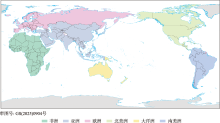
Fig. 1
Map of the study area"

Tab. 1
35 selected crop types in this study"
| FAO 编码 | 作物 名称 | 作物 类别 | FAO 编码 | 作物 名称 | 作物 类别 |
|---|---|---|---|---|---|
| 15 | 小麦 | 谷物 | 242 | 生花生 | 油料作物 |
| 27 | 大米 | 谷物 | 249 | 椰子 | 油料作物 |
| 56 | 玉米 | 谷物 | 254 | 油棕果 | 油料作物 |
| 44 | 大麦 | 谷物 | 267 | 葵花籽 | 油料作物 |
| 79 | 小米 | 谷物 | 270 | 油菜籽 | 油料作物 |
| 83 | 高粱 | 谷物 | 289 | 芝麻籽 | 油料作物 |
| 116 | 土豆 | 根茎类 | 328 | 棉花 | 纤维作物 |
| 122 | 红薯 | 根茎类 | 656 | 生咖啡 | 兴奋剂类作物 |
| 137 | 山药 | 根茎类 | 661 | 可可豆 | 兴奋剂类作物 |
| 125 | 木薯 | 根茎类 | 667 | 茶叶 | 兴奋剂类作物 |
| 156 | 甘蔗 | 糖类作物 | 486 | 香蕉 | 水果 |
| 157 | 甜菜根 | 糖类作物 | 489 | 大蕉 | 水果 |
| 176 | 干豆 | 豆类 | 512 | 柑橘 | 水果 |
| 191 | 干鹰嘴豆 | 豆类 | 388 | 番茄 | 蔬菜 |
| 195 | 干豇豆 | 豆类 | 403 | 洋葱 | 蔬菜 |
| 197 | 干鸽豆 | 豆类 | 826 | 烟草 | 其他作物 |
| 201 | 干扁豆 | 豆类 | 836 | 橡胶 | 其他作物 |
| 236 | 大豆 | 油料作物 |
Tab. 2
Selection of indicators for drivers of virtual water in crop trade"
| 维度 | 序号 | 指标 | 单位 |
|---|---|---|---|
| 经济因素 | 1 | 国内生产总值 | $ |
| 2 | 消费者物价指数 | - | |
| 3 | 农林渔业增加值 | $ | |
| 社会因素 | 4 | 物流绩效指数 | - |
| 5 | 商品净出口总额 | $ | |
| 6 | 总人口 | - | |
| 自然因素 | 7 | 耕地面积 | hm2 |
| 8 | 森林面积 | km2 | |
| 9 | 人均可再生内陆淡水资源量 | m3 | |
| 10 | 水资源压力水平 | - | |
| 地理因素 | 11 | 是否为内陆国 | - |
| 12 | 国家邻接数 | - |
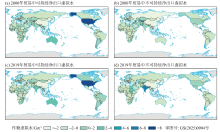
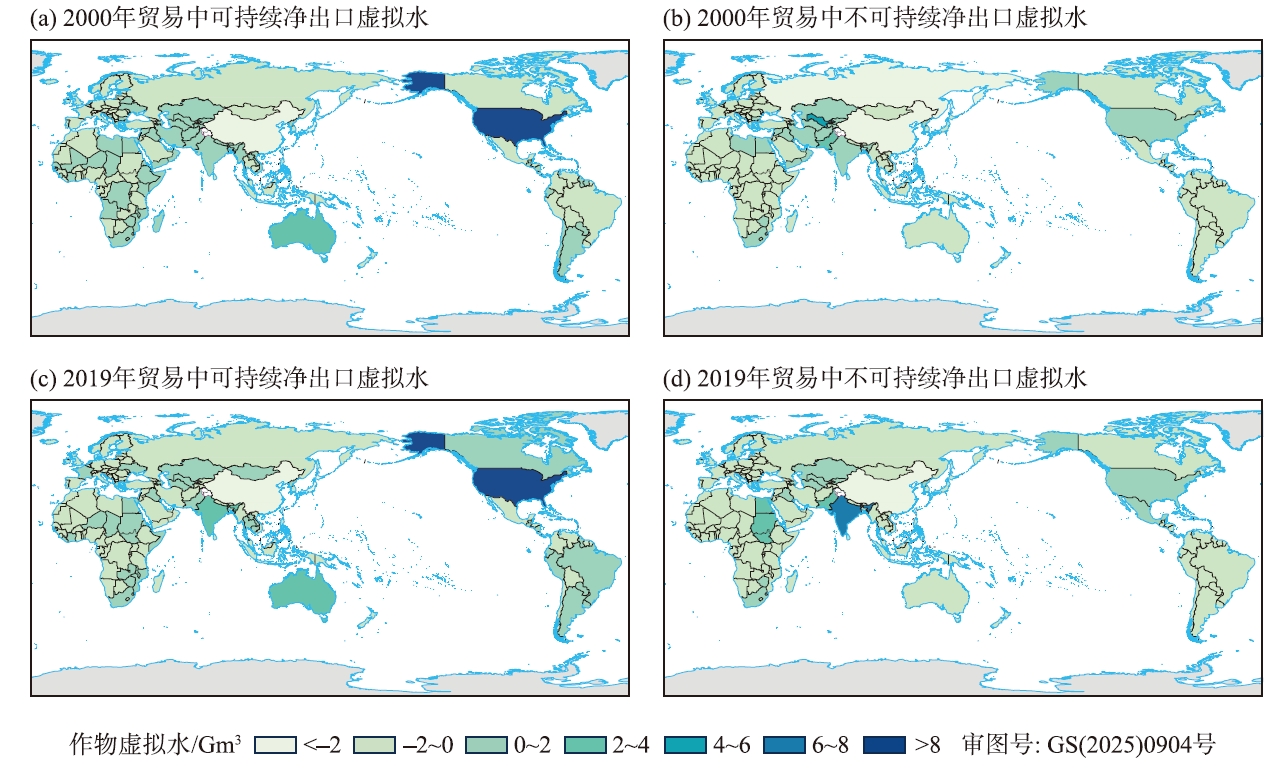
Fig. 2
Spatial distribution patterns of sustainable and unsustainable net exports of virtual crop trade water from 2000 to 2019"
Tab. 3
Estimated Moran’s I values for net exports of virtual crop trade water from 2000 to 2019"
| 指标 | 指数 | 2000年 | 2004年 | 2009年 | 2014年 | 2019年 |
|---|---|---|---|---|---|---|
| 农作物可持续净出口虚拟水 | Moran’s I值 | 0.00 | 0.00 | 0.00 | 0.00 | 0.00 |
| Z得分 | -0.18 | -0.16 | 0.38 | 0.36 | -0.08 | |
| P值 | 0.57 | 0.56 | 0.35 | 0.36 | 0.53 | |
| 农作物不可持续净出口虚拟水 | Moran’s I值 | 0.14 | 0.10 | 0.09 | 0.06 | 0.04 |
| Z得分 | 5.58 | 3.90 | 4.29 | 2.48 | 1.66 | |
| P值 | 0.00 | 0.00 | 0.00 | 0.01 | 0.05 |
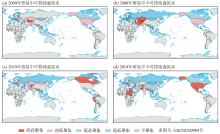
Fig. 3
Spatial LISA clustering patterns of sustainable and unsustainable net virtual water exports in global crop trade from 2000 to 2019"

Tab. 4
Comparison of MGWR Model and Linear Regression Model Results"
| R2 | 调整R2 | AIC | |
|---|---|---|---|
| OLS | 0.74 | 0.72 | 465.88 |
| MGWR | 0.83 | 0.80 | 289.00 |
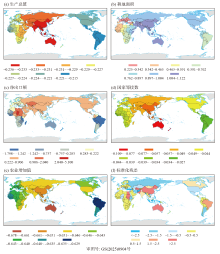
Fig. 4
Distribution of regression coefficients from the MGWR model for factors influencing the spatial differentiation of virtual water in net crop trade exports from 2000 to 2019"

| [1] |
Mekonnen M M, Hoekstra A Y. Blue water footprint linked to national consumption and international trade is unsustainable[J]. Nature Food, 2020, 1(12): 792-800.
doi: 10.1038/s43016-020-00198-1 pmid: 37128061 |
| [2] | 徐东来, 孙秀秀, 李文良, 等. 自然变化和人类活动影响下区域虚拟水贸易定量分析[J]. 人民黄河, 2023, 45(9): 90-95. |
| [Xu Donglai, Sun Xiuxiu, Li Wenliang, et al. Quantitative analysis of virtual water net exports under the impacts of natural changes and human activities[J]. Yellow River, 2023, 45(9): 90-95.] | |
| [3] | 邓光耀, 毛颖. 黄河流域虚拟水贸易核算及影响因素研究[J]. 人民黄河, 2024, 46(4): 68-72, 85. |
| [Deng Guangyao, Mao Ying. Study on virtual water trade accounting and its influencing factors in the Yellow River Basin[J]. Yellow River, 2024, 46(4): 68-72, 85.] | |
| [4] | Hanjra M A, Qureshi M E. Global water crisis and future food security in an era of climate change[J]. Food Policy, 2010, 35(5): 365-377. |
| [5] |
沈晓梅, 孔千慧, 于欣鑫, 等. 长三角地区农业虚拟水流动格局研究——基于水资源拓展的多地区投入产出分析[J]. 中国农村水利水电, 2023(9): 17-25.
doi: 10.12396/znsd.222415 |
|
[Shen Xiaomei, Kong Qianhui, Yu Xinxin, et al. Research on the pattern of agricultural virtual water flow in Yangtze River Delta: Based on water resource expanded MRIO model[J]. China Rural Water and Hydropower, 2023(9): 17-25.]
doi: 10.12396/znsd.222415 |
|
| [6] | 孙才志, 张佳亮. 中国与“一带一路”沿线国家农产品贸易的水资源压力效应[J]. 水利水电科技进展, 2023, 43(4): 1-8. |
| [Sun Caizhi, Zhang Jialiang. Effects of water resources stress on agricultural trade between China and countries along belt and road[J]. Advances in Science and Technology of Water Resources, 2023, 43(4): 1-8.] | |
| [7] | Nishad S N, Kumar N. Virtual water trade and its implications on water sustainability[J]. Water Supply, 2022, 22(2): 1704-1715. |
| [8] | 王宁, 董小刚, 钟耀, 等. 陕西省虚拟水产业配置及省际贸易时空变化[J]. 人民黄河, 2023, 45(3): 66-72. |
| [Wang Ning, Dong Xiaogang, Zhong Yao, et al. Temporal and spatial changes in the configuration of the virtual water industry and inter-provincial trade in Shaanxi[J]. Yellow River, 2023, 45(3): 66-72.] | |
| [9] |
洪思扬, 王红瑞, 程涛, 等. 国际及省际贸易视角下的中国虚拟水和隐含能源流通规律分析[J]. 地理科学, 2022, 42(10): 1735-1746.
doi: 10.13249/j.cnki.sgs.2022.10.006 |
|
[Hong Siyang, Wang Hongrui, Cheng Tao, et al. Circulation characteristics of virtual water and embodied energy in China from the perspective of international and inter-provincial trade[J]. Scientia Geographica Sinica, 2022, 42(10): 1735-1746.]
doi: 10.13249/j.cnki.sgs.2022.10.006 |
|
| [10] | Gu W, Wang F, Siebert S, et al. The asymmetric impacts of international agricultural trade on water use scarcity, inequality and inequity[J]. Nature Water, 2024, 2(4): 324-336. |
| [11] | 韩宇平, 李想, 苏潇雅, 等. 基于多区域投入产出模型的京津冀地区虚拟水贸易分析[J]. 华北水利水电大学学报(自然科学版), 2022, 43(5): 45-52. |
| [Han Yuping, Li Xiang, Su Xiaoya, et al. Virtual water trade in Beijing-Tianjin-Hebei Region based on multiregional input-output model[J]. Journal of North China University of Water Resources and Electric Power (Natural Science Edition), 2022, 43(5): 45-52.] | |
| [12] | 王珊珊, 刘小慧. 新发展理念下安徽省虚拟水贸易测算与分析[J]. 黑龙江工程学院学报, 2022, 36(3): 51-58. |
| [Wang Shanshan, Liu Xiaohui. Calculation and analysis of virtual water trade in Anhui Province under the new development principles[J]. Journal of Heilongjiang Institute of Technology, 2022, 36(3): 51-58.] | |
| [13] | 刘叶, 张馨戈, 王镇岳. 河南省农产品虚拟水贸易发展水平测度及其驱动因素分析[J]. 华北水利水电大学学报(自然科学版), 2022, 43(4): 29-35. |
| [Liu Ye, Zhang Xinge, Wang Zhenyue. Measurement of the development level of virtual water trade of agricultural products in Henan Province and analysis of its driving factors[J]. Journal of North China University of Water Resources and Electric Power (Natural Science Edition), 2022, 43(4): 29-35.] | |
| [14] | 杨晨, 马育军, 谢婷. 基于粮食作物的广州市虚拟水贸易研究[J]. 水文, 2022, 42(4): 96-100, 107. |
| [Yang Chen, Ma Yujun, Xie Ting. Research on virtual water trade based on grain crops in Guangzhou city[J]. Journal of China Hydrology, 2022, 42(4): 96-100, 107.] | |
| [15] | 杨婷婷, 张雪妮, 高翔, 等. 中国粮食省份间流通及对虚拟水土资源的影响[J]. 草业科学, 2022, 39(8): 1686-1697. |
| [Yang Tingting, Zhang Xueni, Gao Xiang, et al. Study on inter-provincial grain trade and its impacts on virtual water and soil resources in China[J]. Pratacultural Science, 2022, 39(8): 1686-1697.] | |
| [16] | 谢维维, 马忠. 黄河流域9个省(区)虚拟水流动格局及趋势研究[J]. 人民黄河, 2022, 44(10): 78-83. |
| [Xie Weiwei, Ma Zhong. Virtual water flow pattern and trend in the nine provinces of the Yellow River Basin[J]. Yellow River, 2022, 44(10): 78-83.] | |
| [17] |
Li Y, Zhong H, Shan Y, et al. Changes in global food consumption increase GHG emissions despite efficiency gains along global supply chains[J]. Nature Food, 2023, 4(6): 483-495.
doi: 10.1038/s43016-023-00768-z pmid: 37322300 |
| [18] | Hekmatnia M, Isanezhad A, Ardakani A F, et al. An attempt to develop a policy framework for the global sustainability of freshwater resources in the virtual water trade[J]. Sustainable Production and Consumption, 2023, 39: 311-325. |
| [19] | Gao J, Zhuo L, Liu Y, et al. Efficiency and sustainability of inter-provincial crop-related virtual water transfers in China[J]. Advances in Water Resources, 2020, 138: 103560. |
| [20] | Zhang L, Feng S, Zhang E, et al. How does virtual water influence the water stress pattern in Africa? A research perspective from the perspectives of production and trade[J]. Science of the Total Environment, 2024, 946: 174244. |
| [21] | Chouchane H, Krol M S, Hoekstra A Y. Virtual water trade patterns in relation to environmental and socioeconomic factors: A case study for Tunisia[J]. Science of the Total Environment, 2018, 613-614: 287-297. |
| [22] | Yang H, Wang L, Abbaspour K C, et al. Virtual water trade: An assessment of water use efficiency in the international food trade[J]. Hydrology and Earth System Sciences, 2006, 10(3): 443-454. |
| [23] | Liu W, Antonelli M, Kummu M, et al. Savings and losses of global water resources in food-related virtual water trade[J]. WIREs Water, 2019, 6(1): e1320. |
| [24] | Liu J, Williams J R, Zehnder A J B, et al. GEPIC-modelling wheat yield and crop water productivity with high resolution on a global scale[J]. Agricultural Systems, 2007, 94(2): 478-493. |
| [25] | Shao L, Guan D, Wu Z, et al. Multi-scale input-output analysis of consumption-based water resources: Method and application[J]. Journal of Cleaner Production, 2017, 164: 338-346. |
| [26] | Ye Q, Bruckner M, Wang R, et al. A hybrid multi-regional input-output model of China: Integrating the physical agricultural biomass and food system into the monetary supply chain[J]. Resources, Conservation and Recycling, 2022, 177: 105981. |
| [27] | Zhao H, Miller T R, Ishii N, et al. Global spatio-temporal change assessment in interregional water stress footprint in China by a high resolution MRIO model[J]. Science of the Total Environment, 2022, 841: 156682. |
| [28] | Kastner T, Kastner M, Nonhebel S. Tracing distant environmental impacts of agricultural products from a consumer perspective[J]. Ecological Economics, 2011, 70(6): 1032-1040. |
| [29] | Mialyk O, Schyns J F, Booij M J, et al. Water footprints and crop water use of 175 individual crops for 1990-2019 simulated with a global crop model[J]. Scientific Data, 2024, 11(1): 206. |
| [30] | Mekonnen M M, Hoekstra A Y. Four billion people facing severe water scarcity[J]. Science Advances, 2016, 2(2): e1500323. |
| [31] | Shan Y, Wang X, Wang Z, et al. The pattern and mechanism of air pollution in developed coastal areas of China: From the perspective of urban agglomeration[J]. PLoS One, 2020, 15(9): e023 7863. |
| [32] | Song W, Wang C, Chen W, et al. Unlocking the spatial heterogeneous relationship between Per Capita GDP and nearby air quality using bivariate local indicator of spatial association[J]. Resources, Conservation and Recycling, 2020, 160: 104880. |
| [33] | Hu Y, Li B, Zhang Z, et al. Farm size and agricultural technology progress: Evidence from China[J]. Journal of Rural Studies, 2022, 93: 417-429. |
| [34] | Gao Y, Zhao D, Yu L, et al. Influence of a new agricultural technology extension mode on farmers’ technology adoption behavior in China[J]. Journal of Rural Studies, 2020, 76: 173-183. |
| [35] | Khan N, Ray R L, Sargani G R, et al. Current progress and future prospects of agriculture technology: Gateway to sustainable agriculture[J]. Sustainability, 2021, 13(9): 4883. |
| [36] | 杨春, 韩正清. 农产品虚拟水实证研究——基于中国30个省市区主要农作物生产、消费、贸易数据[J]. 重庆工商大学学报(社会科学版), 2016, 33(3): 25-31. |
| [Yang Chun, Han Zhengqing. An empirical study on virtual water for agricultural products——production, consumption and trading data based on main crops of 30 provinces, cities and districts in China[J]. Journal of Chongqing Technology and Business University (Social Science Edition), 2016, 33(3): 25-31.] | |
| [37] |
Anderson R, Bayer P E, Edwards D. Climate change and the need for agricultural adaptation[J]. Curr Opin Plant Biol, 2020, 56: 197-202.
doi: S1369-5266(19)30121-9 pmid: 32057694 |
| [38] | Fukase E, Martin W. Economic growth, convergence, and world food demand and supply[J]. World Development, 2020, 132: 104954. |
| [39] | Piñeiro V, Arias J, Dürr J, et al. A scoping review on incentives for adoption of sustainable agricultural practices and their outcomes[J]. Nature Sustainability, 2020, 3(10): 809-820. |
| [40] | Zhang X, Yao G, Vishwakarma S, et al. Quantitative assessment of agricultural sustainability reveals divergent priorities among nations[J]. One Earth, 2021, 4(9): 1262-1277. |
| [41] | Chopra R, Magazzino C, Shah M I, et al. The role of renewable energy and natural resources for sustainable agriculture in ASEAN countries: Do carbon emissions and deforestation affect agriculture productivity?[J]. Resources Policy, 2022, 76: 102578. |
| [42] | Sridhar A, Balakrishnan A, Jacob M M, et al. Global impact of COVID-19 on agriculture: Role of sustainable agriculture and digital farming[J]. Environmental Science and Pollution Research, 2023, 30(15): 42509-42525. |
| [43] | Zhang D, Sial M S, Ahmad N, et al. Water scarcity and sustainability in an emerging economy: A management perspective for future[J]. Sustainability, 2021, 13(1): 144. |
| [44] | Mishra V, Thirumalai K, Jain S, et al. Unprecedented drought in south India and recent water scarcity[J]. Environmental research letters, 2021, 16(5): 54007. |
| [45] | Miao M, Liu H, Chen J. Factors affecting fluctuations in China’s aquatic product exports to Japan, the USA, South Korea, Southeast Asia, and the EU[J]. Aquaculture International, 2021, 29(6): 2507-2533. |
| [46] | Xia W, Chen X, Song C, et al. Driving factors of virtual water in international grain trade: A study for belt and road countries[J]. Agricultural Water Management, 2022, 262: 107441. |
| [47] | Wu B, Tian F, Zhang M, et al. Quantifying global agricultural water appropriation with data derived from earth observations[J]. Journal of Cleaner Production, 2022, 358: 131891. |
| [48] | Kastner T, Chaudhary A, Gingrich S, et al. Global agricultural trade and land system sustainability: Implications for ecosystem carbon storage, biodiversity, and human nutrition[J]. One Earth, 2021, 4(10): 1425-1443. |
| [49] | Erokhin V, Diao L, Du P. Sustainability-related implications of competitive advantages in agricultural value chains: Evidence from central asia—China trade and investment[J]. Sustainability, 2020, 12(3): 1117. |
| [50] | 朱启荣, 孙雪洁, 杨媛媛. 虚拟水视角下中国农产品进出口贸易节水问题研究[J]. 世界经济研究, 2016, 32(1): 87-98. |
| [Zhu Qirong, Sun Xuejie, Yang Yuanyuan. Saving water from China’s agricultural imports & exports based on virtual water[J]. World Economy Studies, 2016, 32(1): 87-98.] |
| [1] | DU Jun, LI Guang, DU Mengyin, YAO Yao, MA Weiwei, YUAN Jianyu. Effects of different land use types on soil N2O fluxes on the Loess Plateau [J]. Arid Zone Research, 2025, 42(6): 1043-1054. |
| [2] | ZHANG Lei, ZHOU Yuming, DONG Jiemou, LI Xiang, LIU Shidong, XU Liping. Spatiotemporal differentiation of nonagricultural and nongrain farmland in China and its management strategies [J]. Arid Zone Research, 2025, 42(2): 372-383. |
| [3] | ZHANG Wenrui, SUN Dongyuan, WANG Yike, YANG Jun, LAN Lijun, JIN Hujia, XU Yu. Coupling relationship and spatiao-temporal differentiation of the water resources-ecological environment-social economic system in the Hexi Corridor [J]. Arid Zone Research, 2024, 41(9): 1527-1537. |
| [4] | LYU Zhuangzhuang, QIAO Qingqing, DONG Sunyi, WANG Dong. Paleoclimatic evolution and driving mechanisms in arid areas of inland Asia during the Middle Miocene Climatic Optimum in the context of global climate warming [J]. Arid Zone Research, 2024, 41(8): 1309-1322. |
| [5] | WU Siyuan, HAO Lina. Changes in vegetation cover and driving factors in the Yellow River Basin from 2001 to 2021 [J]. Arid Zone Research, 2024, 41(8): 1373-1384. |
| [6] | ZHOU Jianwei, LUO Jun, MA Xueyang. Spatio-temporal evolution and driving factors of land use and ecosystem service value in the Lhasa River Basin, China [J]. Arid Zone Research, 2024, 41(6): 1021-1031. |
| [7] | XU Mingjing, FENG Qiang, LYU Meng. Tradeoffs of ecosystem services and their influencing factors: A case study of the Shanxi Section of the Yellow River Basin [J]. Arid Zone Research, 2024, 41(3): 467-479. |
| [8] | CHENG Qiulian, LIU Jie, YANG Zhiwei, ZHANG Tianyi, WANG Bin. Spatial distribution and factor analysis of avalanche in the Aerxiangou section of the Duku expressway [J]. Arid Zone Research, 2024, 41(2): 220-229. |
| [9] | WANG Chengwu, YAO Liangjie, WANG Zhoufeng, ZHANG Qiao, XIE Liang. Landscape ecological risk assessment and driving factors analysis in the Three River Source Region from 2000 to 2020 [J]. Arid Zone Research, 2024, 41(11): 1908-1920. |
| [10] | LIU Yidan, YAO Xiaojun, LI Zongxing, HU Jiayu. Impacts of climate change and land use/cover change on the net primary productivity of vegetation in Hexi Region, Northwest China [J]. Arid Zone Research, 2024, 41(1): 169-180. |
| [11] | CHEN Jiawei, CHU Jianmin, GAN Honghao, XU Lei, GONG Shuai, LIU Hao, WANG Yingxin, YANG Hongxiao, XU Xiaoqing, QI Danhui. Asociation characteristics of Amygdalus pedunculata and the environmental factors driving them in Otindag Sandy Land [J]. Arid Zone Research, 2023, 40(5): 777-784. |
| [12] | REN Liwen, WANG Xingtao, LIU Mingchun, WANG Dawei. Temporal and Spatial changes and the driving factors of vegetation NPP in Shiyang River Basin [J]. Arid Zone Research, 2023, 40(5): 818-828. |
| [13] | DONG Hanlin, WANG Wenting, XIE Yun, Aydana YESINALI, JIANG Yuantian, XU Jiaqi. Climate dry-wet conditions, changes, and their driving factors in Xinjiang [J]. Arid Zone Research, 2023, 40(12): 1875-1884. |
| [14] | ZHANG Haochen,SA Chula,MENG Fanhao,LUO Min,WANG Mulan,GAO Hongdou,ADIYA Saruulzaya. Dynamic changes and driving factors of the surface freeze-thaw index in Inner Mongolia [J]. Arid Zone Research, 2022, 39(6): 1996-2008. |
| [15] | YAO Jia,CHEN Qihui,LI Qiongfang,CUI Gang,ZHANG Liangjing. Spatial and temporal variability of evapotranspiration and influencing factors in the Ili River-Balkhash Lake Basin [J]. Arid Zone Research, 2022, 39(5): 1564-1575. |
|
||
