
Arid Zone Research ›› 2025, Vol. 42 ›› Issue (5): 895-906.doi: 10.13866/j.azr.2025.05.12
• Plant Ecology • Previous Articles Next Articles
LIU Xin1( ), ZHANG Yutao2,3(), SHI Qingdong1, LI Jimei2,3, SUN Xuejiao2,3
Received:2025-01-02
Revised:2025-03-26
Online:2025-05-15
Published:2025-10-22
Contact:
ZHANG Yutao
E-mail:lx779228239@163.com;zyt218@163.com
LIU Xin, ZHANG Yutao, SHI Qingdong, LI Jimei, SUN Xuejiao. Effects of levelling stubble on the growth of shrub communities and carbon sequestration in the shallow mountain belt of the northern slope of Tianshan Mountains[J].Arid Zone Research, 2025, 42(5): 895-906.
Add to citation manager EndNote|Reference Manager|ProCite|BibTeX|RefWorks

Fig. 1
Overview map of the study area"


Tab. 1
Basic information on sample plots"
| 平茬处理 | 群落组成 | 样地数量/个 | 灌木平均高度/m | 灌木平均冠幅/m2 | 平均盖度/% | 各样地平均株数/株 |
|---|---|---|---|---|---|---|
| CK | Sh 7株;Rp 8株;Ba 5株 | 4 | 0.42±0.04 | 0.71×0.64 | 34.07±0.02 | 19 |
| QP | Sh 8株;Rp 8株;Ba 4株 | 6 | 0.55±0.06 | 0.59×0.54 | 34.02±0.08 | 26 |
| LG1/2 | Sh 4株;Rp 9株;Ba 7株 | 4 | 0.69±0.09 | 0.71×0.68 | 41.13±0.10 | 26 |
| LG1/4 | Sh 5株;Rp 8株;Ba 7株 | 4 | 0.85±0.08 | 0.60×0.54 | 40.05±0.11 | 30 |
Tab. 2
Basic information on the sample plants in the assimilation chamber"
| 处理 | 同化箱内树种数量及组成 | 平均株高/m | 平均冠幅/m2 | 平均盖度/% |
|---|---|---|---|---|
| CK | Sh 2株;Rp 1株;Ba 1株 | 0.38±0.14 | 0.35±0.07 | 43.10±0.07 |
| QP | Sh 1株;Rp 1株;Ba 1株 | 0.42±0.06 | 0.32±0.06 | 45.06±0.06 |
| LG1/2 | Sh 1株;Rp 1株;Ba 1株 | 0.50±0.17 | 0.37±0.15 | 47.06±0.05 |
| LG1/4 | Sh 1株;Rp 1株;Ba 1株 | 0.65±0.26 | 0.32±0.09 | 50.03±0.11 |
Tab. 3
Rates of change in ground diameter of three shrubs with different levelling heights"
| 物种 | QP | LG1/2 | LG1/4 |
|---|---|---|---|
| 宽刺蔷薇 | 116.7 | 5.0 | 50.0 |
| 金丝桃叶绣线菊 | 33.3 | -33.3 | -6.7 |
| 黑果小檗 | 50.0 | 2.5 | -2.5 |
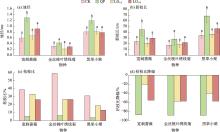
Fig. 2
Comparison of ground diameter, deadwood ratio and new branch height of shrub communities under different levelling heights"

Tab. 4
New branch length and rates of change of three shrubs with different levelling heights %"
| 指标 | 处理 | 物种 | ||
|---|---|---|---|---|
| 宽刺蔷薇 | 金丝桃叶绣线菊 | 黑果小檗 | ||
| 新枝长/cm | CK | 23.0 | 18.0 | 35.0 |
| QP | 44.0 | 28.0 | 73.0 | |
| LG1/2 | 21.0 | 20.0 | 38.0 | |
| LG1/4 | 29.0 | 22.0 | 48.0 | |
| 平茬处理与CK的新枝长度变化率/% | QP与CK | 91.2 | 56.5 | 109.2 |
| LG1/2与CK | -9.3 | 11.4 | 9.1 | |
| LG1/4与CK | 26.4 | 22.1 | 37.1 | |
Tab. 5
Number and rate of change of sprouting tillers of three shrubs at different levelling heights %"
| 指标 | 处理 | 物种 | ||
|---|---|---|---|---|
| 宽刺蔷薇 | 金丝桃叶绣线菊 | 黑果小檗 | ||
| 单株萌蘖枝条 数/个 | CK | 3 | 12 | 5 |
| QP | 10 | 28 | 21 | |
| LG1/2 | 5 | 16 | 13 | |
| LG1/4 | 8 | 18 | 16 | |
| 平茬处理与CK的单株萌蘖枝条数变化率/% | QP与CK | 233.1 | 133.2 | 323.0 |
| LG1/2与CK | 67.5 | 33.1 | 164.0 | |
| LG1/4与CK | 167.3 | 50.3 | 224.0 | |
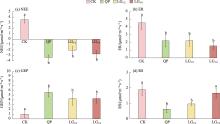
Fig. 3
Comparison of NEE, ER, RS and GEP of shrub communities under different flat stubble heights"

Tab. 6
Vertical changes in soil carbon and enzyme activity in shrub communities"
| 平茬处理 | 土层深度 /cm | 土壤有机碳 /(g·kg-1) | 土壤微生物量碳 /(mg·kg-1) | 脲酶 /[μg·(24h)-1·g-1] | 超氧化物歧化酶 /(U·g-1) | 磷酸酶 /[μmol·(24h)-1·g-1] |
|---|---|---|---|---|---|---|
| CK | 0~5 | 55.27±12.94 | 231.53±11.82 | 414.45±41.41 | 391.35±29.30 | 151.98±8.57 |
| 5~10 | 42.60±5.32 | 192.63±45.39 | 351.52±66.13 | 314.03±83.91 | 105.48±22.06 | |
| 10~20 | 32.78±6.07 | 144.03±67.68 | 142.20±21.01 | 292.98±20.20 | 43.57±6.38 | |
| 20~40 | 24.61±3.23 | 120.35±56.55 | 106.37±1.24 | 386.52±34.32 | 40.31±11.50 | |
| QP | 0~5 | 83.48±20.20 | 234.19±40.44 | 269.80±71.74 | 582.74±35.93 | 160.85±19.42 |
| 5~10 | 59.81±11.66 | 237.52±52.75 | 266.60±53.60 | 642.53±86.23 | 131.95±43.55 | |
| 10~20 | 46.39±7.85 | 263.53±62.87 | 166.67±57.96 | 517.83±55.37 | 84.08±3.10 | |
| 20~40 | 40.43±4.60 | 304.77±74.14 | 178.62±36.06 | 521.14±65.67 | 52.31±12.91 | |
| LG1/4 | 0~5 5~10 10~20 20~40 | 91.49±13.22 68.66±17.61 47.34±12.37 44.60±7.05 | 202.62±16.26 178.55±52.82 136.12±20.41 92.30±25.39 | 99.81±22.87 64.85±19.05 37.76±10.87 25.96±7.36 | 595.02±158.70 553.41±133.68 583.83±159.68 520.49±21.04 | 174.18±6.62 115.82±0.89 83.68±25.72 43.11±12.22 |
| LG1/2 | 0~5 5~10 10~20 20~40 | 88.43±11.84 56.97±7.17 35.41±2.83 37.03±7.02 | 211.14±8.71 229.16±20.41 200.02±57.39 165.33±17.29 | 349.34±52.66 294.86±58.32 235.72±56.56 194.64±59.61 | 491.81±26.64 472.25±48.15 388.04±77.31 418.56±88.58 | 159.58±15.38 118.56±35.37 89.44±21.12 82.89±16.21 |
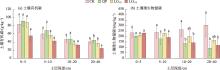
Fig. 4
Changes in soil organic carbon and soil microbid biomass carbon of shrub communities under different levelling height"


Fig. 5
Changes in soil urease, superoxide dismutase, phosphatase activities of shrub communities under different levelling heights"

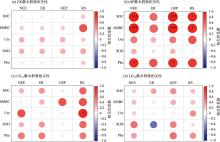
Fig. 6
Comparison of shrub community correlations at different levelling heights"

| [1] | 张颖, 李晓格, 温亚利. 碳达峰碳中和背景下中国森林碳汇潜力分析研究[J]. 北京林业大学学报, 2022, 44(1): 38-47. |
| [Zhang Ying, Li Xiaoge, Wen Yali. Forest carbon sequestration potential in China under the background of carbon emission peak and carbon neutralization[J]. Journal of Beijing Forestry University, 2022, 44(1): 38-47.] | |
| [2] | Zhou B H, Liao Z Z, Chen S R, et al. Net primary productivity of forest ecosystems in the southwest karst region from the perspective of carbon neutralization[J]. Forests, 2022, 13(9): 1367. |
| [3] | 付玉杰, 田地, 侯正阳, 等. 全球森林碳汇功能评估研究进展[J]. 北京林业大学学报, 2022, 44(10): 1-10. |
| [Fu Yujie, Tian Di, Hou Zhengyang, et al. Review on the evaluation of global forest carbon sink function[J]. Journal of Beijing Forestry University, 2022, 44(10): 1-10.] | |
| [4] | 朴世龙, 岳超, 丁金枝, 等. 试论陆地生态系统碳汇在“碳中和”目标中的作用[J]. 中国科学: 地球科学, 2022, 52(7): 1419-1426. |
| [Piao Shilong, Yue chao, Ding Jinzhi, et al. Perspectives on the role of terrestrial ecosystems in the “carbon neutrality” strategy[J]. Scientia Sinica Terrae, 2022, 52(7): 1419-1426.] | |
| [5] | 王兴昌, 王传宽, 于贵瑞. 基于全球涡度相关的森林碳交换的时空格局[J]. 中国科学(D辑:地球科学), 2008, 38(9): 1092-1102. |
| [Wang Xingchang, Wang Chuankuan, Yu Guirui. Spatiotemporal patterns of forest carbon exchange based on global eddy covariance[J]. Scientia Sinica (Terrae), 2008, 38(9): 1092-1102.] | |
| [6] | 周丽艳, 贾丙瑞, 周广胜, 等. 中国北方针叶林生长季碳交换及其调控机制[J]. 应用生态学报, 2010, 21(10): 2449-2456. |
|
[Zhou Liyan, Jia Binrui, Zhou Guangsheng, et al. Carbon exchange of Chinese boreal forest during its growth season and related regulation mechanisms[J]. Chinese Journal of Applied Ecology, 2010, 21(10): 2449-2456.]
pmid: 21328928 |
|
| [7] | 陈骥. 模拟增温和围栏封育对青海湖北岸高寒草甸化草原生态系统碳交换影响[D]. 西安: 中国科学院研究生院(地球环境研究所), 2015. |
| [Chen Ji. Effects of Simulated Warming and Fencing on Carbon Exchange in Alpine Meadow-steppe Ecosystems on the Northern Shore of Qinghai Lake[D]. Xi’an: Institute of Earth Environment, Chinese Academy of Sciences, 2015.] | |
| [8] | 方显瑞. 杨树人工林生态系统碳交换及其环境响应[D]. 北京: 北京林业大学, 2011. |
| [Fang Xianrui. Carbon Exchange and Environmental Response of Poplar Plantation Ecosystems[D]. Beijing: Beijing Forestry University, 2011.] | |
| [9] | 李金山, 马旭君, 吴晶, 等. 不同强度平茬对柠条生长及养分归还的影响[J]. 西部林业科学, 2023, 52(1): 57-63. |
| [Li Jinshan, Ma Xujun, Wu Jing, et al. Effects of different intensities of thinning on the growth and nutrient return of Caragana korshinskii[J]. Journal of West China Forestry Science, 2023, 52(1): 57-63.] | |
| [10] | 李宇, 徐新文, 许波, 等. 塔里木沙漠公路防护林乔木状沙拐枣平茬复壮技术的研究[J]. 干旱区资源与环境, 2014, 28(2): 103-108. |
| [Li Yu, Xu Xinwen, Xu Bo, et al. Cutting rejuvenation technologies for Calligonum arborescens shelterbelt along the Tarim desert highway[J]. Journal of Arid Land Resources and Environment, 2014, 28(2): 103-108.] | |
| [11] | 裴志永, 段广东, 郝少荣, 等. 基于防风效益的毛乌素沙地沙柳灌丛平茬方法优选[J]. 农业工程学报, 2019, 35(4): 153-161. |
| [Pei Zhiyong, Duan Guangdong, Hao Shaorong, et al. Optimization of stumping method based on wind control benefit for Salix psammophila shrub in Mu Us Sandy Land[J]. Transactions of the Chinese Society of Agricultural Engineering, 2019, 35(4): 153-161.] | |
| [12] | 尼珍, 赵垦田, 杨小林, 等. 平茬高度对砂生槐萌蘖的影响[J]. 林业调查规划, 2014, 39(3): 114-116. |
| [Ni Zhen, Zhao Kentian, Yang Xiaolin, et al. Effects of flat stubble height on sprout tillers of Sophora moorcroftiana[J]. Forest Inventory and Planning, 2014, 39(3): 114-116.] | |
| [13] | Noormets A, Epron D, Domec J C, et al. Effects of forest management on productivity and carbon sequestration: A review and hypothesis[J]. Forest Ecology and Management, 2015, 355: 124-140. |
| [14] | Nophea K P, Wolfgang K, Sophanarith K. Appropriate measures for conservation of terrestrial carbon stocks: Analysis of trends of forest management in Southeast Asia[J]. Forest Ecology and Management, 2004, 191(1-3): 283-299. |
| [15] | 张泽宁, 李芳, 郭彩云, 等. 中国沙棘伐桩萌枝能力对平茬高度的响应[J]. 西南林业大学学报(自然科学), 2020, 40(6): 34-39. |
| [Zhang Zhening, Li Fang, Guo Caiyun, et al. Response of sprouting ability of Hippophae rhamnoides ssp. sinensis to stubble height[J]. Journal of Southwest Forestry University (Natural Sciences), 2020, 40(6): 34-39.] | |
| [16] | 聂恺宏, 吉生丽, 邹旭, 等. 中国沙棘平茬萌蘖动态及其对种群结构的影响[J]. 云南大学学报(自然科学版), 2018, 40(4): 804-813. |
| [Nie Kaihong, Ji Shengli, Zou Xu, et al. Dynamics of sprouting of Hippophae rhamnoides and its effects on population structure[J]. Journal of Yunnan University (Natural Sciences Edition), 2018, 40(4): 804-813.] | |
| [17] | Ella A, Jacobsen C, Stür W W, et al. Effect of plant density and cutting frequency on the productivity of four tree legumes[J]. Tropical Grasslands, 1989, 23(1): 28-34. |
| [18] | Erdmann T K, Nair P K R, Kang B T. Effects of cutting frequency and cutting height on reserve carbohydrates in Gliricidia sepium (Jacq.) Walp.[J]. Forest Ecology and Management, 1993, 57(1): 45-60. |
| [19] | Laurent M, Tang J W, Ming X, et al. Influences of recovery from clear-cut, climate variability, and thinning on the carbon balance of a young ponderosa pine plantation[J]. Agricultural and Forest Meteorology, 2005, 130(3): 207-222. |
| [20] | 田登娟, 白双成, 聂恺宏, 等. 平茬高度对中国沙棘萌枝能力及非结构性碳水化合物积累与分配的影响[J]. 西北植物学报, 2021, 41(4): 627-634. |
| [Tian Dengjuan, Bai Shuangcheng, Nie Kaihong, et al. Effects of stubble height on sprouting ability and non-structural carbohydrates accumulation and distribution of Hippophae rhamnoides ssp. sinensis[J]. Acta Botanica Boreali-Occidentalia Sinica, 2021, 41(4): 627-634.] | |
| [21] | 于文涛. 平茬措施对柠条生理特征及土壤理化性质的影响[D]. 杨凌: 西北农林科技大学, 2016. |
| [Yu Wentao. Effects of Cutting Measures on the Physiological Characteristics of Caragana korshinskii and Soil Physicochemical Properties[D]. Yangling: Northwest A & F University, 2016.] | |
| [22] | 董雪, 郝玉光, 辛智鸣, 等. 科尔沁沙地4种典型灌木灌丛下土壤碳、氮、磷化学计量特征[J]. 西北植物学报, 2019, 39(1): 164-172. |
| [Dong Xue, Hao Yuguang, Xin Zhiming, et al. Stoichiometric characteristics of soil carbon, nitrogen and phosphorus of four typical shrubs in Horqin Sandy Land[J]. Acta Botanica Boreali-Occidentalia Sinica, 2019, 39(1): 164-172.] | |
| [23] | 李元, 时伟宇, 闫美杰, 等. 土壤呼吸影响因素概述及展望[J]. 水土保持研究, 2013, 20(5): 311-316. |
| [Li Yuan, Shi Weiyu, Yan Meijie, et al. Review and prospect on impact factors of soil respiration[J]. Research of Soil and Water Conservation, 2013, 20(5): 311-316.] | |
| [24] | Ilmarinen K, Mikola J. Soil feedback does not explain mowing effects on vegetation structure in a semi-natural grassland[J]. Acta Oecologica, 2009, 35(6): 838-848. |
| [25] |
谢宗强, 唐志尧. 中国灌丛生态系统碳储量的研究[J]. 植物生态学报, 2017, 41(1): 1-4.
doi: 10.17521/cjpe.2017.0012 |
|
[Xie Zongqiang, Tang Zhiyao. Studies on carbon storage of shrubland ecosystems in China[J]. Chinese Journal of Plant Ecology, 2017, 41(1): 1-4.]
doi: 10.17521/cjpe.2017.0012 |
|
| [26] | 陈晓阳. 中国灌木林资源[M]. 北京: 中国林业出版社, 2021. |
| [Chen Xiaoyang. Resources of Shrub Forests in China[M]. Beijing: China Forestry Publishing House, 2021.] | |
| [27] | 肖媛媛, 冯薇, 乔艳桂, 等. 固沙灌木林地土壤微生物群落特征对土壤多功能性的影响[J]. 生物多样性, 2023, 31(4): 128-141. |
| [Xiao Yuanyuan, Feng Wei, Qiao Yangui, et al. Effects of soil microbial community characteristics on soil multifunctionality in sand-fixation shrublands[J]. Biodiversity Science, 2023, 31(4): 128-141.] | |
| [28] | 李文, 李小龙, 刘玉祯, 等. 不同强度放牧对东祁连山高寒灌丛土壤理化特征的影响[J]. 草原与草坪, 2020, 40(4): 8-15. |
| [Li Wen, Li Xiaolong, Liu Yuzhen, et al. Effects of long-term grazing with different intensities on soil physicochemical characteristics of alpine shrub in the eastern Qilian Mountains[J]. Grassland and Turf, 2020, 40(4): 8-15.] | |
| [29] | 刘启嵘. 平茬对沙柳生长及碳汇能力的影响[D]. 呼和浩特: 内蒙古农业大学, 2022. |
| [Liu Qirong. Effects of Levelling Stubble on the Growth and Carbon Sink Capacity of Salix[D]. Hohhot: Inner Mongolia Agricultural University, 2022.] | |
| [30] | 骆土寿, 陈步峰, 李意德, 等. 海南岛尖峰岭热带山地雨林土壤和凋落物呼吸研究[J]. 生态学报, 2001, 21(12): 2013-2017. |
| [Luo Tushou, Chen Bufeng, Li Yide, et al. Litter and soil respiration in a tropical mountain rain forest in Jianfengling, Hainan Island[J]. Acta Ecologica Sinica, 2001, 21(12): 2013-2017.] | |
| [31] | 李耀林, 郭忠升. 平茬对半干旱黄土丘陵区柠条林地土壤水分的影响[J]. 生态学报, 2011, 31(10): 2727-2736. |
| [Li Yaolin, Guo Zhongsheng. Effect of cutting management on soil moisture in semi-arid Loess Hilly region[J]. Acta Ecologica Sinica, 2011, 31(10): 2727-2736.] |
| [1] | PEI Hongze, ZHAO Yachao, ZHANG Tinglong. Analysis of spatial and temporal patterns and drivers of local regional NEP in the Loess Plateau from 2000 to 2020 [J]. Arid Zone Research, 2023, 40(11): 1833-1844. |
| [2] | ZHANG Manyu, WANG Zhitao, DENG Lei, ZHOU Hong. Differences in the physical and chemical properties of biological soil crusts in different shrub communities in the Gonghe Basin [J]. Arid Zone Research, 2023, 40(11): 1797-1805. |
| [3] | ZHANG Yang,ZHU Gaofeng,QIN Wenhua,ZHAO Nan,CHEN Huiling. Net carbon exchange and its influencing factors of the oasis vineyard in China’s northwest arid region [J]. Arid Zone Research, 2021, 38(3): 833-842. |
|
||
