
Arid Zone Research ›› 2025, Vol. 42 ›› Issue (4): 668-681.doi: 10.13866/j.azr.2025.04.09
• Ecology and Environment • Previous Articles Next Articles
ZHANG Yan1,2( ), YANG Weixin1,2, LYU Tao1,2
Received:2024-09-04
Revised:2025-02-26
Online:2025-04-15
Published:2025-04-10
ZHANG Yan, YANG Weixin, LYU Tao. Driving factors analysis and multi-scenario simulation of land use change based on GeoDetector-Mixed-cell Cellular Automata: A case of the Gansu section in the Yellow River Basin[J].Arid Zone Research, 2025, 42(4): 668-681.
Add to citation manager EndNote|Reference Manager|ProCite|BibTeX|RefWorks
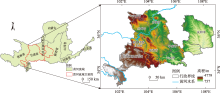
Fig. 1
Location map of the Gansu section in the Yellow River Basin"

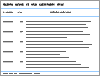
Tab. 1
Land use intensity classification of the Gansu section in the Yellow River Basin"
| 土地利用类型 | 未利用地 | 林地、草地、水域 | 耕地 | 建设用地 |
|---|---|---|---|---|
| 分级指数 | 1 | 2 | 3 | 4 |
Tab. 2
Situation construction"
| 情景类型 | 设置依据 | 描述 |
|---|---|---|
| 自然演变情景 | 遵循历史惯性 | 以黄河流域甘肃段2005—2020年土地利用数据为基础利用MCCA模型线性回归模块得到预期土地利用结构占比,不考虑政策等其他约束作用 |
| 耕地保护情景 | 国家粮食安全战略、耕地保护政策 | 严守耕地红线,控制耕地数量,响应国家粮食安全战略,保证区域粮食安全。该情景降低耕地向外转换强度,并减缓建设用地的增长速率 |
| 生态优先情景 | 国土空间生态修复、黄河流域生态保护 | 该情景重点考虑生态环境,强化生态用地保护和多元化利用,将林地、水域预期面积提高5%,且禁止林地、草地、水域转变为建设用地 |
| 经济发展情景 | 城镇化发展动力强劲,建设用地需求增大 | 强调以经济发展和城市建设为核心,保持高速增长的态势,将建设用地预期面积提高至2020年的1.3倍,并减缓耕地、水域的缩减速率 |
Tab. 3
Transition matrix for simulated scenarios"
| 2020— 2035年 | 自然演变 | 耕地保护 | 生态优先 | 经济发展 | |||||||||||||||||||||||
|---|---|---|---|---|---|---|---|---|---|---|---|---|---|---|---|---|---|---|---|---|---|---|---|---|---|---|---|
| a | b | c | d | e | f | a | b | c | d | e | f | a | b | c | d | e | f | a | b | c | d | e | f | ||||
| a | 1 | 1 | 1 | 0 | 1 | 0 | 1 | 0 | 0 | 0 | 0 | 0 | 1 | 1 | 1 | 0 | 1 | 0 | 1 | 1 | 1 | 0 | 1 | 0 | |||
| b | 1 | 1 | 1 | 0 | 0 | 0 | 1 | 1 | 1 | 0 | 1 | 0 | 0 | 1 | 0 | 0 | 0 | 0 | 1 | 1 | 1 | 0 | 1 | 0 | |||
| c | 1 | 1 | 1 | 1 | 1 | 1 | 1 | 1 | 1 | 1 | 1 | 1 | 0 | 1 | 1 | 0 | 0 | 0 | 1 | 1 | 1 | 1 | 1 | 1 | |||
| d | 1 | 0 | 1 | 1 | 1 | 0 | 1 | 0 | 1 | 1 | 1 | 0 | 0 | 0 | 0 | 1 | 0 | 0 | 1 | 0 | 1 | 1 | 1 | 0 | |||
| e | 1 | 0 | 0 | 0 | 1 | 0 | 1 | 0 | 0 | 0 | 1 | 0 | 1 | 0 | 1 | 1 | 1 | 0 | 0 | 0 | 0 | 0 | 1 | 0 | |||
| f | 1 | 1 | 1 | 1 | 1 | 1 | 1 | 1 | 1 | 1 | 1 | 1 | 1 | 1 | 1 | 1 | 1 | 1 | 1 | 1 | 1 | 1 | 1 | 1 | |||
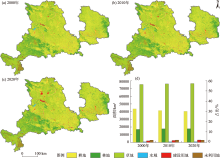
Fig. 2
Spatial and temporal distribution of land use types of the Gansu section in the Yellow River Basin from 2000 to 2020"

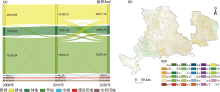
Fig. 3
Sankey diagram of land use transfer and transfer map from 2000 to 2020"

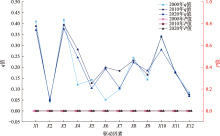
Fig. 4
Driver detection results from 2000 to 2020"

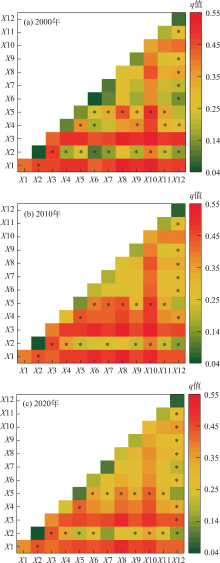
Fig. 5
Interaction detection results of driving factors"

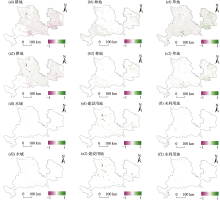
Fig. 6
Actual (a1-f1) and simulated (a2-f2) degree of change in land use composition"

Tab. 4
Dynamic changes of land use area under multiple scenarios in 2020 and 2035"
| 土地利用类型 | 2020年 | 2035年 | ||||||||||||
|---|---|---|---|---|---|---|---|---|---|---|---|---|---|---|
| 利用现状 | 自然演变 | 耕地保护 | 生态优先 | 经济发展 | ||||||||||
| 面积/km2 | 占比/% | 面积/km2 | 占比/% | 面积/km2 | 占比/% | 面积/km2 | 占比/% | 面积/km2 | 占比/% | |||||
| 耕地 | 40377.18 | 28.43 | 38710.09 | 27.26 | 40416.20 | 28.46 | 39016.95 | 27.47 | 39329.49 | 27.69 | ||||
| 林地 | 17864.79 | 12.58 | 17898.04 | 12.60 | 17924.73 | 12.62 | 18323.39 | 12.91 | 18136.55 | 12.77 | ||||
| 草地 | 76359.54 | 53.77 | 77274.01 | 54.41 | 75821.99 | 53.39 | 77316.72 | 54.44 | 76276.51 | 53.71 | ||||
| 水域 | 969.04 | 0.68 | 995.78 | 0.70 | 947.74 | 0.67 | 1009.80 | 0.71 | 1005.10 | 0.71 | ||||
| 建设用地 | 3308.93 | 2.33 | 4153.44 | 2.92 | 3951.87 | 2.77 | 3852.74 | 2.71 | 4285.56 | 3.02 | ||||
| 未利用地 | 3132.55 | 2.21 | 2980.67 | 2.10 | 2949.52 | 2.08 | 2492.42 | 1.76 | 2978.83 | 2.10 | ||||
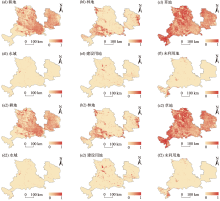
Fig. 7
Land use structure diagram of 2020 (a1-f1) and 2035 natural evolution scenario (a2-f2)"

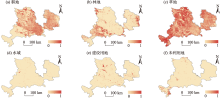
Fig. 8
Land use structure of cultivated land protection scenario in 2035"

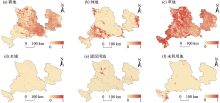
Fig. 9
Land use structure map of ecological priority scenarios in 2035"

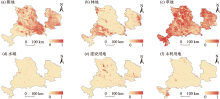
Fig. 10
Land use structure map of economic development scenarios in 2035"

| [1] | 崔国屹, 张艳, 晁阳, 等. 秦岭地区近40年土地利用变化及其生态环境效应[J]. 水土保持研究, 2023, 30(1): 319-326. |
| [Cui Guoyi, Zhang Yan, Chao Yang, et al. Land use change and eco-environmental effects in Qinling Mountains in recent 40 years[J]. Research of Soil and Water Conservation, 2023, 30(1): 319-326.] | |
| [2] | Zheng F, Hu Y. Assessing temporal-spatial land use simulation effects with CLUE-Sand Markov-CA models in Beijing[J]. Environmental Science and Pollution Research, 2018, 25(32): 32231-32245. |
| [3] |
白娥, 薛冰. 土地利用与土地覆盖变化对生态系统的影响[J]. 植物生态学报, 2020, 44(5): 543-552.
doi: 10.17521/cjpe.2020.0071 |
|
[Bai E, Xue Bing. A review of influences of land use and land cover change on ecosystems[J]. Chinese Journal of Plant Ecology, 2020, 44(5): 543-552.]
doi: 10.17521/cjpe.2020.0071 |
|
| [4] |
王鹏, 秦思彤, 胡慧蓉. 近30 a拉萨河流域土地利用变化和生境质量的时空演变特征[J]. 干旱区研究, 2023, 40(3): 492-503.
doi: 10.13866/j.azr.2023.03.15 |
|
[Wang Peng, Qin Sitong, Hu Huirong. Spatial-temporal evolution characteristics of land use change and habitat quality in the Lhasa River Basin over the past three decades[J]. Arid Zone Research, 2023, 40(3): 492-503.]
doi: 10.13866/j.azr.2023.03.15 |
|
| [5] |
高宇婷, 于洋, 孙凌霄, 等. 塔里木盆地南缘绿洲土地覆盖变化及驱动力[J]. 干旱区研究, 2021, 38(4): 1172-1183.
doi: 10.13866/j.azr.2021.04.29 |
|
[Gao Yuting, Yu Yang, Sun Lingxiao, et al. Land coverage change and driving forces of an oasis in the southern margin of Tarim Basin[J]. Arid Zone Research, 2021, 38(4): 1172-1183.]
doi: 10.13866/j.azr.2021.04.29 |
|
| [6] | 郝晓敬, 张红, 徐小明, 等. 晋北地区土地利用覆被格局的演变与模拟[J]. 生态学报, 2020, 40(1): 257-265. |
| [Hao Xiaojing, Zhang Hong, Xu Xiaoming, et al. Evolution and simulation of land use/land cover pattern in northern Shanxi Province[J]. Acta Ecologica Sinica, 2020, 40(1): 257-265.] | |
| [7] | 张浚茂, 臧传富. 东南诸河流域1990—2015年土地利用时空变化特征及驱动机制[J]. 生态学报, 2019, 39(24): 9339-9350. |
| [Zhang Junmao, Zang Chuanfu. Spatial and temporal variability characteristics and driving mechanisms of land use in the Southeastern River Basin from 1990 to 2015[J]. Acta Ecologica Sinica, 2019, 39(24): 9339-9350.] | |
| [8] |
邓元杰, 侯孟阳, 张晓, 等. 基于Logistic回归模型的陕西秦巴山区林地变化驱动力分析[J]. 南京林业大学学报(自然科学版), 2022, 46(1): 106-114.
doi: 10.12302/j.issn.1000-2006.202009045 |
| [Deng Yuanjie, Hou Mengyang, Zhang Xiao, et al. Drivers of forestland change in the Qinba Mountain region of Shaanxi based on the Logistic regression model[J]. Journal of Nanjing Forestry University (Natural Science Edition), 2022, 46(1): 106-114.] | |
| [9] | 张启扬, 刘仁志, 栾朝旭. 基于PLUS模型的典型农牧交错带土地利用驱动力分析与多情景模拟[J]. 水土保持研究, 2025, 32(1): 368-378. |
| [Zhang Qiyang, Liu Renzhi, Luan Chaoxu. Analysis of driving force and multi-scenario simulation of land use in a typical agro-pastoral ecotone based on the PLUS model[J]. Research of Soil and Water Conservation, 2025, 32(1): 368-378.] | |
| [10] | 杨丽萍, 张静, 贡恩军, 等. GEE联合多源数据的西安市土地利用时空格局及驱动力分析[J]. 农业工程学报, 2022, 38(2): 279-288. |
| [Yang Liping, Zhang Jing, Gong Enjun, et al. Analysis of spatio-temporal land-use patterns and the driving forces in Xi’an City using GEE and multi-source data[J]. Transactions of the Chinese Society of Agricultural Engineering (Transactions of the CSAE), 2022, 38(2): 279-288.] | |
| [11] |
刘彦随, 李进涛. 中国县域农村贫困化分异机制的地理探测与优化决策[J]. 地理学报, 2017, 72(1): 161-173.
doi: 10.11821/dlxb201701013 |
|
[Liu Yansui, Li Jintao. Geographic detection and optimizing decision of the differentiation mechanism of rural poverty in China[J]. Acta Geographica Sinica, 2017, 72(1): 161-173.]
doi: 10.11821/dlxb201701013 |
|
| [12] | 王萍, 林乐乐, 彭杨靖, 等. 基于CLUE-S模型的浙江省土地利用结构变化趋势分析[J]. 生态科学, 2024, 43(3): 196-206. |
| [Wang Ping, Lin Lele, Peng Yangjing, et al. The trend analysis of land-use structure change in Zhejiang Province based on CLUE-S Model[J]. Ecological Science, 2024, 43(3): 196-206.] | |
| [13] |
祁育汀, 张平, 刘雷, 等. 关中平原城市群土地利用结构多情景优化和生态系统服务价值预测[J]. 应用生态学报, 2023, 34(9): 2507-2517.
doi: 10.13287/j.1001-9332.202309.009 |
|
[Qi Yuting, Zhang Ping, Liu Lei, et al. Multi-scenario optimization of land use structure and prediction of ecosystem service value in Guanzhong Plain urban agglomeration[J]. Chinese Journal of Applied Ecology, 2023, 34(9): 2507-2517.]
doi: 10.13287/j.1001-9332.202309.009 |
|
| [14] | 黎云云, 畅建霞, 王义民, 等. 基于CA-Markov模型的黄河流域土地利用模拟预测研究[J]. 西北农林科技大学学报(自然科学版), 2020, 48(12): 107-116. |
| [Li Yunyun, Chang Jianxia, Wang Yimin, et al. Land use simulation and prediction in the Yellow River Basin based on CA-Markov model[J]. Journal of Northwest A & F University (Natural Science Edition), 2020, 48(12): 107-116.] | |
| [15] | 兰健, 渠立权. 未来10年珠江流域土地利用多情景模拟及碳储量评估[J]. 水土保持学报, 2024, 38(3):266-275. |
| [Lan Jian, Qu Liquan. Multi-scenario simulation of land use and carbon storage assessment in the Pearl River Basin in the next decade[J]. Journal of Soil and Water Conservation, 2024, 38(3): 266-275.] | |
| [16] | 张寒冰, 高阳, 崔艳智. 基于风沙防治的典型农牧交错区土地利用多情景模拟[J]. 环境科学研究, 2019, 32(6): 1081-1089. |
| [Zhang Hanbing, Gao Yang, Cui Yanzhi. Multi-scenarios simulation of land use for reducing wind erosion in typical agro-pastoral ecotone[J]. Research of Environmental Sciences, 2019, 32(6): 1081-1089.] | |
| [17] | 王丹, 兰安军, 范泽孟, 等. 典型喀斯特区域土地利用变化对生态系统服务价值的响应情景模拟[J]. 水土保持研究, 2024, 31(4): 308-315, 325. |
| [Wang Dan, Lan Anjun, Fan Zemeng, et al. Scenario modeling of response of land use change to ecosystem service values in a typical Karst Region[J]. Research of Soil and Water Conservation, 2024, 31(4): 308-315, 325.] | |
| [18] | 唐相龙, 蔡乐山, 张博文. 生态过渡带土地利用及生态系统服务价值多情景模拟:以甘肃省为例[J/OL]. 生态与农村环境学报, 1-15. https://doi.org/10.19741/j.issn.1673-4831.2024.0439. |
| [Tang Xianglong, Cai Leshan, Zhang Bowen. Multi-scenario simulation of land use and ecosystem service value in Ecological Transition Zone: A case study of Gansu Province[J/OL]. Journal of Ecology and Rural Environment, 1-15. https://doi.org/10.19741/j.issn.1673-4831.2024.0439.] | |
| [19] | Vandansambuu B, Davaa T, Gantumur B, et al. Spatiotemporal monitoring and prediction of land use/land cover changes using CA-Markov Chain model: A case study in Orkhon Province, Mongolia[C]// Conference on remote sensing technologies and applications in urban environments, 2020. |
| [20] |
王端睿, 毛德华, 王宗明, 等. 东北地区土地覆被格局变化模拟:基于CLUE-S和Markov-CA模型的对比分析[J]. 地理科学, 2024, 44(2): 329-339.
doi: 10.13249/j.cnki.sgs.20221043 |
|
[Wang Duanrui, Mao Dehua, Wang Zongming, et al. Simulation of land cover pattern change in Northeast China: A comparative analysis based on CLUE-S and Markov-CA models[J]. Scientia Geographica Sinica, 2024, 44(2): 329-339.]
doi: 10.13249/j.cnki.sgs.20221043 |
|
| [21] |
王旭东, 姚尧, 任书良, 等. 耦合FLUS和Markov的快速发展城市土地利用空间格局模拟方法[J]. 地球信息科学学报, 2022, 24(1): 100-113.
doi: 10.12082/dqxxkx.2022.210359 |
| [Wang Xudong, Yao Yao, Ren Shuliang, et al. A coupled FLUS and Markov approach to simulate the spatial pattern of land use in rapidly developing cities[J]. Journal of Geo-information Science, 2022, 24(1): 100-113.] | |
| [22] | 陶伟, 刘译泽, 孙清, 等. 基于GeoSOS模型的金华市土地利用变化动态模拟[J]. 浙江师范大学学报(自然科学版), 2024, 47(3): 249-256. |
| [Tao Wei, Liu Yize, Sun Qing, et al. Dynamic simulation of land use and cover change in Jinhua based on GeoSOS[J]. Journal of Zhejiang Normal University, 2024, 47(3): 249-256.] | |
| [23] |
张艳, 李骏南, 潘博华. 基于PLUS模型的黄河流域生态系统服务评价及多情景预测——以陕西段为例[J]. 干旱区地理, 2024, 47(11): 1935-1946.
doi: 10.12118/j.issn.1000-6060.2023.651 |
|
[Zhang Yan, Li Junnan, Pan Bohua. Evaluation and multi-scenario prediction of ecosystem services in the Yellow River Basin based on PLUS model: A case of Shaanxi section[J]. Arid Land Geography, 2024, 47(11): 1935-1946.]
doi: 10.12118/j.issn.1000-6060.2023.651 |
|
| [24] | Qin X, Fu B. Assessing and predicting changes of the ecosystem service values based on land use/land cover changes with a random Forest-Cellular Automata model in Qingdao Metropolitan Region, China[J]. IEEE Journal of Selected Topics in Applied Earth Observations and Remote Sensing, 2020, 13: 6484-6494. |
| [25] | Liang Xun, Guan Qingfeng, Clarke, et al. Mixed-cell Cellular Automata: A new approach for simulating the spatio-temporal dynamics of mixed land use structures[J]. Landscape and Urban Planning, 2021, 205(1): 103960. |
| [26] | 蒋小芳, 段翰晨, 廖杰, 等. 基于多模型的黑河中游甘临高地区土地利用情景模拟[J]. 农业机械学报, 2022, 53(9): 178-188. |
| [Jiang Xiaofang, Duan Hanchen, Liao Jie, et al. Multi-model-based simulation of different land use scenarios in Gan-Lin-Gao Area in Middle Reaches of Heihe River[J]. Transactions of the Chinese Society for Agricultural Machinery, 2022, 53(9): 178-188.] | |
| [27] | 田云, 刘俊艳, 白爽, 等. 近20年黄河流域甘肃段植被覆盖度变化与驱动因素分析[J]. 农业机械学报, 2024, 55(7): 365-372, 404. |
| [Tian Yun, Liu Junyan, Bai Shuang, et al. Fractional vegetation cover change and driving factors in Gansu section of Yellow River Basin[J]. Transactions of the Chinese Society for Agricultural Machinery, 2024, 55(7): 365-372, 404.] | |
| [28] |
戴文渊, 玛久草, 陈亦晨, 等. 黄河流域甘肃段水生态安全驱动力分析及动态演变[J]. 干旱区研究, 2024, 41(10): 1662-1671.
doi: 10.13866/j.azr.2024.10.05 |
|
[Dai Wenyuan, Ma Jiucao, Chen Yichen, et al. Analysis of driving forces and dynamic evolution of water ecological security in the Gansu section of the Yellow River Basin[J]. Arid Zone Research, 2024, 41(10): 1662-1671.]
doi: 10.13866/j.azr.2024.10.05 |
|
| [29] |
陆莹, 张敏, 王彦阁. 内蒙古黄河流域生态保护恢复优先区识别[J]. 干旱区研究, 2024, 41(11): 1946-1955.
doi: 10.13866/j.azr.2024.11.14 |
|
[Lu Ying, Zhang Min, Wang Yange. Identification of priority areas for the ecological protection and restoration of the Yellow River Basin in Inner Mongolia[J]. Arid Zone Research, 2024, 41(11): 1946-1955.]
doi: 10.13866/j.azr.2024.11.14 |
|
| [30] |
程玉恒, 乔伟峰, 何天祺, 等. 南京市高淳区村域尺度土地利用功能变化及生态系统服务价值响应研究[J]. 地理科学, 2024, 44(2): 340-350.
doi: 10.13249/j.cnki.sgs.20220938 |
|
[Cheng Yuheng, Qiao Weifeng, He Tianqi, et al. Response of ecosystem services value to land use function change at the village scale in Gaochun District, Nanjing[J]. Scientia Geographica Sinica, 2024, 44(2): 340-350.]
doi: 10.13249/j.cnki.sgs.20220938 |
|
| [31] |
王思远, 刘纪远, 张增祥, 等. 中国土地利用时空特征分析[J]. 地理学报, 2001, 56(6): 631-639.
doi: 10.11821/xb200106001 |
|
[Wang Siyuan, Liu Jiyuan, Zhang Zengxiang, et al. Analysis on spatial-temporal features of land use in China[J]. Acta Geographica Sinica, 2001, 56(6): 631-639.]
doi: 10.11821/xb200106001 |
|
| [32] |
苏泽琛, 邵战林. 干旱区土地利用变化对耕地空间的影响及预测——以昌吉市为例[J]. 干旱区研究, 2024, 41(11): 1936-1945.
doi: 10.13866/j.azr.2024.11.13 |
|
[Su Zechen, Shao Zhanlin. Influence and prediction of land use change on the space of arable land in arid zones: Taking Changji City as an example[J]. Arid Zone Research, 2024, 41(11): 1936-1945.]
doi: 10.13866/j.azr.2024.11.13 |
|
| [33] | 王劲峰, 徐成东. 地理探测器: 原理与展望[J]. 地理学报, 2017, 72(2): 116-134. |
|
[Wang Jinfeng, Xu Chengdong. Geodetector: Principle and prospective[J]. Acta Geographica Sinica, 2017, 72(1): 116-134.]
doi: 10.11821/dlxb201701010 |
|
| [34] | 李楚瑜, 徐伟铭, 王开家, 等. 基于MCCA的多情景土地利用演变及其ESV变化研究——以龙岩市为例[J]. 贵州大学学报(自然科学版), 2023, 40(5): 114-124. |
| [Li Chuyu, Xu Weiming, Wang Kaijia, et al. Multi-scenario land use evolution and ESV change based on MCCA: A case study of Longyan City[J]. Journal of Guizhou University (Natural Sciences), 2023, 40(5): 114-124.] | |
| [35] | 胡丰, 陈瑶, 张长春, 等. 基于MCCA土地利用情景模拟的太行山区生态系统服务价值时空演变及预测[J]. 环境科学, 2024, 45(10): 5912-5923. |
| [Hu Feng, Chen Yao, Zhang Changchun, et al. Spatiotemporal evolution and prediction of ecosystem service value in Taihang Mountains based on MCCA land use scenario simulation[J]. Environmental Science, 2024, 45(10): 5912-5923.] | |
| [36] | 许月卿, 罗鼎, 郭洪峰, 等. 基于CLUE-S模型的土地利用空间布局多情景模拟研究——以甘肃省榆中县为例[J]. 北京大学学报(自然科学版), 2013, 49(3): 523-529. |
| [Xu Yueqing, Luo Ding, Guo Hongfeng, et al. Multi-simulation of spatial distribution of land use based on CLUE-S model: A case study of Yuzhong County, Gansu Province[J]. Acta Scientiarum Naturalium Universitatis Pekinensis, 2013, 49(3): 523-529.] | |
| [37] |
张恩月, 郑君焱, 苏迎庆, 等. 基于情景模拟的流域低碳土地利用格局优化研究——以汾河流域为例[J]. 干旱区研究, 2023, 40(2): 203-212.
doi: 10.13866/j.azr.2023.02.05 |
|
[Zhang Enyue, Zheng Junyan, Su Yingqing, et al. Optimization of low-carbon land use pattern based on scenario simulation: A case study of Fenhe River Basin[J]. Arid Zone Research, 2023, 40(2): 203-212.]
doi: 10.13866/j.azr.2023.02.05 |
|
| [38] | 张舟, 刘晶晶, 张权, 等. 基于PLUS-InVEST-Geodector模型的苏州市碳储量时空变化及驱动力分析[J/OL]. 环境科学, 1-17. https://doi.org/10.13227/j.hjkx.202405077. |
| [Zhang Zhou, Liu Jingjing, Zhang Quan, et al. Analysis of spatial-temporal variation and driving forces of carbon storage in Suzhou City based on the PLUS-InVEST-Geodector model[J/OL]. Environmental Science, 1-17. https://doi.org/10.13227/j.hjkx.202405077.] | |
| [39] | 黄钰清, 李骁尧, 于强, 等. 1995—2018年黄河流域土地利用变化及驱动力分析[J]. 西北林学院学报, 2022, 37(6): 113-121. |
| [Huang Yuqing, Li Xiaoyao, Yu Qiang, et al. An analysis of land use change and driving forces in the Yellow River Basin from 1995 to 2018[J]. Journal of Northwest Forestry University, 2022, 37(6): 113-121.] | |
| [40] |
张佰发, 苗长虹. 黄河流域土地利用时空格局演变及驱动力[J]. 资源科学, 2020, 42(3): 460-473.
doi: 10.18402/resci.2020.03.05 |
|
[Zhang Baifa, Miao Changhong. Spatiotemporal changes and driving forces of land use in the Yellow River Basin[J]. Resources Science, 2020, 42(3): 460-473.]
doi: 10.18402/resci.2020.03.05 |
|
| [41] |
胡丰, 张艳, 郭宇, 等. 基于PLUS和InVEST模型的渭河流域土地利用与生境质量时空变化及预测[J]. 干旱区地理, 2022, 45(4): 1125-1136.
doi: 10.12118/j.issn.1000-6060.2021.510 |
|
[Hu Feng, Zhang Yan, Guo Yu, et al. Spatial and temporal changes in land use and habitat quality in the Weihe River Basin based on the PLUS and InVEST models and predictions[J]. Arid Land Geography, 2022, 45(4): 1125-1136.]
doi: 10.12118/j.issn.1000-6060.2021.510 |
|
||
